
When to Outsource Software Development (and What to Keep In-House)

In this article
- When to outsource software development: a verdict for each situation
- Signs you should outsource software development
- Signs it's too early, or the wrong tool
- The money test: one US developer or 2.7 of ours
- What to keep in-house, even when you outsource
- Frequently asked questions
- Check your situation against the table
Outsource software development if you can write the work down well enough for someone else to do it and have a technical person on your side to check their work. When both conditions are met, the question then becomes what type of outsourcing you should use. When neither condition is met, you're paying a premium to learn what you really needed.
I make a career out of selling this to clients at Full Scale. Take my "yes, outsource" answer with a grain of salt proportional to how much it contributes to my salary. I'd put my own money behind the following "no" and "wait" answers, however.
Quick Answer: The right time to outsource software development is when your work has a clear definition of done or an ongoing roadmap, and your company has a technical person who can review what comes back. Outsource a finishable build as a project, add dedicated engineers through staff augmentation for ongoing product work, and keep product direction, architecture decisions, and technical leadership in-house. Wait if nobody technical is on your side or the requirements are still a guess.
When to outsource software development: a verdict for each situation
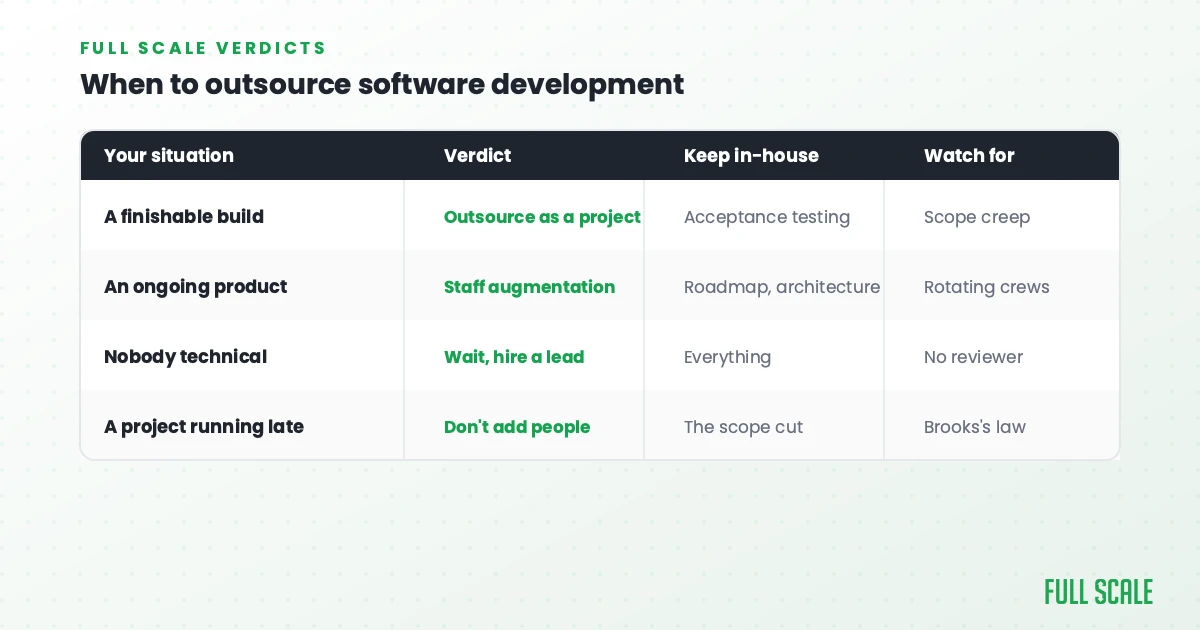
The decision is rarely "outsource or not." It all depends on what kind of work you're looking at, so here's my answer for each:
| Your situation | Verdict | What to keep in-house |
|---|---|---|
| A finishable build with a clear end, like a marketing site, a WordPress build, or a one-time data migration | Outsource it as a project | Acceptance testing, so you decide when it's done |
| An ongoing product with a roadmap, and you already have a technical lead | Add dedicated engineers through staff augmentation | The roadmap and the architecture sign-off |
| A skill you need for one stretch of the roadmap | Outsource it for that stretch, then scale back | The review of what ships |
| Nobody technical on your side | Wait. Hire or borrow a technical lead first | Everything, until that person exists |
| Requirements are still a guess, or no customer has asked for it yet | Keep the figuring-out in-house, outsource the build later | Customer conversations and the decision to build |
| A project that is already late | Don't add people to rescue it | The scope cut |
| The goal is the lowest rate on the quote | Don't. That's cheapshoring | The vendor decision itself |
| Regulated data like patient or payment records | Outsource only after a compliance review | The compliance sign-off |
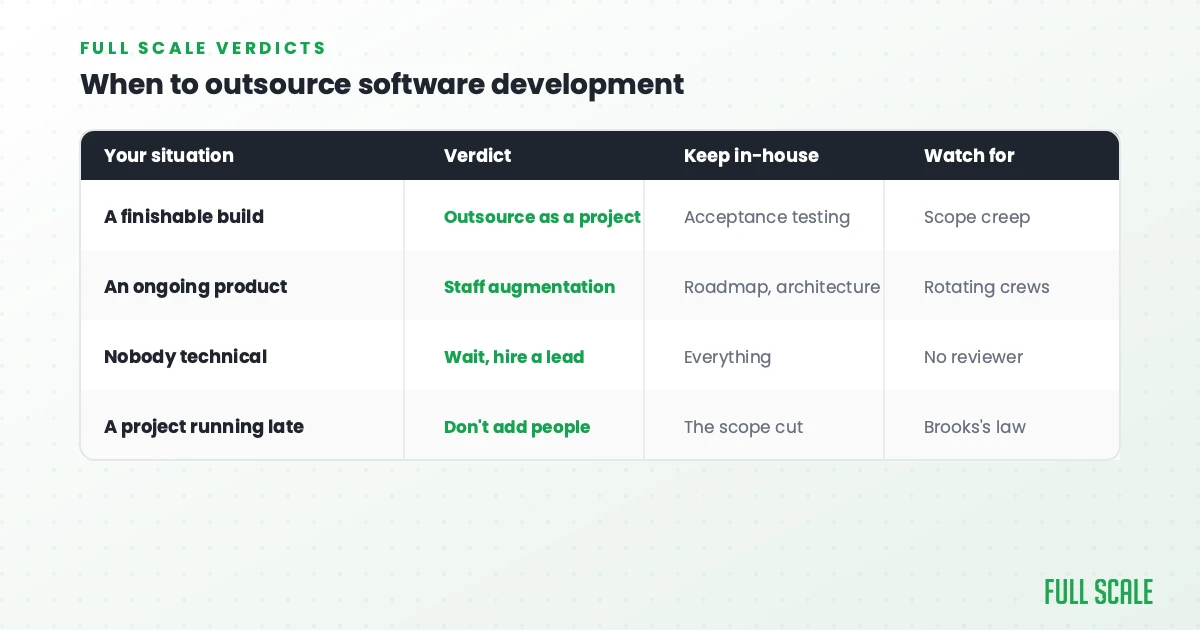
Some of these cells need more than one line in the table.
A finishable build is the easiest yes
A WordPress build is as close as software gets to a haircut. You need one, it takes an afternoon, and nobody wants to keep a barber on the payroll. I've outsourced WordPress builds and an Elasticsearch project myself, because both were quick, well-scoped jobs with a finish line.
For the project case, this works great. When the work is going to be over at some fixed point in time, the vendor owns the whole process, and no one needs to stick around afterwards. But that's not how ongoing product work works, which is why the second row says staff augmentation.
Ongoing product work calls for a team that stays
If you're going to spend the next few years maintaining your software, the people who have learned to use it are your most valuable asset. A dedicated engineer who knows your codebase beats a rotating project crew. This is why Full Scale operates as a dedicated team model, because our engineers come from across the Philippines and all work for one client, participating in their daily standups and code reviews. For a more detailed breakdown of the two models, see our article on staff augmentation vs outsourcing and the dedicated team model.
Another advantage of this model is that it's easy to ramp down. Staff augmentation allows you to easily add developers and remove them when needed. You don't have to commit long-term; if it isn't working out in the first two weeks, you get your money back. After that, you can drop a developer on 30 days' notice, with no long-term contract.
"Wait" is a real verdict
There are two things that I say "wait" about, which are the two I care the most about.
The first is: no technical person on your side. There's always going to be a need for technical leadership on the inside, because someone needs to figure out what to build, and evaluate if what comes back is any good. If there isn't that person on the inside, then the partner is building something with nobody to review it.
The second is: a product that hasn't been validated yet. I've had two experiences where I've built products and tested them at Full Scale Ventures. One got polite "sounds good" feedback and then nobody used it. For the other, people called back begging to know when it would ship. They used the same people and the same tools, but the results were different, and a vendor could have built them both on time. Make sure you validate first, then outsource the build.
Signs you should outsource software development
The signs are about the work you have to get done. They don't mention your company size or how much money you have. If you can agree with all five of them, it's generally safe to outsource.
- The work is documented. Someone else can read your spec or backlog and know what needs to be built.
- The work has a deadline or a nameable overflow. Either there's a clear day when you'll be done, or there's a well-defined backlog that just needs more hands.
- You're renting a skill. You'll need the skill for some period of time, but not indefinitely.
- Someone with technical chops can evaluate the result. Even one good developer on your side can be enough to get started.
- Your internal team could use their time more effectively. The people doing the work are your scarce ones, and the work isn't what makes your product special.
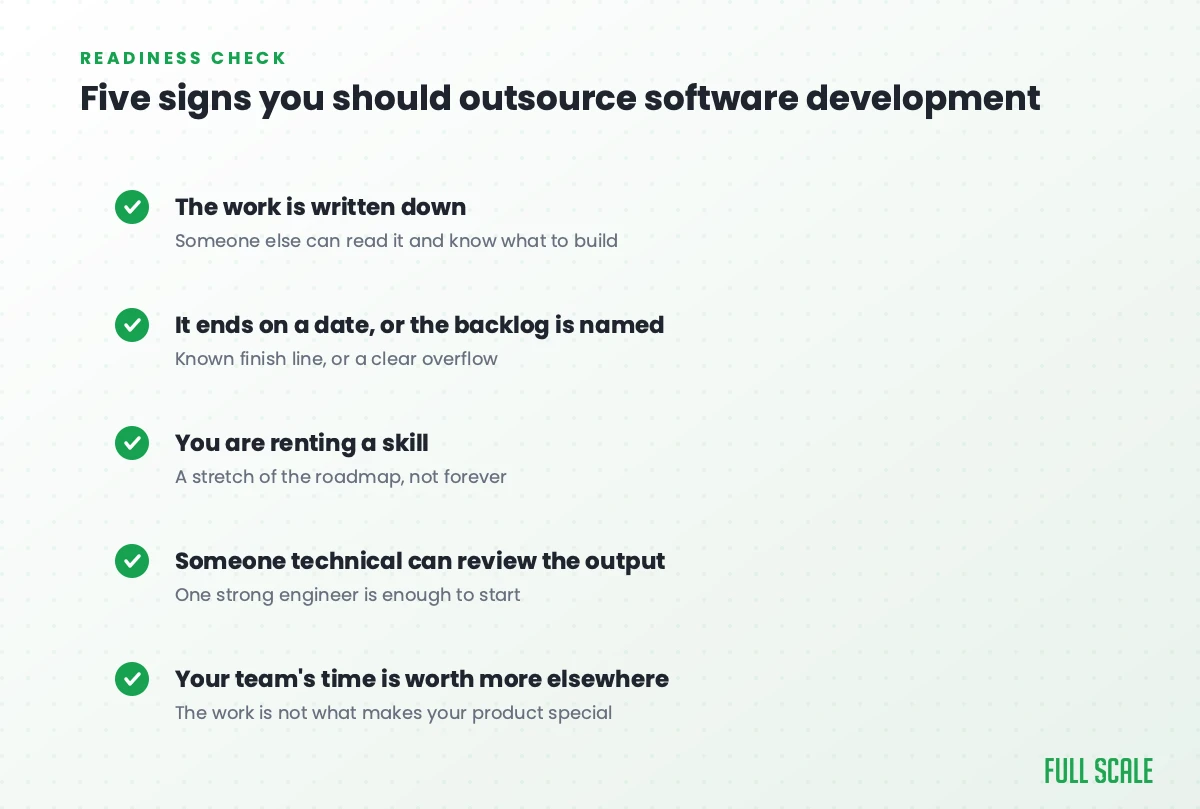
Cost isn't among those signs. According to Deloitte's 2024 Global Outsourcing Survey, which surveyed over 500 executives, skilled talent and agility have joined cost reduction as key drivers for outsourcing. None of these signs mention "cost." Cost is a reason to favor outsourcing after the work has been qualified. It's never a qualification on its own.
Signs it's too early, or the wrong tool
The "no" signs are shorter, and I'd weigh them heavier.
- You can't say what done looks like. The partner will build whatever the words say, and the words are still changing.
- No one can review the code. If you can't tell the good from the bad, the bill is the only thing you can check.
- The project is late and you want a rescue. Fred Brooks said it in 1975 in The Mythical Man-Month: adding manpower to a late software project makes it later. New people take time to get up to speed, and each additional person adds another person you need to keep aligned. "Just add more devs" means hiring more drivers for a bus that's already in gridlock.
- The goal is the cheapest quote. The cheapest quote is usually the shortest, with fewer people or months than other quotes.
The money test: one US developer or 2.7 of ours
Assuming the job qualifies, arithmetic determines how much you'll outsource. The Bureau of Labor Statistics places the US software developer median at $135,980 a year. Wages comprise only 70% of what private employers spend, so the fully loaded figure stands at approximately $194,000 annually.
A full time Full Scale developer at our $35-an-hour starting rate costs about $72,800 per year. This is nearly 62% lower, or a little over two and a half Full Scale developers compared with a single US hire at the median. This is a back-of-the-envelope calculation based on public figures, so treat it as a guide rather than a definitive quote. Your exact figures will vary by experience level, skillset, and team size, but Full Scale's typical customer saves between 50 to 70% versus a similar hire in the US.
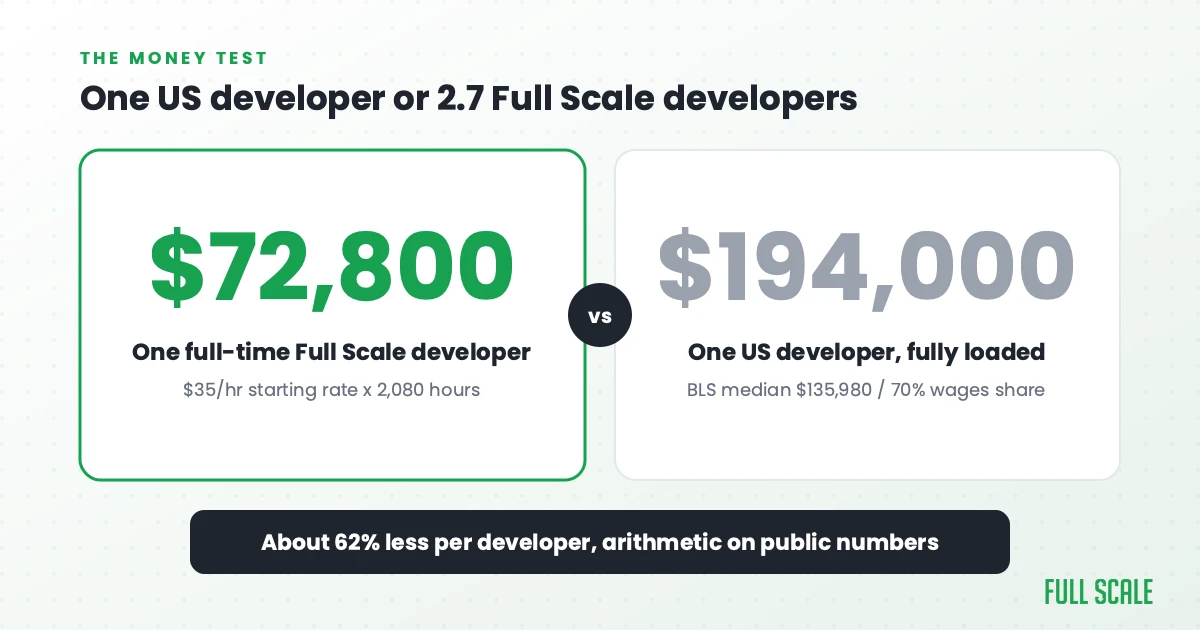
One caveat on taxes. Under the 2025 tax law, US research spending is fully deductible in the year it's incurred, while foreign research must still be amortized over 15 years. I have yet to hear any Full Scale customer mention this issue. Your accountant should confirm whether it affects your bottom line before making a large financial commitment.
What to keep in-house, even when you outsource
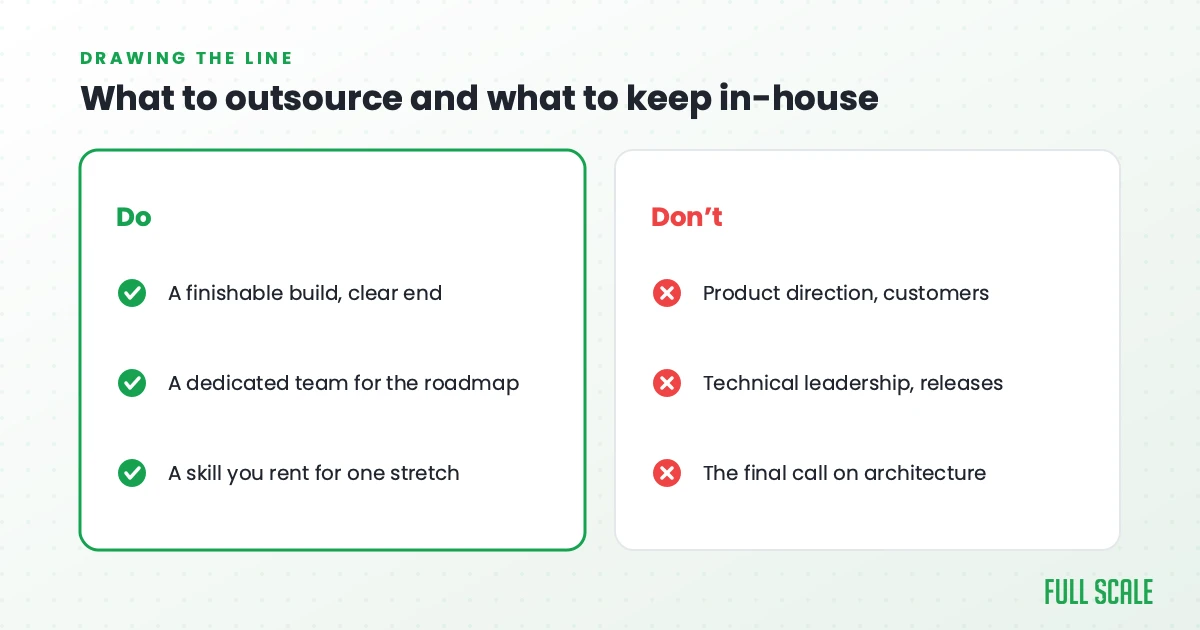
But you're not outsourcing thinking. You're keeping four things close:
- Product direction. The "why" comes from your users, not your vendor.
- Technical leadership. One accountable owner of quality, testing, and releases.
- Final say on architecture and code review. Your partner suggests, you decide.
- Customer conversations. No one learns what to build by reading a ticket.
That's the thesis of my book, Product Driven. When AI and a capable team drive down the cost of writing code, the human skills that determine whether the product succeeds live nearest your customer. Choose a partner who will challenge specs that look wrong; a team that only executes tickets never does.
If you want to dive into how to run the handoff, how to outsource software development covers the process, and the software outsourcing guide breaks down models and pricing. If your question is more about adding a person or team to your existing one, then outsourcing or hiring in-house is the article for you.
Frequently asked questions
When is the right time to outsource software development?
The right time to outsource software development is when the work can be described clearly enough for someone else to build it and your company has a technical person who can review what comes back. Full Scale sees the best fit in two cases: a finishable build with a clear end, and an ongoing product where you want dedicated engineers working alongside your own technical lead.
What are the signs you should outsource software development?
Five signs point to outsourcing: the work is written down well enough to hand off, it ends on a known date or has a backlog you can name, you are renting a skill you won't need for long, someone technical on your side can review the output, and your own team's time is better spent elsewhere. If all five are true, outsourcing software development is usually safe. If the first or the fourth is missing, fix that first.
When should you not outsource software development?
Do not outsource software development when nobody on your side is technical, when you still can't say what done looks like, or when you hope extra developers will rescue a project that is already late. Fred Brooks's 1975 rule that adding manpower to a late software project makes it later is the reason the last case usually backfires.
What should stay in-house when you outsource software development?
Four things should stay in-house when you outsource software development: the product direction, the technical leadership, the final call on architecture and code review, and the conversations with your customers. A partner can supply the hands and, with the right model, a lot of the judgment, but your company still has to own the why.
Is it cheaper to outsource software development than to hire in-house?
Per developer, yes, by a wide margin. A US software developer at the Bureau of Labor Statistics median salary costs about $194,000 a year fully loaded, while a full-time Full Scale developer at the $35-an-hour starting rate costs about $72,800, roughly 62% less. The savings shrink if the outsourced work needs a lot of rework, which is why the readiness checks matter more than the rate.
Check your situation against the table
And if your situation falls on "hire more engineers", and you'd like a second opinion, let's chat. Tell us about what you're building tell us what you're building, and we'll tell you plainly if the answer is to wait.