
Top Mobile App Development Frameworks in 2026: The Framework Matters Less Than Who’s Coding It

In this article
I’ve been picking frameworks for products since before “cross-platform” meant anything other than “runs on Windows and a Mac.” I’ve modernized systems off WCF, back when that was considered a modern choice. I co-founded VinSolutions, which sold for around $150 million on a stack nobody would pick today. I built Stackify, sold in 2021, on tooling that was already unfashionable the year we shipped it. Now I run Full Scale, where we staff mobile teams on the frameworks companies actually build businesses on: iOS, Android, Flutter, and React Native. We place the rarer Kotlin Multiplatform and .NET MAUI requests too, though those come with a longer search no matter who’s doing the hiring.
Three different “obviously correct” framework choices got replaced by the next obviously correct one over that stretch. The team shipped every time anyway.
Most framework roundups miss this: the framework matters, but only about as much as the team building on it, and AI just changed exactly which part of that equation still needs a human.
Quick Answer: React Native still wins the hiring race for mobile app development in 2026, since JavaScript and TypeScript are the most common skills in software while the UI underneath is genuinely native. Flutter buys pixel-perfect consistency across devices and now has the best first-party AI tooling among cross-platform options, Kotlin Multiplatform is the fastest-growing choice worth watching, and .NET MAUI suits teams already living in C#. Native (SwiftUI, Jetpack Compose) still wins for real-time performance work or day-one OS access. AI absorbed most of the framework syntax and boilerplate differences, so which framework your team can actually hire for and keep shipping with now matters more than the technical specs. Full Scale staffs teams across all of these frameworks and can help match the choice to what you can actually hire and retain.
The 30-second answer
- React Native still wins the hiring race. JavaScript and TypeScript are the most common skills in software, and the UI underneath is genuinely native.
- Flutter buys you pixel-perfect consistency across every device from a single codebase, plus, as of 2026, the best first-party AI tooling among the cross-platform options.
- Kotlin Multiplatform is the fastest-growing option here, worth watching closely before your next greenfield build.
- .NET MAUI is the quiet pick for teams already living in C#, especially enterprise shops.
- Native (SwiftUI, Jetpack Compose) still wins when you need OS day-one access or a performance ceiling nothing else touches, and it just got its own AI coding assistant baked into the IDE, so “native means no AI help” stopped being true in 2026.
What each one actually is in 2026
React Native compiles down to actual native views on both iOS and Android, while the app itself is written in JavaScript or TypeScript. Meta’s own New Architecture (JSI) has run the show since version 0.76, so the framework talks to native code directly now instead of routing through the older async layer. Most new builds start on Expo now rather than a bare native project. Full Scale places React Native developers regularly, and it’s usually the fastest seat to fill.
Flutter, from Google, runs on Impeller, its own rendering engine, so it never hands rendering off to the operating system the way native toolkits do. You get a UI that renders identically on any device. The same codebase extends to desktop and web builds too, embedded targets included, with no rewrite needed. It uses Dart, a language you hire for specifically rather than one your existing team already half-knows. It’s also where Full Scale’s own Flutter development work has grown the most in the last two years. The 2024 layoffs across Google’s Flutter and Dart teams raised a real “is Google abandoning this” question; the honest 2026 answer is no, and I cover why in the Flutter vs React Native comparison linked below.
Kotlin Multiplatform (KMP) lets your iOS and Android apps keep their own native interfaces while the business logic underneath runs from one shared codebase, and recent releases extend that sharing to UI too, for teams that want it. Usage more than doubled year over year, from 7% to 18% of developers in JetBrains’ 2025 State of Developer Ecosystem survey. It’s real momentum for a young framework, and it’s still the newest option here. Some of its integration points are less polished than Flutter’s or React Native’s.
.NET MAUI, from Microsoft, is the cross-platform path for teams already writing C#. It gets less hype than Flutter or React Native, which mostly tells you its audience isn’t the one writing framework roundups. One historical detail worth knowing before you commit a multi-year app to it: Microsoft built MAUI specifically to replace Xamarin. Xamarin itself was discontinued in 2024. MAUI itself has shipped on a steady annual cadence tied to .NET’s own release cycle since the switch, real follow-through so far, even if the Xamarin history is worth remembering.
Native (SwiftUI and Jetpack Compose) means Swift on iOS and Kotlin on Android, no shared codebase between them. You pay for two teams and get first-day access to everything Apple and Google ship. Full Scale staffs both sides directly through iOS developers and Android developers, or a combined mobile app development engagement when a project needs both.
One option you won’t find ranked above: Ionic. It builds apps with web technology inside a native wrapper, and the web-view layer is exactly the problem: real overhead on anything scroll- or animation-heavy, and gaps in native module support (camera-heavy screens are a common pain point) that a framework compiling straight to native code doesn’t have. It still shows up on plenty of roundups. For a business app you intend to scale, it’s rarely the modern pick anymore.
That’s five options, and none of them have touched AI yet. That comes next.
How AI changed the calculus
Every “best frameworks” roundup treats AI as a bullet point: framework X shipped an AI SDK, tick the box, move on. This is the wrong unit of analysis. What AI actually took off your plate, and what it left standing, matters far more than which SDK shipped first.
Framework syntax was always the easy part
I wrote about this split in a recent newsletter issue on Fred Brooks’ 1986 essay “No Silver Bullet,” which divides software difficulty into two kinds. Accidental complexity is the stuff that’s hard because of your tools and languages: the typing, the boilerplate, the glue code. Essential complexity is the stuff that’s hard because the problem itself is hard: figuring out what the app should actually do. AI is eating the accidental side fast. Framework syntax was always accidental complexity. That’s exactly why it’s the first thing losing its status as a competitive advantage, and it’s why the hiring-and-team question running through the rest of this article is really what’s left of the essential kind.
Conventional beats assembled
I made a version of this argument about Laravel in our PHP framework guide, and the mobile version carries over directly: give an agent exactly one way to build something, and it stops guessing. Give it five equally valid ways, and every screen becomes a fresh coin flip. Nobody’s run the actual benchmark. Consider this my working theory.
Flutter has that one-way property: one language, one widget tree, one rendering model. It now has dedicated tooling to match, too. The Flutter AI Toolkit and Firebase AI Logic reached general availability at Google I/O 2026, and together they wire Gemini straight into a Flutter app with no backend of your own. Native SwiftUI and Jetpack Compose have the same property, one blessed path per platform. So does .NET MAUI, for the same reason: a single opinionated convention gives an agent something to lock onto.
React Native could earn that same agent-friendliness. It doesn’t yet, because the surrounding JavaScript tooling gives teams too many equally valid setups: Expo versus bare, Redux versus Zustand versus nothing at all. An agent working in that space has to guess at your particular team’s flavor before it can write code that actually fits. To be fair, React Native’s patterns also sit in far more training data than Dart’s or MAUI’s, more examples for an agent to draw from, and that cuts the other direction. Nobody’s published a controlled study weighing those two forces against each other; it’s too new for that. Call it a bet either way.
Native just got its own AI assistant too
Native app development got first-party AI coding help too, and it’s recent enough that most people comparing frameworks haven’t caught up to it yet. Apple built Google’s Gemini into Xcode 26.6, sitting right alongside Anthropic’s Claude Agent and OpenAI’s Codex inside the IDE. Android Studio ships Gemini Code Assist natively. Cross-platform frameworks don’t have a monopoly on AI tooling anymore, if they ever really did.
The AI dividing line runs through the middle of every option in this article: Flutter, native SwiftUI, native Jetpack Compose, and .NET MAUI all give an agent a clean, conventional target. Kotlin Multiplatform is promising but young enough that its patterns are still shaking out. An agent’s confident-sounding guess is most likely to be wrong in exactly that situation. Review AI-generated code from any of them like you’re reviewing a junior developer’s pull request, because that’s precisely the skill level you’re getting.
Pure coders will be replaced by AI. Problem solvers will run technology organizations. That’s the whole thesis of the Product Driven approach, and it’s as true for whoever picks your mobile stack as it is for whoever writes the API layer.
The hiring market still decides it
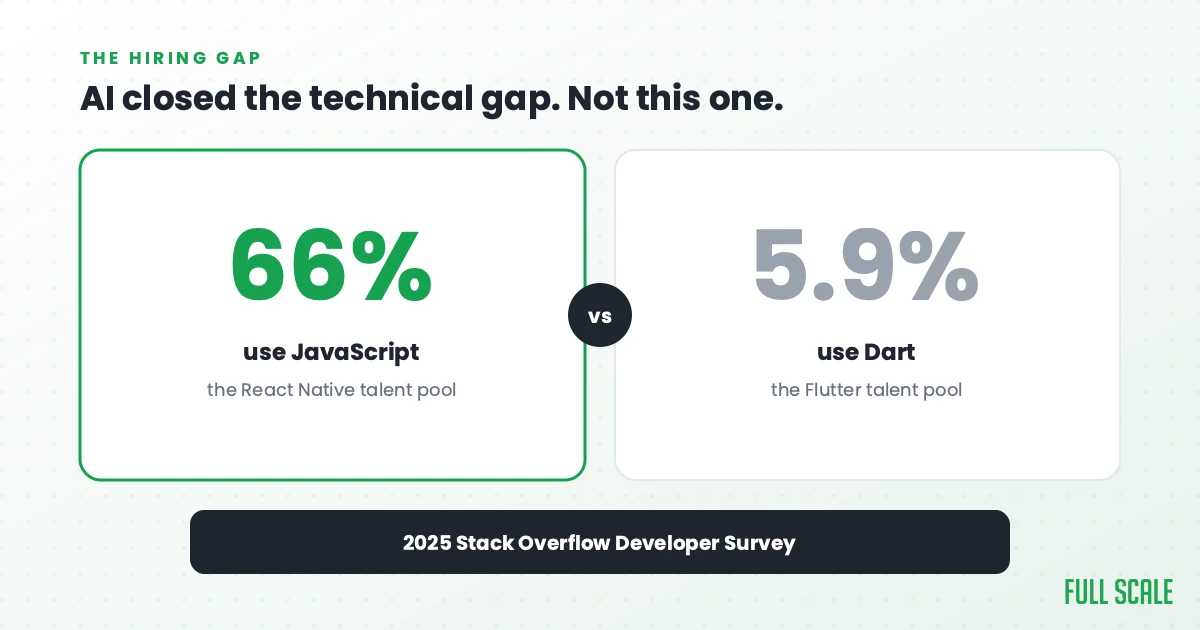
AI narrowed the technical gap between React Native, Flutter, Kotlin Multiplatform, .NET MAUI, and native. It did nothing to the hiring gap, and that gap is bigger than most CTOs think.
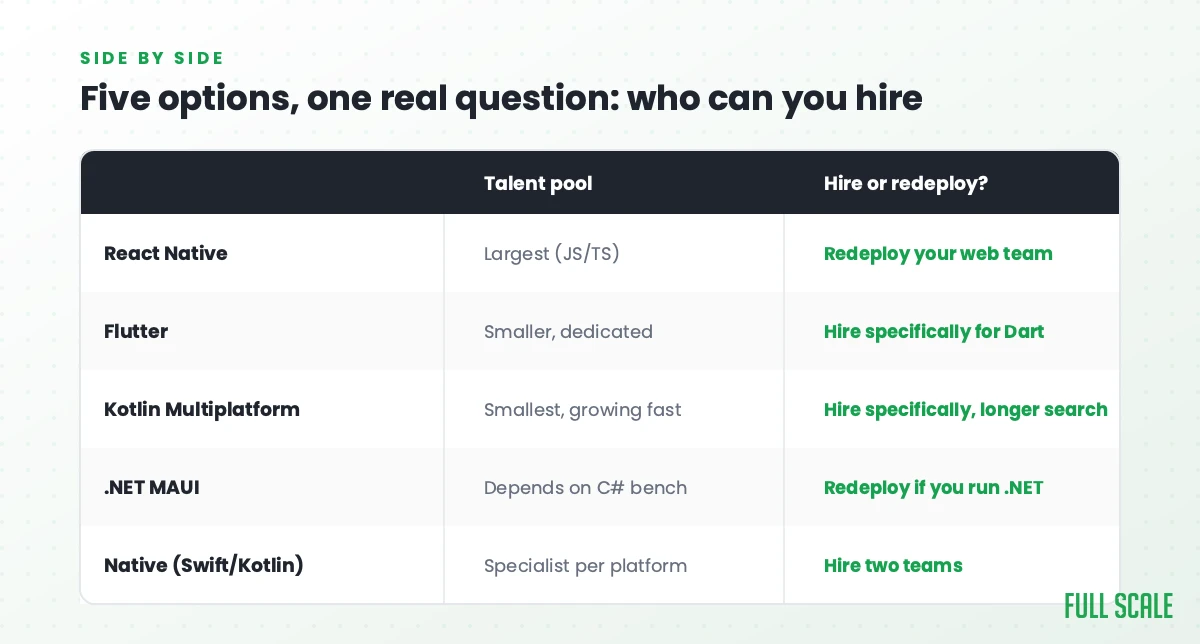
Redeploying an existing web developer onto React Native takes an afternoon of onboarding. Getting a Flutter or Kotlin Multiplatform specialist takes a real search, since it’s a dedicated recruiting effort against a much smaller pool. The scale of that gap: 66% of developers use JavaScript and 44.7% use React, against 5.9% for Dart, per the 2025 Stack Overflow Developer Survey.
That matches what we see in our own placement mix. React Native is still the framework clients ask for most, with Flutter now solidly in second place and closing the gap fast.
| Talent pool | Hire for it, or redeploy an existing team? | |
|---|---|---|
| React Native | Largest (JS/TS) | Redeploy your web team |
| Flutter | Smaller, dedicated | Hire specifically for Dart |
| Kotlin Multiplatform | Smallest, growing fast | Hire specifically, expect a longer search |
| .NET MAUI | Depends on your C# bench | Redeploy if you already run .NET |
| Native (Swift/Kotlin) | Specialist per platform | Hire two teams |
If you want the full head-to-head between the two most common picks, including when performance actually separates them and who’s shipped on each, I wrote the complete Flutter vs React Native comparison here on the blog. The short version: the hiring market, not a benchmark chart, should make that call for you. It’s also why Full Scale runs a standing internal AI training program (the Spartan Training Academy) across every stack we staff, so the team you hire is fluent in whichever AI tooling your framework ships next, not just the one it shipped last quarter.
When to go native instead
Cross-platform doesn’t win every argument here, whatever the framework marketing pages want you to believe. Sometimes native is just the correct answer, full stop, and I’d rather say that than sell you a framework you don’t need. For the deeper case on iOS specifically, including where Swift’s own tooling has pulled further ahead, see the Swift vs. Objective-C rundown.
Two situations still call for Swift and Kotlin, no matter how good cross-platform AI tooling gets:
You need something the OS shipped yesterday. Think a brand-new camera API, an AR or VR capability, or anything Apple or Google announced last month. Cross-platform wrappers are always a release behind the native SDK.
Performance has to be flawless. Think real-time audio processing, live camera filters, a high-end game, or anything where a single dropped frame is visible to the user. Native code still carries the least overhead of any option here.
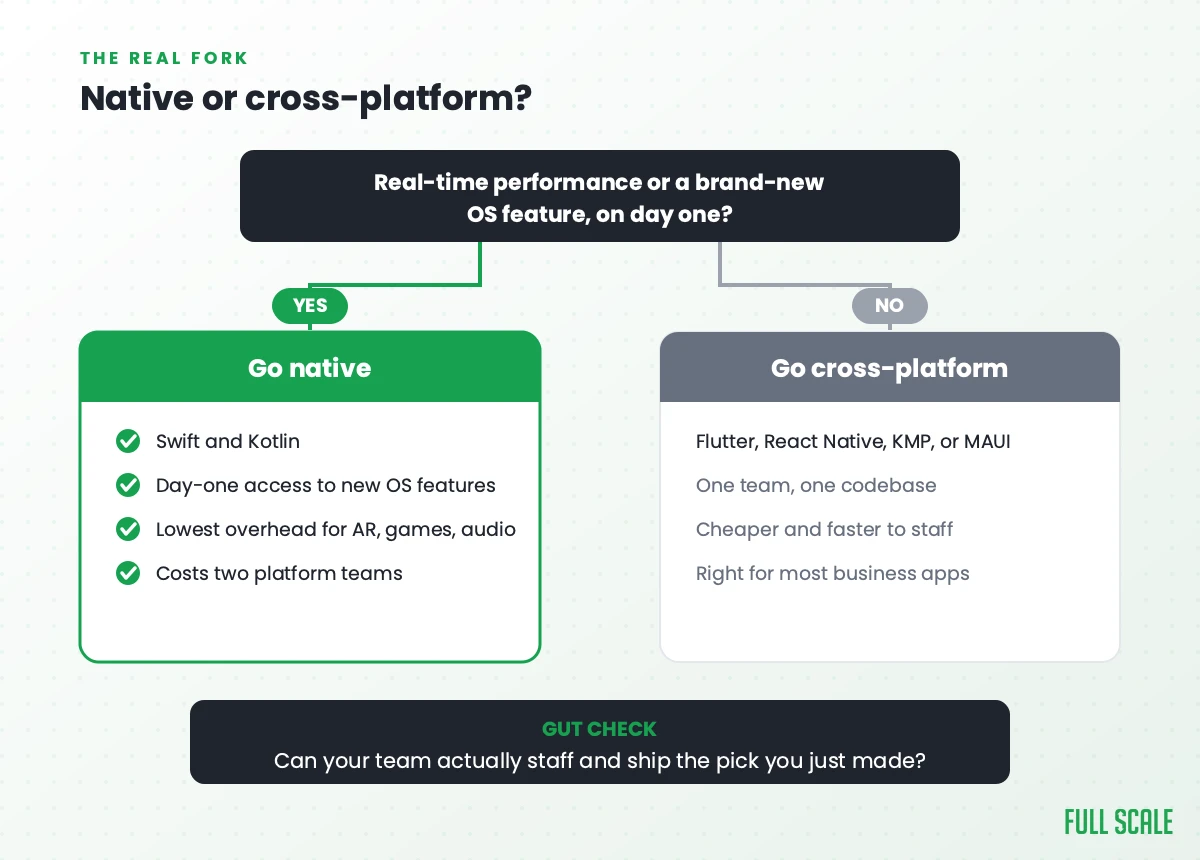
Everyone else building a normal business app is overpaying for two platform teams to avoid a decision a single cross-platform team would make just fine.
What getting the framework choice wrong actually costs
AMC Theatres, a Full Scale client, had spent three years building its original mobile app on Xamarin, Microsoft’s now-retired cross-platform framework. It needed a full rewrite. A small group of engineers took it on in Flutter instead, largely on nights and weekends that turned into a standing D&D game more than overtime. They shipped in a few months.
Whether or not anyone stops to weigh the framework on purpose, that gap between three years and a few months is real money either way.
How to actually decide
Four questions get you there faster than any weighted scorecard:
- What does your team already know? A team that’s productive today beats a team learning your “objectively better” pick for the next two quarters.
- How long does that hire realistically take? Check the real hiring market yourself; framework marketing pages don’t count. It’s also worth reading how AI changed the mobile developer job description itself, since the questions worth asking in an interview have shifted along with the frameworks.
- Does it give an AI agent one obvious way to build a screen, or a dozen? That favors Flutter, native SwiftUI and Jetpack Compose, and .NET MAUI over an assembled JavaScript stack, though a strong team can still make any of them work.
- Does the app need something only native gives you on day one? If yes, stop reading roundups and go native.
Answer those honestly, and the “best” framework turns out to be the one your team can actually ship and staff. The benchmark charts were never the real question. Picking what your team can already build with, over the shinier new pick, is the mobile-development version of buying the minivan instead of the sports car.
Nobody brags about it at a meetup.
Frequently asked questions
Which mobile framework is best for AI-assisted development in 2026?
By my read, Flutter currently has the strongest combination of a single, conventional way to build screens and dedicated first-party AI tooling (the Flutter AI Toolkit and Firebase AI Logic). Native SwiftUI and Jetpack Compose are close behind now that Xcode and Android Studio both ship built-in AI coding assistants. React Native works fine with AI tools too, but its wider range of project setups means more guessing for an agent to get right. No data exists on this yet, just my own working assumption.
Does AI make the mobile framework choice matter less?
Yes, for the technical side. AI coding tools absorb framework syntax and boilerplate, the accidental complexity that used to separate frameworks. It has not touched the harder, essential complexity: which framework your team can hire for, ramp on, and keep shipping with. That part still decides the outcome.
Is Flutter or React Native easier to hire for?
By a wide margin, React Native. Two languages, JavaScript and TypeScript, cover the large majority of software developers, so hiring means choosing from an enormous pool rather than waiting on a niche one. Flutter’s Dart-only requirement puts every hire in that niche.
Should I go native or cross-platform in 2026?
Run it through the four questions above. In practice that resolves to cross-platform for the large majority of business apps, since staffing one team beats staffing two. The exception is a short list: real-time performance work, AR/VR, or a feature that only exists on a brand-new OS release, where native earns the cost of a second team.
Is Kotlin Multiplatform ready to use for a new mobile app?
It’s the fastest-growing option in this article, more than doubling in usage between 2024 and 2025, and it’s a legitimate choice for a team that wants to keep each platform’s native interface while sharing the logic layer underneath. It’s also the youngest option here, so budget extra time for interop questions that Flutter and React Native settled years ago.
Building the team behind the framework
Whichever framework wins this argument at your company, someone still has to build it, hire for it, and keep it staffed. The AI tooling underneath it keeps changing every few months regardless. Talk to us, tell us which stack you landed on, and we’ll match you with vetted engineers who already know it, mainstream pick or rare one, with a straight answer either way about how long that takes.