Flutter vs React Native in 2026: Which to Build On (and Hire For)

In this article
If you’re choosing between Flutter and React Native, the comparison articles will bury you in render-pipeline diagrams and frames-per-second charts. Almost none of them answer the question you actually have: which one can I build my app on, staff a team for, and still feel good about in three years? Both frameworks are mature, both ship real products at scale, and for most apps a user could never tell which one you used. The decision comes down to your existing team, your hiring market, and whether you should even be building cross-platform at all.
I run Full Scale, and we staff mobile teams for US companies, so I see this choice from the side the benchmark posts ignore: who you can actually hire, and how fast. Here’s the honest comparison, including the part where the right answer is sometimes neither one.
The 30-second answer
- React Native is the easier hire and the faster start if you already have a web or React team. It uses JavaScript and TypeScript, the largest developer pool in software, and it renders real native UI components. Backed by Meta and the new React Foundation.
- Flutter gives you the most control over how your app looks and performs. It draws every pixel itself, so the UI is identical across platforms, and it extends to web, desktop, and embedded from one codebase. It uses Dart, a smaller talent pool you hire specifically for. Backed by Google.
- Sometimes the answer is native, or Kotlin Multiplatform. If you’re building AR, heavy 3D, or something that has to use day-one OS features, skip cross-platform. More on that below, because no one else on this topic says it.
What each one actually is in 2026
React Native, from Meta, lets you build iOS and Android apps in JavaScript or TypeScript, and it renders real native platform views. The big news is architectural: the New Architecture became the default in React Native 0.76, replacing the old asynchronous “bridge” with a direct, synchronous layer called JSI. That bridge was the source of most of React Native’s historical performance complaints, so any comparison you read that’s still arguing about “the bridge” is testing a version that’s already gone. As of late 2025, React and React Native are governed by the new React Foundation, and Expo is now the recommended way to start a project.
Flutter, from Google, uses the Dart language and takes the opposite approach: instead of using the platform’s UI components, it draws every pixel itself with its own rendering engine, now called Impeller (it replaced Skia). That’s why a Flutter app looks pixel-identical on every device, and why one codebase can target mobile, web, desktop, and embedded. Dart compiles ahead of time to native machine code.
One thing worth addressing head-on, because it scared a lot of teams: in 2024 Google laid off staff across the Flutter and Dart teams, and “is Google abandoning Flutter” became a real question. The 2026 answer is no. Google’s public roadmap commits to a minimum of four stable Flutter and Dart releases this year, continued investment in the rendering engine, and WebAssembly as the default for Flutter web. The real shift is toward shared governance: non-Google contributors now outnumber Google employees on the project. That’s a different story than abandonment, but it’s a fair thing to weigh.
The hiring market: the factor that should decide it
This is where the decision actually gets made, and it’s the section every benchmark article leaves out.
React Native draws from the JavaScript talent pool, which is the largest in software. In the 2025 Stack Overflow Developer Survey, 66% of developers use JavaScript and 44.7% use React. Dart, the language Flutter requires, sits at 5.9%. That gap is the single most important practical difference between the two. A React Native hire is a short step from any of the millions of web and React developers already out there. A Flutter hire is someone you recruit specifically for Flutter.
In the broader survey of who’s worked with each framework, React Native and Flutter are closer than that language gap suggests (Flutter slightly ahead at 9.4% versus 8.4% in the 2024 survey), because Flutter has been winning new-app starts. But for a company trying to staff a team in the US, the language pool is what determines how many résumés you see and how fast the seat fills. React Native roles consistently outnumber Flutter roles, and you can redeploy an existing web engineer onto React Native in a way you simply can’t with Dart.
Salaries for the two are within noise of each other, so this isn’t a cost-per-developer decision. It’s a how-many-developers-exist-and-how-fast-can-I-hire decision, and on that axis React Native has the clear edge, especially if you already employ React developers.
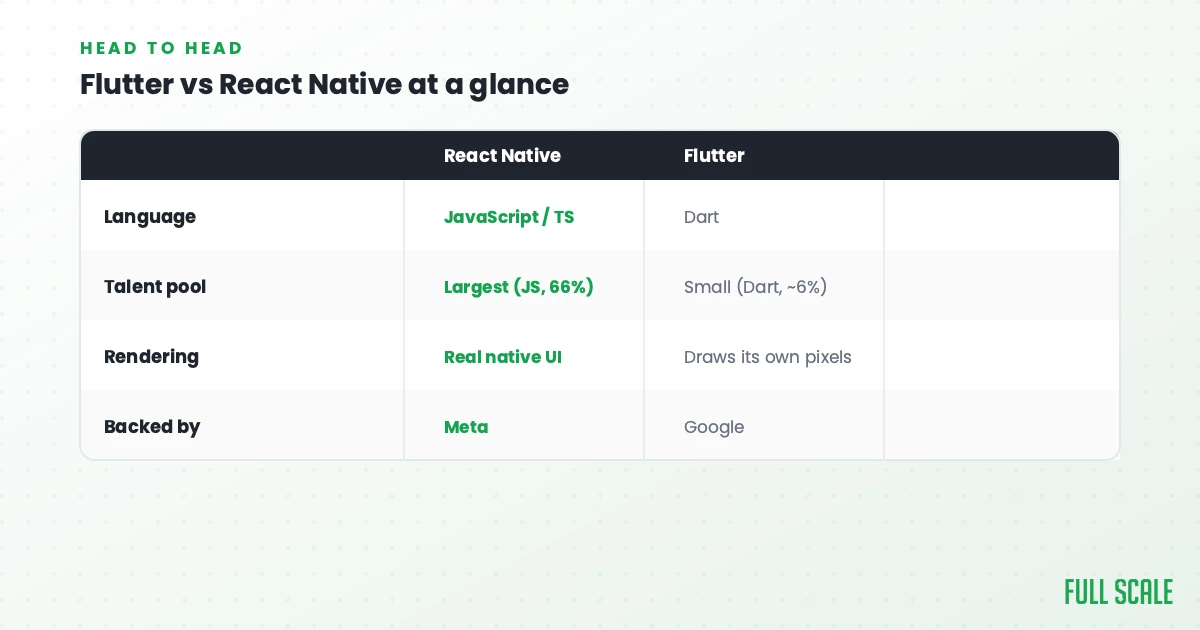
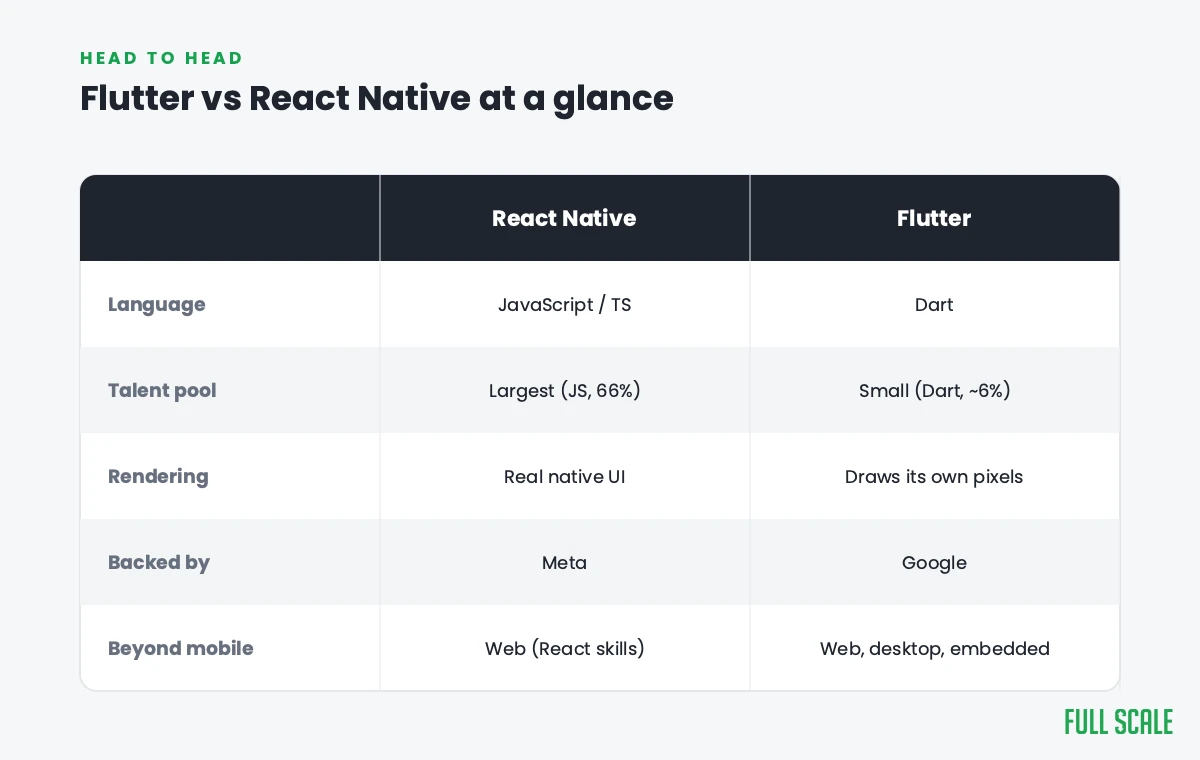
| React Native | Flutter | |
|---|---|---|
| Language | JavaScript / TypeScript | Dart |
| Talent pool | Largest in software (JS) | Small, hire-specifically |
| Rendering | Real native UI components | Draws its own pixels (Impeller) |
| Backed by | Meta / React Foundation | |
| Reuse beyond mobile | Web (shares React skills) | Web, desktop, embedded |
| Best fit | Teams with JS/React talent | UI-control and multi-platform needs |
Performance, honestly
Flutter has a real edge in animation smoothness and consistent frame times, because it controls the entire rendering pipeline and precompiles its shaders, which eliminates a class of stutter that used to plague it. React Native, with the New Architecture enabled, is competitive on raw frame rate and gives you genuine native components for free. Native code still beats both on memory and binary size, because both cross-platform frameworks ship a runtime.
But here’s the caveat that matters: for the overwhelming majority of business apps, the performance difference between Flutter and a current React Native build is invisible to users. It shows up in animation-heavy interfaces and games, and it disappears in the CRUD-and-API apps that most companies actually build. Don’t let a benchmark you’ll never feel outweigh a hiring reality you’ll feel every time you open a req. And be skeptical of any React Native benchmark that doesn’t say it used the New Architecture, because it’s probably measuring a version that no longer exists.
When to skip cross-platform entirely
No one writing about Flutter versus React Native wants to tell you that the answer might be neither. I will, because picking the wrong tool here is more expensive than picking the wrong cross-platform framework.
Go native, with Swift and Kotlin, when:
- You’re building AR, VR, or vision features. The native APIs run months ahead of any cross-platform wrapper.
- You’re building a high-end game or anything heavy on 3D. Use native or a game engine.
- Every millisecond counts. Dropbox famously rebuilt its document scanner from React Native to native Swift for exactly this reason.
- You need day-one support for the latest OS features, or deep system integration.
There’s also a rising middle path worth knowing about: Kotlin Multiplatform lets you share business logic across iOS and Android while keeping native UI, and as of 2025 it can share UI too. It’s the option for teams that want native Swift and Kotlin on the surface with shared logic underneath. It’s younger than both Flutter and React Native, and some of its interop is still stabilizing, but it’s the genuinely new entrant in this decision and it belongs on your list. If Kotlin is the shared thread across your stack, our Kotlin app development services page covers what that engagement looks like in practice. For the wider landscape, including .NET MAUI and native, see the mobile app development frameworks roundup.
One Full Scale client, AMC Theatres, rebuilt a mobile app from an older cross-platform framework to Flutter and shipped it in a few months, after the native rewrite had been estimated in years. The lesson isn’t “Flutter wins.” It’s that the framework decision has real consequences for cost and timeline, and it’s worth making deliberately rather than defaulting to whatever your last team used.
When to choose each
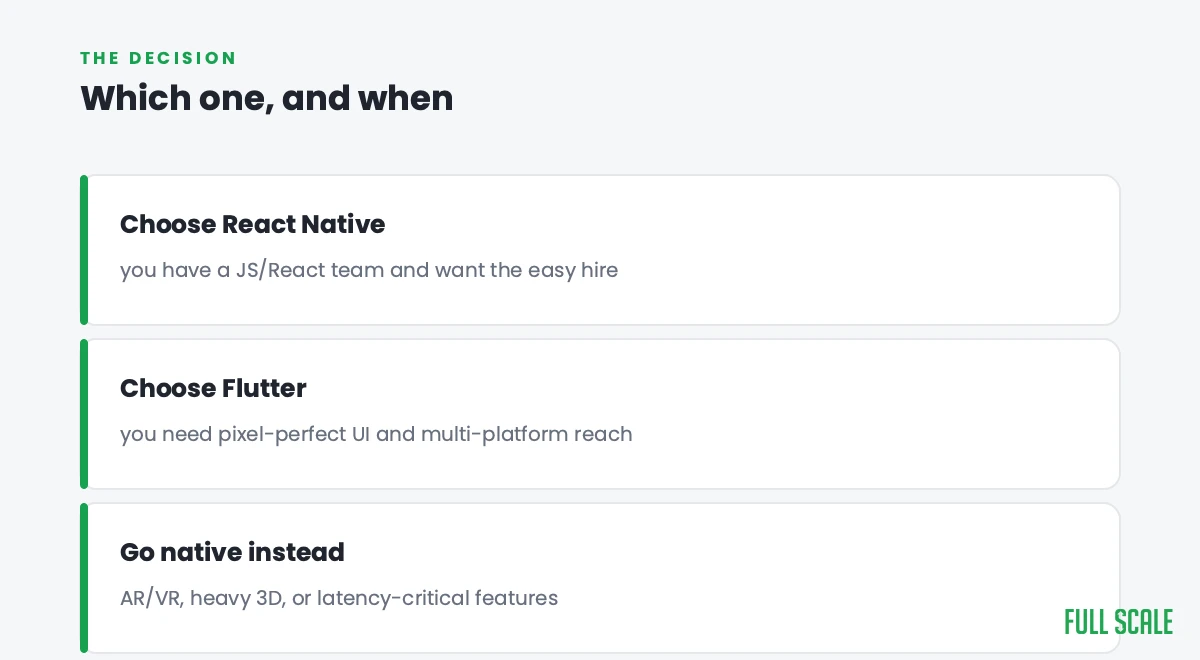
Choose React Native if you already have a web or React team, you want the fastest and deepest hiring pipeline, you want real native UI components, or you want to share logic with a React web app. The managed Expo workflow also removes most of the native-build pain that used to make React Native hard to start.
Choose Flutter if you need pixel-identical UI across platforms, you’re building animation-heavy interfaces, you want one codebase spanning mobile plus web plus desktop, or you’re willing to hire specifically for Dart to get that control. Its larger binary size and smaller talent pool are the costs.
One more current detail that dates a lot of advice: Microsoft retired App Center in early 2025, so the old CodePush over-the-air update story is gone. The live answer for React Native is Expo’s EAS Update. If a guide still recommends CodePush, it’s out of date, which tells you how fast this space moves and why the version your sources tested matters so much.
Who builds on each
Flutter runs Google Pay, the My BMW app, eBay Motors (which reported sharing the vast majority of its code across platforms), Alibaba, Nubank, and Toyota’s in-vehicle software. React Native runs at Shopify, which went all in on it and reaffirmed that bet after five years, plus Meta’s own apps, Coinbase (which publicly migrated to it and moved hundreds of screens), Microsoft in parts of Office and Teams, and Discord. The most-cited cautionary tale, Airbnb dropping React Native, is real but from 2018, before the New Architecture, so weigh it as history rather than current evidence.
Frequently asked questions
Is Flutter better than React Native?
Neither is universally better. Flutter gives you more control over UI and animation because it draws its own pixels, and it extends to more platforms from one codebase. React Native is easier to hire for, faster to start if you have a JavaScript team, and renders real native components. The right pick depends on your team and product, not a benchmark.
Which is easier to hire for, Flutter or React Native?
React Native, clearly. It uses JavaScript and TypeScript, the largest talent pool in software, so you can hire from millions of web developers or redeploy ones you already have. Flutter uses Dart, a much smaller pool (about 6% of developers versus 66% for JavaScript), so you hire specifically for it.
Is Google going to abandon Flutter?
No. After the 2024 layoffs raised the question, Google’s 2026 roadmap commits to regular stable releases, continued engine investment, and WebAssembly for web. The real change is that the project moved toward shared governance, with non-Google contributors now outnumbering Google employees, rather than Google walking away.
Is React Native still slow because of the bridge?
No. The bridge was replaced by the New Architecture, which became the default in React Native 0.76 in late 2024. It uses a direct, synchronous layer instead of the old asynchronous bridge, which removed the main historical performance bottleneck. Any comparison still arguing about “the bridge” is testing an outdated version.
Should I use Flutter, React Native, or go native?
Use a cross-platform framework for most business apps, since one codebase and one team is cheaper and faster. Go native for AR/VR, heavy 3D or games, latency-critical features, or day-one OS-feature support. Consider Kotlin Multiplatform if you want native UI with shared business logic.
Which has better performance?
Flutter has a consistent edge in animation smoothness because it controls the full rendering pipeline. React Native with the New Architecture is competitive on frame rate and uses real native components. For most apps the difference is invisible to users and matters only for animation-heavy or compute-heavy work.
The decision is about your team, not the framework
Flutter and React Native are both good. You can ship an excellent app on either, and the benchmark differences will not be what makes or breaks the product. What will is whether you can staff the choice and keep it staffed, and whether cross-platform is even the right call for what you’re building.
So weigh it the way you’d weigh a long-term hire. React Native is the easier, deeper hire, especially if you already have JavaScript talent. Flutter is worth hiring specifically for when UI control or multi-platform reach is the point. And be honest about whether the job actually calls for native instead. This framework call is one piece of a bigger picture; see the rest of this year’s mobile app development trends for the other decisions worth making.
If you’d rather not sort the hiring side of that out alone, that’s what we do. Talk to us about building your mobile team, and we’ll put pre-vetted Flutter or React Native developers in front of you who already work the way the AI era demands.