
Scrum vs Kanban: Which One Your Team Actually Needs

In this article
- Kanban vs Agile: Kanban is Agile
- What Scrum is really good at
- What Kanban is really good at
- Scrum vs Kanban: the differences that change your decision
- How to choose: match the framework to the team you actually have
- Scrumban: when to run both
- Which one fits when you add outside engineers
- Frequently asked questions
- The framework follows the team, not the other way around
Most of the “Scrum vs Kanban” questions I get are actually the wrong question.
People ask because they read that Kanban is more flexible or that Scrum is more structured, and they want to know which one is correct. But the framing is off from the start. Both Scrum and Kanban are just ways to run Agile. They are tools, not beliefs. The real question is simpler: which one fits the shape of your work and the kind of people you have? Either way, the work still moves through the SDLC and its phases.
I am Matt Watson, CEO of Full Scale and a 4x tech founder. I have run teams under Scrum, Kanban, and plenty of variations in between. Our engineers run both across different client engagements today, and the choice is almost never about which framework is philosophically superior.
Quick Answer: Scrum vs Kanban comes down to the shape of your work and the kind of people you have. Scrum runs fixed sprints, usually two weeks, with a planning meeting, a review, and a retrospective, so it fits product teams that need a delivery rhythm and accountability. Kanban is a continuous flow board with work-in-progress limits and no sprints, so it fits support, maintenance, and teams that pull their own work. Both are Agile, and many teams run a mix called Scrumban. At Full Scale, our engineers slot into whichever one the client already runs.
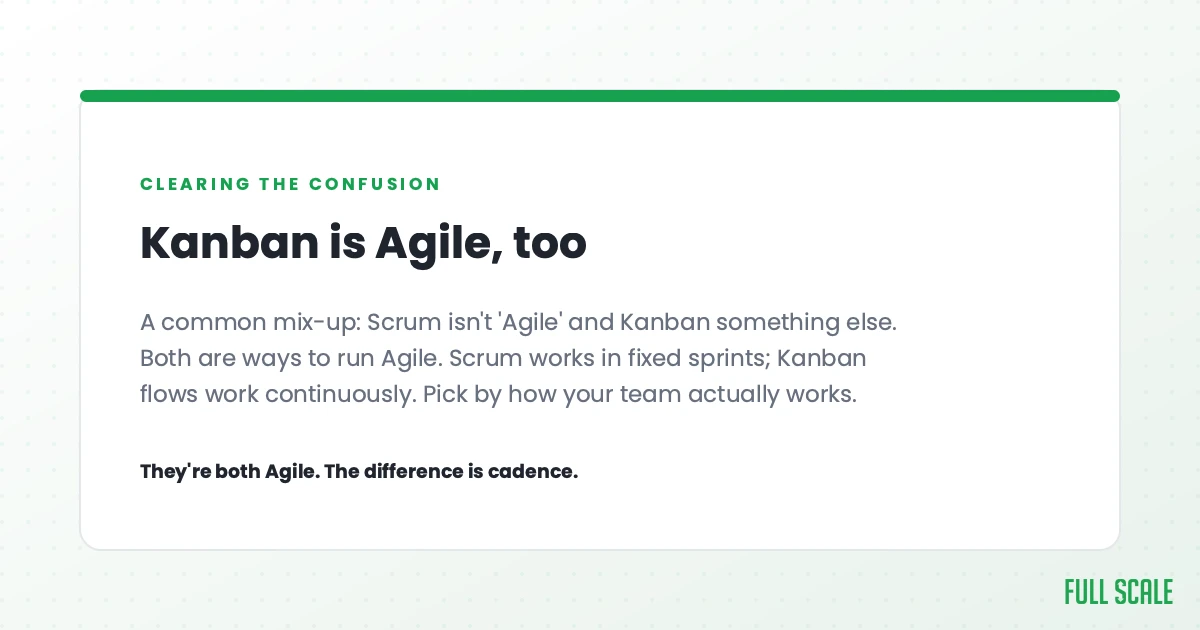
Before we get into the comparison, one thing worth clearing up: Kanban is not an alternative to Agile. It is Agile.
That clears up most of the “kanban vs agile” confusion you see out there. Kanban is one of the Agile approaches, the same way Scrum is. The full breakdown of software development methodologies covers the whole family. Both Scrum and Kanban are flavors of the same idea: work in smaller chunks, limit what is in progress, and adjust based on what you learn. Both inherit the advantages of the agile methodology itself.
Kanban vs Agile: Kanban is Agile
If you have been reading about “kanban vs agile,” here is the short version: the framing is wrong.
Agile is an umbrella term for a set of approaches. Scrum, Kanban, Extreme Programming, and Lean all live under it. Kanban is one of those implementations, sitting right alongside Scrum.
The confusion comes from how teams talk about it in practice. When someone says “we use Agile,” they often mean Scrum specifically, because Scrum is the most common flavor. Kanban is less prescriptive and has fewer named roles, so it sometimes gets positioned as the lightweight, non-Agile alternative. That positioning is wrong. Kanban is Agile run with a different set of mechanics.
Both are grounded in the same principles from the Agile Manifesto: deliver value in small chunks, keep the work visible, limit waste, and respond to change. What differs is how each one structures time, work, and accountability.
What Scrum is really good at
Scrum organizes work into fixed-length sprints, usually two weeks. At the start of each sprint, the team pulls a set of work from the backlog. At the end, they review what shipped and run a retrospective. Daily standups keep the work visible day to day.
The structure is the point. Scrum gives teams a regular heartbeat: a planning event, a delivery cadence, and a moment to reflect. That cadence creates accountability in both directions. The team commits to a sprint, and leadership knows what to expect every two weeks.
The Scrum Guide defines three roles: the Product Owner owns what gets built and in what order, the Scrum Master runs the ceremonies and removes blockers, and the Developers do the work. My take on the Scrum Master role is that it only pays off when the person in it actually removes obstacles and keeps the ceremonies tight, not when they treat the calendar as their job.
What Scrum is especially good at is holding feet to the fire. If you have a team that needs estimates, needs a cadence to pull them forward, and needs a regular commitment to deliver by, Scrum provides all of that. The sprint is a deadline, and deadlines do something for people. The capacity planning that goes into sprint sizing also gives teams a more honest picture of how much they can actually ship, which feeds into team capacity planning at the delivery level.
Scrum works best when someone needs to ask “what did we ship this week?”
What Kanban is really good at
Kanban is a visual flow system. Work goes on a board, you set a limit on how much can be in progress at once, and when someone finishes a task they pull the next highest-priority item. There are no sprints and no formal roles beyond whoever manages the board and backlog, so work just flows.
That flow model fits a specific kind of work very well: support queues, maintenance requests, bug backlogs, and ongoing infrastructure work where the right next task changes constantly and forcing everything into a two-week sprint creates artificial pressure that does not match how the work actually arrives.
Kanban works best when proactive people take ownership and pull their own work. If you have a team where engineers will look at the board in the morning, grab the highest-priority open item, and work it through to done without being chased, Kanban runs fast and clean. There is less overhead because there are fewer ceremonies. The work speaks for itself. Whichever framework you run, the bigger question is what “done” actually means, and most teams stop at shipped code.
Kanban also makes work-in-progress problems visible faster. If a task sits in the “In Progress” column for three days, the board shows it. WIP limits force the team to finish before starting something new, which is a useful discipline on teams that tend to start many things and finish none.
Scrum vs Kanban: the differences that change your decision
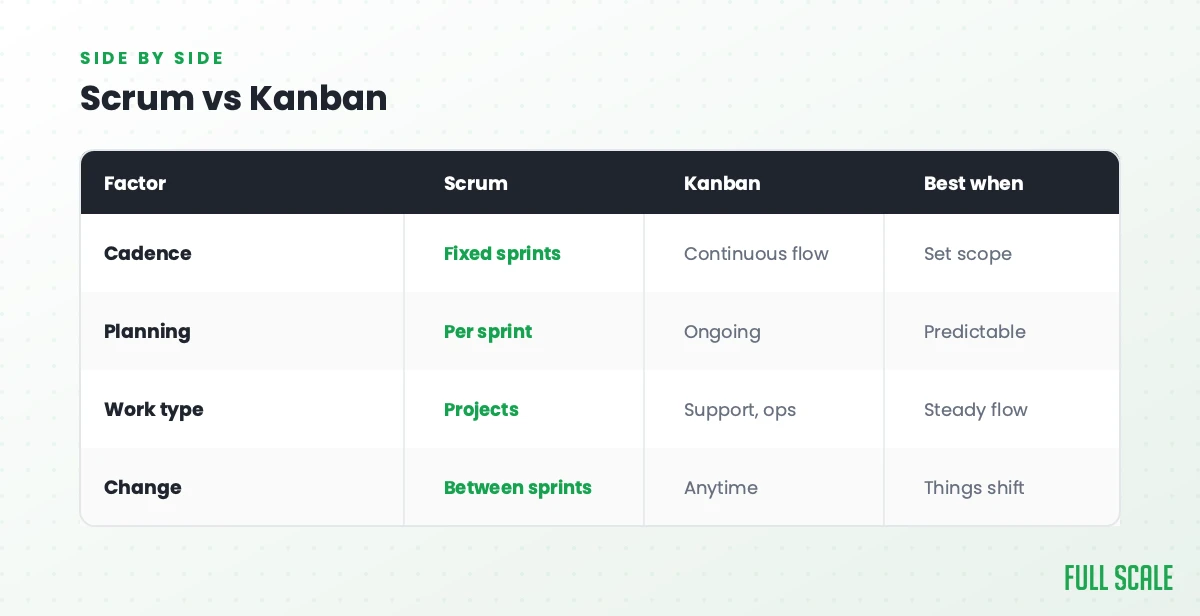
Here is a plain comparison of the dimensions that actually matter when you are deciding.
| Scrum | Kanban | |
|---|---|---|
| Work cadence | Fixed sprints (1-2 weeks) | Continuous flow, no sprints |
| Delivery rhythm | End of each sprint | Whenever a card is done |
| Planning | Sprint planning + backlog refinement | Ongoing, as work arrives |
| Commitments | Sprint commitment per cycle | No formal commitment; WIP limits instead |
| Meetings | Sprint planning, standup, review, retro | Standup only (or none) |
| Prioritization | Product Owner sets the sprint backlog | Board order, managed by whoever owns the backlog |
| Best for | Product builds, feature teams, predictable work streams | Support, maintenance, ops, unpredictable demand |
| Failure mode | Cargo-culting the ceremonies without product thinking | Work piling up with no one pulling it forward |
The table is useful, but it does not capture the most important dimension: the people.
How to choose: match the framework to the team you actually have
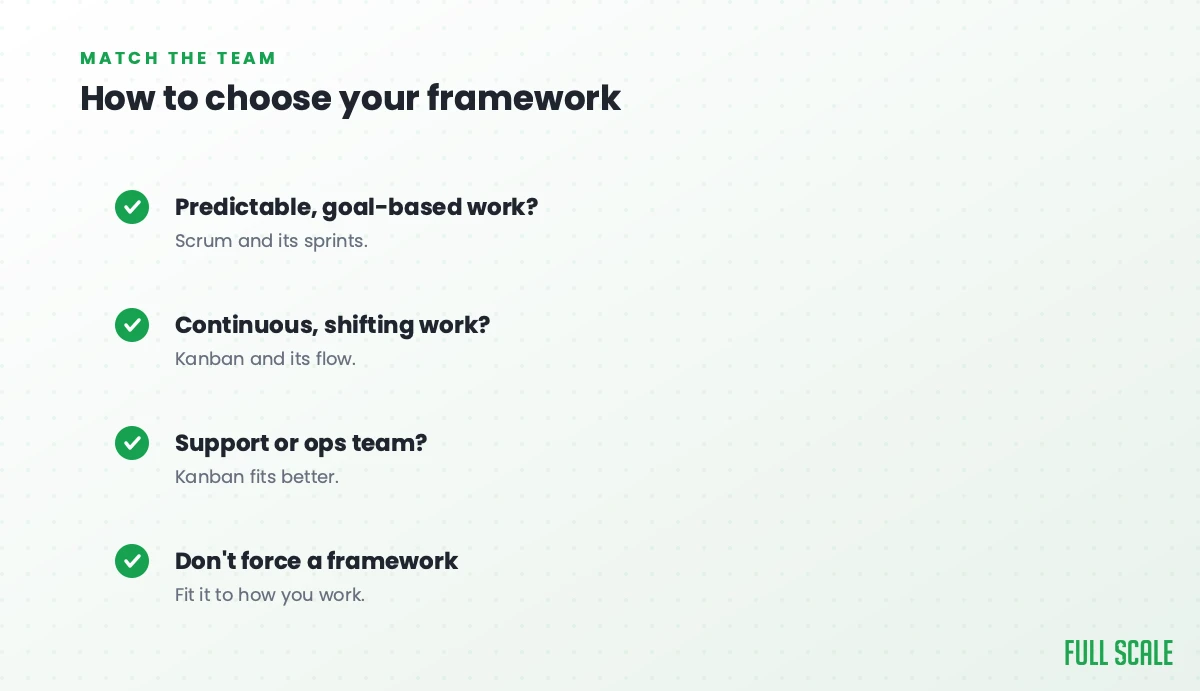
Here is my real selector, after years of watching both work and fail.
Kanban wins when you have proactive people who take ownership and pull their own work. If your engineers look at the board every morning and grab what needs doing without being told, Kanban is faster and leaner. With fewer ceremonies you get more output, and the self-organization is the product.
Scrum wins when you need to hold feet to the fire. When the team needs estimates, needs a regular cadence to pull them toward delivery, and needs leadership to be able to ask “what shipped this week,” Scrum provides all of that. The sprint commitment is the accountability mechanism.
This is not a judgment about developer quality. It is a judgment about what kind of support a team needs to do its best work. Some very talented people work better with a sprint structure, and some work better without it. Neither is wrong.
The cargo-culting failure mode. The failure mode I see most often is a team that runs all the Scrum ceremonies and still has no idea why they are building what is in the sprint. They have standups where everyone says “working on my tickets,” sprint planning where they just break the last sprint’s unfinished work into smaller pieces, and reviews where nobody from the business shows up. The ceremonies did not cause this. The ceremonies are covering for a product-thinking problem. You cannot fix that with a framework. As I wrote in Product Driven, you can’t fix engineering with Agile, OKRs, or roadmaps. The framework is scaffolding, not strategy.
The same failure happens in Kanban when there is no one proactively pulling work. The board fills up with things in progress, the WIP limits get ignored, and work stalls. Kanban needs self-organizing people or a strong queue manager. Without either, you just have an unmanaged backlog with sticky notes.
Scrumban: when to run both
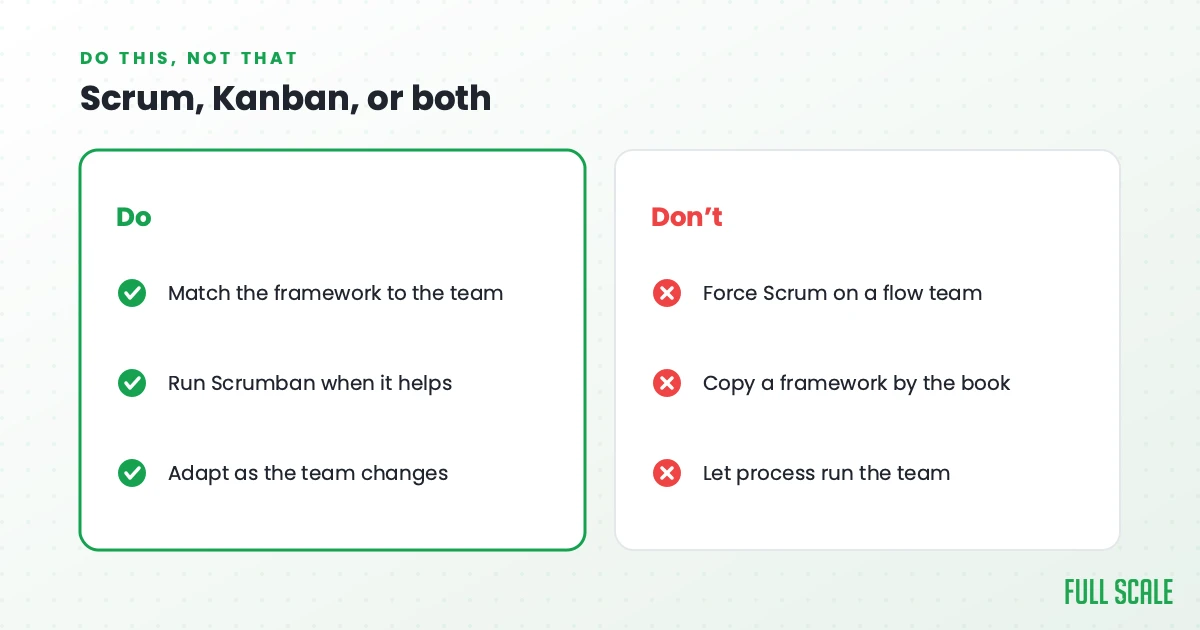
Scrumban is exactly what it sounds like: a hybrid. Some teams use it intentionally; most teams drift into it without naming it.
The most common version is a team that holds sprint planning and a retrospective on a two-week cadence but lets work flow in and out of the sprint more like Kanban. Instead of a locked sprint backlog, they add work as priorities change. Instead of a strict sprint review, they demo whatever is ready.
This can work well for teams that are doing a mix of planned feature work and ongoing maintenance. The sprint gives structure to the planned work. The Kanban flow handles the unpredictable inbound.
Full Scale teams that handle both product development and support for the same client often run something close to Scrumban. The agile practices that work well in offshore teams follow the same principle: use the sprint structure for planned feature work and let a separate Kanban lane absorb the unpredictable inbound, so neither disrupts the other. We run planned feature work on a sprint cadence and keep a separate Kanban lane for support, bug fixes, and quick-turn requests. The two lanes do not fight each other when they are properly separated.
Whether you call it Scrumban or just “how we actually work,” running a hybrid is not a failure. Most real teams work this way. The risk is losing the disciplines that make each method work. If the sprint cadence becomes meaningless and the Kanban board becomes a dumping ground, you have neither structure nor flow. You just have chaos with a nice board.
For the broader question of whether Agile-based approaches like these are still worth using in an AI-accelerated world, that gets into the live debate on whether Agile is dead, and the short answer is that the mindset is more important than ever even as the ceremony matters less. The modern software development process is changing under both frameworks regardless of which you choose.
If you are still figuring out whether Agile is even the right direction for your team, the place to start is the comparison between Agile and Waterfall and when each one wins.
Which one fits when you add outside engineers
This is the version of the question a CTO actually has to answer. You are about to add engineers to a team, so which process do they plug into? Staff augmentation works under either one, because the engineers join the process you already run. The difference is what each framework hands a new person on day one.
A Scrum team hands them a calendar and a sprint goal. They know when planning happens, what the team committed to, and who to ask. A Kanban team hands them a board and a WIP limit. That works when someone owns the queue and keeps the top of the backlog in order. When no one does, the new engineer waits for work, and you pay for the waiting.
So check which gap you have before you add people. If the work is unpredictable, keep the Kanban board and name a queue owner. If the team keeps missing dates, a sprint cadence gives everyone the same deadline.
Frequently asked questions
What is the difference between Scrum and Kanban?
Scrum organizes work into fixed two-week sprints with defined roles, planning meetings, and a regular delivery cadence. Kanban uses a continuous flow board where work is pulled when capacity opens up, with no sprints and fewer formal roles. Scrum suits teams that benefit from a regular heartbeat and accountability on commitments. Kanban suits teams doing unpredictable, continuous work like support and maintenance.
Is Kanban better than Scrum?
Neither is universally better. Kanban is better for proactive, self-organizing teams doing continuous or unpredictable work. Scrum is better when the team needs structure, estimates, and a regular delivery cadence to stay accountable. The right choice depends on the type of work and the team, not on a universal ranking.
What is Scrumban?
Scrumban is a hybrid that combines elements of both Scrum and Kanban. A common version keeps sprint planning and retrospectives on a two-week cadence but allows work to flow in and out more flexibly, like Kanban. Many teams run something close to Scrumban in practice, particularly when handling a mix of planned feature work and ongoing maintenance.
Which is better for a small team, Scrum or Kanban?
For a small, senior team that self-organizes, Kanban usually fits better because the overhead of full Scrum ceremonies is disproportionate to the team size. For a small team that needs structure or where the work is feature development with stakeholder reviews, Scrum’s two-week cadence can work well even at small scale. Five to eight people is the sweet spot for either.
Can you use both Scrum and Kanban?
Yes. Many teams use Scrum for planned product work and Kanban for support or maintenance work running in parallel. Some teams adopt a Scrumban hybrid. The key is keeping the two lanes separate enough that each retains its discipline. A sprint backlog that continuously receives emergency Kanban work is not really Scrum anymore.
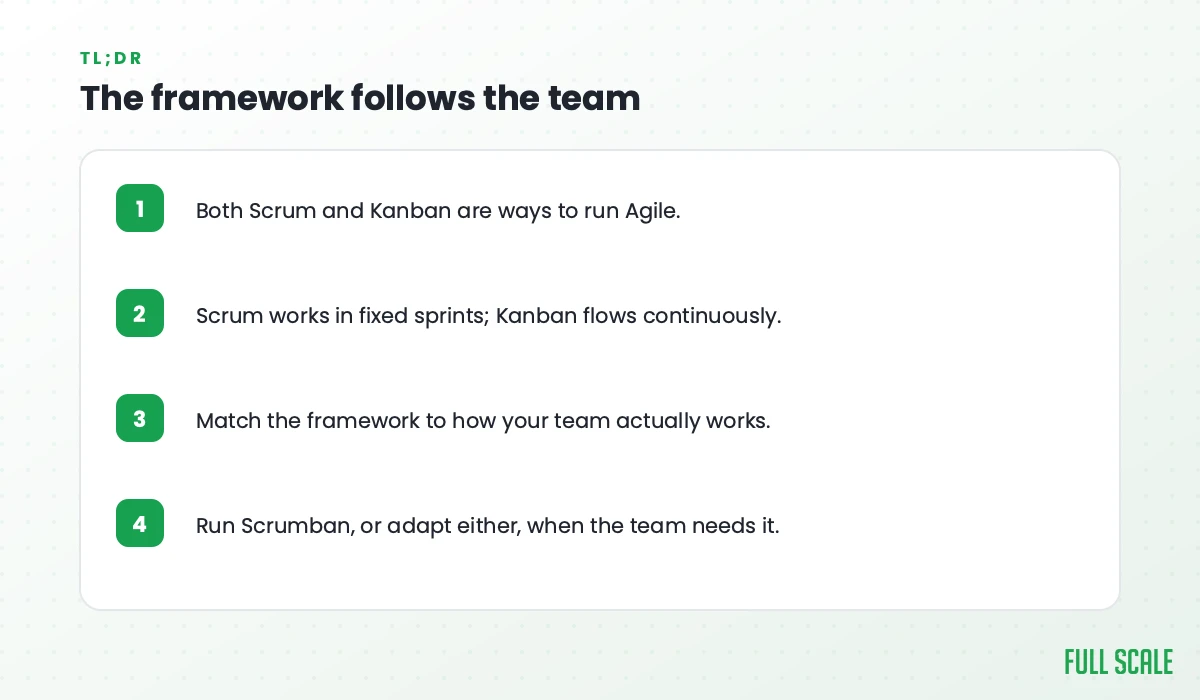
The framework follows the team, not the other way around
At Full Scale, our engineers slot into whatever process the client runs. We have seen both work well and both fail, and the variable is almost never the framework itself.
The teams that deliver are the ones where engineers understand the product, pull the work that matters, and speak up when something is wrong. Scrum or Kanban can hold that kind of team together. Neither one creates it.
If you want a team that thinks that way, let’s talk about building yours.