
What Does a Scrum Master Actually Do, and Do You Even Need One?

In this article
- What is a Scrum Master, in plain terms
- What a Scrum Master actually does, day to day
- The three jobs that actually matter
- Scrum Master vs. Product Owner vs. Project Manager
- The qualities of a Scrum Master worth hiring
- Do you actually need a dedicated Scrum Master?
- How AI is changing what a Scrum Master does
- Hiring a Scrum Master, or the role, for a distributed team
- Frequently Asked Questions
- The bottom line
Ask ten people what a Scrum Master does and you’ll get ten answers that all sound right and none of which help you decide anything.
So let me answer it the way a CTO would, in terms of what the role actually buys you, instead of the way a certification course would. It is the same gut check worth running on whether you need a technical product owner when the product is deeply technical.
What does a Scrum Master do? On a good team, a Scrum Master clears the things blocking your engineers, protects their focus from the constant pull of new requests, and slowly builds a team that can run itself. On a bad team, a Scrum Master schedules a lot of meetings and turns Scrum into a religion. The gap between those two outcomes is the whole story, and it’s the part the textbook definitions skip.
I’ve run engineering at three companies. I started as a software engineer, became a CTO, and now I’m the CEO of Full Scale, where we build and staff software teams for other companies. I’ve hired for this role, worked alongside great ones, and watched plenty of teams add the title because they thought it was a checkbox. So this isn’t a definition pulled from the Scrum Guide. It’s what the role actually looks like when you’re the one paying for it.
What is a Scrum Master, in plain terms
A Scrum Master is the person responsible for helping a team work well inside the Scrum framework. Scrum is one of the most common ways software teams organize their work into short cycles called sprints, usually one to two weeks long. The official answer, from Scrum.org, is that the Scrum Master is accountable for the team’s effectiveness and serves the team, the product owner, and the wider organization.
That’s accurate, and it’s also the reason nobody understands the role. “Serves the team” can mean almost anything.
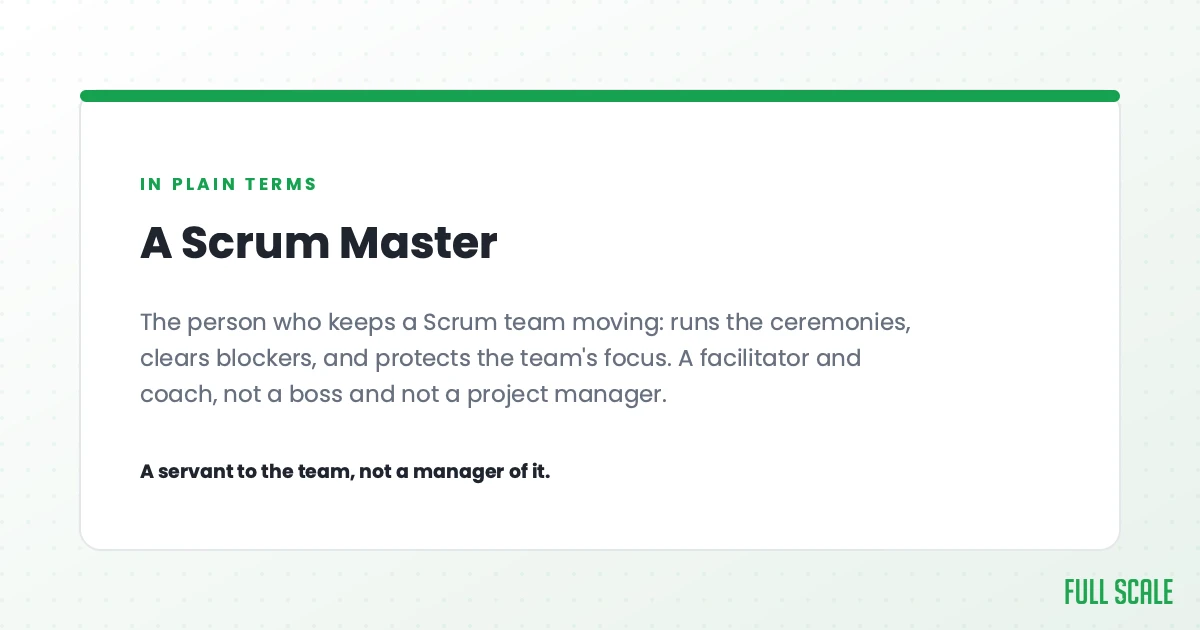
Here’s the version that survives contact with a real engineering org. A Scrum Master is a coach, not a boss. They don’t assign work, they don’t own the product, and they don’t manage people’s careers. Their job is to make the team faster and calmer by removing whatever is in the way, whether that’s a broken deployment pipeline, a stakeholder who keeps changing the requirements, or a habit the team has of overcommitting every sprint. The good ones are close to invisible. The team just feels like it’s running better, and they’re the reason why.
What a Scrum Master actually does, day to day
Most articles give you the ceremonial list: facilitates standups, runs sprint planning, leads retrospectives, manages the board. All of that is real, and all of it is the easy part. Here’s the fuller picture of where a strong Scrum Master spends their time. When managers start grading the team on velocity or story points, a good Scrum Master pushes back, because those are exactly the kind of activity numbers that measure how busy a team looks, not whether the work mattered.
- Running the Scrum events so they stay short and useful. The daily standup, sprint planning, the sprint review, and the retrospective. The skill isn’t scheduling them, it’s keeping them from turning into the hour-long status meetings everyone dreads.
- Removing blockers. This is the real job. An engineer is stuck waiting on access to a system, or a dependency from another team, or an answer from a stakeholder who’s been ignoring Slack for three days. A good Scrum Master makes that problem theirs and clears it before it costs the team a day.
- Protecting the team’s focus. Mid-sprint, someone always shows up with an urgent new request. The Scrum Master is the one who pushes back, so the team can finish what they started instead of thrashing.
- Coaching the team toward owning its own process. Helping engineers get better at estimating, at calling out problems early, at running their own retrospectives. The goal is a team that needs the Scrum Master less every quarter.
- Working with the product owner on the backlog. They don’t own it, but they make sure the list of work is clear, prioritized, and ready, so sprint planning isn’t a mess.
- Surfacing the uncomfortable stuff. Two engineers quietly disagree about the architecture. The team keeps missing its sprint goal and nobody wants to say why. The Scrum Master is supposed to name those things out loud, which takes more courage than facilitation skill.
Notice how much of that list is about people and how little of it is about Scrum trivia. That’s not an accident. The administrative half of this role, the boards and the burndown charts and the status tracking, is the part that’s easiest to do and easiest to automate. The human half is the part that’s hard, and it’s the part worth paying for. A good scrum master also owns agile capacity planning, the honest read on what the team can really finish in a sprint.
The three jobs that actually matter
If you strip the role down to what earns its keep, a Scrum Master does three things. Everything else is in service of these.
Clear blockers. A team of senior engineers is expensive, and every hour they spend blocked is money on fire. The single most valuable thing a Scrum Master does is make sure your best people are never stuck waiting on something a phone call could fix.
Protect focus. Most teams don’t fail because they’re slow. They fail because they’re scattered across too many half-finished things. This is one of the five pillars I wrote about in Product Driven: focus is a discipline, and someone has to defend it every single sprint. A Scrum Master who says no to mid-sprint chaos is worth more than one who runs a flawless standup.
Build a team that runs itself. The best Scrum Masters work themselves toward irrelevance. They coach the team until it owns its own process, surfaces its own problems, and holds its own standards. As I like to put it, engineers who think like owners outperform the ones who wait for tickets. A Scrum Master’s real legacy is a team that doesn’t need to be managed.
Scrum Master vs. Product Owner vs. Project Manager
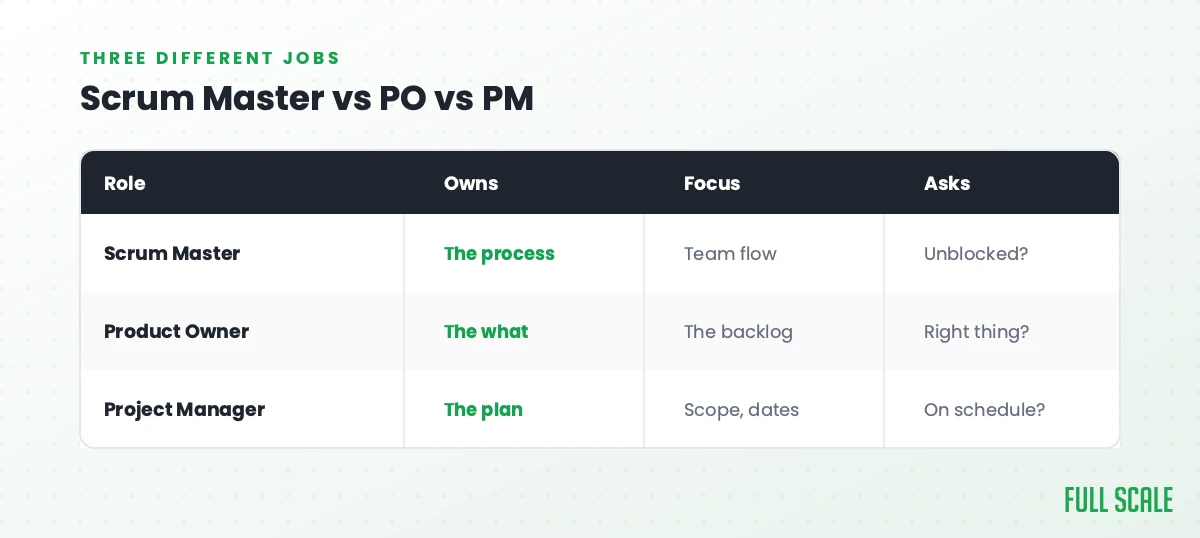
This is where most of the confusion lives, and it matters because hiring the wrong one wastes a salary and frustrates a team. The three roles get blurred constantly, so here’s how they actually differ.
| Role | Owns | Main question they answer |
|---|---|---|
| Scrum Master | The team’s process and health | “How do we work better together?” |
| Product Owner | The product backlog and priorities | “What should we build next, and why?” |
| Project Manager | Scope, timeline, and budget | “Will this ship on time and on plan?” |
The Product Owner decides what gets built and in what order. The Scrum Master makes sure the team can build it well. A traditional project manager sits on a different axis entirely, tracking scope and dates against a plan, which is a model Scrum was partly designed to move away from.
One warning from experience. On distributed and offshore teams especially, an extra process layer can quietly become a wall between you and your engineers. I’ve written before about how a project manager can undermine an offshore team by becoming the only person the client ever talks to. The same risk applies to a Scrum Master who turns into a gatekeeper instead of a coach. The role is supposed to clear the path between people, and a gatekeeper does the opposite.
The qualities of a Scrum Master worth hiring
The usual list of qualities reads like a horoscope: communication, empathy, leadership, adaptability. True, and useless for actually picking someone. Here’s what I’d look for if I were hiring for this role today.
- They run toward conflict. The whole value of the role is naming the hard things, so someone who smooths over tension just to keep meetings pleasant is the opposite of what you want.
- They have enough technical depth to be useful. A Scrum Master doesn’t need to write production code, but they need to understand what blocks engineers, what tech debt is, and why “just add it to this sprint” is sometimes a terrible idea. The ones who can’t follow a technical conversation get ignored by the team, and rightly so.
- They measure themselves by what the team shipped. A Scrum Master who’s proud of how many ceremonies they ran has missed the point. The right one is proud of how little the team needed them last month.
- They’re genuinely curious. This matters more every year, for reasons I’ll get to. The framework is going to keep shifting under everyone’s feet, and the people who stay curious are the ones who stay useful. The Scrum Alliance frames the role around continuous coaching for exactly this reason.
You’ll notice Scrum Master certification isn’t on that list. A cert tells you someone learned the framework. It tells you nothing about whether they can clear a blocker, defend a team’s focus, or have a hard conversation. Treat it as a starting point and judge the rest in the interview. For the broader comparison of Scrum vs Kanban and when each framework actually fits a team, the decision guide covers the full choice.
Do you actually need a dedicated Scrum Master?
Here’s the question the certification sites won’t ask you, because they have an obvious incentive not to. Do you need a full-time, dedicated Scrum Master at all?
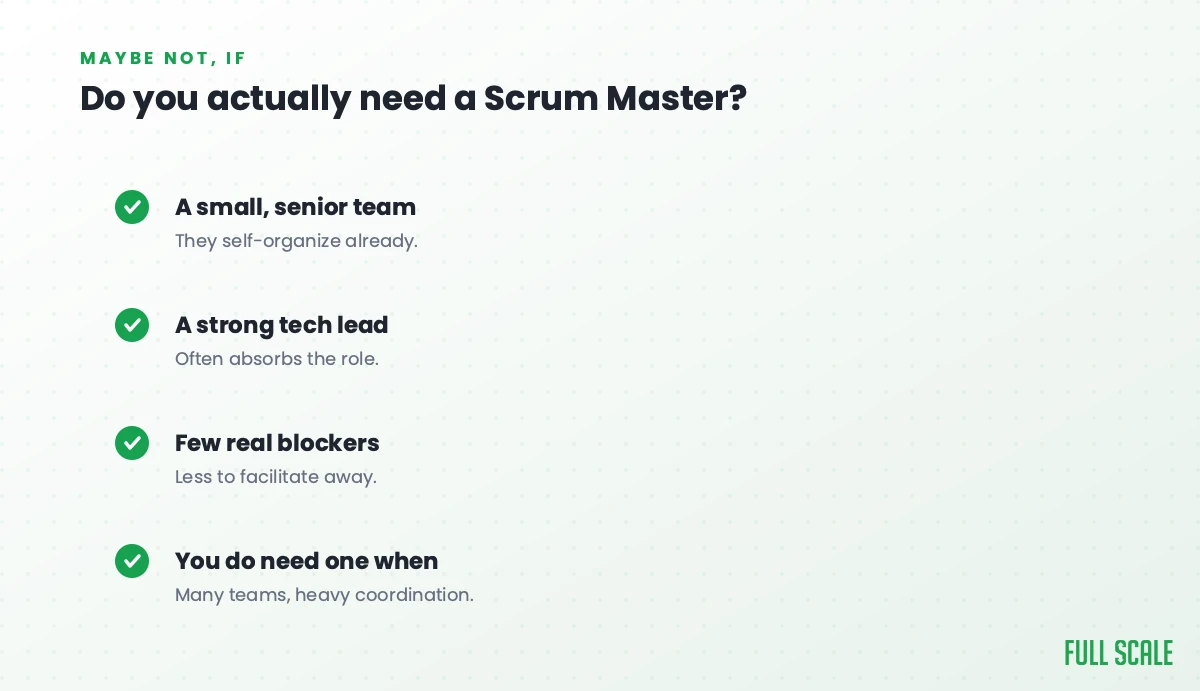
For a lot of teams, the honest answer is no, or at least not yet. A small team of five or six strong engineers with a clear product owner often doesn’t need a separate person to run their process. A senior engineer or a tech lead can facilitate the ceremonies, and the team can own the rest. Adding a dedicated Scrum Master to a team that small can actually slow it down, because now there’s a person whose entire job depends on the process existing, which is a strong incentive to add more of it.
You start to genuinely need the role when scale breaks the things that used to be informal. When you have multiple teams that depend on each other, when blockers cross team boundaries, when the product owner is drowning and the backlog is a mess, that’s when a dedicated person earns their seat. The role exists to absorb coordination overhead that would otherwise land on your most expensive engineers.
But I want to be careful here, because this is where I watch companies get it wrong most often. They feel like their engineering is struggling, so they reach for process. They hire a Scrum Master, add ceremonies, buy the tool, and expect it to fix things. It almost never does.
You can’t fix broken engineering with more process.
If your team is shipping the wrong things, or the code quality is bad, or people don’t understand what they’re building, a Scrum Master and a tighter sprint cadence won’t save you. Those are problems of vision, clarity, and ownership, and no amount of ritual substitutes for them. I learned this the expensive way at Stackify, where we had a solid roadmap and shipped constantly and the product still didn’t land, because the problem was never our process. The teams I’ve run that worked best needed less process as they got better. Process is a tool for a healthy team. It is not a cure for a sick one.
How AI is changing what a Scrum Master does
Any honest answer to “what does a Scrum Master do” in 2026 has to deal with AI, because it’s quietly eating one half of the role.
Think back to that list of daily tasks. A big chunk of it is administrative: tracking status, updating the board, assembling burndown charts, taking notes in retrospectives, chasing people for updates. That’s exactly the kind of work AI tools are getting good at. The same shift is happening to the writing of code itself. Google’s CEO said in 2026 that about 75% of the company’s new code is now AI-generated, with every line still reviewed and approved by an engineer. When the mechanical parts of building software compress like that, the mechanical parts of managing it compress too.
So the administrative half of the Scrum Master role is going to shrink, and the human half gets more important as it does. I think about it through what I call the three C’s: communication, curiosity, and courage. Communication matters more because the job is increasingly about helping people understand each other and the problem. Curiosity keeps you employed, since the tools and the framework will keep changing, and the people who stay curious adapt while everyone else gets automated around them. And it takes real courage to surface a hard truth on a team, which is the one thing no tool is going to do for you.
If running tidy meetings and keeping the board current was the whole job, AI is quietly taking it. What’s left is the coaching, and that’s the part worth hiring for.
Hiring a Scrum Master, or the role, for a distributed team
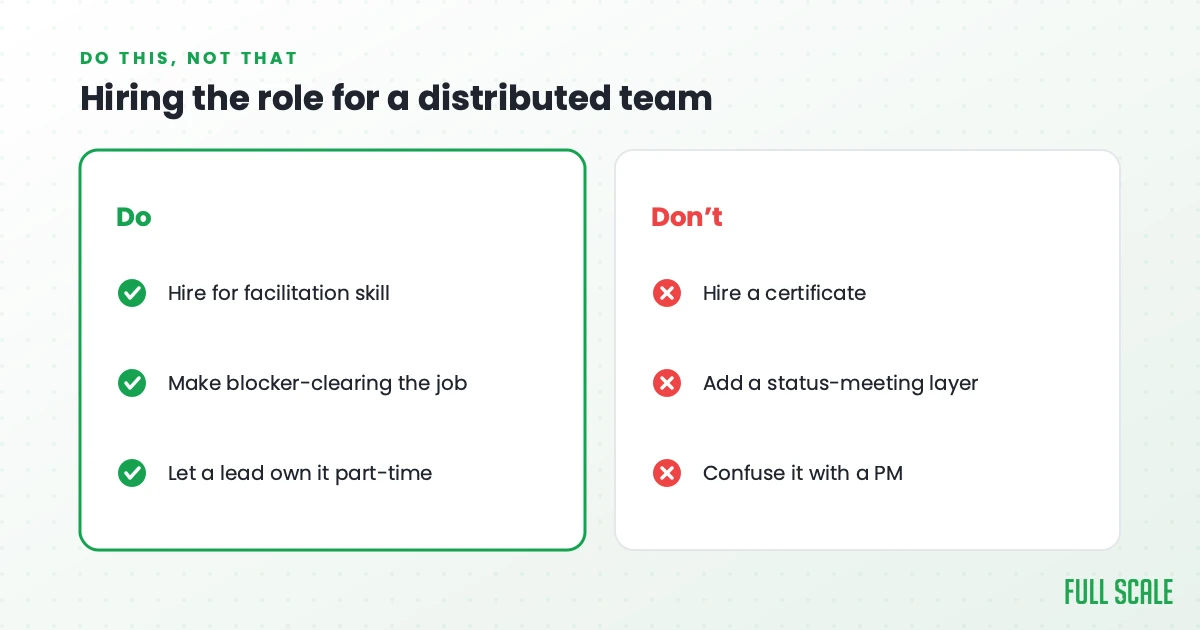
If you decide you do need the role, you have more options than hiring one expensive full-time person locally. The function matters more than the title, and good agile facilitators exist all over the world.
At Full Scale, we build dedicated software teams for companies, and the teams that work best treat their offshore engineers as full members of the team. There’s no vendor sitting on the other side of a wall. That works because software development is about communication more than anything else, which is exactly the muscle a good Scrum Master is built to strengthen. We hire engineers and team leads in the Philippines who run agile the same way your in-house team does, on the same standups, the same tools, and the same standards. If your team already works well remotely, it will work well globally too.
The thing to avoid is hiring the role as a box to check. Whether the Scrum Master sits in your office or joins your standup from Cebu, what you’re paying for is the same: someone who clears blockers, protects focus, and builds a team that runs itself.
Frequently Asked Questions
What does a Scrum Master do in simple terms?
A Scrum Master helps a software team work well by running its sprint meetings, removing anything blocking the engineers, protecting the team’s focus, and coaching the team to improve over time. They coach how the team works rather than bossing people around or handing out the assignments.
What is the difference between a Scrum Master and a Product Owner?
The product owner decides what the team builds and in what order, based on customer and business needs. The Scrum Master makes sure the team can build it well by improving how the team works together. One owns the “what,” the other owns the “how we work.”
What are a Scrum Master’s main responsibilities?
The core scrum master responsibilities are facilitating the Scrum events, removing blockers, protecting the team from mid-sprint scope creep, coaching the team toward self-management, and helping the product owner keep the backlog clear and prioritized. Still, why scope creep keeps happening is usually a leadership question, not a process one.
Do small teams need a Scrum Master?
Often not a dedicated one. A small team of strong engineers with a clear product owner can usually have a senior engineer or tech lead facilitate the process. A dedicated Scrum Master earns their seat once you have multiple teams, cross-team dependencies, and coordination overhead that would otherwise fall on your senior engineers.
Does a Scrum Master need to be technical or certified?
Certification teaches the framework, which is a fine starting point but proves little on its own. Technical depth matters more in practice: a Scrum Master who understands what actually blocks engineers and why some requests are costly will earn the team’s trust, while one who can’t follow a technical conversation tends to get ignored.
The bottom line
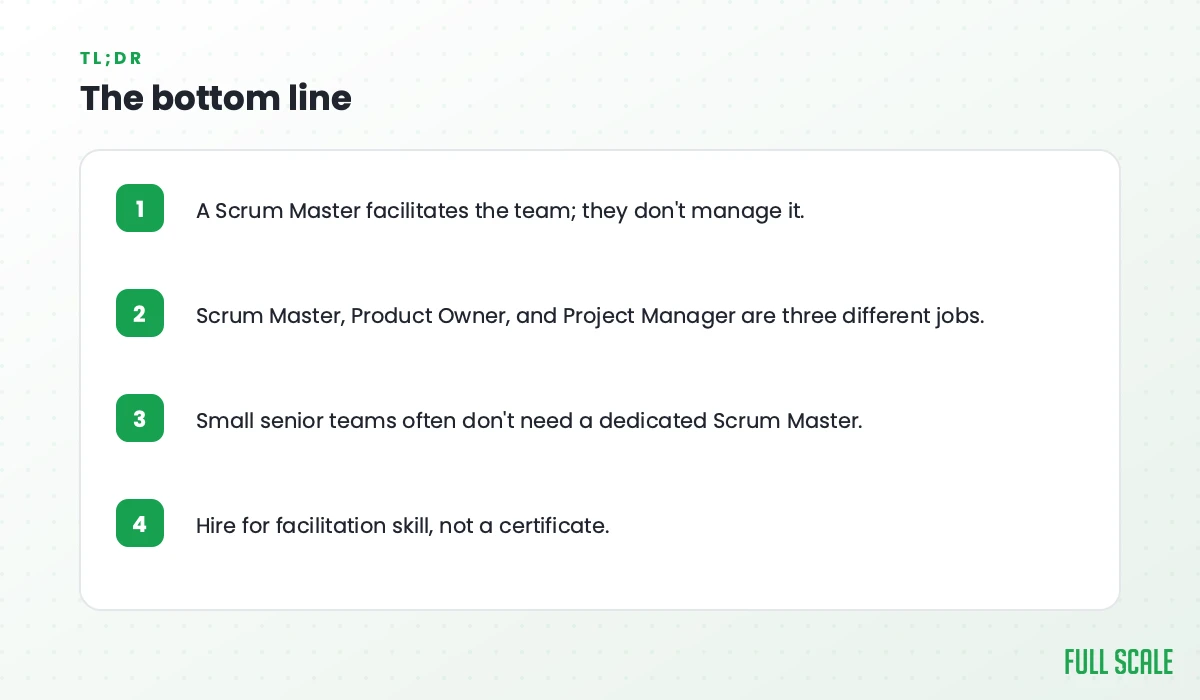
What does a Scrum Master do? At their best, they make a good team faster and calmer by clearing blockers, defending focus, and coaching the team to run itself. At their worst, they add ceremony to a team that needed clarity instead. Knowing which one you’re hiring, and whether you need the role at all, is the decision that actually matters.
If you’re building or scaling a software team and want engineers who already work this way, let’s talk about building your dedicated team.