
Benefits of Agile Development: Which Ones Survive the AI Era

In this article
- What is agile development methodology?
- The benefits every list promises
- What AI actually changed about the math
- The agile benefits AI made worth more
- The agile benefit AI quietly demoted
- The quality benefit moved instead of growing
- Why these benefits look different on a distributed team
- How to actually capture these benefits
- Frequently asked questions
- The bottom line
Most lists of agile’s benefits promise the same five things: faster delivery, happier customers, flexibility, better quality, and higher morale. The lists aren’t wrong, exactly. They’re just written by people selling you agile, and they treat every benefit as equal and permanent.
They’re not equal, and after the last two years, they’re not all permanent either.
I’m Matt Watson, CEO of Full Scale and a 4x tech founder. I co-founded VinSolutions and sold it for $147 million, I built Stackify, and I’ve run engineering teams for more than 20 years. I’ve watched agile deliver real value, and I’ve watched teams run every ceremony in the book and still ship the wrong thing. Now AI writes a large share of the code, and that’s quietly re-sorted which agile benefits actually matter.
Most of the advertised benefits of agile development methodology are real. AI just changed which ones are worth the most, and made one or two of them close to pointless. Here’s how I’d score them.
Quick Answer: The real benefits of agile development methodology are fast feedback, the flexibility to change direction cheaply, close contact with customers, lower risk from finding mistakes early, and team ownership of outcomes. AI made these worth more, since knowing what to build now matters more than typing it. Faster delivery is real but now table stakes, since AI made building fast for everyone. Predictability through velocity and story points is the most oversold benefit and the easiest to fake. Full Scale builds engineering teams that capture these benefits for real, not just the ceremony around them.
What is agile development methodology?
Agile development methodology is a way of building software in short cycles, checking your direction with real users after each one, and changing the plan based on what you learn. It grew out of the Agile Manifesto, which seventeen software developers published in 2001 as a reaction to long, plan-everything-first projects. Scrum and Kanban are the best-known versions, and I compare them in Scrum vs Kanban. The benefits below come from the short loop itself, whichever version you run.
The benefits every list promises
Let me give you the standard list first, because it’s worth being honest about what’s genuinely true before I argue about it. These are the benefits people mean when they ask what agile gives you.
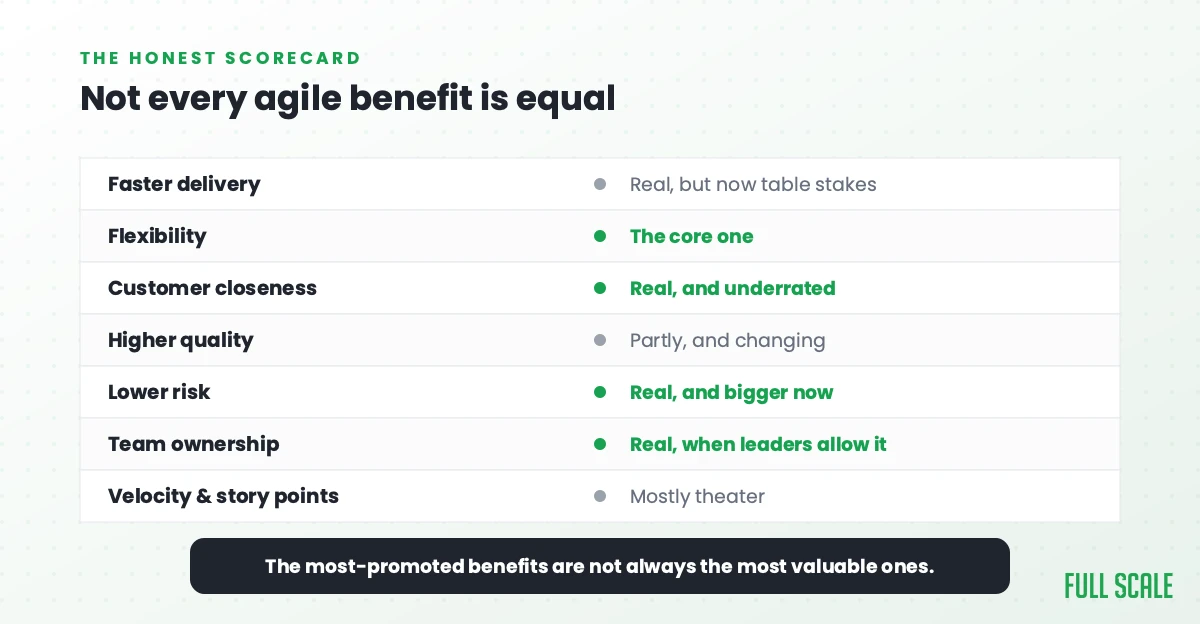
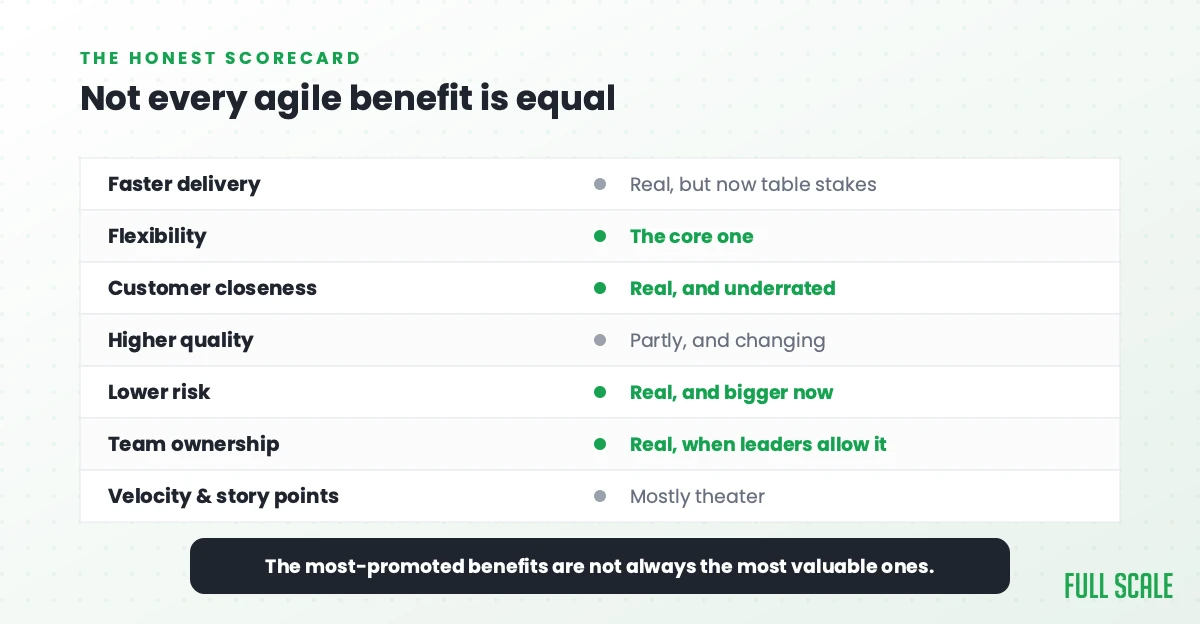
| The promised benefit | What it actually means | Is it real? |
|---|---|---|
| Faster delivery | Ship working features in short cycles instead of one big launch | Yes, but now table stakes |
| Flexibility | Change direction without throwing out months of work | Yes, this is the core one |
| Customer closeness | Get feedback early and often, not at the end | Yes, and underrated |
| Higher quality | Test continuously instead of one QA gate at the end | Partly, and changing |
| Lower risk | Find out you’re wrong in a week, not a quarter | Yes, and bigger now |
| Team ownership | Developers own outcomes, not just tickets | Yes, when leaders allow it |
| Predictability | Velocity and story points make planning easier | Mostly theater |
Notice the last column. The benefits aren’t all the same size, and the most-promoted ones aren’t always the most valuable. The single most useful thing agile ever gave me wasn’t speed. It was finding out I was building the wrong thing while it was still cheap to change course.
Years ago at Stackify, we spent $10,000 sponsoring a developer conference for a big product launch and signed up zero new customers. The product didn’t land because we’d never really checked whether anyone wanted it. That’s the exact mistake agile is supposed to catch, and catching it early is the benefit I care about most.
So that’s the lens for the rest of this post. Not “is this benefit on the brochure,” but “is this benefit worth more or less now that AI builds the first draft.” If you’re asking why use agile methodology at all in 2026, the answer is in that re-sorting, not in the brochure.
What AI actually changed about the math
AI made writing code cheap, and that changed which agile benefits are worth the most.
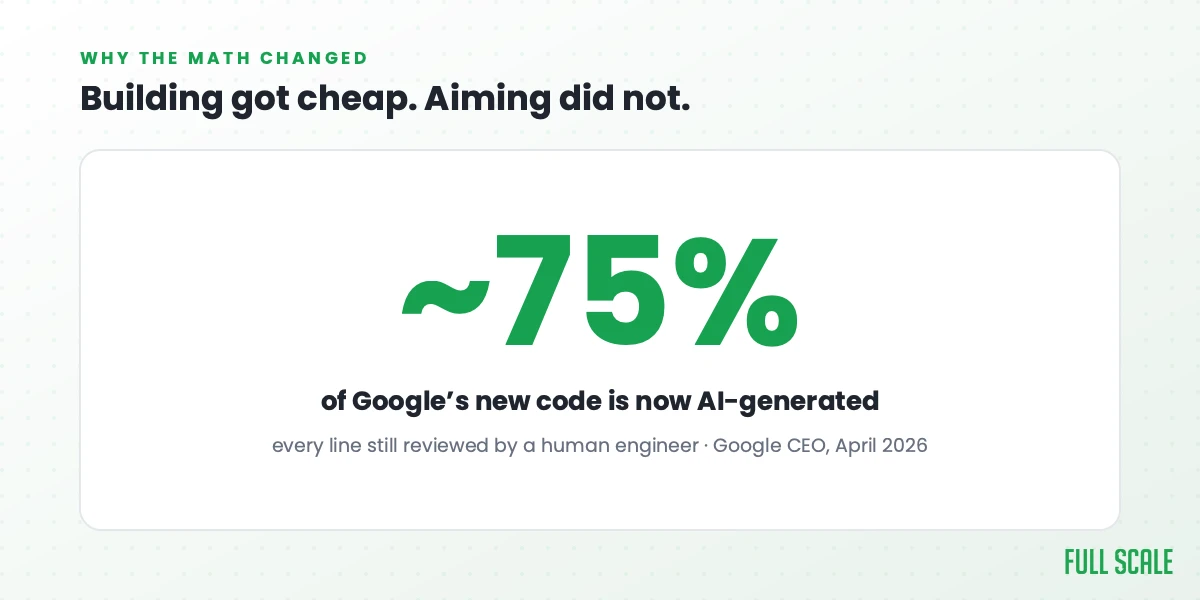
In April 2026, Google’s CEO said about 75% of the company’s new code is AI-generated, with a human still reviewing every line. Whatever your number is, you’re on that curve. When a machine produces the first version of a feature in an afternoon, the whole software development process shifts. Typing code is no longer the part that’s scarce.
The bottleneck moved up the stack. The hard part is now knowing what to build, judging whether the output actually solves the problem, and deciding what comes next. That’s context, and context is exactly what good agile was always about.
This is also why faster delivery, the benefit that headlines every list, quietly dropped in value. When everyone can ship quickly, shipping quickly stops being an advantage and becomes the price of being in the game. Speed is cheap now. Aim is not.
The 2025 DORA report puts it well: AI amplifies what’s already there. Strong teams get faster and better. Weak teams just ship their problems quicker. So the agile benefits that help you aim get more valuable, and the ones that only helped you manage the cost of building lose their point.
The agile benefits AI made worth more
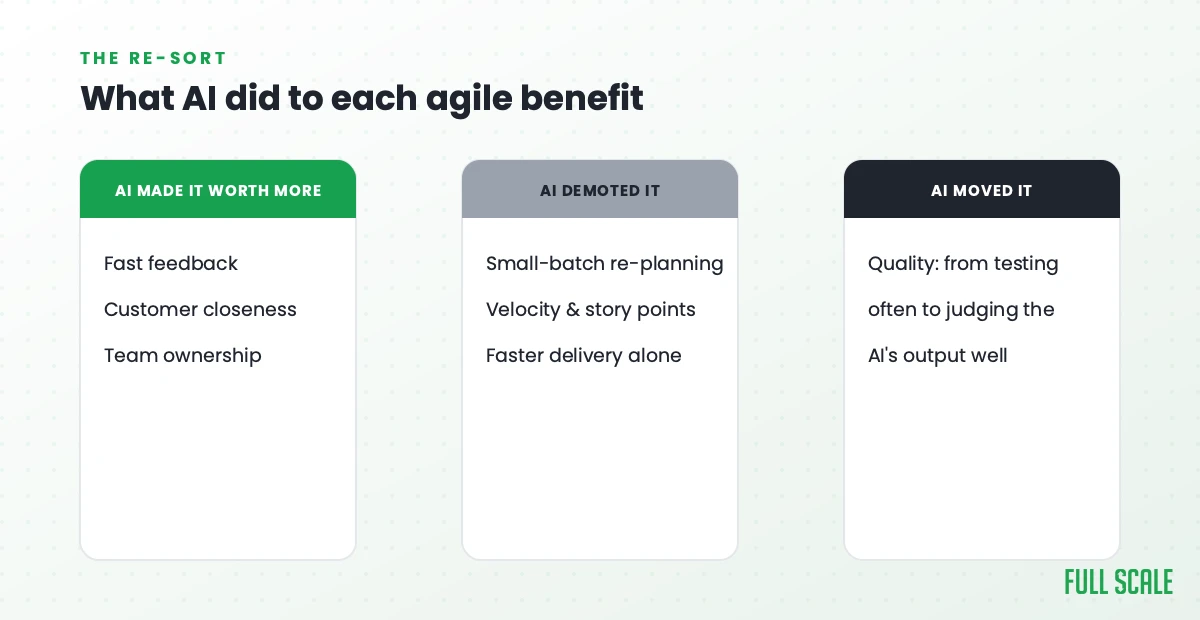
Fast feedback, customer closeness, and team ownership are the three agile benefits I’d now rank at the top. They were always good, and AI made them better.
Fast feedback is the big one. The original case for agile was that requirements change, so you should work in short loops and check your direction often. That argument is stronger than ever. If you can build a working version in a day, one customer conversation that redirects your effort costs almost nothing, while a cycle spent building the wrong thing costs more than it used to, because you could have built the right thing in that same time. This is where the lower-risk benefit comes from too: you used to find out you were wrong in a week instead of a quarter, and now you find out in a day. Cheap building makes good aim the entire game.
Customer closeness compounds the same way. Staying in front of the people who use your software was always smart. Now it’s the constraint. The teams that win with AI are the ones that understand the problem well enough to tell when the machine’s confident-looking output is subtly wrong. That understanding comes from talking to customers, not from a backlog grooming meeting. Customers don’t buy cool code. They buy products that solve their problem, and knowing the difference is a human job.
Team ownership matters more now. Agile was supposed to give developers ownership of outcomes instead of turning them into ticket-takers at a station on the line. Plenty of teams lost that thread and ended up with the assembly-line version. AI punishes that version hard, because someone has to own the judgment about what the machine produced. A team of people who think like product owners gets more out of AI than a team waiting to be told what to do. This is most of what I wrote Product Driven about: the shift from shipping output to owning outcomes.
The agile benefit AI quietly demoted
The agile benefit AI demoted is small batches that make re-planning cheap, and I expect to get argued with about it.
That benefit used to carry a lot of weight. It existed because building was expensive, so you sliced work small to make sure a wrong turn only cost a sprint instead of a quarter. When a prototype takes an afternoon, the machinery built to make re-planning cheap is solving a problem that mostly went away. You can often just build two versions and compare them, rather than slicing and sequencing the work to protect against an expensive mistake.
This is the difference the brochures miss. The flexibility benefit didn’t disappear, it split in two. The outcome of flexibility, changing direction cheaply, is worth more than ever. The machinery teams built to get there, the elaborate slicing and re-sequencing, is worth less. Keep the first. Stop spending three meetings a week defending the second. If you want the full comparison of when heavy up-front planning still beats iterating, I laid that out in agile versus waterfall.
I’d put velocity and story points in the same bucket, and honestly they were always shakier than the brochures admit. Tracking velocity to predict delivery is mostly comfort, not signal, and chasing story points as a goal makes teams optimize the number instead of the outcome. When AI can change a team’s raw output overnight, a story-point average from last quarter tells you even less than it used to. If you want to plan capacity well on a real team, I’ve written separately about how to do that without leaning on velocity as a crystal ball.
There’s a fair objection here worth meeting head on. AI made the first draft cheap, not the whole system. Integrating a feature, maintaining it, and being wrong at scale in production still cost real money. That’s true. But it cuts in favor of aiming well, not against it. The cheaper the first version gets, the more of your cost moves downstream into integration and upkeep, and the only way to hold that down is to build the right thing in the first place. That’s an argument for the feedback benefit, not for the planning machinery.
The quality benefit moved instead of growing
Quality is the interesting one, because it didn’t grow or shrink. It moved.
The old agile quality benefit was “test all the way through instead of one gate at the end.” Continuous testing, integration, peer review. That still matters, but the center of gravity shifted. When a person writes the code, review catches their mistakes. When a machine writes most of it, review isn’t a backstop anymore. It’s the main event.
So the quality benefit of agile in 2026 is less about how often you test and more about whether your process forces real human judgment on what the AI produced. A team that runs continuous integration but rubber-stamps AI output has the ceremony without the benefit. A team that treats every AI-generated change as something a person has to actually understand before it ships has the benefit even if their process looks lighter. The difference between engineering and just producing code is exactly this judgment, and it’s where the quality benefit now lives.
Why these benefits look different on a distributed team
I run a company built on distributed teams, and on a distributed or offshore team the feedback-loop benefit is worth even more, because the cost of a misunderstanding is higher. When a developer is twelve time zones away, a wrong assumption can run for a full day before anyone catches it. Tight agile loops, short cycles, frequent check-ins, and a clear definition of done are how you close that gap. The benefit is the same one as before. Distance just raises the stakes. That’s the whole reason getting agile offshore development right is worth the effort.
The trap is thinking the answer is the cheapest possible developers running a rigid process. Hiring on price alone is what I call cheapshoring, and it kills every benefit on this list, because the benefits come from people who can own outcomes, not from people who only execute tickets cheaply. We’ve run Full Scale on this model since 2018, paying at the top of the local market and embedding engineers who think like owners into a client’s team, rather than handing the project to a process running offshore. Agile’s benefits travel across distance. They don’t survive being run by people who were hired to be cheap instead of good.
How to actually capture these benefits
Most of the value leaks out between knowing which benefits survived and getting them out of a real team.
You don’t get faster feedback because you hold a standup. You get it because you actually talk to customers and change direction when they tell you something. Team ownership comes from leaders letting developers own the problem from user to production, not from handing someone a Scrum Master title. So the practical move is to adopt less agile, not more. Keep the benefits AI made valuable, stop defending the ones it demoted, and aim your process at judgment and customer context instead of at hitting a velocity target.
That’s a lighter agile than most teams run, and a more valuable one. The reason it works comes down to the agile mindset mattering more even as the ceremonies matter less, which is its own argument that I made in full in is agile dead.
Frequently asked questions
What are the main benefits of agile development methodology?
The real ones are fast feedback, the flexibility to change direction cheaply, close contact with customers, lower risk because you find mistakes early, and team ownership of outcomes. Faster delivery and higher quality are real too, but only when scope is cut to match and when testing is treated as judgment rather than a checkbox. Predictability through velocity and story points is the most oversold benefit and the easiest to fake.
Which agile benefits still matter now that AI writes most of the code?
The benefits that help you aim got more valuable: fast feedback, customer closeness, and team ownership. When AI makes building cheap, knowing what to build and judging whether the output is right becomes the whole game. The benefits that only helped manage the cost of building, like slicing work into small batches purely to make re-planning cheap, lost weight, because being wrong in code is no longer expensive to fix. That shift is also why upskilling your team for the AI era is now less about tools and more about judgment.
What is the single biggest benefit of agile for an engineering leader?
Finding out you’re building the wrong thing while it’s still cheap to change course. Every other benefit is downstream of that. A leader who runs tight feedback loops spends less money building features nobody wanted, and that gap is wider in 2026 than ever, because the cost of producing a first version dropped while the cost of being wrong at scale did not.
Do the benefits of agile apply to offshore and distributed teams?
They apply more, not less. Distance raises the cost of a misunderstanding, so the feedback-loop and customer-closeness benefits matter even more when your team is remote or offshore. The benefits come from engineers who can own outcomes, though, not from a rigid process run by the cheapest developers you could find. Hire for ownership, then run tight loops.
What are the biggest advantages of agile methodology over waterfall?
The advantages and the benefits are the same thing, just different words for it: fast feedback, the flexibility to change direction cheaply, and close contact with customers. Waterfall front-loads planning and locks in the plan; agile checks direction constantly instead. That advantage matters more now that building is cheap, since a wrong assumption in a waterfall plan gets expensive to unwind, while agile catches it in days.
The bottom line
The benefits of agile development methodology are mostly real, but they aren’t equal and they aren’t frozen in time. AI raised the value of fast feedback, customer closeness, and team ownership, and lowered the value of the planning machinery built to make expensive building safer. Sort your practice that way and you’ve got an agile built for how software actually gets made now.
Getting those benefits out of a distributed team is its own skill, and it comes down to who’s on the team. If you want engineers who own outcomes instead of just running your process, talk to us about building your team.