
Mexico vs Philippines Software Developers: Cost, Time Zone, and Retention Compared

In this article
- Mexico vs Philippines: the numbers side by side
- What the extra rate for nearshore Mexico buys you
- What a Mexico rate doesn't tell you about employer costs
- English scores favor the Philippines, and communication habits decide the rest
- Retention: what you can prove
- When Mexico wins and when the Philippines wins
- Frequently asked questions
- Price a Philippines team against your Mexican quote
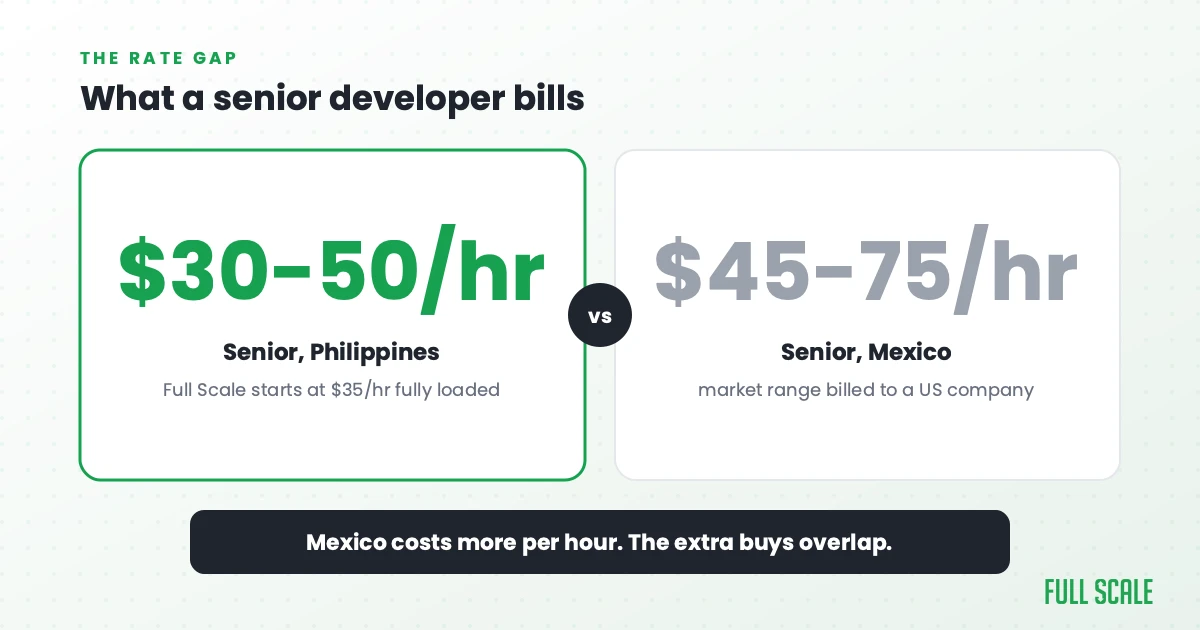
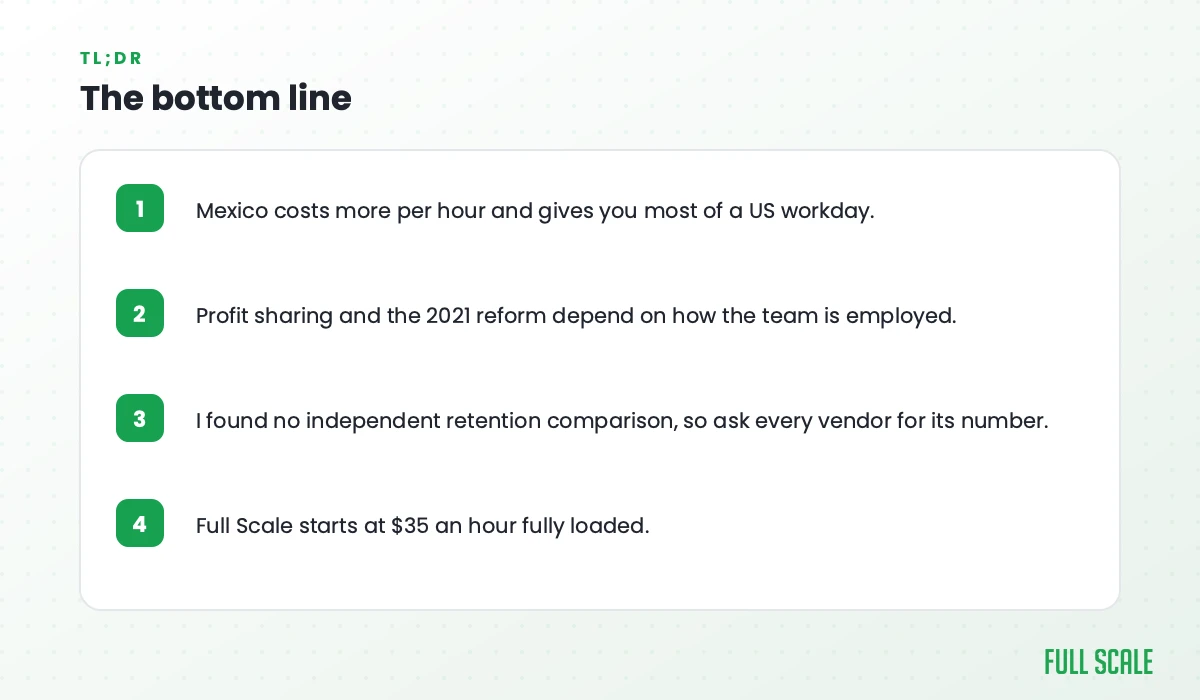
Quick Answer: Mexico vs Philippines comes down to what you pay for the time zone. On market ranges, a senior developer in Mexico bills a US company roughly $45 to $75 an hour, against $30 to $50 in the Philippines, where Full Scale starts at $35 an hour fully loaded. Mexico gives you most of the same working day. It also adds mandatory profit sharing and staffing rules that changed in 2021, and what those cost you depends on how the team is employed.
At Stackify I hired a DevOps engineer in Mexico through a dev agency that specialized in DevOps, and he was as good as any engineer I've worked with. He owned our production deployments and helped configure the production environment.
I run Full Scale, so I know the Philippines side from the inside. The Philippines team I built at Stackify started in 2018 and was past 20 developers by the time Stackify sold in 2021. People I know who ran teams in Mexico told me about the rest, and I went and checked what I could.
Mexico vs Philippines: the numbers side by side
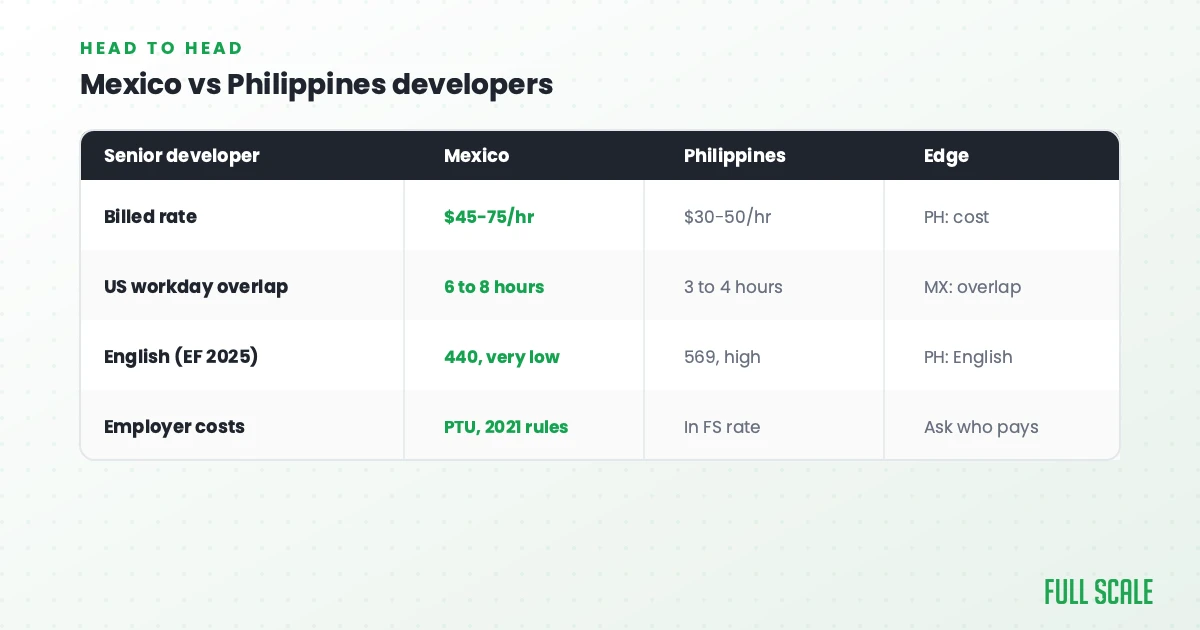
Full Scale's cost model puts a senior developer in the two countries about $15 to $25 an hour apart on market ranges, not quotes from any one vendor. Those ranges start from local salary data plus the 30 to 50 percent markup staffing firms add. Every figure below is for senior developers.
| What you're comparing | Mexico | Philippines |
|---|---|---|
| Senior developer pay, earned locally | $30-50/hr | $20-30/hr |
| Senior developer rate billed to a US company (market range) | $45-75/hr | $30-50/hr, and Full Scale starts at $35/hr fully loaded |
| Time zone | Mexico City runs UTC-6 all year, one hour behind US Central in summer | UTC+8, so Manila runs 13 to 14 hours past US Central |
| Overlap with a US team's workday | Roughly 6 to 8 hours | About 3 to 4 shared hours on the common half-day schedule, up to 4 to 8 when the schedule shifts, or a night shift that mirrors US hours |
| English on the 2025 EF English Proficiency Index (national average) | 440, very low band, 103rd | 569, high band, 28th |
| How the developer is employed | Depends on the structure: contractor, your own Mexican entity, or a registered specialized-services provider | Nearly all Full Scale engineers are Full Scale employees, and you direct the work |
| Retention evidence | No independent comparison found | Full Scale's own annual employee retention is 93%+ |
What Filipino developers earn locally is in our salary breakdown.
What the extra rate for nearshore Mexico buys you
It buys real-time overlap with a US working day, and for some teams that is worth every dollar. A developer in Mexico City works inside your team's workday, so pairing and on-call rotations happen without anyone planning around a gap. Our time zone guide has the overlap math by city.
Nearshore sounds like a place you could drive to for lunch.
The Philippines side has its own cost. The usual half-day schedule gives you about 3 to 4 shared hours, and anything more means a shifted schedule or a night shift, which Full Scale can staff but which is a real schedule change for that person. If you need all-day live coverage with nobody working nights, Mexico is the cleaner answer.
Don't read the rate gap as an instruction to hire the cheapest option. I call that cheapshoring. Paying for overlap you never use is the opposite mistake.
What a Mexico rate doesn't tell you about employer costs
Mexican law attaches employer costs to a hire, and whether they show up in a vendor's rate, on top of it, or in your own books depends on the structure you choose.
Profit sharing is the law
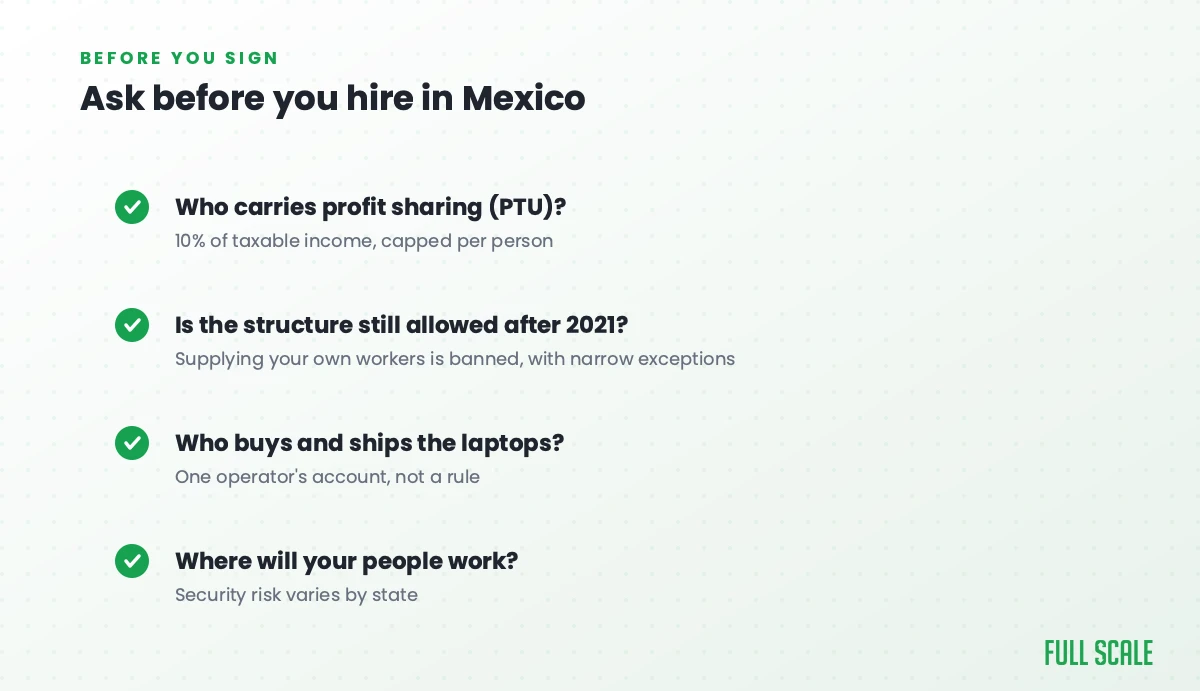
I'd heard that employers in Mexico have to share a percentage of profit with their employees. I checked, and it's true. Employers generally must distribute 10 percent of taxable income from the prior year to their employees through a payment called PTU (participación de los trabajadores en las utilidades). A company with no taxable income distributes nothing.
Since the 2021 labor reform, each person's share is capped at the higher of three months' salary or the average they received over the previous three years, and Mexico's Supreme Court upheld that cap in 2024. General administrators, managers and directors are excluded, and so are fixed-term employees who worked fewer than 60 days in the year.
Mexico also requires an aguinaldo, a year-end bonus of at least 15 days' pay due before December 20.
That isn't in anyone's quote.
Whether PTU falls on you depends on how the developer is employed.
The 2021 outsourcing reform changed staff augmentation
Mexico's April 2021 labor reform banned supplying your own workers to another company, with narrow exceptions. That is close to what staff augmentation does.
Only registered specialized services outsourcing survived. The client is jointly and severally liable if the provider fails its obligations to its own employees, per ECIJA's summary of the reform.
At Full Scale, nearly all engineers are our employees in the Philippines, and you direct the work. In Mexico, a provider that lends you its employees to direct is the arrangement the 2021 law targets, so the legal setup there gets more involved than a rate card suggests. The Philippines regulates this too, so ask any vendor, us included, how its structure complies with local law.
The agency I used was a specialized provider that did only DevOps. That hire predates the 2021 reform, so I can't tell you how it would be structured under today's rules.
People hire in Mexico through contractors, their own Mexican entities, employers of record, or registered specialized-service providers. Each one splits the employer obligations, PTU included, in its own way.
I'm not a lawyer, and none of this is legal advice. If you're hiring in Mexico, talk to a Mexican labor lawyer before you sign anything.
Buying computers was a project
People I know have run teams in Mexico. Buying computers there was hard enough that they nearly had to buy the parts and assemble the machines themselves.
Onboarding should not start with a parts list. That is what they ran into, and I can't tell you it holds for every company or every year.
Security is a real cost for some operators
Another person I talked to was always worried about security because of the cartels, and kept full-time security around the clock. That's their account, and I haven't verified it. Risk varies a lot by region. The US State Department's Mexico advisory is broken out state by state, so check where your people would actually work.
The best number I found comes from Arantza Alonso, a senior analyst at Verisk Maplecroft. She wrote in 2024 that around a third of member companies of the American Chamber of Commerce in Mexico were spending more than 5 percent of their annual operating budgets on security. That describes companies with physical operations. It says nothing about whether a remote software team needs guards, but the cost is real for some operators.
The Philippines has employer costs too
To keep this fair, the Philippines has its own mandatory employer costs. One is the 13th-month pay that private-sector employers owe their rank-and-file employees by December 24. For the engineers on our payroll, which is nearly all of them, those costs sit inside the fully loaded rate. That rate starts at $35 an hour, and our pricing page has the current numbers.
English scores favor the Philippines, and communication habits decide the rest
On the 2025 EF English Proficiency Index, the Philippines ranks 28th with a score of 569, in the high band, and Mexico ranks 103rd with 440, in the very low band. Those are national averages from people who chose to take EF's test, so they say little about any one developer. Treat the gap as a direction. Interview every candidate directly before you decide.
The Uruguay and Colombia developers I hired at Stackify were fine in English, and a national score would have told me nothing about them. I wrote up that experience in the Latin America vs Philippines comparison.
Communication habits, more than English scores, decide how a team works together. In the Philippines and much of Latin America, a "yes" in a meeting often means "I heard you" and not "I agree," and that habit needs managing in either country.
Where I see a Philippines advantage is shared US cultural context. SOTA Cloud's co-founder and CTO, Dustin Johnson, compared the Philippines with the other regions the company could have hired from:
The Philippines is great because the cultural similarity between folks in the United States and the Philippines is very strong relative to other regions that we could be getting talent from.
Dustin Johnson, Co-Founder and CTO of SOTA Cloud, on working with Full Scale
At Full Scale the developer works directly with your team and takes direction from you. That comes from my book, Product Driven.
Retention: what you can prove
I couldn't find an independent source comparing developer retention in Mexico and the Philippines, so country-level retention claims are vendor assertions. That includes claims from vendors like us.
The one sourced attrition figure I know of for the Philippines covers the business process outsourcing (BPO) industry, mostly call centers. It says little about software teams, so I won't use it for developers.
The number I can stand behind is our own. Full Scale's annual employee retention is 93%+, and it describes our developers, not the Philippines as a country. When any vendor quotes you a retention figure, ask what it measures and over what period, because vendors count it differently.
I'd take a vendor who admits the comparison doesn't exist over one who hands you a confident percentage.
When Mexico wins and when the Philippines wins
I'd pick Mexico when the work has to happen live inside the US day, and the Philippines when I'm building a team that will keep growing and cost matters. Full Scale places developers in the Philippines, so weigh that pick accordingly. Here is how the cases break down.
| Your situation | Better fit | Why |
|---|---|---|
| Pairing sessions and on-call rotations have to run inside the US workday, with no night shift | Mexico | Mexico City runs UTC-6 all year, so most of a US workday overlaps |
| Your engineers and your customers both need to be reachable in person or in Spanish | Mexico | A short flight and a shared language make site visits and customer calls easier |
| You expect the team to keep growing and cost matters | Philippines with Full Scale | Market rates run $30 to $50 an hour against $45 to $75 in Mexico, and Full Scale starts at $35 an hour fully loaded |
| You want employer costs inside one rate | Philippines with Full Scale | For the engineers on Full Scale's payroll, which is nearly all of them, employer costs sit inside the fully loaded rate |
| You'd rather not manage Mexican labor-law structures | Philippines with Full Scale | Nearly all Full Scale engineers are our employees, so you direct the work without setting up an entity |
If you want to price a Philippines team against a Mexican quote, we'll walk through the rate on a call. You can read how we hire developers in the Philippines first if you'd like.
Full Scale has a two-week money-back guarantee, and you can cancel with 30 days' notice and no long-term contract. A developer can start in as little as 7 days.
Frequently asked questions
Is it cheaper to hire developers in Mexico or the Philippines?
Hiring senior developers in the Philippines costs less per hour. Market ranges put a senior Mexican developer at roughly $45 to $75 an hour billed to a US company, against $30 to $50 in the Philippines, where Full Scale starts at $35 an hour fully loaded. Mexican employment law can also add costs, such as mandatory profit sharing, depending on how the developer is employed.
Is Mexico or the Philippines better for US time zone overlap?
Mexico gives a US team more shared hours. Mexico City stays on UTC-6 all year, one hour behind US Central in summer. Manila runs 13 to 14 hours past US Central, so Full Scale builds overlap with a half-day schedule of about 3 to 4 shared hours or a night shift that mirrors US hours.
How does English in Mexico compare with the Philippines?
The Philippines scores higher on English. On the 2025 EF English Proficiency Index, the Philippines ranks 28th with 569, in the high band, and Mexico ranks 103rd with 440, in the very low band. These are national averages, not developer scores, so interview every candidate directly.
Can you still outsource software development to Mexico after the 2021 reform?
Mexican law still allows registered specialized services, but the 2021 reform changed how outsourcing software development to Mexico works. It banned companies from supplying their own workers to another company, with narrow exceptions, and the client is jointly liable if the provider fails its employees. Talk to a Mexican labor lawyer before you pick a structure.
What does profit sharing mean when you hire developers in Mexico?
Employers in Mexico generally must distribute 10 percent of the prior year's taxable income to employees through a payment called PTU. Each person's share is capped at the higher of three months' salary or their three-year average. Whether PTU falls on your company depends on how you employ the developer, so confirm that structure first.
Is nearshore always better than offshore for software development?
Nearshore is not always better. It buys time zone overlap and short travel at a higher hourly rate, while offshore buys a lower rate with fewer shared hours. The offshore vs nearshore comparison walks through which one fits which kind of team.