Offshoring Pros and Cons: 10 Real Benefits and 6 Honest Downsides

In this article
- What offshoring actually is
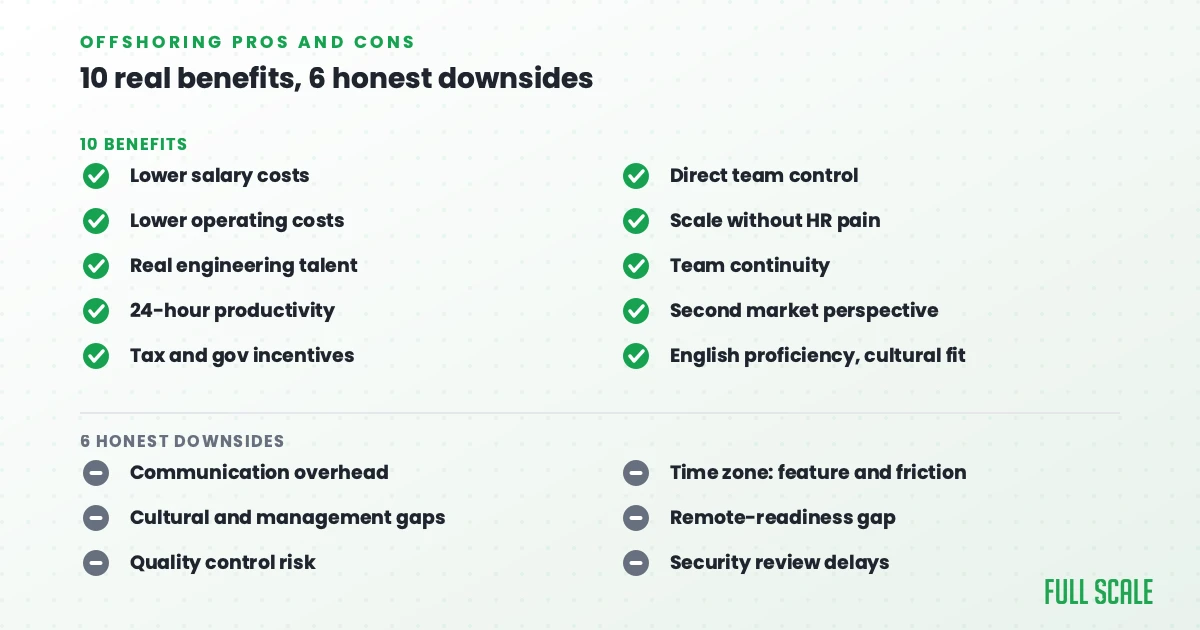
- The 10 real benefits of offshoring
- 1. Lower salary costs (and the math is not subtle)
- 2. Lower operating costs across the board
- 3. Access to real software engineering talent
- 4. Real 24-hour productivity, when you set it up right
- 5. Tax and government incentives
- 6. Direct control over your team (the part that makes offshore actually work)
- 7. Scalability without HR pain
- 8. Team continuity (the part nobody tells you about)
- 9. A second market perspective baked into your team
- 10. English proficiency and Western cultural fit
- The honest disadvantages of offshoring
- When offshoring isn’t the right call
- Frequently asked questions about the benefits of offshoring
- How to actually get started
I’ve been offshoring engineering work for more than 20 years, not as an analyst or a consultant but as the founder and CTO who hired the developers, ran the teams, and lived with the results. One of those results: offshore security comes down to how a partner hires, not where the work happens. These advantages stand out against the 2026 developer hiring landscape.
At VinSolutions, the SaaS company I co-founded in 2003, we used offshore developers because we couldn’t ship product on time on US salaries. AutoTrader.com later acquired it for around $150 million. At Stackify, the APM company I founded in 2012, I built a Philippines engineering team of 20+ developers. That team survived two acquisitions, Netreo in 2021 and BMC in 2024, without a single developer leaving. That experience is also why I started Full Scale in 2018, to give other founders the same model that worked for me. Most of those founders are hiring offshore web developers to build web apps they will run for years.
So when I write about the benefits of offshoring, I’m not summarizing somebody else’s framework. These are the 10 advantages I’ve actually used to build, sell, and grow companies.
These advantages did not exist for most of offshoring’s history. The history of offshoring covers how the factory model that worked for manufacturing broke when people first tried to apply it to software.
I’m also going to be honest about the 4 real downsides. The pros-and-cons articles that pretend offshoring is risk-free are the ones that get founders burned.
If you want the broader frame for how offshore developers fit into a high-functioning engineering org, that’s what my book Product Driven covers in depth.
What offshoring actually is
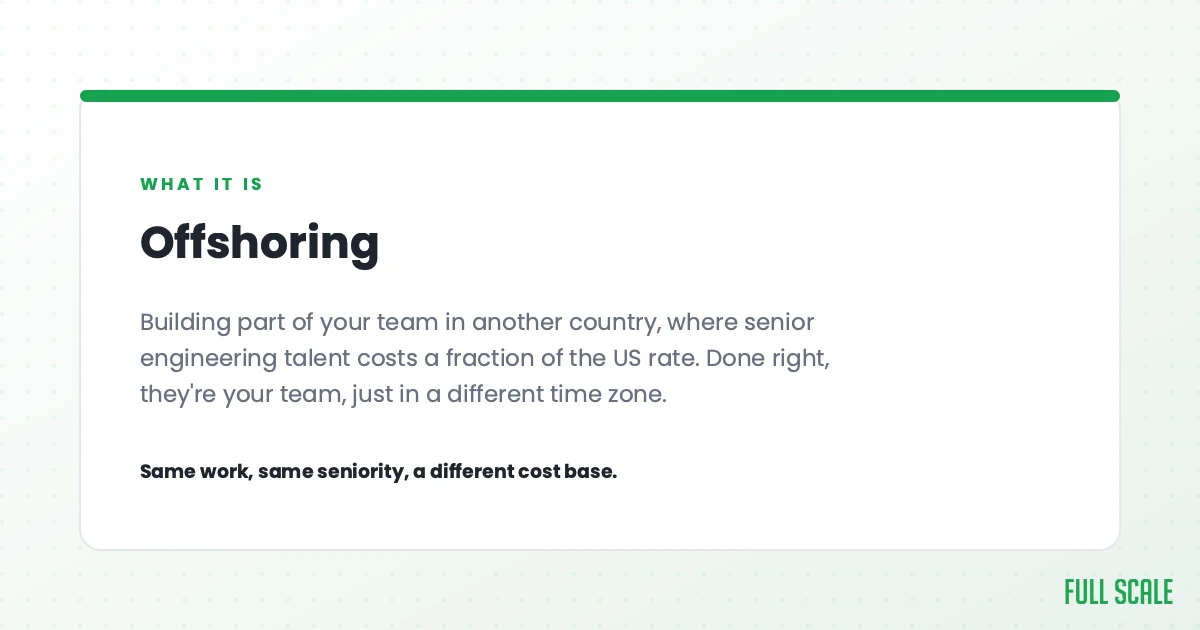
Offshoring means moving part of your work to a team in another country, while keeping ownership and direction in-house. It’s not the same as outsourcing, where you hand a project off to a vendor and hope it comes back right. With offshoring done well, the developers are your team. They take direction from your tech leads, work in your codebase, and follow your roadmap. They just happen to live somewhere else.
For software specifically, the most common destinations are the Philippines, India, Eastern Europe, and Latin America. The benefits of offshoring below apply across all of them, with some Philippines-specific notes where the data differs.
The 10 real benefits of offshoring
1. Lower salary costs (and the math is not subtle)
This is the obvious one. Every offshoring article leads with it, so I’ll get it out of the way.
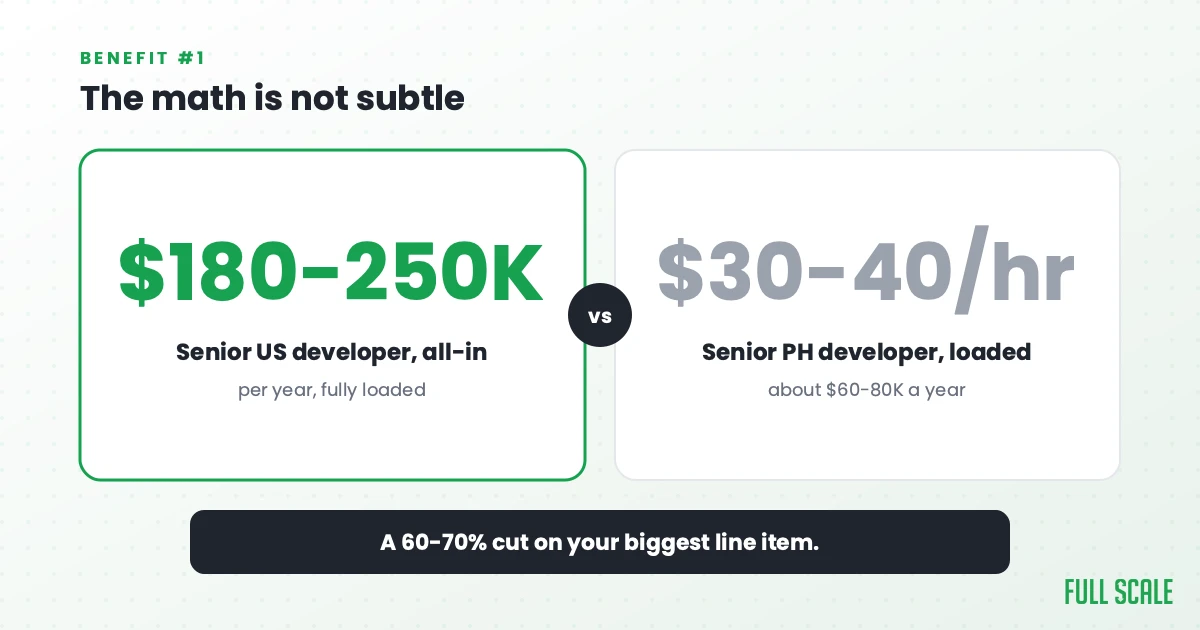
A senior US software developer costs $180,000 to $250,000 all-in when you add base salary, benefits, payroll taxes, equipment, office space, and recruiter fees. A senior developer in the Philippines doing the same work costs you $30 to $40 per hour fully loaded. That’s roughly $60,000 to $80,000 a year for a full-time developer. For founders building without outside funding, that gap decides how big a team the budget can carry.
That’s a 60% to 70% reduction on the single biggest line item in any software company.
The savings don’t come from paying developers less than they’re worth. We pay at the top of the local market, and it’s still a fraction of a US salary because of the cost of living gap and the strong dollar against the Philippine peso. Running an office in Cebu also costs a fraction of what the same office costs in San Francisco.
2. Lower operating costs across the board
Salary is the headline, but running an office in the US adds another 30% to 40% on top of every salary line.
Office space in a tier-one tech city, equipment, and US-quality healthcare benefits all carry a premium you can’t negotiate away. Payroll tax is its own line item, and managing state-by-state employment law becomes a job by itself once you’re hiring across several US states.
When you offshore through a partner like Full Scale, all of that overhead becomes our problem, not yours. We cover the office, the equipment, payroll, benefits, and Philippine labor compliance. You pay one hourly rate per developer, and the developer shows up ready to work.
3. Access to real software engineering talent
US engineering hiring has not gotten easier. I’ve hired developers in Kansas City, San Francisco, Austin, and Manila over the last 20 years. The US side has gotten harder every year.
Three to six months from job posting to a signed offer is normal. The offer often lands around 20% above what you budgeted. And plenty of candidates take a counter from their current boss, which leaves you starting over. US hiring has worked like this for years.
The Philippines produces hundreds of thousands of college graduates each year, with strong programs in computer science, engineering, and IT. The country is also the third-largest English-speaking nation in the world, per the Philippine Embassy in DC. English is the language of instruction for technical fields. The talent supply exceeds local demand. You can hire well-qualified senior engineers without competing with the same 200 companies in the same 5 zip codes.
4. Real 24-hour productivity, when you set it up right
The US-to-Philippines time difference is 12 to 13 hours. People hear that and assume it means no communication is possible. The reality is more useful.
There’s a 3 to 4 hour overlap window every weekday, when US morning is Philippines late afternoon. That’s enough time for daily standups, code reviews, planning sessions, and any synchronous discussion the team needs. The rest of the day, the Philippines team works heads-down on the tickets and pull requests they got during overlap, and the US team sleeps.
Done right, this means code gets written while your US team is asleep and reviewed while the Philippines team is asleep. The product keeps moving while one half of the team is always awake.
5. Tax and government incentives
The Philippines runs special economic zones through the Philippine Economic Zone Authority (PEZA). These zones grant tax holidays and a reduced corporate income tax rate to registered offshore providers. Full Scale and other providers operate inside these zones, and that’s part of why the hourly rates work the way they do.
You don’t see the tax break on your invoice. You see it in the rate, because providers inside PEZA zones pass those savings through, and that’s a big piece of what makes the offshore math add up.
6. Direct control over your team (the part that makes offshore actually work)
This is the most important benefit on the list, and the one most offshoring articles get wrong.
There are two different ways to use developers in another country, and the difference between them is what determines whether the whole thing works.
Project outsourcing means you hand a spec to a vendor and they deliver finished software some months later. The vendor controls the team, the priorities, the codebase, and the timeline. You usually get what you paid for, which is often not what you wanted. Most of the offshore horror stories you’ve heard are project outsourcing stories.
Staff augmentation (also called offshoring or outstaffing) means the developers are dedicated to you, take direction from your tech leads, and integrate with your team. They show up in your standups, push code to your repo, and follow your roadmap. The only difference between them and an in-house developer is geography.
Staff augmentation is the version that actually works, and project outsourcing is the version that usually doesn’t. The outstaffing model we use at Full Scale is the staff-augmentation version. It’s the same model I used at Stackify, the one that let the Philippines team transfer cleanly through two acquisitions without losing a single developer.
7. Scalability without HR pain
Growing a US engineering team is months of work per hire. You’re paying recruiter retainers, sourcing candidates, and running four-stage interview loops. Then you negotiate the offer and wait out two weeks of notice before the new hire even starts ramping up.
Growing an offshore team through a provider is weeks of work per hire. You tell the provider what role you need. They put 3 to 5 vetted candidates in front of you. You interview the ones you like, say yes, and the developer starts inside two weeks.
Shrinking is even cleaner. If a project ends and you don’t need the seat, you tell the provider and give the contractual notice. The developer goes back to the bench. There’s no severance and no drawn-out HR process to manage. You spend the time you used to lose to hiring and firing on actually shipping product.
When I scaled Stackify from 3 Philippines developers to 20 over the course of 18 months, that was the model that made it possible.
8. Team continuity (the part nobody tells you about)
The conventional wisdom is that offshore teams have terrible retention, that you’re constantly retraining and the productivity benefits disappear under the churn.
That’s true at bad offshore shops, but it isn’t the rule.
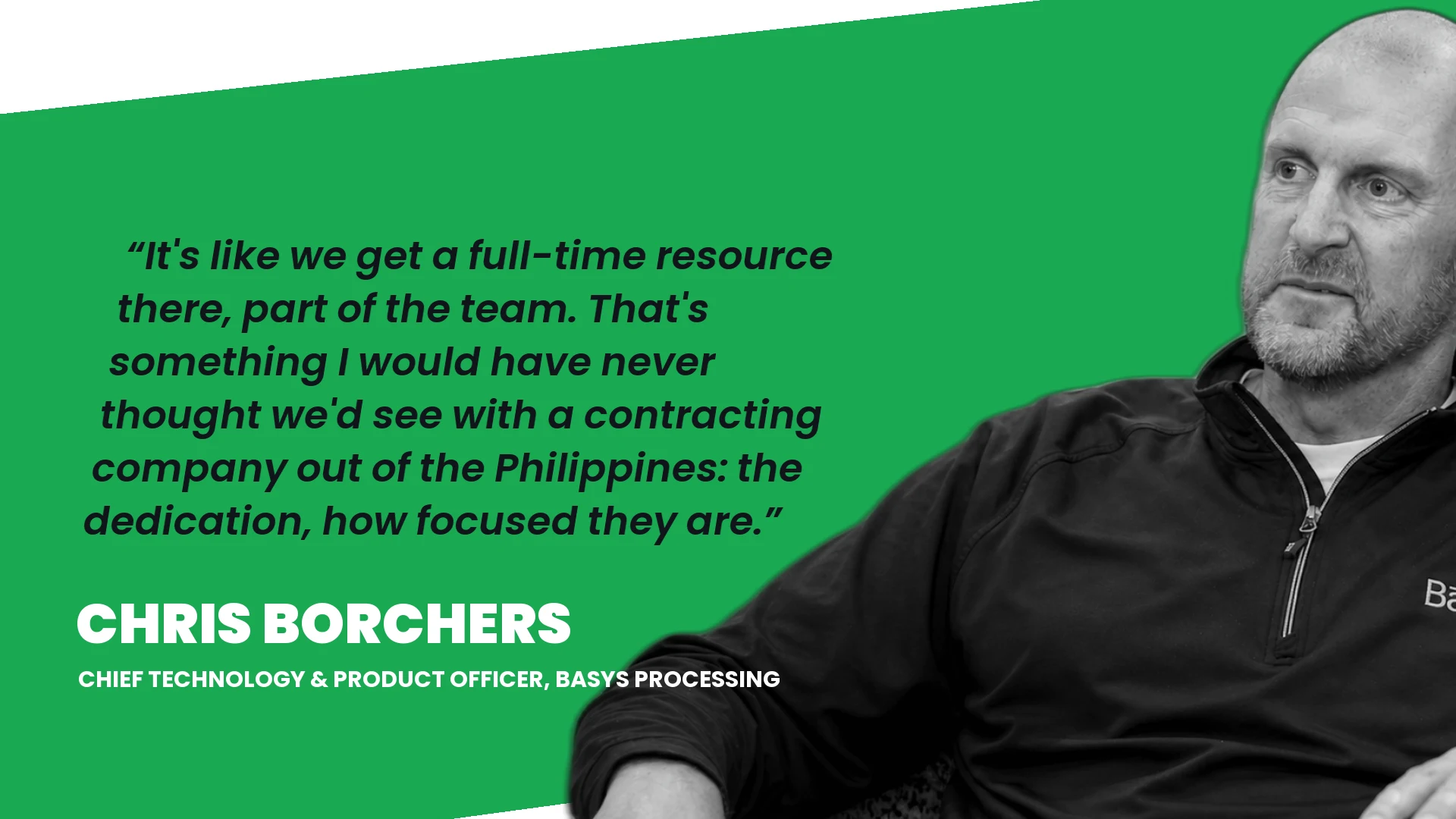
At a well-run offshore provider, pay and benefits are competitive for the local market. The work is engaging, and the in-house team treats them as full members. Retention is actually better than US tech, where engineers move every two years for a 15% bump. US tech turnover runs in the low double digits a year, and ours stays well below that.
The Stackify story is the proof. I built that Philippines team up to 20+ developers. When Stackify sold to Netreo in 2021, the whole team came along, and when Netreo sold to BMC in 2024, the same developers transferred again. The same 20+ engineers stayed together through three parent companies and two acquisitions without losing a single person. That’s what getting the team structure right buys you.
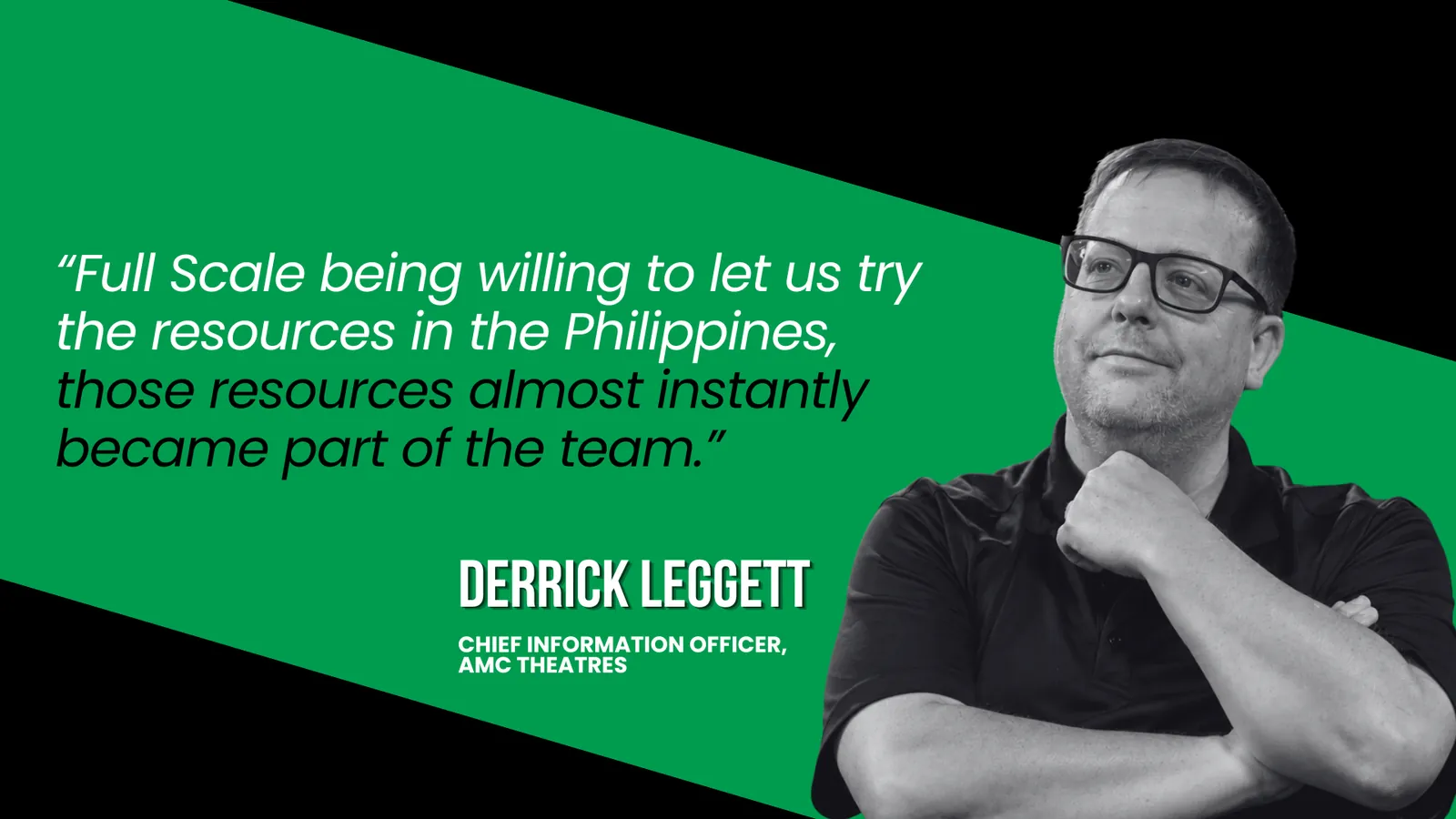
Full Scale’s biggest client, AMC Theatres, has been running the same model with us for years across their .NET stack. Continuity like that is what makes the rest of the math hold up.
9. A second market perspective baked into your team
This benefit is easy to overlook. When your engineers live and work in another country, you get a free read on that market. You learn its users and how software gets built and bought there, without paying for separate research.
For some products that’s the real return. If you sell into Southeast Asia, or your users skew toward emerging markets, a Philippines team gives you on-the-ground perspective a US-only team can’t fake. Even for a purely US-facing product, this helps. Engineers who think differently about cost and connectivity catch assumptions your US team never thought to question.
10. English proficiency and Western cultural fit
This is the Philippines-specific benefit, and it’s the one that puts the country near the top of the list against other offshore destinations.
The Philippines ranks 28th globally on the EF English Proficiency Index. That puts it inside EF’s “high proficiency” band, well above the global average, and among the strongest English-speaking countries in Asia. English is the language of instruction in Philippine universities for technical degrees. A Filipino developer can handle a Slack thread, a code review, or a video standup without the friction you hit across much of the offshore world.
Cultural fit matters as much as language. Four hundred years of Spanish and American influence shaped the Philippines. Its business and communication norms line up closely with how American product teams already work. That cultural overlap is the part competitors in other offshore destinations struggle to replicate.
The honest disadvantages of offshoring
I’m not going to pretend there are no downsides. There are 6 real ones, and the founders who get into trouble are the ones who skip this section. Each of these is a risk you can plan for, which is different from a reason not to do it.
1. Communication overhead is real
Even with great English proficiency and a good overlap window, you have less spontaneous communication with an offshore team than with people sitting two desks over. You’ll lean harder on written documentation, recorded video, and deliberate async process than you would with a team down the hall. That’s a real cost, and it doesn’t go to zero with experience.
The fix is to lean into async. Teams that already run remote-first have mostly paid this cost, and for everyone else it’s the first thing they feel.
2. Cultural and management differences
Filipino professional culture is more reserved than American culture in some specific ways. Direct disagreement with a boss is less common, and bad news tends to travel slower. Picture the American manager who runs a US team by saying “tell me what’s broken” and expecting raw honesty. That style has to change to get the same information from a Philippines team.
This isn’t a flaw in either culture. It’s a fact, and the fix is to ask better questions and create lower-stakes ways for the offshore team to flag problems.
3. Quality control if you pick the wrong model
I separated the staff-augmentation model from the project-outsourcing model in benefit #6 because the difference is everything. Pick the wrong model and you’ll have quality problems, and you’ll blame the geography when the actual problem is the model. The data on why offshore projects fail mostly traces back to project outsourcing, not offshoring as a category.
4. The time zone is a feature and a friction
The same time gap that gives you 24-hour productivity also costs you quick back-and-forth. If your US tech lead has a question at 3pm Eastern, the Philippines team is asleep. The team can answer it when they wake up, which is fine for most things and frustrating for the ones that aren’t.
The fix is overlap discipline: anything synchronous gets scheduled inside the overlap window, and everything else runs async.
5. Your company may not be ready to work remotely
Offshoring is a remote-work problem before it’s an offshore problem. If your decisions get made in hallways and the real spec lives in somebody’s head, a developer eight time zones away can’t participate. Neither can your own remote hires, and they mostly quit instead of saying so. When a founder tells me he likes being able to tap people on the shoulder, I know the first month is going to be bumpy, and I also know it would be bumpy with a team in Denver.
The fix is written decisions, recorded demos, a backlog with real acceptance criteria, and three to four hours of honest overlap. That’s the whole list, and it’s the same list that makes an in-house team better. More on why this is the actual prerequisite in our breakdown of offshore development challenges.
6. System access and security reviews take longer than you budgeted
Two things slow down a start, and neither one is the ocean. The first is your own IT department, which usually has no process for giving a real account to somebody who isn’t on payroll, so the single sign-on ticket sits in a security queue while the developers wait. The second is the compliance conversation, which is real if you’re under HIPAA, SOC 2, or GDPR, and which turns out to be an exercise in controls and contracts rather than geography.
Both are solvable, and both eat a couple of weeks you didn’t plan for. Start provisioning before the contract is signed, and read the offshore IP protection framework before your legal team writes the objection for you. The thing to avoid is the workaround people invent while they wait, because a shared login is a worse security story than the offshore developer ever was.
When offshoring isn’t the right call
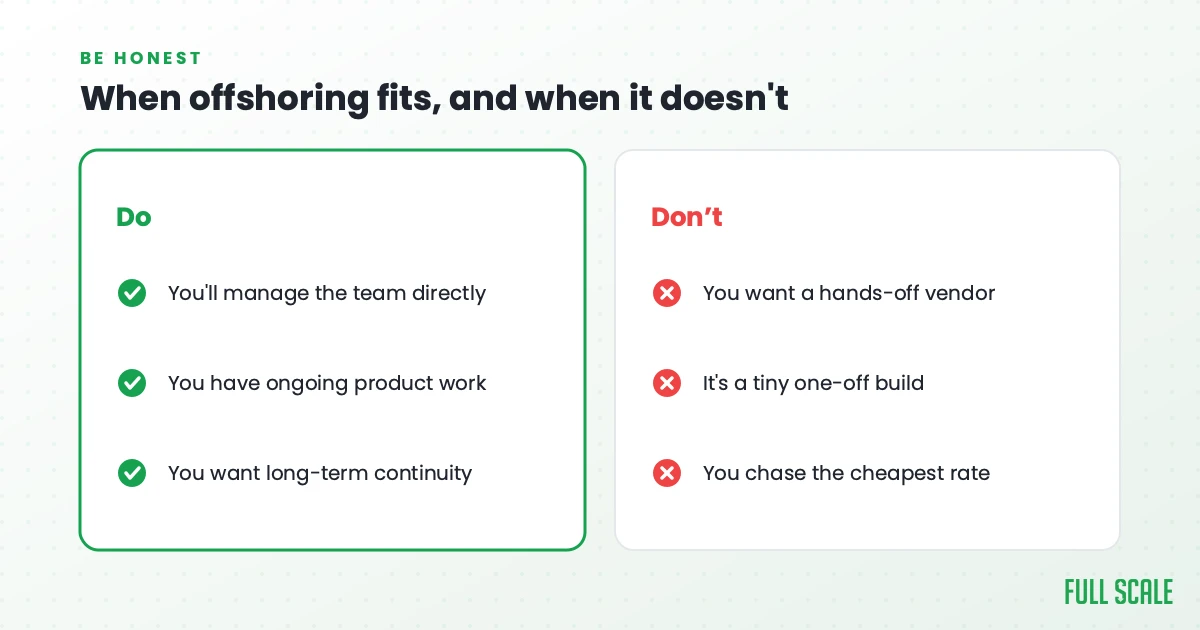
Three situations where I’d talk a founder out of going offshore in the first round:
- You need a team of one or two. Offshore math works best at four engineers and up. Below that, the management overhead eats the savings.
- You’re doing greenfield R&D with a small product team that needs to iterate in the same room every day. Wait until the product has a stable shape, then add offshore for build-out.
- You’re in a highly regulated industry where data residency or specific clearances require US-based engineers. Some defense, finance, and healthcare work falls here, though not all of it does.
For everything else, the model works. I’ve used it for 20 years across four companies. Plenty of other well-known companies run the same model, from big tech platforms to lean startups.
Frequently asked questions about the benefits of offshoring
What are the main benefits of offshoring software development?
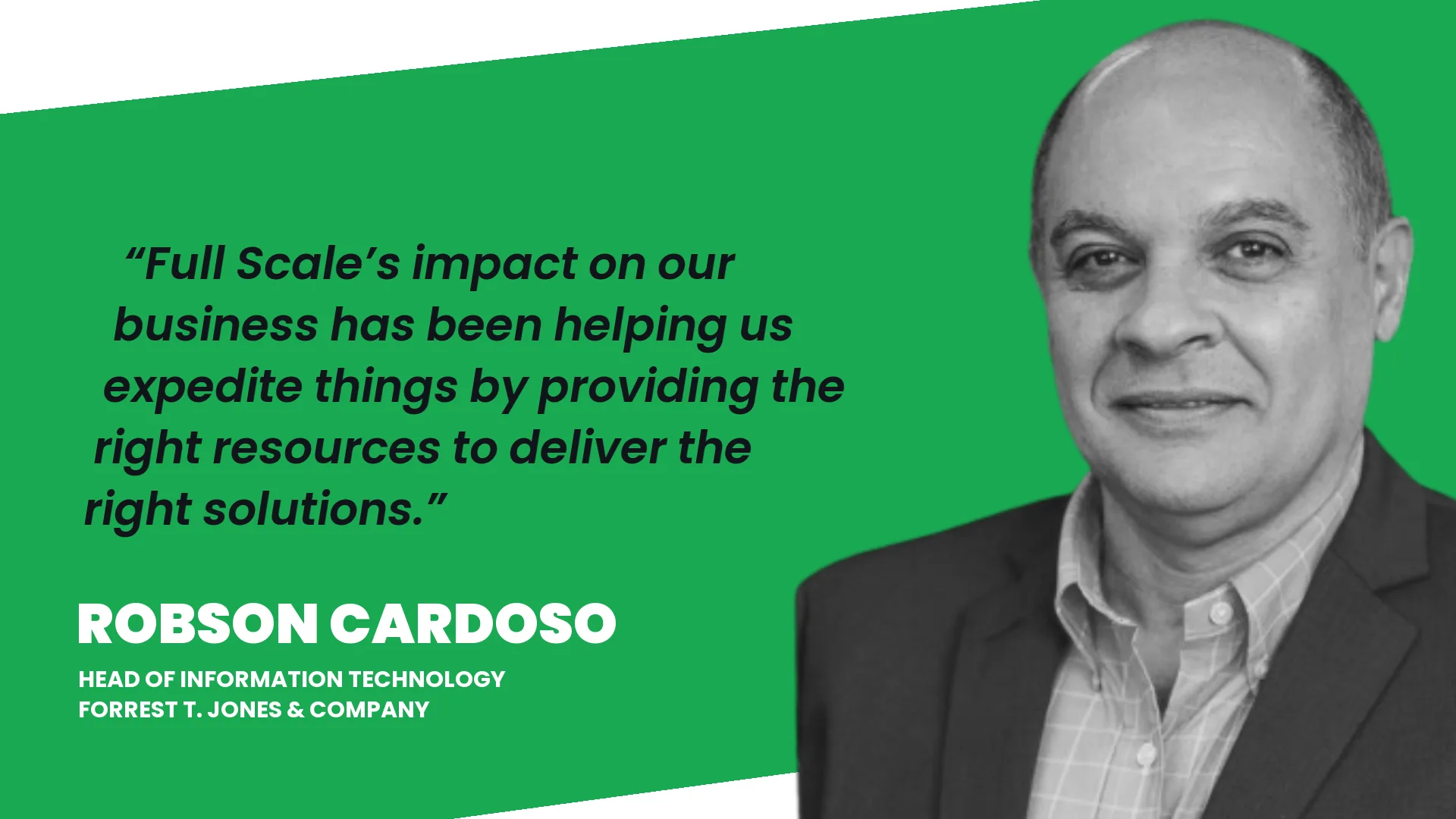
The biggest benefits of offshoring are lower salary and operating costs, access to deep senior talent, near 24-hour productivity, and easier scaling. You also get strong long-term retention, as long as you run it as staff augmentation rather than project outsourcing. That’s the staff-augmentation model Full Scale runs, and it’s why those benefits hold up past the first year, a pattern outside research on offshore developer productivity backs up independently.
Is offshoring the same as outsourcing?
No. With outsourcing you hand a project to a vendor who controls the team and delivers a finished product. With offshoring done as staff augmentation, the developers are your team. They take direction from your tech leads, work in your codebase, and follow your roadmap. That control difference is what separates the success stories from the horror stories.
How much can you save by offshoring developers to the Philippines?
A senior US developer costs roughly $180,000 to $250,000 all-in. A senior Philippines developer doing the same work runs about $30 to $40 per hour fully loaded, or $60,000 to $80,000 a year. That’s a 60% to 70% cut on the largest line item most software companies carry.
What are the disadvantages of offshoring?
There are six real disadvantages and risks: communication overhead, cultural and management differences, quality problems if you pick project outsourcing instead of staff augmentation, a time-zone gap that costs you quick back-and-forth, a company that has never run anybody remotely, and the weeks that system access and security review quietly consume. Each is manageable, but only if you plan for it instead of pretending it isn’t there.
Why is the Philippines a top destination for offshoring?
The Philippines offers a large pool of English-speaking engineering graduates and high English proficiency. Its business norms, shaped by long American influence, make Filipino developers easy for US product teams to work with directly. Government tax incentives through PEZA also help providers keep hourly rates competitive.
What are the benefits of offshore software development specifically?
For software teams specifically, the benefits above compound: lower cost per engineer, access to senior talent that’s hard to hire in the US, and near round-the-clock progress when the overlap window is used for standups and reviews. The extra benefit unique to software is code continuity: the same engineers stay on your codebase for years instead of rotating through a project vendor, which is the model Full Scale runs as staff augmentation rather than project outsourcing.
How to actually get started
If you’ve gotten this far and the math makes sense for your situation, the next question is which provider to work with. The due diligence checklist for picking an offshore partner is its own post. The short version is simple. Pick a provider that puts dedicated developers on your team, not a project shop. Make sure they work in your time zone with a real overlap window. And insist on interviewing every candidate before they start.
That’s what we do at Full Scale. We’ve been on the Inc. 5000 list five years in a row, and we run a Philippines engineering operation of more than 350 developers offering offshore software development services. The model we use is the one I built at Stackify, because it’s the one I needed to exist.
If the benefits of offshoring line up with where your company is headed, the next step is a conversation, not a contract. Schedule a call with Full Scale, and we can usually have qualified Philippines developers in front of you inside a week.