Offshore Software Testing Explained: Models, Risks, and How to Choose

In this article
- Why QA became the bottleneck
- Offshore QA is an affordable way to scale
- The models: how offshore software testing works
- The time-zone advantage
- Offshore or nearshore for QA?
- Manual QA still matters, and it matters more now
- Automated testing done right, and the AI bloat trap
- So why not just use AI to do the QA?
- The risks, and how offshore QA handles them
- How to choose an offshore software testing partner
- Frequently asked questions
Quick answer: Offshore software testing is hiring QA engineers in another country to test your software, usually as part of your own team rather than a separate vendor. It can cut testing costs by 50% to 80%, and software testing in the Philippines gives you strong English, a communication culture that surfaces problems instead of hiding them, a deep QA talent pool, and a time-zone gap that works in your favor. Done well, it’s an affordable way to add testing capacity in a moment when QA has become the real bottleneck in shipping software. Wherever your testers sit, it only works with a clear risk-based testing strategy behind it. It helps to understand where software testing is headed as AI changes how much code actually needs verifying. It also reshaped what a QA engineer actually does now.
Software is getting written faster than at any point in my career. AI writes a first draft of almost everything now, and developers are shipping a flood of code they never could have typed themselves.
That speed moved the bottleneck. It used to be writing the code. Now the hard part is checking that all of it actually works.
Quality assurance has quietly become the constraint on how fast you can ship. You can generate features faster than ever, but somebody still has to decide whether each one does what the customer needs, and that judgment hasn’t gotten any cheaper or any faster.
This is why I keep telling engineering leaders to take offshore software testing seriously, not as a way to cut corners but as an affordable way to add the testing capacity the AI era demands. I’m Matt Watson), founder and CEO of Full Scale, and I’ve spent 20 years building software companies and the offshore teams that test them. Here’s how offshore QA actually works, where it goes wrong, and how to pick a partner who clears your bottleneck instead of adding to it. That capacity matters most on the changes that carry the most risk, where a single bug can do real damage.
Why QA became the bottleneck
The slow step used to be building. You waited on developers, and testing was something you squeezed in at the end if there was time. AI flipped that. When a developer is shipping two or three times the code they used to, the volume of new behavior that needs checking goes up just as fast, and the human attention on each line goes down.
All that extra code is just more surface area for things to break, and someone has to look at it with real judgment and decide whether it’s right. There aren’t enough of those people to go around. Google’s 2025 DORA report landed on the same conclusion: AI’s primary role is as an amplifier, magnifying the strengths and weaknesses an organization already has. If your testing capacity is thin, AI makes it thinner.
It’s not a tooling problem you can solve by buying another scanner. It’s a capacity problem: you need more skilled testing eyes on a growing pile of work, and you need them without blowing up your budget.
Offshore QA is an affordable way to scale
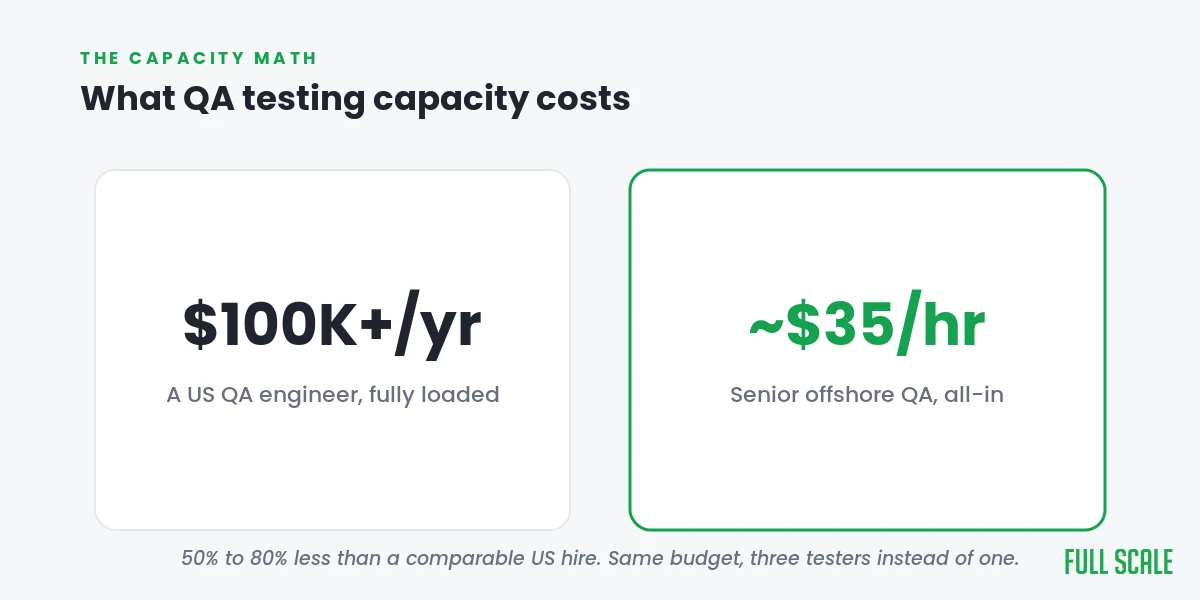
Here’s the part most leaders underrate. A strong QA engineer in the US runs well past six figures fully loaded. The Bureau of Labor Statistics puts median pay for the occupation at over $100,000 a year before you add benefits and overhead, and those people are hard to find. Hiring two or three of them to keep up with your new shipping speed isn’t realistic for most teams.
Senior offshore QA engineers cost a fraction of that. Our rates run around $35 an hour, all in, which is 50% to 80% less than a comparable US hire.
Offshore QA is the most affordable way to add real testing capacity, which makes it the most practical way to clear the bottleneck. For the same budget, you’re choosing between one tester and three.
One thing to be clear about: affordable isn’t the same as cheap. The goal is senior testers in a lower-cost market, not the lowest bidder you can find. Chasing the cheapest possible tester is a mistake I call cheapshoring, and it produces exactly the offshore horror stories that scare people off the model.
The models: how offshore software testing works
When people picture offshore testing, they picture a vendor on the other side of a wall. You hand over a build, you wait, and you get back a report from someone you never talk to. That model exists, and it’s the one that disappoints people.
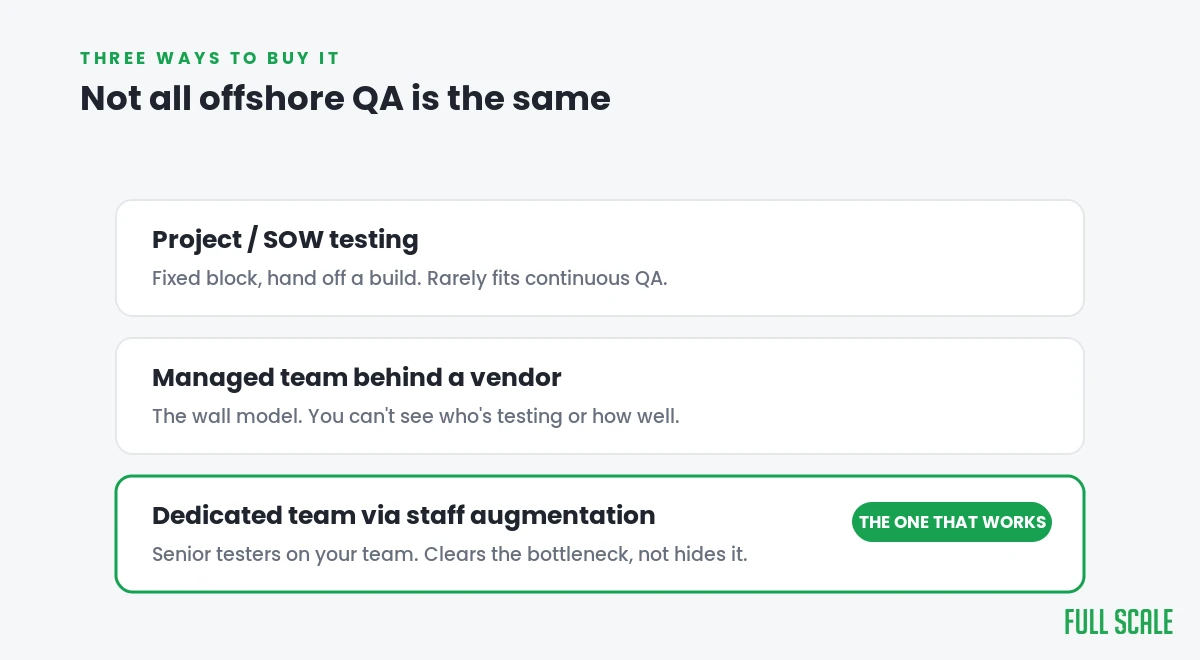
There are really three ways to buy offshore QA, and they’re not equally good.
Project-based, or SOW, testing
You scope a fixed block of work with a start and end date, hand over a build, and get results back. It’s fine for a one-time push like a pre-launch pass, but quality is continuous. You don’t need testing for one week and then never again, so this rarely fits how QA actually works.
A managed QA team behind a vendor
You pay a firm to run testing and talk to an account manager instead of the testers. This is the wall model. It feels hands-off, which sounds good until you realize you can’t see who’s doing the work or how well.
A dedicated team through staff augmentation
You add senior offshore testers to your own team for the long term through staff augmentation, and the work gets better the longer the same testers know your product, your edge cases, and your release process. This is the model that clears a QA bottleneck instead of hiding it, and it’s the one we run.
What makes the dedicated model work
That third model is the one worth setting up right, and two things decide whether it works.
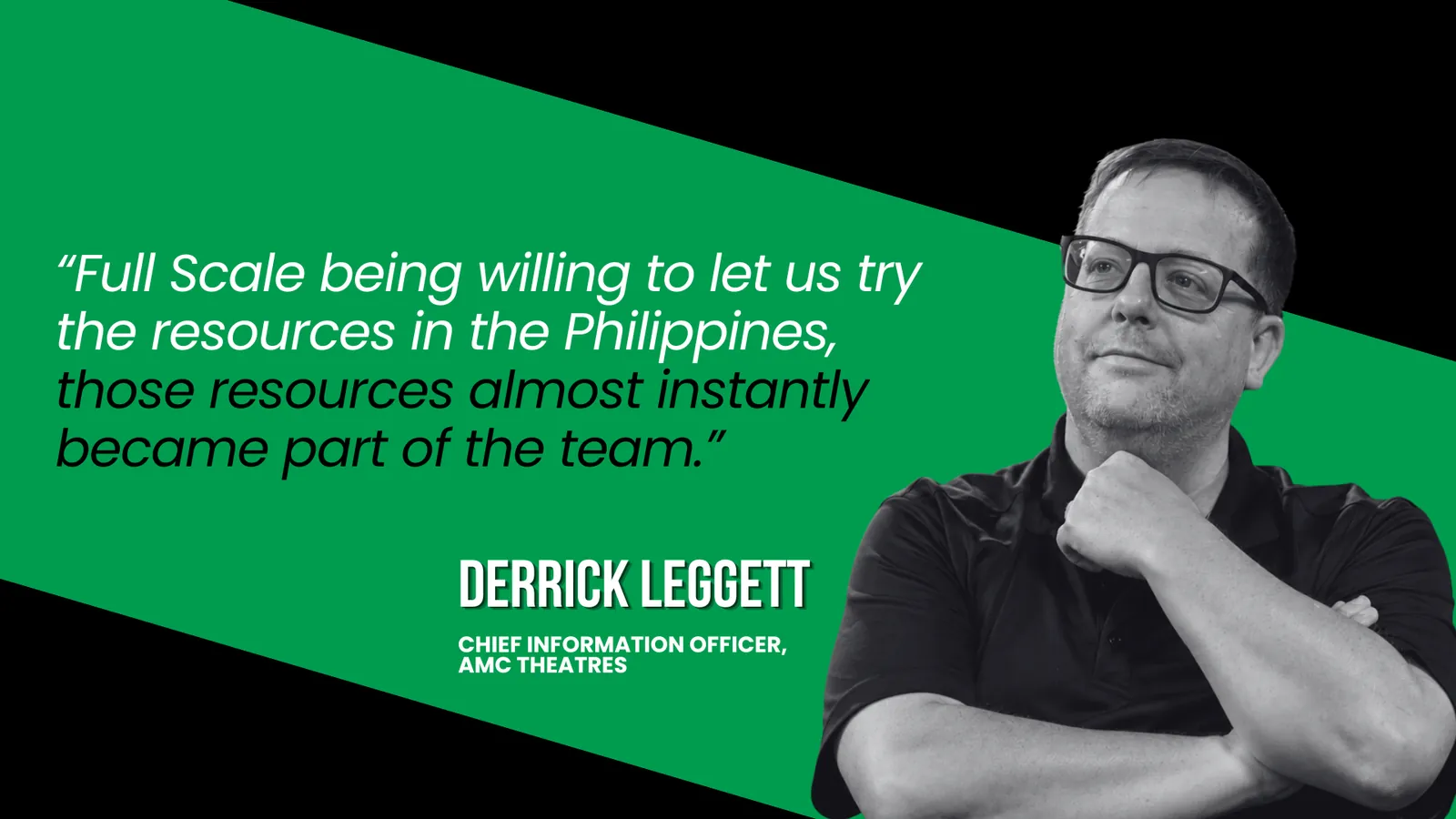
Treat the testers as your team, not a separate group. They join your standups, work in your Jira, learn your product, and report to your engineering lead, exactly like an in-house hire would. The only difference is where they sit. AMC Theatres runs its Full Scale engineers in the Philippines as full members of the team, and their CIO Derrick Leggett puts it plainly:
It’s a fully integrated team. It’s just some of the people happen to be living in the Philippines.
Hire through a partner, not a random freelancer. You can pull one freelance tester off a marketplace, or you can work with a partner that recruits, vets, employs, and backs up the people on your team. The freelancer is one person juggling other clients with nobody behind them, and when they disappear your product knowledge walks out with them. A partner screens for seniority, handles the employment and retention, and can replace or scale the team without you starting over. For something as continuous as QA, that durability is the whole point.
Within that model you can staff manual testers, automation engineers, or both, depending on where your bottleneck actually is. You’re adding the specific testing capacity you’re short on.
The time-zone advantage
One of the reasons I built my own team in the Philippines in the first place was this exact dynamic. The roughly 13-hour gap meant I could hand off work before I went to bed and wake up to a QA team’s results the next morning. Done right, it let us run something close to a 24-hour cycle, and depending on how your team works, you can structure the same thing.
The time difference sounds like a problem until you use it on purpose. There are about 14 hours between the Philippines and the central US, and if you want, that gap becomes a second shift.
Your developers finish their day and hand off, your QA team tests overnight, and you wake up to a list of results every morning. Bugs get found and written up while your engineers sleep, so the fixes are ready to start the moment they log on. Even the overnight setups keep a short daily overlap for standup, so a blocked tester isn’t waiting a full day for an answer.
This isn’t required. Plenty of clients run their offshore QA on overlapping hours instead, and most find a half-day of overlap is plenty. But if you want a near-continuous build-and-test loop, the time zone gives you one for free.
Either way, the schedule is only as good as the judgment of the testers working it, and that judgment is the next thing to get right.
Offshore or nearshore for QA?
If you’re weighing the Philippines against a nearshore option in Latin America, the honest answer is that offshore and nearshore aren’t really that different for QA. It mostly comes down to time-zone overlap, and that gap is smaller than it looks: our engineers in the Philippines shift their hours to overlap with the US workday, so you get real-time overlap either way. That shrinks most of nearshore’s supposed advantage. On the two variables that are left, the Philippines usually wins. It’s typically cheaper than Latin America, and the English is often stronger. The overnight second shift is a bonus you simply can’t get from a same-time-zone team.
Manual QA still matters, and it matters more now
There’s a temptation to think automation and AI make manual testing obsolete. The opposite is true.
The scarce skill in the AI era is human judgment about whether the product is actually right, and that’s exactly what good manual QA provides. A test script confirms the code does what the test says. It can’t tell you the feature was a confusing idea, or that the flow makes no sense for the customer it was built for.
The manual testers you want on your team operate like product owners. They’re doing the final verification of how the product is supposed to work instead of clicking through a checklist. They understand the user, they understand the intent, and they catch the things that are technically passing and still wrong. It’s the same ownership mindset I wrote about in Product Driven: the teams that win are the ones where everyone owns whether the product is right, not just whether their task is done.
As AI piles up more and more code, that final layer of human review becomes the most important job on the team. Developers themselves know it: in the 2025 Stack Overflow survey, more developers said they actively distrust the accuracy of AI tools (46%) than trust it (33%). The verification has to come from somewhere. It’s the part you can’t automate, and it’s the part that decides whether what you ship is any good. (We go deeper on where each approach fits in our guide to manual versus automated testing.)
Automated testing done right, and the AI bloat trap
We do a lot of automation work, mostly in Playwright and Cypress, and they’ve earned their popularity. A solid automated suite running on every release is table stakes for any real product now.
AI has made writing those tests faster too. That’s mostly good, with one real downside.
AI is generous with tests. Ask it to build a feature and it hands you the feature plus a stack of test cases nobody scoped, some of them duplicates, some of them checking behavior that was never a requirement, a few of them quietly wrong. The research matches what we keep finding in client repos: a December 2025 CodeRabbit analysis of 470 pull requests found AI-written code carried about 1.7 times more issues than human-written code, and tests generated alongside that code inherit its flaws.
Six months later one of those tests goes red, and that’s where the cost shows up. Nobody remembers what it was checking or whether it ever mattered, so the failure gets shrugged off, and a team that shrugs off failures has lost the reason it built the suite in the first place.
The fix is editorial. Somebody senior has to own the suite the way an editor owns a manuscript: keep the tests that protect real behavior, cut the ones that don’t, and keep the whole thing fast enough that people respect a red build. That takes a QA engineer who knows the product well enough to make those calls. (If you’re formalizing this, our overview of software testing methodologies covers the layers worth automating.)
So why not just use AI to do the QA?
It’s a fair question, and AI is genuinely powerful here. It can write its own automated tests, and it can even check its work against the original spec to confirm a feature does what it was designed to do. That’s real, and we use it.
But it tests only what it was told to test. It has no judgment about whether the thing it’s verifying was the right thing to build in the first place. A good QA person thinks like a product owner: they understand what we’re trying to do and why, they carry the history and the tribal knowledge of the product, and they can look at a screen and know “that looks right” or “that doesn’t look right” in a way a test script never will. They’re the human in the loop.
And AI still makes mistakes. We built this website with AI, and I trained the agent on exactly what I want and how I want it done. It still produces content that’s wrong. We run multiple audit passes, and a human review still catches things the AI missed: a heading that’s too long, a paragraph that runs on, too much white space in one spot. Those are small examples, but they’re the point. There are things AI simply doesn’t catch, and on shipping software those things are bugs in front of your customers. You still need a human in the loop.
The risks, and how offshore QA handles them
The honest framing on risk is this: shipping faster with AI is the risk, and QA is the mitigation. Speed without verification is how you put broken software in front of customers. A good QA function is the brake that lets you drive fast safely.
The risks specific to going offshore are real but mostly self-inflicted. Three to watch:
The hidden-developer problem. At a lot of offshore shops you only ever talk to one project manager, and every tester hides behind that person. You never know who’s doing the work or how well. The fix is the integrated model: your testers are in your standups and talk to your team directly.
Cheapshoring. Picking the cheapest possible testers gets you juniors who need constant supervision, and then people blame the whole offshore model for a problem they created by optimizing for the wrong number. Hire senior people in an affordable market, not the cheapest people anywhere.
Starving the team of tools. Offshore testers set up without proper hardware, licenses, or test environments are set up to fail. If you wouldn’t make your in-house QA work that way, don’t do it to the offshore team either. They’re one team.
Handle those three and offshore QA carries less risk than rushing unverified AI-written code to production, which is the actual alternative most teams are living with.
There’s one more concern worth naming directly, because it’s the first thing most CTOs ask: IP, NDAs, and data protection. These people will see your code and, potentially, your data. It’s a real worry with a real, mechanical answer, a US-based MSA, IP assignment that flows through to your company, access controls, and scrubbed rather than production data where it matters. It’s involved enough that I wrote it up on its own. If that’s your main question, start with our offshore IP protection framework.
How to choose an offshore software testing partner
Pull the threads together and the checklist for picking a partner is short:
- They staff testers who can think like product owners and read your code, not just run scripts.
- They keep automation lean instead of billing you for test count.
- They integrate as one team, with no hidden-PM layer in the middle.
- They give you senior people at an affordable rate rather than the cheapest bodies they can find.
- They can work your hours or run the overnight shift, whichever fits how you want to operate.
The right offshore QA partner clears your bottleneck. The wrong one becomes a new one. The difference is whether the testers think, and whether the company puts them on your team or behind a wall.
If you want testing capacity that works this way, Full Scale staffs senior QA engineers in the Philippines on exactly this model. See our software testing services and QA outsourcing page, or schedule a call and tell us where your bottleneck is.
Frequently asked questions
What is offshore software testing?
Offshore software testing is hiring QA engineers in another country to test your software. In the model that works, those testers are part of your team through staff augmentation: they use your tools, join your standups, and report to your engineering lead, rather than working as a detached vendor.
Is offshore software testing cheaper than hiring QA in-house?
Yes, substantially. At Full Scale, senior offshore QA engineers run around $35 an hour all in, 50% to 80% less than a comparable US hire. For the same budget you can add several testers instead of one, which is what makes offshore the practical way to scale QA capacity.
Does offshore QA cover manual testing, automation, or both?
Both. You can staff senior manual testers, automation engineers working in tools like Playwright and Cypress, or a mix, depending on where your bottleneck is. Most teams need some of each.
How does the time-zone difference work?
It can work for you. With about a 14-hour gap to the Philippines, your QA team can test overnight after your developers finish, so you wake up to results to review. If you prefer real-time overlap instead, offshore QA teams can also work your business hours.
Can’t I just use AI to handle QA?
AI helps, but it can’t replace QA. It writes and runs tests well and can even check work against a spec, but it only tests what it’s told to and has no judgment about whether the feature was the right thing to build. Human testers who think like product owners catch what’s technically passing and still wrong, and AI itself still makes mistakes, so you want a human in the loop on anything you ship.
How do I avoid a bad offshore testing experience?
Avoid the cheapest option, insist on talking to the testers directly rather than through a single project manager, and equip them like you would your in-house team. Most offshore testing failures come from those three self-inflicted mistakes, not from the model itself.