
Custom Software Development Process: What You Should Get at Every Stage

In this article
There are seven stages of the software development process, namely, discovery, requirements, design, development, testing, launch, and maintenance. These are just some rebranded names vendors use for the seven stages, which are always presented in the same order.
What most software development process articles fail to tell buyers is that each stage must result in something tangible to the buyer. Moreover, each stage comes with a question that can only be answered by the buyer. If there's no "thing" that can be produced at the end of the stage, you paid for motion.
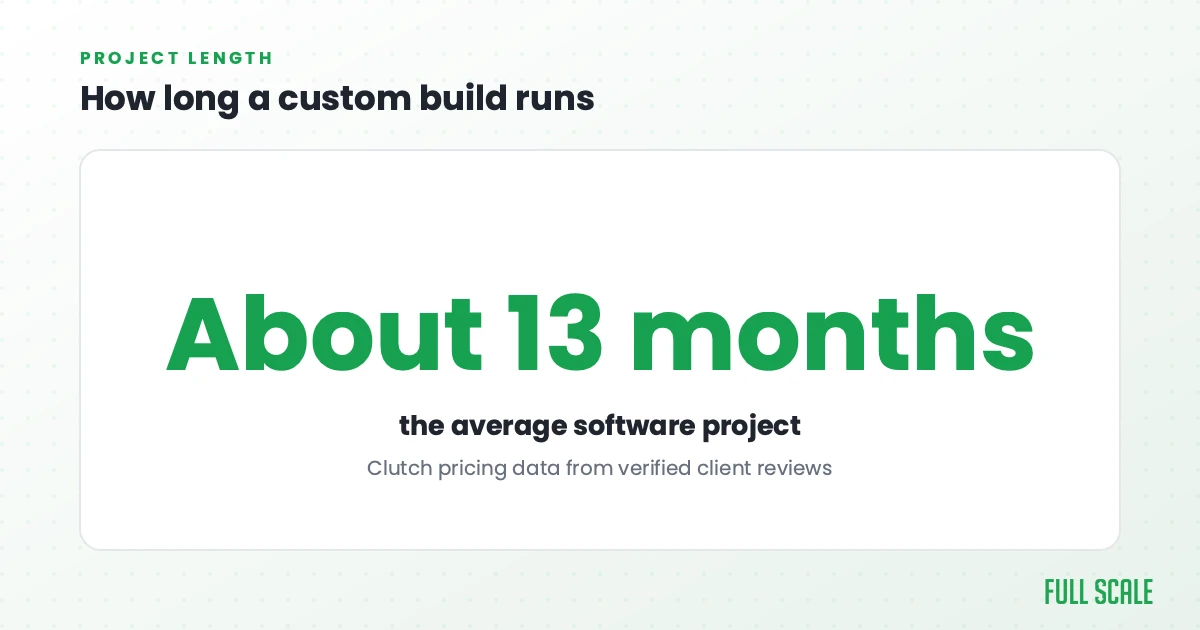
Quick Answer: There are 7 stages of the software development process, namely: discovery, requirements, design, development, testing, launch, and maintenance. At Full Scale, we consider a stage complete once the buyer can hold the deliverable: problem statement, prioritized backlog, clickable prototype, functional software delivered each sprint, signoff on testing results, source code and runbooks, and a maintenance plan. The Clutch pricing guide places the average project at around 13 months, based on data from verified clients.
Why a custom build needs a different process than the textbook
Custom software is developed for one customer, and no one has ever developed that particular software before. In such a situation, the customer is the primary source of information about the required functionality, and the process can be no better or worse than the decisions you make during its progress.
The usual seven phases of software development are outlined in our article about how AI changed the software development life cycle. Here, we'll shift the focus to you, the customer. What should you decide at each step, and what should you expect to receive? These are the questions we will answer.
There's a lot at stake even for a modest custom software project. McKinsey and the University of Oxford conducted research on 5,400+ IT projects in 2012. Large ones, those with initial budgets of $15 million or more, were 45% over budget on average and 56% below the expected level of business value. Your project might be smaller. The issue is that the disparity usually begins very early on and remains unnoticed until you see the final invoice.
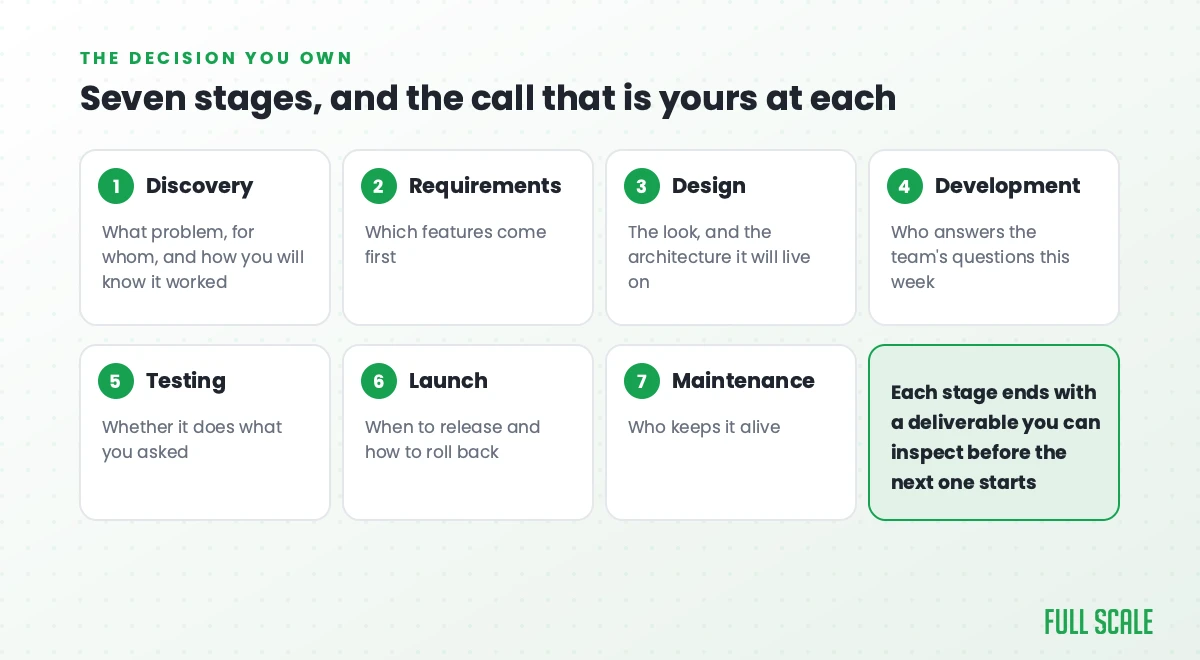
The seven stages at a glance
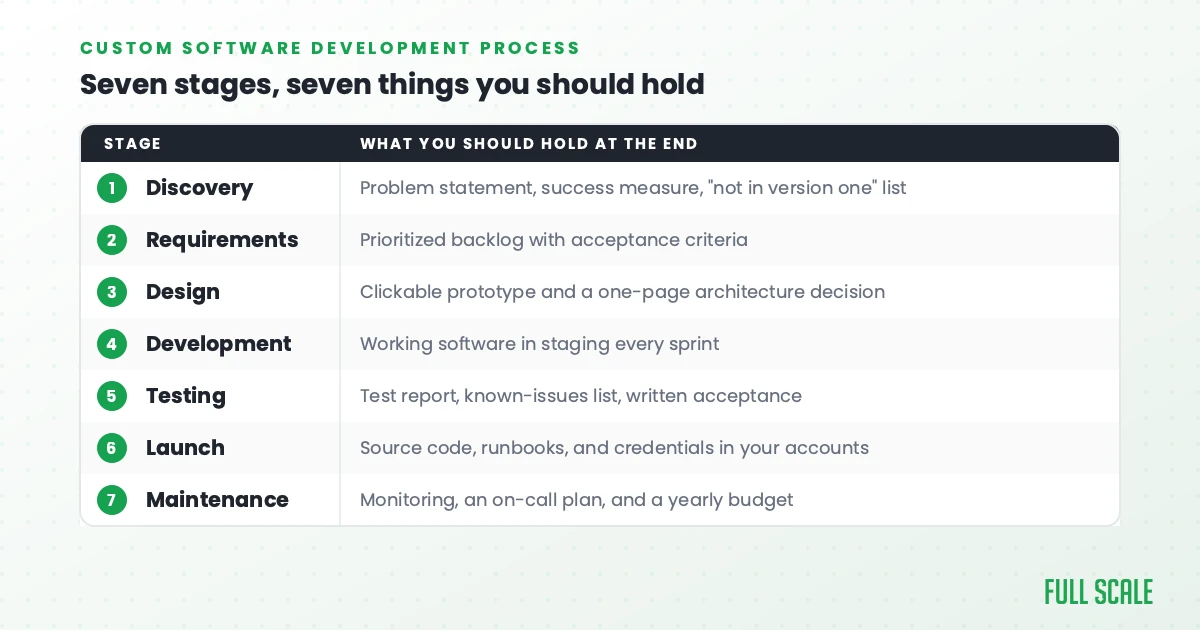
Here's how we at Full Scale define "done" for each step in a custom build. That "Deliverable" column is the test, and if you don't have it, that step isn't over.
| Stage | The decision you own | The deliverable you should hold | Where it usually goes wrong |
|---|---|---|---|
| 1. Discovery | What problem, for whom, and how you will know it worked | Problem statement, success measure, rough scope with a "not in version one" list | Skipped, because everyone is excited to start building |
| 2. Requirements | Which features come first | Prioritized backlog with acceptance criteria for each item | Written as a wish list with no order |
| 3. Design | The look, and the architecture the product will live on | Clickable prototype and a one-page architecture decision | Design signed off without anyone clicking through it |
| 4. Development | Who answers the team's questions this week | Working software in a staging environment every sprint | The buyer disappears and returns at the end |
| 5. Testing | Whether it does what you asked | Test report, known-issues list, written acceptance | Acceptance testing squeezed into the last week |
| 6. Launch | When to release and how to roll back | Source code, runbooks, and credentials in your own accounts | The vendor holds the keys |
| 7. Maintenance | Who keeps it alive | Monitoring, an on-call plan, and a yearly budget | Nobody owns it after the party |
I'll go over the table row by row for the remainder of this post.
Stage by stage
1. Discovery: decide what problem you are paying to solve
The result of discovery should be a written problem statement, a single success metric and a list of items that won't make it into the first version.
That final list is actually more important than any other section in the whole document. A product that lacks a not now list is a product without an end date.
Discovery is also when you determine if building makes sense at all. If a packaged product does most of the job, custom software might be the wrong investment. We wrote about that decision process in our build vs buy software guide from an engineering perspective, and custom software vs off the shelf from a business point of view.
2. Requirements: the cheapest place to fix a mistake
I put this on LinkedIn once: "You don't need rockstar developers. You need rockstar requirements." A bad requirement costs you one sentence to change on day three, and a month of rework to change in week ten.
You should leave this stage with a prioritized backlog, where each item says what finished looks like. The order matters here. A list of forty features in no particular order is a wish list, and engineers will quietly pick their favorites.
3. Design: click the thing before they build it
There are two outputs from design, and they're often confused. One is the user interface, preferably as a mock-up that's interactable enough to show to a customer.
The second is the architecture, the choice of database, programming language and hosting environment the product will live in for many years. I have one rule on the architecture: make it boring until it isn't. No one buys cool code, only cool products. Have your team describe the architecture on a single page, and be wary of anything that takes more than that.
4. Development: working software, every sprint
Agile says, deliver working software frequently, from a couple of weeks to a couple of months. It also says business people and developers must work together daily.
Read that sentence again. That is the part you control.
Working software is software that runs in a staging environment that you can click through at the end of each sprint. Not slides. Not a video you watch of a demo running on the developer's laptop. If you don't get to play with it, you're just trusting people when they say they did the work.
The question you control is who will answer the team's questions. Choose one person, someone who can say "yes" or "no" within a day. When engineers are waiting three days to find out what to build next, they are building the wrong thing very quickly.
5. Testing: your acceptance is the test that counts
They test while they build, but you need to test when it's done. This is the point where the people who will actually use the system have their best shot at breaking it. You'll get a report on the results, a list of known defects and a written acceptance you sign.
Don't cram it into the last week. Acceptance finds the gap between what you said and what you meant, and that gap takes time to close.
6. Launch: make sure you hold the keys
The launch includes the release plan, rollback plan, and handover. The deliverables include the source code, the runbooks, and all the credentials, all in accounts that you own.
On code ownership: Get it in writing. Software developed by an external contractor is not automatically yours in the US, where "work made for hire" doesn't apply without an explicit assignment in the contract. Our guide to the legal requirements for hiring developers in the Philippines explains the clause. At Full Scale, our client contract assigns intellectual property to our clients, and we don't reuse what we build for one client with another. Whatever you're signing should be reviewed by your own attorney.
7. Maintenance: the stage nobody budgets
Software costs money even after you launch it. Estimates say maintenance is 15 to 20 percent of the build cost per year (see our custom software development cost). And eventually, your code gets deleted. Until then, someone needs to be on call for it.
So the final deliverable is a monitoring system, on-call plan, and annual budget with a specific dollar figure attached.
The process changes with who builds it
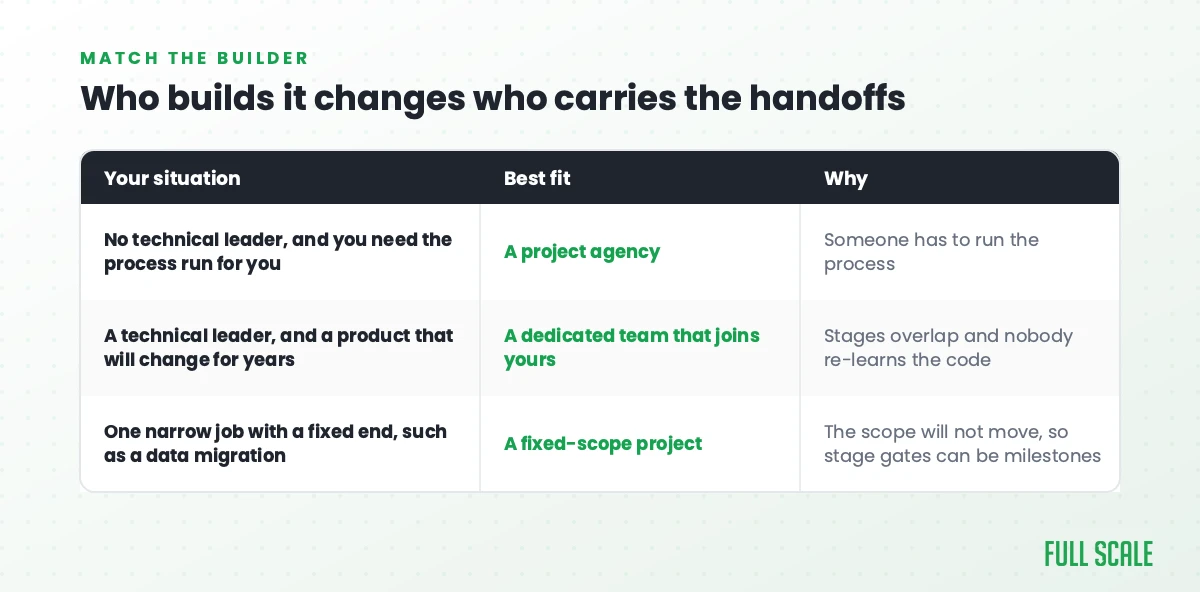
The process remains the same, no matter who develops the software. What changes is who conducts the handoffs.
| Your situation | Best fit | Why |
|---|---|---|
| You have no technical leader and need discovery, design, and project management included | A project agency | Someone has to run the process, and you do not have that person yet |
| You have a technical leader and a product that will change for years | A dedicated team that joins yours | Stages overlap, nobody re-learns the code, and you keep the decisions |
| One narrow job with a fixed end, such as a data migration | A fixed-scope project | The scope will not move, so the stage gates can be contract milestones |
To me, you need in-house technical leadership. A vendor can drive the process, but someone on your side has to own the product. For my two cents on that, our Agile vs Waterfall article goes over when each works best.
Full Scale fills the second row. Engineers from the Philippines integrate with your team, tools, and stand-ups, while you drive the process. A project shop treats the contract as the process. A dedicated team treats your roadmap as the process.
What AI changed, and what it left alone
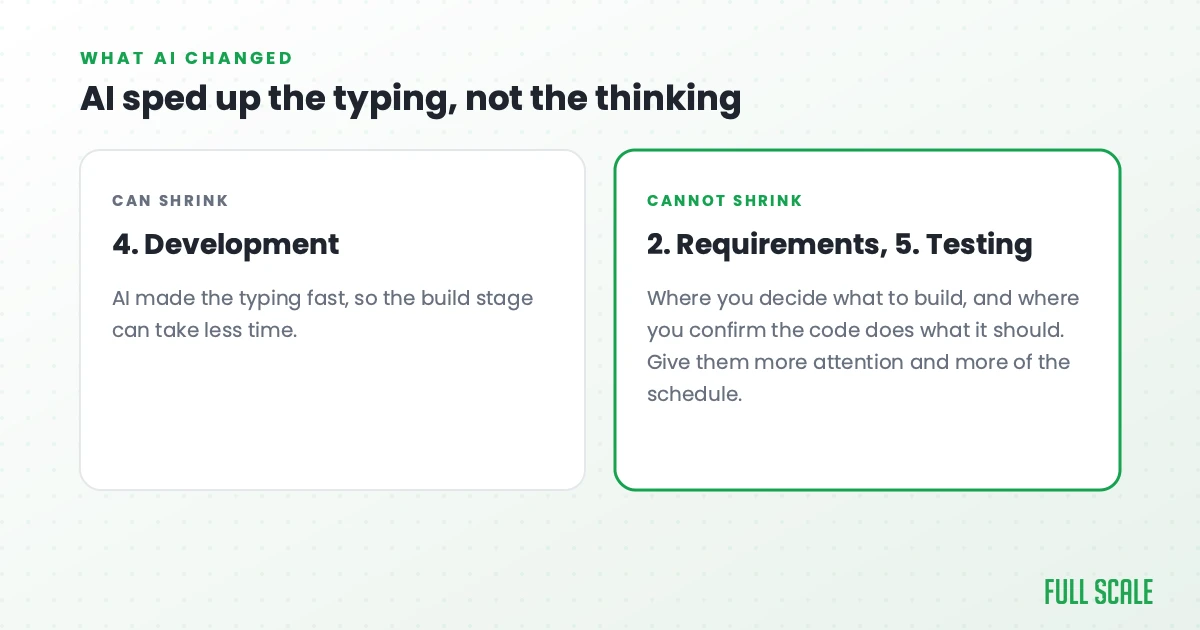
AI made the typing fast. That shifted the heavy lifting to requirements, where you define what you're building, and to review, where you verify the code behaves as expected. I lay out the whole argument in the software development process is broken, so let me keep it brief here.
For a buyer, the net result is that stages 2 and 5 deserve more of your focus and more of your time. The build stage can shrink. The thinking stages cannot.
If you want the reasoning for that, read my book, Product Driven.
Frequently asked questions
What is the custom software development process?
The custom software development process is the sequence of stages a team follows to build software for one specific customer: discovery, requirements, design, development, testing, launch, and maintenance. Vendors name and count the stages differently, but the order is the same. Each stage should end with a deliverable the customer can inspect before the next stage starts.
How long does the custom software development process take?
Clutch's pricing data from verified client reviews puts the average software project at about 13 months. Small tools can ship in a few months and large platforms take longer. The build stage is the least predictable, because it is the stage where the team learns what the software actually needs.
What is the first step in custom software development?
The first step is discovery, where the buyer and the team agree on the problem, the user, and how success will be measured. The output is a written problem statement and a rough scope that includes a list of what is not in the first version. Skipping discovery is the most common reason a custom build gets the wrong thing right.
Who owns the code in a custom software project?
The customer should own it, but only if the contract says so in writing. Under US copyright law, software written by an outside contractor is generally not a work made for hire, so the contract needs an explicit assignment of intellectual property. Full Scale's client agreement assigns intellectual property to the client.
Is the custom software development process Agile or Waterfall?
Most modern custom builds run Agile for the build stage, with short cycles that deliver working software, and use Waterfall-style planning for discovery and launch. The Agile Manifesto asks teams to deliver working software every couple of weeks to a couple of months, with business people and developers working together daily.
Hold the deliverable, then pay for the next stage
Seven stages. Seven things to hold onto. When the vendor cannot tell you what you will get at the end of a stage, ask them before you buy another.
Schedule a call and we'll go over how a custom build would work with your team.