
AI Software Development Cost in 2026: Developer-Months vs. the Model Bill

In this article
- AI software development cost has five lines
- What the engineering costs in developer-months
- The model bill, in the same units
- Evals are what turn a 100x price gap into savings
- Costs outside the quote
- What changes when AI helps write the code
- Cheap AI quotes are thin AI quotes
- Pick the budget by your situation
- How Full Scale prices AI feature work
- Frequently asked questions
- Price the people, then the tokens
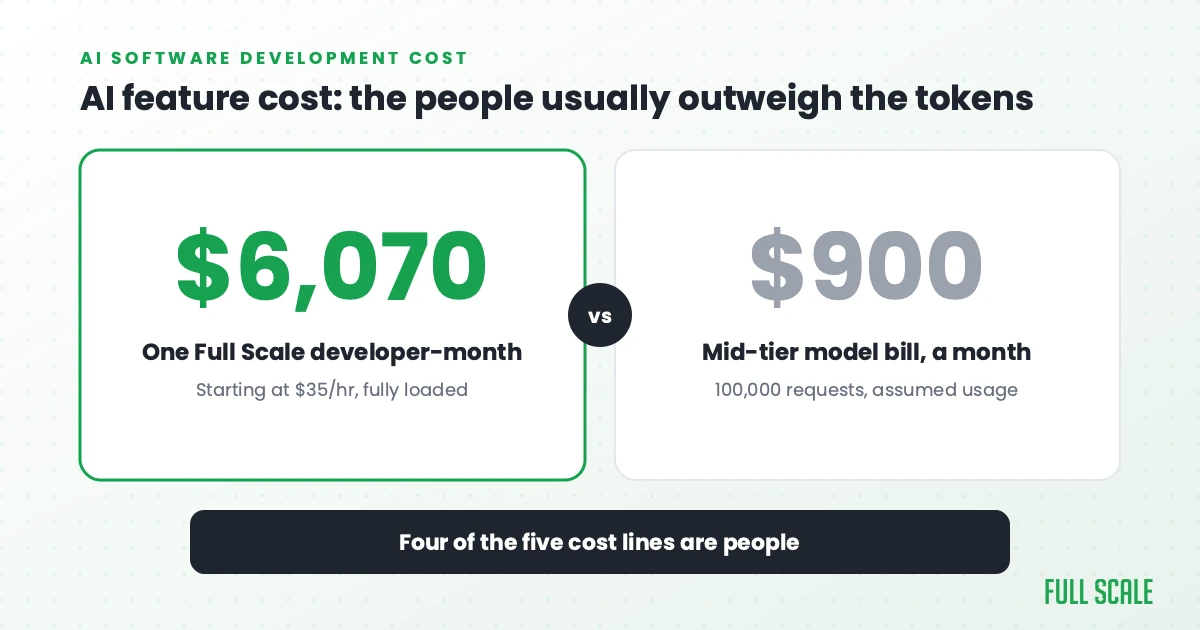
Quick Answer: AI software development cost, for building AI features into a product, is two bills: engineering and the model. Engineering is a team times a number of months, and a Full Scale developer-month starts at about $6,070. The model bill is per token and can range from under $50 to over $4,000 a month at the same 100,000 requests. Budget both, plus the evaluation work that lets you switch to a cheaper model safely.
Most pages covering AI feature pricing give one range and leave it up to the reader to figure out what's inside. The range is too large to be actionable. That's because those pages lump together several distinct projects, each of which costs differently. I'm not doing that. In this article I only estimate the cost of building AI features into an application you're shipping: LLM integration, RAG, agents with guardrails, and testing to ensure reliability. I am not estimating costs for training your own models, or for AI research, or for AI consulting, which are all specialized services. For building AI features, Full Scale has the developers, as we explain in our article on AI staff augmentation.
AI software development cost has five lines
There are 5 different lines of AI software development costs that each have a different scaling curve: 1) integration engineering, 2) the data & retrieval pipeline, 3) evaluation, 4) infrastructure and observability, and 5) the model bill. 4 of them are priced in developer-months, only the last one is priced per token.
| Cost line | What it buys | Price unit |
|---|---|---|
| Integration engineering | The feature inside your product: prompts, structured outputs, streaming UI, fallbacks | Developer-months |
| Data and retrieval pipeline | Ingesting your documents, chunking, search, permissions | Developer-months |
| Evaluation | Test sets, scoring, regression checks on every prompt or model change | Developer-months |
| Infrastructure and observability | Tracing, caching, rate and spend limits, guardrails | Developer-months plus a cloud bill |
| Model usage | The tokens the feature consumes | Dollars per million tokens |
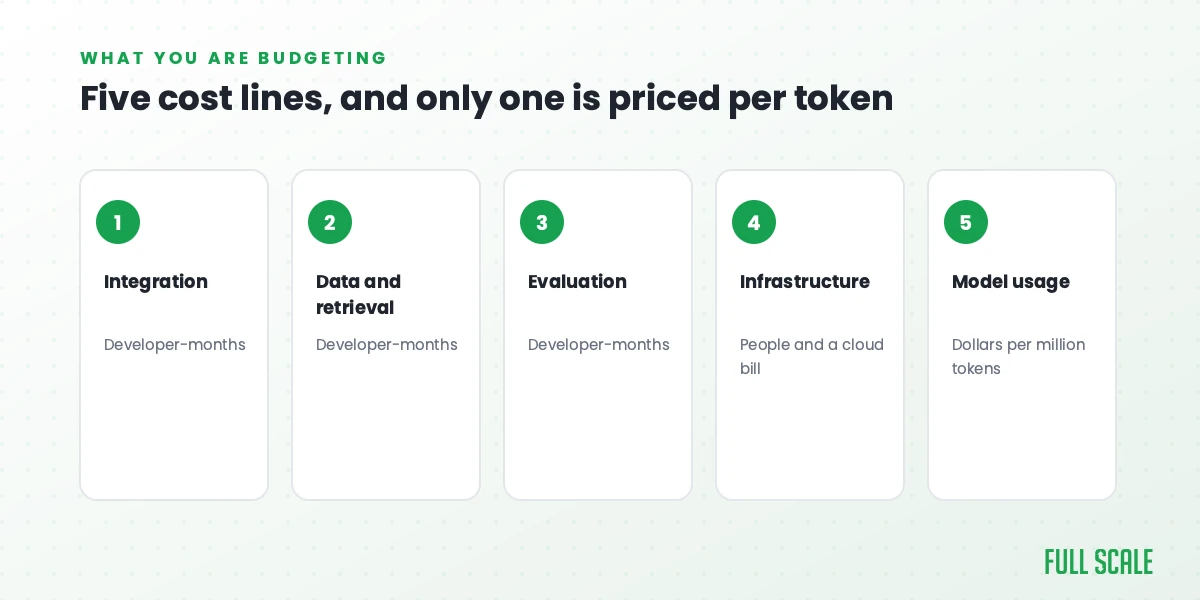
Four of the five cost lines above are measured in people-time. This is important to keep in mind, as most conversations about AI costs revolve around the 5th line item.
What the engineering costs in developer-months
The cost of engineering an AI feature is the number of developers * the number of months * a monthly rate. Full Scale's starting rate puts one developer-month at approximately $6,070. The comparison number is a U.S. employee at the Bureau of Labor Statistics (BLS) median software developer salary of $135,980, grossed up because wages are 70% of what private employers spend. This comes out to about $16,200 per month.
| Team shape (illustrative) | Developer-months | Full Scale dedicated team at $35/hr | US employees, fully loaded at the BLS median |
|---|---|---|---|
| 2 engineers for 2 months: a proof of value on one feature | 4 | About $24,300 | About $64,800 |
| 3 engineers for 4 months: one production feature with retrieval and evals | 12 | About $72,800 | About $194,300 |
| 5 engineers for 9 months: several AI features and the platform under them | 45 | About $273,000 | About $728,500 |
We're treating these team shapes as scale markers and not specs because your scope determines your team. A more senior-heavy team would bill higher than the starting rate. At the median, the difference between a US hire and a Full Scale hire is about 62%, within the 50 to 70% range that Full Scale clients save on compared to a comparable US hire. Roles also play as big a part in cost as headcount. Generally, a feature requires a person who owns the integration and interface, someone who owns retrieval over your data, and someone who owns evals and monitoring, and on a smaller team, one person often wears two of these hats. Our software development cost calculator uses these same inputs for a more general calculation.
The model bill, in the same units
With mid-sized features, the model bill will be smaller than the engineering bill, and will flip at volume, or if you go with a premium model. Let's demonstrate this with an illustrative feature that sends 2,000 input tokens and gets 500 output tokens back on each request. At 100,000 requests a month that's 200 million input tokens and 50 million output tokens.
The prices below come from Anthropic's pricing page as fetched on October 30, 2026. Provider prices change often, so check the page before you plan against them.
| Model tier | Input / output per million tokens | Monthly bill at 100,000 requests | Monthly bill at 1,000,000 requests | 100,000-request bill as a share of one $6,070 developer-month |
|---|---|---|---|---|
| Haiku 5.5 | $0.10 / $0.50 | About $45 | About $450 | Under 1% |
| Sonnet 5.5 | $2 / $10 | About $900 | About $9,000 | About 15% |
| Opus 5.5 | $4 / $20 | About $1,800 | About $18,000 | About 30% |
| Fable 5.1 | $10 / $50 | About $4,500 | About $45,000 | About 74% |
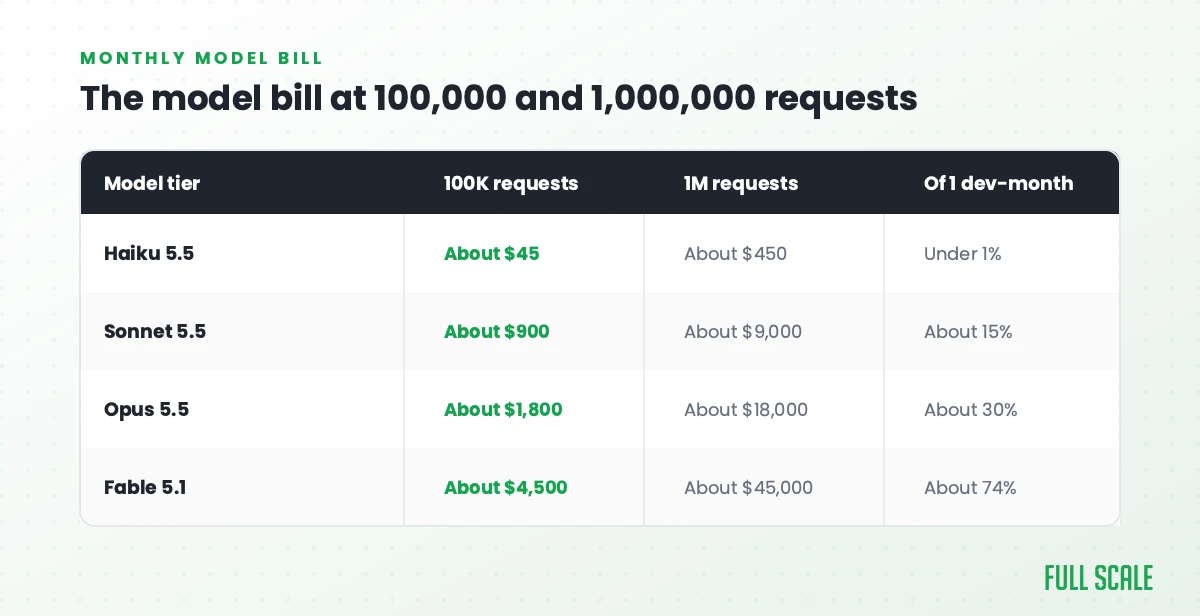
The arithmetic is Full Scale's, applied to the published rates and our assumed usage, so your numbers will move with your prompt length. A couple of things jump out here. At 100,000 requests, even the most expensive tier costs less than a developer-month, so the human engineers are still your biggest cost. But at 1,000,000 requests, the most expensive tier costs about 7.4 developer-months every month, and the model cost is now the biggest expense in your project.
The model bill is also the one invoice in software that grows when customers like the feature. Anthropic's pricing page lists batch processing at a 50% discount, and cached inputs are much cheaper. So the price of the same functionality can be very different when it's designed to take advantage of those options. That's also engineering.
Evals are what turn a 100x price gap into savings
Fable is priced 100x higher than Haiku on both input and output. You shouldn't move a feature to the cheap model blindly, but you also shouldn't continue paying the premium price out of fear. An eval is the tool that allows you to make this decision based on actual data.
An eval suite consists of a collection of real-world test cases, an evaluation rubric, and a continuous testing process that runs whenever you update a prompt or switch models. Building an eval suite requires months of developer effort, and it pays for itself the very first time it enables you to migrate a high-traffic feature to a more cost-effective model without compromising quality.
This is critical because the professionals using these tools aren't relying on AI's accuracy either. The 2025 Stack Overflow developer survey revealed that 46% of developers do not trust the accuracy of AI tools, compared to only 33% who do. Additionally, 66% of respondents cited responses that are "almost right, but not quite" as their primary frustration. If those creating these applications scrutinize the results, your application should do the same.
For further insight into how generative AI has altered the industry, see our blog post AI vs. machine learning.
Costs outside the quote
A quote for an AI feature usually covers the build alone. There are four costs around it that are cheap to account for in planning and very expensive to deal with in production:
| Cost outside the build quote | Why it matters | How to plan it |
|---|---|---|
| Model price changes and deprecations | Providers reprice and retire models, so an integration can age out | Build behind an abstraction and keep an owner on the team after launch |
| Usage growth | The bill scales with requests, not with your headcount | Set per-tenant spend limits before launch |
| Quality regressions | A model update can change behavior without a code change | Run the eval suite on a schedule, not only on releases |
| Security and data handling | Prompts can carry customer data | Decide what leaves your systems before the first integration |
Maintenance will also likely require mostly developer time. A common estimate is 15-20% of the build cost per year for maintenance, but I couldn't find a source for this estimate, so take it as a guideline and push back for a more specific number.
What changes when AI helps write the code
There's one final factor worth including, but it works against you: Those same APIs that you call accelerate the humans creating your product. That's the "AI-adjusted hours" concept from our calculator article. Don't build in a large discount, because developers have every right to distrust AI outputs, and reviewing them requires time. Consider any acceleration a benefit you discover in month three, not an adjustment you make to the estimate in month zero.
Cheap AI quotes are thin AI quotes
A lowball AI quote typically excludes either evals or observability, or both. You'll inevitably pay for these when an issue arises due to missing evals, poor observability, or both. This is what I refer to as cheapshoring when applied to hiring. In short, an AI solution without proper evals is just cheapshoring in disguise.
There are four key questions you should ask to make AI quotes more comparable:
- How many people will be working on this feature on a full-time basis, and for how long?
- Are they creating an evaluation suite? Who will maintain it post-launch?
- What model are they using, and what volume do you expect per month?
- What's missing from the cost estimate?
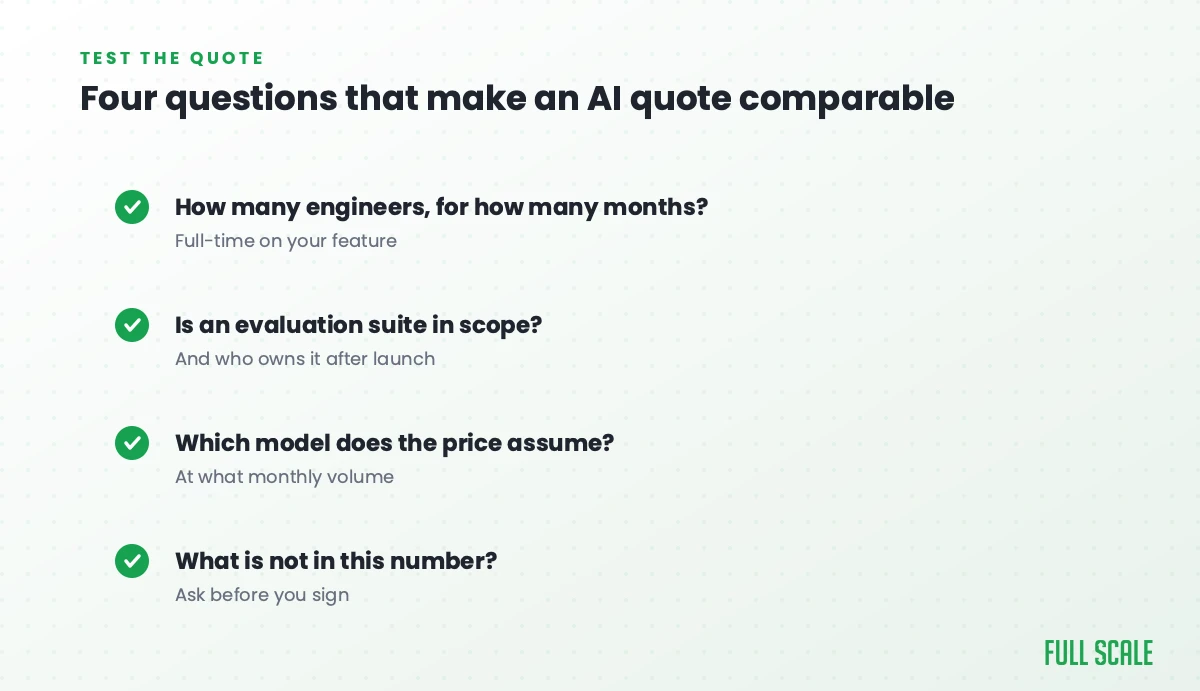
If a vendor is unable to answer the first and third questions in a single sentence, they have quoted you for a demo. There is another question you should be asking: Should you develop this feature at all? Our guide to build vs buy software is a good starting point for answering this question.
Pick the budget by your situation
Your situation dictates which line dominates. Here's how I'd read the numbers above.
| Your situation | Line that dominates | What to do first |
|---|---|---|
| One AI feature in an existing product, modest volume | Engineering | Fund a small team for a few months and build evals from day one |
| A high-volume feature, such as support or search for many users | The model bill | Budget evals and model tiering before launch |
| Several AI features across a platform | Engineering plus infrastructure | Staff a team that stays, not a project crew |
| Training your own models or doing research | Not covered here | Hire a specialist, which is a different budget |
How Full Scale prices AI feature work
We can put dedicated engineers from our pool of developers across the Philippines on your team via staff augmentation at a starting cost of $35 an hour fully loaded. Your exact rate will depend on the seniority level, skills and number of developers required, and you can find out more about how it all works by visiting our pricing page.
Every engineer works for a single client, and work can start in as little as 7 days. If it isn't working out in the first two weeks, you get your money back. After that, you can drop a developer on 30 days' notice with no long-term contract. You can read more about this in our blog post when it isn't working out.
We've detailed the type of work we staff in our AI development services and dedicated AI developers pages. Engineers on our team are also trained using concepts from my book, Product Driven.
Frequently asked questions
How much does it cost to add AI to an app?
The cost is engineering time plus a model bill. At Full Scale's $35-an-hour starting rate one developer-month is about $6,070, so a production AI feature built by three engineers over four months is about $72,800. The model bill is separate: at 100,000 requests a month, a mid-priced model costs roughly $900 and a premium model roughly $4,500 under the stated usage assumptions.
How much does LLM API usage cost?
Providers charge per million tokens, and prices differ by about 100 times between small and premium models. Anthropic's pricing page lists a small Haiku model at $0.10 input and $0.50 output per million tokens, and its premium Fable model at $10 and $50. Batch processing is discounted 50% and cached input is far cheaper, so the same feature can cost very different amounts depending on how it is built.
Is the model bill or the engineering the bigger cost?
For a mid-sized feature, engineering usually is. At 100,000 requests a month, a mid-priced model costs about 15% of one developer-month. The balance flips at volume or with a premium model, where 1,000,000 requests a month can cost more than seven developer-months every month. That is why model choice and measurement belong in the budget.
Does Full Scale do AI and machine learning consulting?
No. Full Scale staffs dedicated engineers who build AI features into software, such as LLM integrations, retrieval, and evaluation pipelines. It does not do AI strategy consulting or model research, and for traditional machine learning or data science you are better served by a specialist. This post prices only the engineering of AI features.
Is it cheaper to build AI features with an offshore team?
It is cheaper for the engineering share, at about 62% below a US employee at the BLS median salary for a Full Scale developer starting at $35 an hour, and clients typically save 50 to 70%. The model provider's bill is the same wherever your engineers sit, so the savings apply to the people, not the tokens.
Price the people, then the tokens
Take your budget, divide it by $6,070 and that's how many developer-months Full Scale can apply to your AI feature.
Then, think about what the model bill will look like at your real volume.
If you need engineering, tell us what you're building and we'll quote your exact scope.