
Dedicated Offshore Development Center: Cost and When to Skip It

In this article
- What Is a Dedicated Offshore Development Center
- ODC Models in Software Development: Customer, Contractor, and Build-Operate-Transfer
- Who Actually Employs the Engineers
- Why Companies Set Up an Offshore Development Center
- ODC vs Staff Augmentation vs Outsourcing
- The Reality Check Most Articles Skip
- When a Dedicated ODC Actually Makes Sense
- Top Locations for an Offshore Software Development Center
- The Full Scale Alternative: A Dedicated Team Without the ODC Overhead
- Frequently Asked Questions
Quick Answer: A dedicated offshore development center (ODC) is a software engineering team in another country that works exclusively for one company. It operates as an extension of your in-house team rather than as a third-party vendor. The dedicated model means engineers handle long-term product work under your processes, security standards, and culture, with no time split across other clients. Most companies researching a dedicated offshore development center don’t actually need to set one up. Full Scale has run dedicated teams in the Philippines since 2018, and the honest answer for most buyers is a simpler structure. Staff augmentation gives you the same dedicated team and the same access to global talent. You get it in two to four weeks instead of six to twelve months, with no legal entity, office lease, or HR overhead.
Most CTOs researching a dedicated offshore development center are asking the wrong question.
They’re not really wondering “what is an ODC?” They want to scale an engineering team without the hiring headaches, budget overruns, and quality compromises. I’ve sat on both sides of this question. As CTO at VinSolutions, we considered standing up our own dedicated offshore development center and ran the numbers three different times. The same question came up again at Stackify, where we ran a mix of US and offshore engineers building our APM platform. Now at Full Scale, I’ve helped over 100 tech companies run the same math. The question is always whether they actually need a dedicated offshore development center, or whether something simpler will do the job. Plenty of these centers run on the Microsoft stack, where you hire offshore C# developers alongside QA and DevOps.
Here’s the honest take after all of that: most of the time, the answer is something simpler. The companies that genuinely need a true dedicated offshore development center are large and well-resourced. They will spend six to twelve months and a few hundred thousand dollars before a single line of code ships. Everyone else is better served by a simpler model. It gives you the same dedicated team and the same access to offshore engineering talent, without the setup overhead.
This guide covers what a dedicated offshore development center actually is and the two main ways companies set one up. It also covers when the model makes sense, and when it doesn’t. I’ll show you what most articles leave out, and what we’ve learned operating our own dedicated teams in the Philippines since 2018.
What Is a Dedicated Offshore Development Center
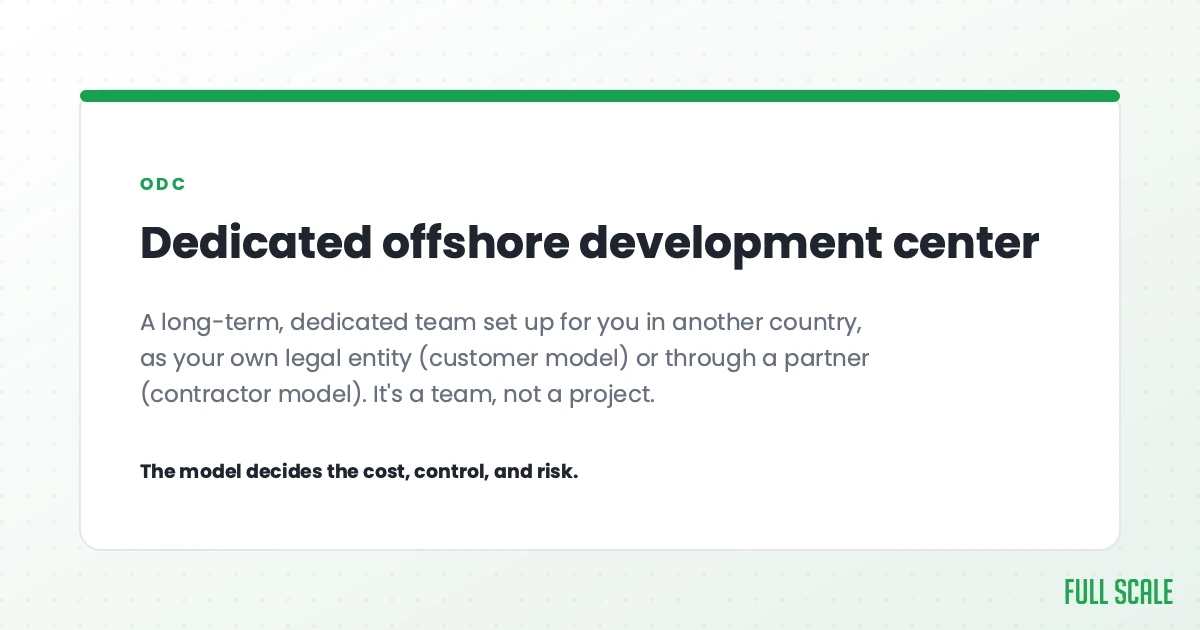
A dedicated offshore development center is a software engineering team in another country that operates as a full extension of your company. It’s a branch office built specifically for product development, with its own engineers, setup, and local staff. The “dedicated” part is what separates this model from generic offshoring or outsourcing. The team works only on your products, following your processes, your security standards, and your culture, with no time split across other clients.
The defining difference between a dedicated offshore development center and traditional outsourcing is control and commitment. With outsourcing, you hire a vendor that takes on a project, and the same engineers may be juggling three other companies’ codebases. With a dedicated ODC, you set up a presence and the engineers report up through your management structure. They build long-term knowledge of your product, your domain, and your team, and they don’t get pulled onto other clients’ work next quarter.
Five characteristics show up in every well-run dedicated offshore development center:
- Dedicated team: Engineers work exclusively on your projects and never get split across vendors or pulled onto whoever’s paying the most this quarter.
- Long-term engagement: The model is built for multi-year work rather than project-by-project handoffs.
- Self-contained operations: Office space, IT setup, payroll, HR, and security all live inside the center.
- Process alignment: The team follows your sprint cadence, code review standards, and security protocols.
- Cultural integration: Engineers attend your standups, join your Slack, and feel like part of the company.
The global tech talent shortage is what’s driving demand for this model. A Korn Ferry study projects a global talent shortage of 85 million workers by 2030, representing roughly $8.5 trillion in unrealized annual revenue. US-based engineering hiring has not gotten easier. Building a talent pipeline outside your home country has gone from optional to a core strategic decision for any growing software company.
ODC Models in Software Development: Customer, Contractor, and Build-Operate-Transfer
A dedicated offshore development center runs on one of two ownership models: you own the entity (the customer model) or a partner owns it (the contractor model). Build-operate-transfer is a third path that starts as the second and ends as the first. They look the same on paper, but they involve very different amounts of work on your end.
Customer Model (You Own the Entity)
In the customer model, you register a legal entity in the offshore country. You sign the office lease, hire the developers directly, run payroll, handle local tax and labor law, and own the equipment. The ODC is a foreign subsidiary of your company.
Opening a wholly-owned entity is what companies like Apple, Google, and Microsoft do when they open dedicated R&D centers abroad. Apple’s Hyderabad center is a good example of the customer model done at scale.
The benefit is total control. You set the rules, own the IP infrastructure, and build a long-term talent base in the country. The cost is complexity. Setting up a legal entity in the Philippines or India is a six to twelve month project on its own. That’s before you’ve interviewed a single developer. You also take on every operational risk: currency fluctuations, local labor law changes, office lease disputes, employee terminations under foreign rules.
Contractor Model (Partner-Owned and Operated)
In the contractor model, you partner with a company that already has the pieces in place: the legal entity, the offices, the recruiting pipeline, and the back-office team. They handle the infrastructure and HR; you get the dedicated team. The engineers still work only on your work, but they’re employed by the partner.
The contractor model is what most growing tech companies actually want. You get the talent, the dedicated team, and the cost arbitrage. You don’t have to become an expert in Philippine labor law or Indian tax structures. The trade-off is that you don’t own the entity. If you want to acquire the team outright in five years, you need a separate build-operate-transfer arrangement with the partner.
Build-Operate-Transfer: The Hybrid
The build-operate-transfer (BOT) model is a hybrid. A local partner sets up the center, hires the team, and runs it for a fixed period. Then ownership transfers to you. It’s the right call for companies that know they want a customer-model ODC down the road but don’t want to manage the setup themselves. The risk is in the transfer: people leave, knowledge walks out the door, and the handoff is rarely as clean as the contract suggests.
Who Actually Employs the Engineers
There are three ways to engage offshore engineers, and they carry very different paperwork. You can hire people directly as independent contractors, you can employ them through your own foreign entity, or you can work with a partner who carries the local relationship. The engineering work looks about the same in all three. The legal and tax exposure does not, and that gap is the part buyers find out about last.
Hiring individual developers directly as contractors is the cheapest option on day one and the one that ages worst. You are the only party in the relationship, so you carry the classification question yourself. The IRS treats worker classification as a facts-and-circumstances test around control and independence, not a label you pick on the invoice, and other countries run their own versions of the same test. A developer who works your hours, uses your tools, sits in your standups, and takes direction from your tech lead starts to look a lot like an employee to a tax authority, whatever the contract says.
Owning a foreign entity solves the classification question by making them real employees. It also hands you a taxable presence in that country, local employment law, and a subsidiary to wind down if the plan changes.
The third option moves the local relationship to somebody whose job is carrying it.
| How you engage them | Who holds the local relationship | Taxable presence for you | Classification risk | IP assignment runs through |
|---|---|---|---|---|
| Individual independent contractors | No one, they are self-employed | Depends on their role and authority | Highest, and it is yours | A separate contract with each person |
| Your own foreign entity (customer model) | You do | Yes, you have a local entity | Low, they are your employees | Local employment contracts you maintain |
| A partner carries it (contractor model) | The partner | None from the engineering team | Low, the partner carries it | One contract with the partner |
At Full Scale our engineers are regularized employees in the Philippines, apart from a handful who prefer to work as independent contractors. Either way, our client agreements are customer contracts with our US-based company, so the local relationship is never the client’s to hold. That is the boring answer, and boring is what you want on this particular question.
I am not a lawyer, and the one time I tried to read a foreign labor code on a flight I was asleep before the second page. Your counsel and your accountant get the final word on how any of this applies to your company. What I can tell you is which structure puts the question on your desk and which one puts it on somebody else’s.
Why Companies Set Up an Offshore Development Center
Companies set up an ODC to hire engineers they can’t find at home, to cut cost without cutting quality, to keep work moving around the clock, and to control their IP. Each reason is real and each comes with fine print, so here is what drives the decision from the buyer’s side.
Access to a Global Talent Pool
The US engineering hiring market is brutal. In the deals Full Scale competes in, loaded cost for a senior US developer runs $180,000 to $250,000 all-in once you add benefits, payroll taxes, and the recruiter fee. For that same budget, you can hire two to three senior engineers in the Philippines or Eastern Europe. The companies that win this trade aren’t optimizing for cheap labor. They’re optimizing for being able to hire at all.
The Philippines is the third-largest English-speaking country in the world, with strong cultural alignment to US business norms. India has the deepest talent pool by raw numbers. Eastern Europe (Poland, Romania, Ukraine) is the standard nearshore choice for European companies, though for a US company weighing the two, Eastern Europe vs the Philippines comes down to cost convergence and risk more than raw talent. Latin America has become the standard nearshore choice for US companies that need heavy time-zone overlap. The same sourcing logic applies when you build out an offshore QA function alongside the developers.
Cost Arbitrage Without the Quality Trade
Offshore labor savings sit in the 39 to 72 percent range depending on the country, per Accelerance’s annual benchmark. The savings are real, but they’re not free money. The companies that lose on cost arbitrage treat offshore engineering as a way to do the same work for less. The ones that win treat it as a way to do more work. They put the savings back into more engineers, faster shipping, or better tooling.
For a closer look at the actual numbers, see our breakdowns on offshore development cost analysis and how rates compare across countries.
24-Hour Development Cycles
The time zone difference only helps if you engineer three to four overlapping hours into the day. With a structured handoff and a few hours of overlap each day, your offshore team ships code while your US team sleeps. The QA cycle compresses from days to hours. Without the overlap, you spend the first hour of every meeting catching up on what happened overnight. The 24-hour cycle turns into a 24-hour communication tax. If you can’t build that overlap into the workflow, the time zone is working against you instead of for you.
IP Control and Security
A dedicated ODC gives you tighter IP control than traditional outsourcing, because you own the security perimeter instead of renting a vendor’s. Your code lives on your stack. Engineers sign NDAs and IP assignment agreements that map cleanly to your US contracts, and you set the access controls. With outsourcing, the same vendor is working on three other clients’ codebases, and IP separation is whatever the vendor’s policy says it is. With an ODC, you own the security perimeter.
ODC vs Staff Augmentation vs Outsourcing
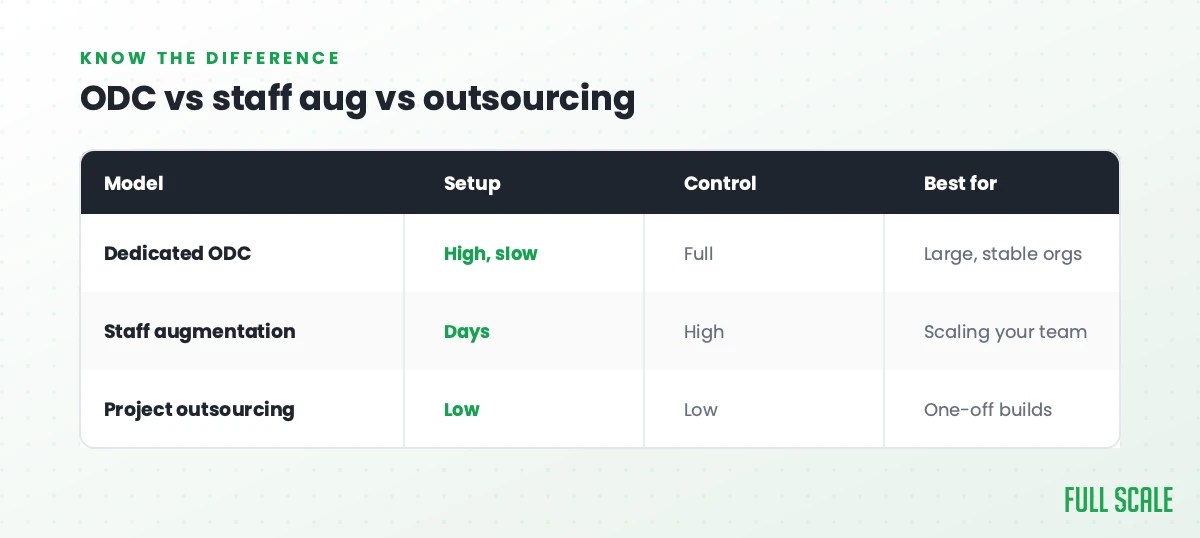
A dedicated ODC, staff augmentation, and traditional outsourcing differ on three things that decide the cost: who employs the team, how long the commitment runs, and how much setup you carry before anyone writes code. The three get conflated constantly, and the differences matter when you’re deciding what you actually need.
| Aspect | ODC (Customer Model) | Staff Augmentation | Traditional Outsourcing |
|---|---|---|---|
| Team dedication | Exclusive, long-term | Exclusive while engaged | Shared across clients |
| Control level | Total | High (you manage daily) | Low (vendor manages) |
| Setup time | 6 to 12 months | 2 to 4 weeks | 2 to 8 weeks |
| Upfront cost | $200K+ | None | None |
| Cultural integration | Deep | Deep (joins your team) | Limited |
| Best for | 50+ engineers, multi-year | Most growing companies | Defined-scope projects |
At Full Scale, the honest answer for most companies in the 5 to 50 engineer range is staff augmentation. It gets you the same talent and the same exclusivity as an ODC, in weeks instead of months. There is no upfront cost and no legal entity to wind down if your strategy changes. See our breakdown of how staff augmentation works and the case for staff augmentation over outsourcing.
The Reality Check Most Articles Skip
The ODC marketing material focuses on the benefits and glosses over what it actually takes to stand one up. From the buyer side, here’s what to expect.
Time
Six to twelve months from “let’s do this” to your first productive engineer. Plan on three months for legal entity setup and two to three months on office space and infrastructure. Recruiting your first cohort takes another three to six months. Those timelines assume everything goes well, and in my experience most things don’t. The plan you start with rarely survives. Local labor law, lease negotiations, and the first round of candidates pulling out all reshape it.
Money
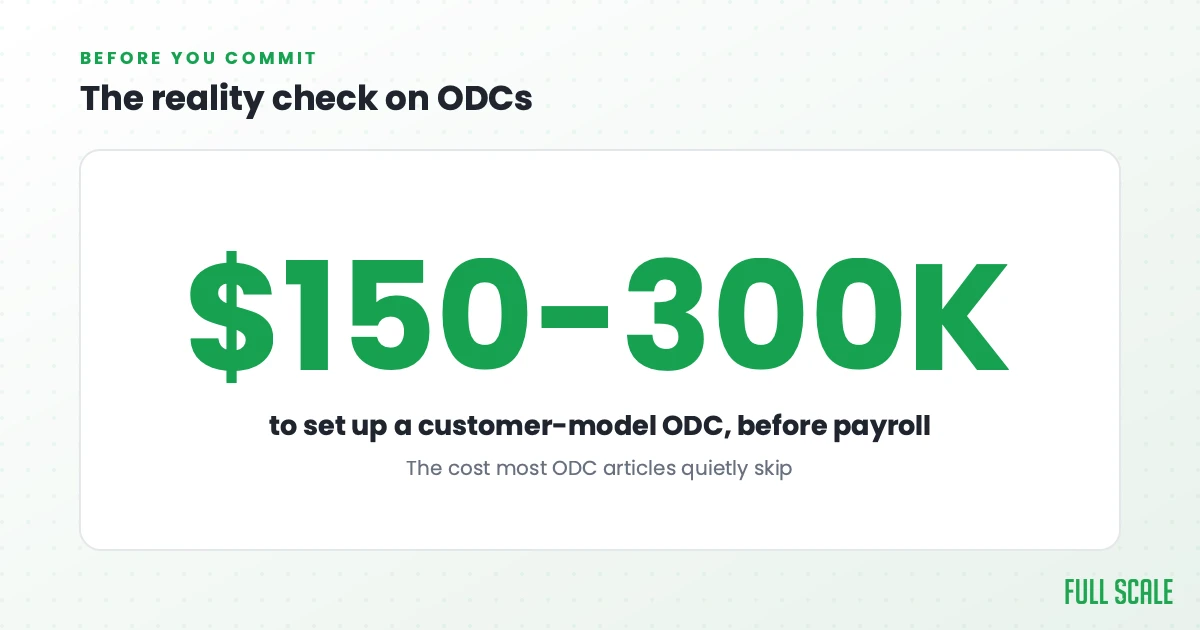
From what Full Scale has seen buyers quoted, a customer-model ODC in the Philippines runs $150,000 to $300,000 in setup costs before payroll starts. That covers legal entity registration, office lease deposits, IT setup, security, HR systems, and a country lead to run the place. Your monthly burn then includes office rent, utilities, IT support, HR overhead, and the loaded cost of the engineers themselves.
Hidden Risk
The risk that doesn’t show up in the spreadsheet is the one that matters most. If your strategy changes in 18 months, an ODC becomes a liability. You can’t easily wind down a foreign subsidiary, lay off 30 employees under foreign labor law, and exit an office lease. Set up an ODC at the wrong point in your growth curve and you pay for it. Companies end up carrying costs for years on a team they no longer need. For a full breakdown of where these projects go wrong, see our offshore development due diligence checklist.
When a Dedicated ODC Actually Makes Sense
The honest test is simple. Would you build a US engineering office of this size, knowing what you know now about the next three to five years? If yes, an ODC is the right structure. If not, staff augmentation gets you to the same place faster and cheaper.
ODCs make sense when:
- You need 50 or more engineers long-term, and you’re confident in that headcount on a three-year horizon.
- You’re an established company (annual revenue above $10 million) with stable funding and a clear product roadmap.
- You have strict compliance or security requirements that demand you own the operational perimeter (regulated industries, defense, certain healthcare).
- You see strategic value in establishing a brand presence in the country, beyond just sourcing engineers.
- You have the executive bandwidth to manage a foreign operation, or you’re hiring someone to do it.
ODCs don’t make sense when:
- You need engineers in the next quarter, not the next year.
- Your team is under 20 people and you’re still figuring out the right shape of the engineering org.
- Your roadmap could shift significantly in the next 18 months.
- You don’t have the leadership capacity to run a foreign operation alongside your day job.
- You’re a startup that needs to stay flexible on team size, location, and structure.
Or read it off your own situation:
| Your situation | What to pick | Why |
|---|---|---|
| Under 20 engineers, roadmap still moving | Staff augmentation | You need the option to change your mind more than you need an entity |
| 5 to 50 engineers, stable roadmap, ongoing product | Staff augmentation | Same dedicated team and the same talent pool, live in weeks instead of months |
| 50+ engineers, confident on a three-year horizon | Customer-model ODC | At that headcount the setup cost amortizes and control is worth owning |
| Regulated industry, you must own the perimeter | Customer-model ODC | Compliance requirements that demand the entity are the one hard case |
| You want the entity eventually, not now | Build-operate-transfer | A partner runs it while you decide, with transfer risk priced in |
| You need engineers next quarter | Staff augmentation | An ODC will not have shipped a line of code by then |
Top Locations for an Offshore Software Development Center
Location choice is the single biggest decision after the model choice. Here’s how the major hubs compare from a buyer’s perspective.
| Country | Time zone overlap (US) | English proficiency | Senior dev hourly rate | Best for |
|---|---|---|---|---|
| Philippines | 3 to 4 hrs (overnight) | Very high | $30 to $40 | US clients, long-term teams |
| India | 2 to 3 hrs | High | $25 to $45 | Scale, deep talent pool |
| Poland | 1 to 3 hrs (EU overlap) | High | $50 to $75 | European clients, complex eng |
| Romania | 1 to 3 hrs (EU overlap) | Very high | $45 to $65 | European clients, fintech |
| Mexico | 4 to 6 hrs (full overlap) | Medium | $45 to $65 | US clients needing real-time |
| Colombia | 5 to 7 hrs (full overlap) | Medium | $40 to $60 | LATAM nearshore |
We chose the Philippines in 2018 for a specific reason: the combination of strong English, cultural alignment with US business norms, and lower cost than India for equivalent talent. Cebu and Manila both have deep engineering communities. Retention is stronger than India’s tech hubs, where competition from large multinationals drives churn. For more on why we picked it, see our offshoring to the Philippines guide. If your project is web product work specifically, I also wrote about how to choose a custom web application development company in the Philippines.
The Full Scale Alternative: A Dedicated Team Without the ODC Overhead
Full Scale gives you the upsides of an offshore development center without the entity: dedicated engineers working only on your projects, real cultural fit, and long-term continuity. You don’t have to set up the legal entity or run the day-to-day.
Our model is staff augmentation in form and ODC in substance. Engineers are dedicated to your work, attend your standups, write code in your repos, and stay with your team long-term. Our developer retention runs above 93 percent, which beats what most companies see with US hires in today’s labor market. We handle payroll, HR, equipment, and all the setup overhead, so you get to manage engineers and not a foreign subsidiary.
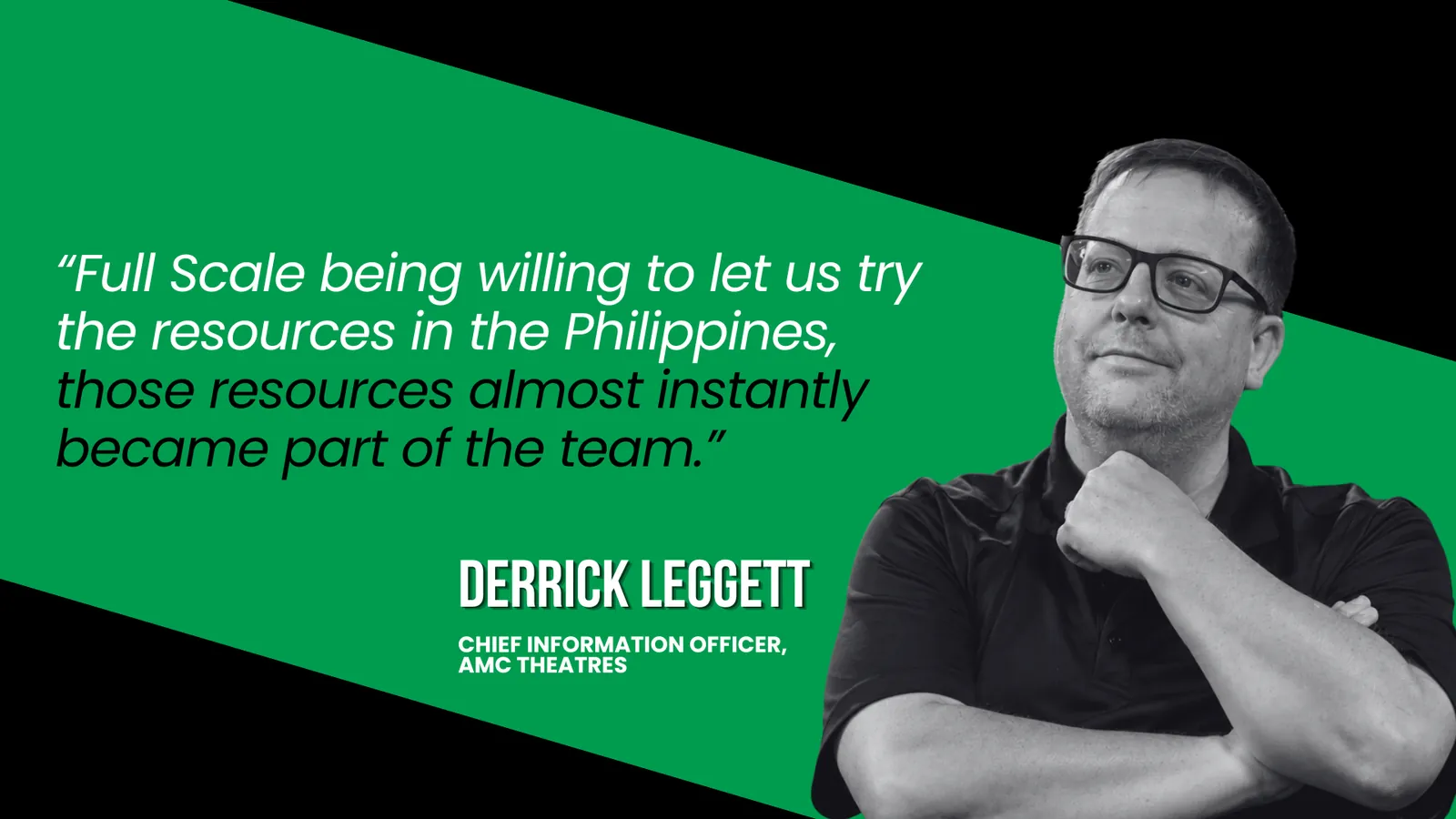
AMC Theatres is one of our longest-running examples. They built out a portion of their .NET engineering team with Full Scale developers in the Philippines. They didn’t need a Philippine subsidiary. They needed great .NET engineers integrated into their existing US team. Years later, those engineers are part of how AMC ships software at scale. The full story is in our AMC Theatres case study.
Full Scale’s been on the Inc. 5000 five years running, and we train our engineers on the Product Driven approach from my book. Three things make the model work for the companies that adopt it: staff augmentation flexibility, ODC-grade dedication, and engineers who think like product owners. If you’re weighing this against a full ODC build, the math works out in our favor. Look at the dimensions that matter: time to first commit, total cost of ownership, and what happens if your strategy shifts.
Browse our case studies for more examples. You can also read about how our offshore software development model works and how to hire developers in the Philippines with us.
Frequently Asked Questions
How long does it take to set up a dedicated offshore development center?
A customer-model ODC takes six to twelve months from decision to first productive engineer. That’s three months on legal entity registration, two to three months on office and infrastructure, and three to six months on hiring. A contractor-model ODC with an established partner runs three to six months. With Full Scale, staff augmentation gets you a productive engineer in two to four weeks.
How much does a dedicated offshore development center cost?
A customer-model ODC in the Philippines or India runs $150,000 to $300,000 in upfront setup costs before payroll. Monthly burn depends on team size, office costs, and engineer salaries. A senior Full Scale engineer bills out at $30 to $40 per hour, all-in, with no setup cost. Compare that to $180,000 to $250,000 loaded cost for a US senior engineer and the model speaks for itself.
How do you protect IP in a dedicated offshore development center?
You protect IP the same way you would with US employees: NDAs, IP assignment agreements, and access controls. The difference with an ODC is that you control the operational perimeter (network, devices, repository access) rather than relying on a vendor’s policies. Full Scale’s contracts are governed by US law, so the IP protections are the same as if you’d hired the engineer in Kansas City.
What’s the difference between a dedicated ODC and offshore outsourcing?
An ODC is a dedicated, long-term engineering function. The engineers work only on your products, follow your processes, and integrate with your team. Offshore outsourcing is project-based: a vendor takes on a scoped deliverable using whichever of their engineers is available. ODCs trade flexibility for depth and continuity. Outsourcing trades depth for flexibility on defined-scope work.
Can I start with staff augmentation and move to a full dedicated ODC later?
Yes, and this is the smart sequence for most companies. Start with two or three Full Scale engineers and prove out the working model with your team. If you grow to 50 or more engineers and the math on a customer-model ODC makes sense, the build-operate-transfer model is the bridge. You go from “we have a great offshore team” to “we own the entity” without starting from scratch on hiring or culture.
Is it safer to hire offshore developers as employees or contractors?
Employees carry less risk for you, because the classification question belongs to whoever holds the local relationship. Engaging developers directly as independent contractors puts that question on your desk, and a contractor who works your hours with your tools under your tech lead’s direction can look like an employee to a tax authority no matter what the agreement says. The third path avoids the question entirely: work with a partner who carries the local relationship, and contract with their home-country entity instead. Full Scale clients sign a customer contract with our US-based company, so they never hold an employment or contractor relationship in the Philippines.
Who employs the engineers in an offshore development center?
It depends on the model. In the customer model you register a foreign entity and the engineers are your employees, with all the local payroll, tax, and labor-law obligations that implies. In the contractor model the partner carries the local relationship and you contract with the partner. At Full Scale the engineers are regularized employees in the Philippines, apart from a handful who prefer to work as independent contractors, and in every case the client’s agreement is with our US-based company rather than with anyone in the Philippines.
How do you build an offshore development center?
There are three routes. You can register your own legal entity, sign the office lease, and hire directly, which is the customer model and runs six to twelve months before your first productive engineer. You can partner with a company that already has the entity, offices, and recruiting pipeline in place, which is the contractor model and runs three to six months. Or you can use a build-operate-transfer arrangement, where a partner sets the center up and runs it for a fixed period before ownership passes to you. Most growing companies skip all three and use staff augmentation, which gets the same dedicated team in two to four weeks with no entity to build or unwind.
Where do most companies actually land?
Most companies in the 5 to 50 engineer range land on staff augmentation through a Philippines or LATAM partner. The few that go straight to a customer-model ODC are usually enterprises. They have 100-plus engineers already in-house, operate in regulated industries, and plan on five to ten year horizons. If you’re not in that group, the simpler model isn’t a compromise, it’s the right call.