
Software Testing Methodologies Explained for Engineering Leaders


In this article
- First, get the vocabulary straight
- The methodologies leaders actually choose between
- It depends on what you’re building
- Manual, automated, and who keeps it alive
- Who actually runs your QA
- What it costs to skip this
- How to actually choose, by stage
- Frequently Asked Questions
- Get the right testing methodology and the right team behind it
I once exited a $150M company with zero unit tests.
That was VinSolutions, which sold for $147 million in 2011. To be fair to us, this was 2011, and software testing methodologies looked nothing like they do today. Unit testing and automated browser testing weren’t anywhere near as common or as easy, and in a lot of ways we were already ahead of the curve on engineering practice. We shipped real software that real dealerships ran their business on without the kind of automated test suite any textbook would call mandatory. A few years later I started Stackify, and by then we couldn’t have built the product without heavy integration testing. Same founder, and two companies that took completely opposite approaches to quality. Teams that cannot staff every layer in-house often handle software testing offshore to add the coverage affordably. Methodologies are only half the picture, though: the harder call is the software testing strategy that decides what is worth testing in the first place. For how this is evolving, see the latest software testing trends and which of them actually matter in 2026. The same logic drives a modern QA engineer job description.
That contradiction is the whole point. The most useful thing I can tell you about software testing methodologies is that there is no single right one. The approach that fits a self-driving car will sink an early-stage MVP, and the approach that fits a weekend prototype will get someone killed in a medical device. The only thing consistent about testing software is that there is no consistency.
So this is not another list of definitions you can get from any tool vendor’s blog. This is how I think about choosing a testing methodology when I’m the one paying for the engineering, written for the person making that call: a founder, a CTO, a VP of Engineering deciding what quality is going to cost and who is going to own it. Security testing belongs in that same decision, and it is one of the core software security best practices every team should bake into the process.
First, get the vocabulary straight
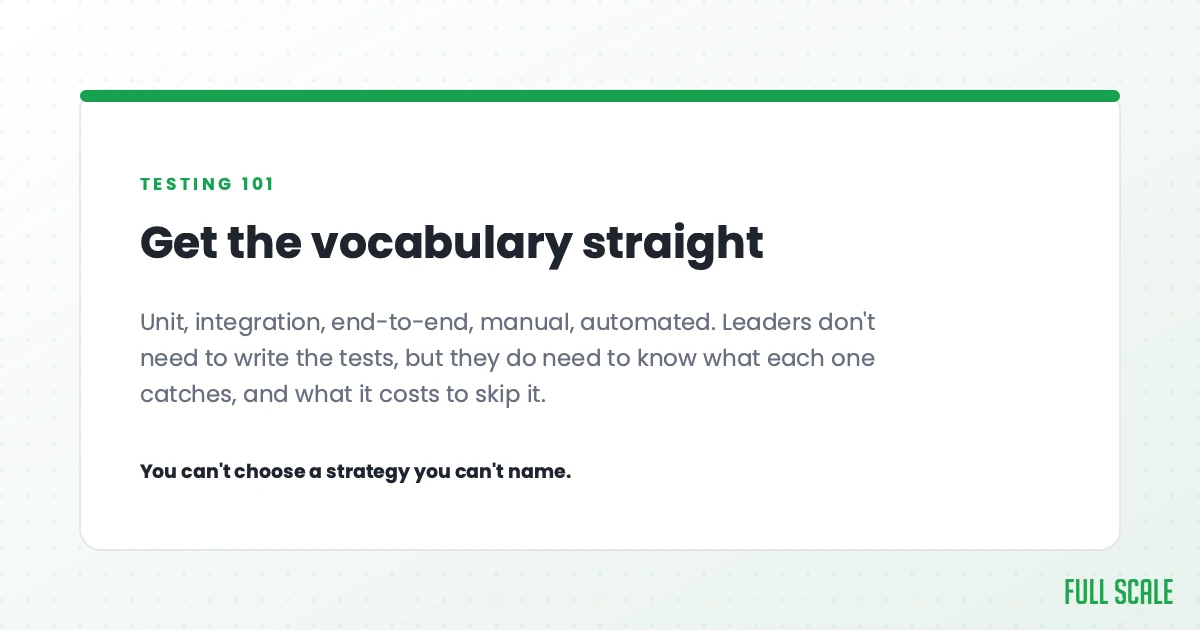
Most articles on this topic lump four different things into one bucket and call them all “methodologies.” That confusion is why these conversations go sideways. Four words get used interchangeably and they mean very different things.
A testing methodology is the strategy: when and how testing happens relative to how you build. Waterfall, V-Model, Agile, and DevOps are methodologies. They answer the question, “at what point in development do we test, and under what process?” The same names show up across the popular software development methodologies, since how you build and how you test are two sides of the same choice.
A testing level is the scope of the thing under test. Unit testing checks one function. Integration testing checks modules working together. System testing checks the whole app end to end. Acceptance testing checks it against what the business actually asked for. Levels answer, “how big is the chunk we’re testing?”
A testing type is the quality goal. Functional versus non-functional testing is the main split here. Functional asks whether the thing does what it should. Non-functional covers the “-ilities,” like performance, security, usability, and compatibility. Types answer, “what aspect of quality are we checking?”
A testing technique is how much you can see inside the code when you design the test. That’s the black box versus white box testing distinction, with grey box in between when you know some of the internals. There’s also a split between static testing, where you review code without running it, and dynamic testing, where the code actually runs.
Keep these straight and the rest gets easier: the methodology is when and how you test, the level is how big a piece you’re checking, the type is which quality goal you’re after, and the technique is how much you can see inside the code. So when a vendor calls “unit testing” a methodology, they don’t know the difference, and you should weigh their advice accordingly. These are not interchangeable software testing methods, and treating them as one blurry list is how teams end up buying the wrong thing.
The methodologies leaders actually choose between
There are six types of software testing methodologies that matter in practice. Here’s the short version before I get opinionated about them.
| Methodology | When testing happens | Best fit |
|---|---|---|
| Waterfall | After the build is done, as its own phase | Fixed, well-understood requirements; regulated rollouts |
| V-Model | Each build phase paired with a matching test phase | Safety-critical and compliance-heavy work |
| Iterative / Incremental | At the end of each build increment | Large systems shipped in stages |
| Spiral | Continuously, driven by risk at each loop | High-risk, high-uncertainty projects |
| Agile | Continuously, inside every sprint | Most modern product development |
| DevOps / continuous testing | Automatically, baked into the deployment pipeline | Teams shipping frequently at scale |
Waterfall tests at the end, after everything is built. It gets a bad reputation, and for consumer software it deserves one. But if your requirements genuinely won’t change, and a regulator needs to see a clean paper trail, testing as a discrete phase is not crazy.
The V-Model is Waterfall’s more disciplined cousin. Every stage of building has a matching stage of testing defined up front, so verification and validation are planned from day one. This is what you reach for when failure is expensive in lives or lawsuits. In regulated fields it is close to mandatory, with standards like DO-178C in avionics, IEC 62304 for medical devices, and ISO 26262 in cars.
Iterative and incremental approaches test each chunk as you finish it, which lets you find problems before they compound. Spiral adds a risk assessment at every loop, which is heavyweight but sensible when you genuinely don’t know whether the thing is even buildable.
Agile folds testing into every sprint, so quality is everyone’s job continuously instead of a gate at the end. It’s the most widely used approach in modern product work for a reason. DevOps, or continuous testing, takes that further and bakes the tests into your CI/CD pipeline so they run automatically on every change.
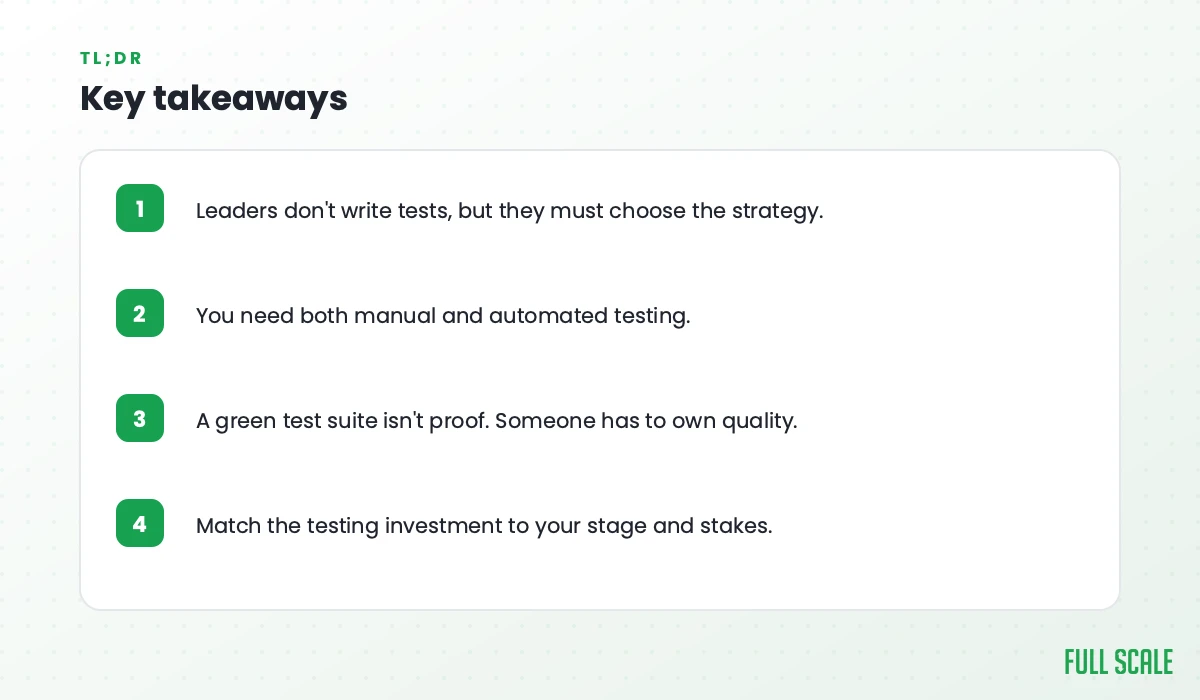
The point isn’t to crown a winner. Each one is good at something different, and the right answer depends entirely on what you’re building.
It depends on what you’re building
This is the part the textbooks skip, and it’s the only part that actually matters.
If I was writing software that flew an airplane, my testing would look nothing like the software I’d write for a little internal database that two of my employees logged into to track their vacation time. If that internal tool went down, nobody would notice and the business wouldn’t blink. If the airplane software fails, people die. The cost of a bug is what determines how much testing you can justify. No universal standard of “good engineering” sets that number for you.
Think about how you’d test a Tesla’s self-driving system. You can’t manually test a self-driving car. There’s no version of a human sitting there clicking through every scenario a car encounters on the road. It has to be automated, simulated, and run at a scale no QA team could touch by hand. The kind of software dictates the kind of testing, full stop.
At Stackify we did a lot of integration testing, because we had so many integrations with outside services. If Google changed something on their end, it could break everything we did, so those integration tests were critical. We also knew that more than 90% of our users were on desktop, so mobile testing was a low priority for us. A mobile-first company would make the exact opposite call. When AMC Theatres rebuilt their app in Flutter with our team, device and compatibility testing across phones was the whole job. Our own engineers run into a version of that same problem constantly: they’re testing apps built for US carriers and US users from the other side of the world, so mobile proxies are how they check that the app behaves the way it would for someone standing in Ohio on Verizon, not Cebu on Globe.
A pure API backend is different again. There’s no screen to click through, so your testing lives in contract and integration tests that prove the endpoints behave under load and don’t break their consumers. The happy path is easy. The failure modes are where the work is.
And then there’s the early-stage MVP, where the biggest testing mistake is doing too much of it. Unit testing can be genuinely helpful, and developers can also wildly overdo it. It makes no sense to write a unit test for every line of code in your app. I always joke that if you’re doing that, you should just use a programming language that compiles. When you’re trying to find product-market fit, elaborate test coverage on features you might delete next month is a tax on speed you can’t afford.
Here’s the honest counterweight to my zero-tests flex, though. When I left VinSolutions, I knew how all of it was supposed to work, and most of that knowledge was in my head. I don’t scale. The company had to hire something like 50 people to reverse-engineer what I’d been carrying around.
Skipping tests isn’t free. You’re borrowing against the future, and someday the loan comes due.
The real question is whether the debt you’re taking on is worth the speed you’re buying right now.
Manual, automated, and who keeps it alive
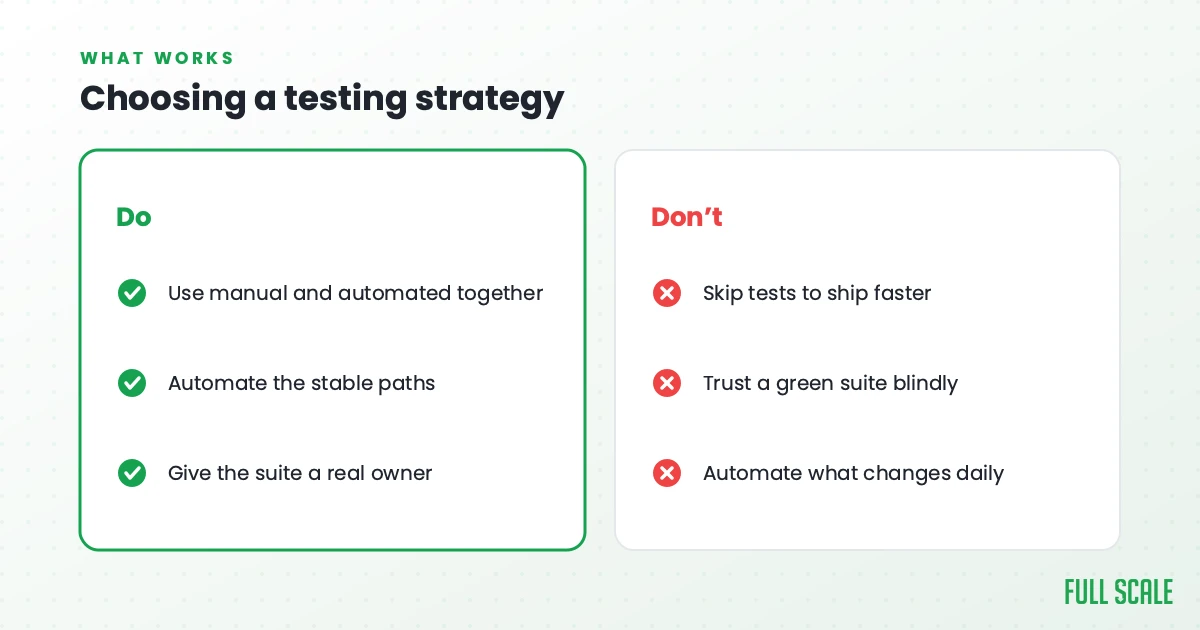
The manual-versus-automated question gets treated like a religious debate. It isn’t one. Manual and automated testing do different jobs, and mature teams run both.
The rule I keep coming back to is simple: if you want to automate something, you have to first do it manually. You can’t automate a test for behavior you’ve never actually verified by hand. Manual testing, and especially exploratory testing, is where a human tries to break your software in ways you didn’t anticipate. When you write code yourself, you naturally test the happy path, because you built it to work that way. You need somebody else to come behind you and try to break it.
Automation earns its keep on the repetitive, predictable work: regression suites, smoke tests, anything you’ll run a thousand times. But automated tests are not free money. They’re software, and software has to be maintained. If you create automated tests, you have to be genuinely committed to updating them, because the moment you change one thing, it’s going to break the test, and a wall of red builds that everyone has learned to ignore is worse than no tests at all. Your automated test suite is a codebase with its own test pyramid and its own upkeep. Budget for that or don’t start.
Who actually runs your QA
This is the decision no vendor blog will help you with, because it comes down to people and money rather than testing techniques.
You have three real options. Your developers own their own testing. You hire a dedicated QA function. Or you extend your QA capacity offshore. Most companies end up with some blend, and the right blend changes as you grow.
I’m a fan of developers owning a lot of their own quality. They should be writing their own unit tests and doing basic checks before code ever leaves their hands. I’m a believer in test-driven development when the logic is genuinely tricky or a bug would be costly, and a skeptic of it as a religion you apply to every line of code. But there’s a limit to what developers testing themselves can catch. As Jay Agnor, who runs the QA firm JDAQA, put it to me on my podcast, unit testing should not replace the need for comprehensive QA. Developers test the happy path. A real QA function exists to ask the questions your builders are blind to, and at some point you need people whose entire job is to break things on purpose.
A warning before you go shopping for that function. You can’t fix broken engineering with more process. Bolting a QA team onto a team that doesn’t understand the problem it’s solving just adds a checkpoint, not quality. I wrote a whole book, Product Driven, about how the real failures are almost never about code quality and almost always about product thinking. Testing proves your code works. It does not prove you built the right thing.
When cost pressure hits, the temptation is to hire the cheapest tester you can find anywhere on the internet. I call this cheapshoring, and it’s how teams end up paying twice. The cheapest QA contractor who needs everything spelled out and still misses the obvious is more expensive than a strong engineer at a higher rate. Skill is not where you save money.
Where you genuinely save money is the cost-of-living difference. A senior developer or QA engineer in the Philippines earns somewhere around $15 to $30 an hour locally, and an engagement runs roughly $30 to $40 an hour, against $80 to $150 an hour for comparable work in the US. The US median for software developers, QA analysts, and testers is about $133,000 a year per the Bureau of Labor Statistics, and a senior hire’s fully loaded cost runs well above that. The offshore version is a 50 to 70% reduction, and it comes from geography, not from hiring weaker people. That’s the entire basis of offshore QA done right, and it’s the model we run at Full Scale. For long-term product work with technical leadership in-house, the team model usually beats both pure in-house hiring and handing a project to an outsourcing shop. A quick, well-scoped build with no leadership to spare is one of the few cases where straight project outsourcing is the right call instead.
Distributing QA across time zones costs you something real. You lose the ability to lean over someone’s desk and clarify what you meant, and some feedback loops genuinely run slower. The trade is that your methodology has to lean harder on automation, written specs, and shift-left practices, and a distributed QA team punishes vague requirements while rewarding teams that document well. That forcing function is usually a discipline you needed anyway. If you want to staff this up, we hire QA engineers and embed them directly into your team, working your hours and your process.
What it costs to skip this
If “it depends” makes you nervous about under-investing, the economics give you a floor to work from. The cost of a defect climbs the later you catch it. According to data from IBM’s Systems Sciences Institute, a defect that costs roughly 1x to fix during design costs around 15x by the time it’s in beta and about 30x once the product has shipped. The longer a bug lives, the more it costs to kill.
The macro numbers are sobering too. A landmark NIST study found that more than half of all software defects aren’t caught until late in development or after release, exactly when they’re most expensive. More recently, the Consortium for Information and Software Quality estimated that poor software quality cost the US economy $2.41 trillion in 2022. This is the case for shift-left testing in one sentence: the earlier you find a problem, the cheaper it is, every single time.
The current frontier is AI. In Capgemini’s World Quality Report 2025-26, nearly 90% of organizations are now pursuing generative AI in quality engineering, yet only 15% have it running at enterprise scale. Everyone is experimenting and almost no one has it working at scale. The tooling is real now. AI can generate test cases, write the automation, and even repair tests that break when the interface changes. That shifts the QA staffing math more than it shrinks the headcount. The work moves from writing tests to checking whether the AI’s tests actually cover the risk. That takes a sharper eye from whoever owns QA. AI is a powerful tool that boosts productivity, but leaning on it to generate tests you don’t understand just creates tomorrow’s technical debt today. The hard part of testing was never writing the test. It’s understanding what could go wrong.
How to actually choose, by stage
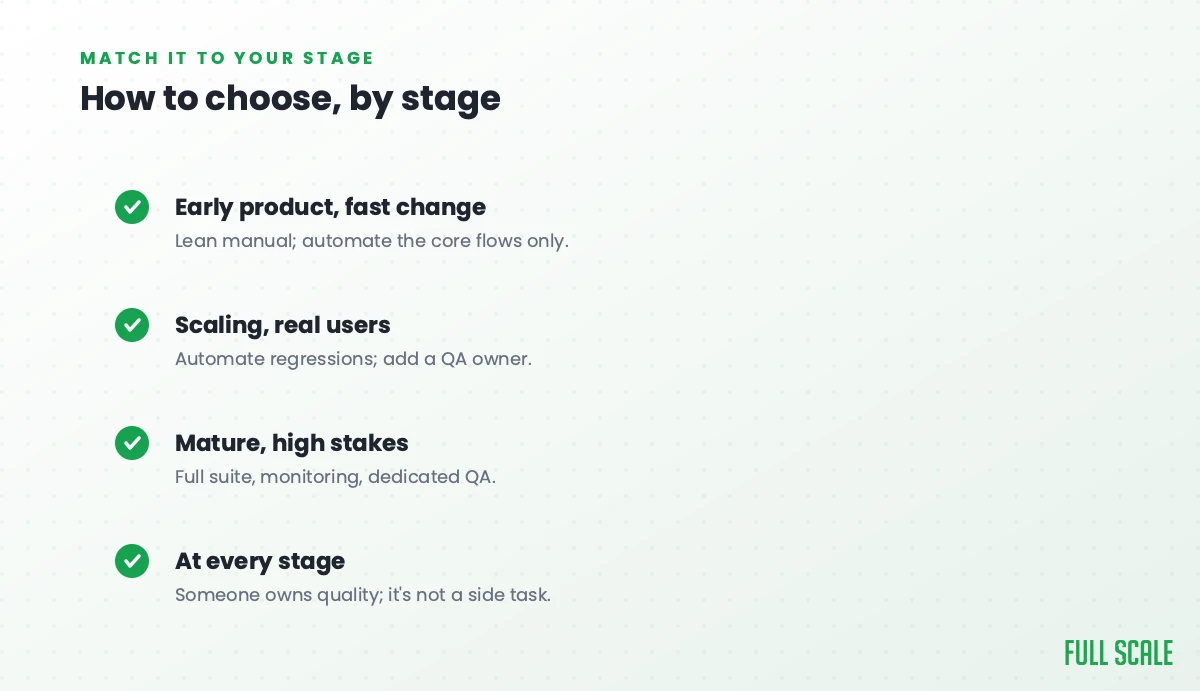
Software testing strategies should track your stage, so here’s what I’d do depending on where you are.
If you’re pre-product-market-fit, stay light. Agile, developers writing their own unit and integration tests, manual checks on the critical flows, and not much else. At this stage moving slowly is the bigger danger than shipping a bug in a feature you might delete next month. Over-testing here is a mistake.
Once you have customers who’d be genuinely hurt by an outage, add real QA. Bring in a dedicated tester or a small offshore QA pod, start automating your regression suite, and push testing left so it happens inside your sprints instead of at the end. This is the stage where most teams wait too long and pay for it in churn.
When you’re scaling, formalize it. Continuous testing in your pipeline, clear ownership, performance and security testing as first-class citizens, and a QA function sized to the cost of your failures. If you’re regulated or safety-critical, this is where a V-Model’s discipline stops being overhead and starts being insurance.
Through all of it, keep technical leadership in-house. You can distribute the hands, but somebody who owns the architecture and the standards has to be steering. Keep your testing simple and boring until the cost of a bug tells you it can’t be.
Frequently Asked Questions
What is the difference between Agile and Waterfall testing?
Waterfall testing happens as a separate phase after the software is built, which works when requirements are fixed and well understood. Agile testing happens continuously inside each development sprint, so defects are caught as features are built rather than at the end. Most modern product teams use Agile because it gives faster feedback, while Waterfall still fits regulated or fixed-scope projects.
How do I choose the right testing methodology for my project?
Start with what you’re building and what a failure costs. Safety-critical or regulated software justifies a rigorous, verification-heavy approach like the V-Model. Consumer products and SaaS usually fit Agile with continuous testing. Early-stage MVPs should stay light and avoid over-investing in test coverage on features that may change. The kind of software, your stage, and your risk tolerance decide the methodology for you. There is no universal best practice that applies to every project.
What is the difference between testing methodologies, levels, and types?
A methodology is the overall strategy for when and how you test, such as Agile or Waterfall. A level is the scope of what’s under test, from unit to integration to system to acceptance. A type is the quality goal, such as functional, performance, or security testing. They describe different dimensions of testing, so a single project uses all three at once.
Should QA testing be in-house or offshore?
It depends on your budget and how your team is structured. Keep technical leadership and architecture ownership in-house, then extend QA capacity offshore to control cost, since equivalent work runs 50 to 70% cheaper in regions like the Philippines because of cost of living. Distributed QA works best when you lean on automation, clear documentation, and shift-left practices to bridge the time-zone gap.
How much should a startup spend on software testing?
Spend in proportion to what a bug would cost you. Pre-product-market-fit, that means very little beyond developers testing their own work. Once an outage would lose you customers, invest in dedicated or offshore QA and start automating regression. The goal is to match your testing investment to your risk and let that set the coverage you actually need.
Get the right testing methodology and the right team behind it
Choosing a methodology is the easy half. Staffing the people to run it well, without blowing your budget, is the part that actually decides whether your software ships clean. If you’re weighing how to build or extend your QA team, schedule a call with Full Scale and we’ll help you figure out what fits.