
Head of Engineering vs. CTO: Which One Your Startup Actually Needs

In this article
- What a CTO actually does
- What a head of engineering actually does
- Head of engineering vs. CTO: the side-by-side
- So which one does your startup actually need?
- The most expensive mistakes founders make here
- How AI is changing what both jobs really are
- You still need technical leadership in-house
- Frequently asked questions
- The bottom line
Most founders asking about head of engineering vs. CTO are really asking a different question. They want to know which person to hire next, and what to call them. Getting that hire right matters, because it shapes how investors judge an early-stage engineering team. Whoever owns hiring has to reckon with why senior engineers got so hard to hire.
I’ve sat in both seats. I was the founder and chief technology officer (CTO) of VinSolutions, which we bootstrapped to $35 million in annual recurring revenue and sold for around $150 million. I did it again as the founder and CTO of Stackify. In the early days of both, I was the CTO, the head of engineering, and the engineer who got paged at 2 a.m. when the database fell over. So I have opinions about where the line between these two roles actually sits, and where founders draw it in the wrong place. Before you hire either one, it is worth deciding whether you even need a technical co-founder at all.
Here’s the short version.
A CTO decides what to build and why. A head of engineering makes sure it actually ships.
The titles get treated as interchangeable, especially at startups, and that’s where the trouble starts. Below you’ll find what each role really does, when you need one versus the other, and why the answer is changing as artificial intelligence (AI) takes over the parts of the job that used to define it. It’s also why the challenges that come with the CTO job look so different than they did five years ago.
What a CTO actually does
The CTO is the outward-facing technical leader. The job is to connect technology to the business, not to run the daily standup.
On a normal week, a startup CTO is setting the technical direction for the next two or three years, deciding what to build in-house and what to buy, and sitting across from investors who want to know whether the architecture will survive 10x growth. When the product team wants a feature that needs six months of plumbing, the CTO is the one who finds the two-week version that gets 80% of the value. The role is closer to the chief executive officer (CEO) and the board than it is to the codebase.
Most CTOs back into the title by accident. They were the first technical hire, or a founder who could code, and the company grew up around them. One day they look up and they’re the chief technology officer without ever having decided to be one. That’s normal, and it’s fine, as long as someone eventually grows into the strategic half of the job instead of staying the smartest engineer in the room. The same confusion shows up one level over, in how a CTO and a CPO divide the work. The line between the CTO and the chief information officer blurs the same way, so I sorted out how the CIO and CTO roles split separately.
The CTO owns the questions that don’t have a right answer: which bets to make, which to skip, and how today’s choices will help or haunt you in two years.
What a head of engineering actually does
The head of engineering is the inward-facing leader. The job is to build and run the team that ships the product.
That means hiring, onboarding, performance reviews, retention, sprint planning, release management, and the on-call rotation. When a launch slips three weeks, the head of engineering is the one explaining why. When you grow from 5 engineers to 20 and everything that used to work over lunch suddenly breaks, this is the person who redesigns how the team communicates, reviews code, and deploys so velocity survives the growth.
One thing worth clearing up: “head of engineering” is a fuzzy title on purpose. At one company it means vice president (VP) of engineering. At another it’s the director of engineering. At a 12-person startup it’s just the senior-most engineer who picked up the management work because somebody had to. The title floats. The function does not. Whoever holds it is accountable for the team and the shipping.
If the CTO answers “what should we build,” the head of engineering answers “how do we ship it, on time, without the team burning out.”
Head of engineering vs. CTO: the side-by-side
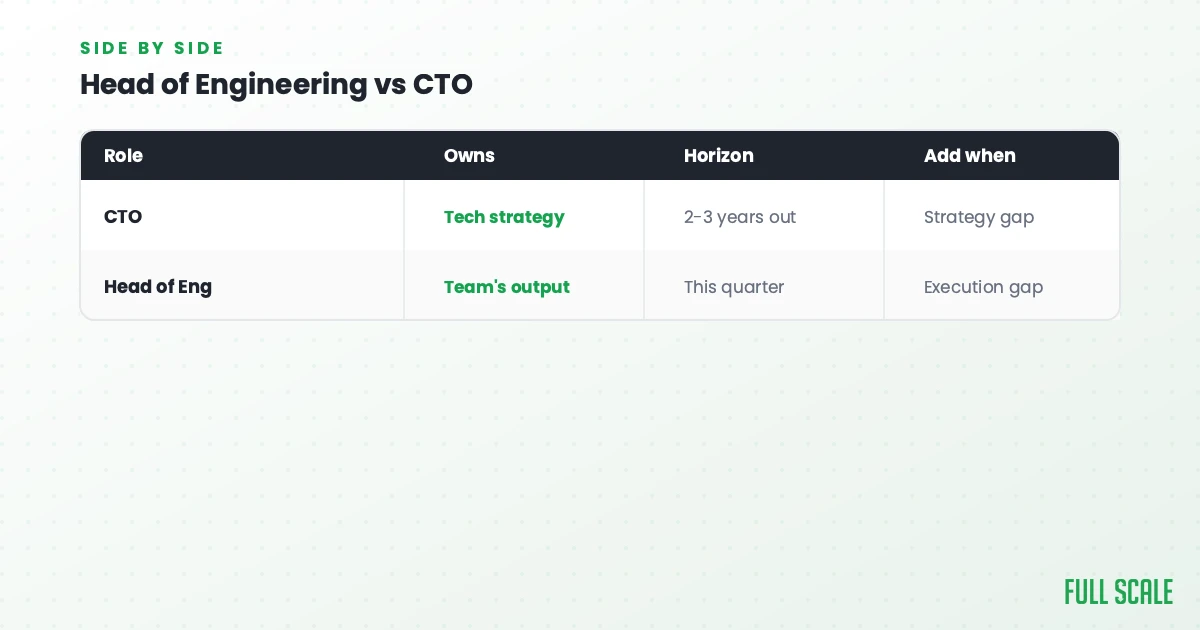
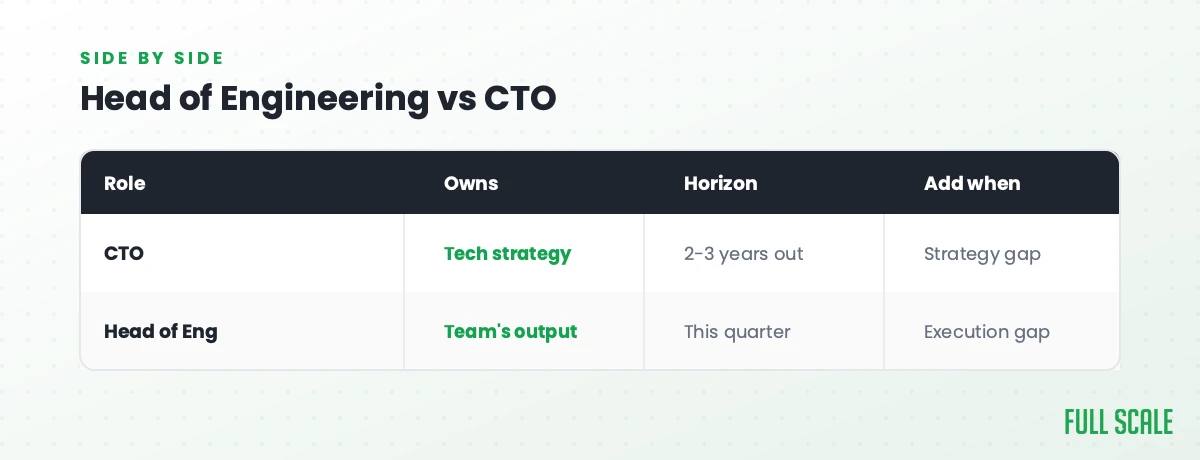
Here’s how the two roles compare on the dimensions that matter when you’re deciding which one to hire.
| Dimension | CTO | Head of engineering |
|---|---|---|
| Primary focus | Technology strategy and vision | Team and delivery |
| Faces | Outward: board, investors, market | Inward: engineers, process, shipping |
| Core question | What should we build, and why? | How do we ship it reliably? |
| Owns | Architecture bets, build vs. buy, tech direction | Hiring, sprints, releases, retention |
| Measured by | Long-term technical advantage | Shipping velocity and team health |
| Time horizon | 1 to 3 years | This sprint to this quarter |
Read it top to bottom and the pattern is clear. These are different jobs that happen to share a hallway, and the skills barely overlap. One is about deciding direction. The other is about getting a group of people to deliver against it.
The reason it’s worth getting right: when you hire for the wrong one, you don’t find out for months. Bring in a pure team-builder when what you actually lacked was technical direction, and the team hums along building something nobody needed. Bring in a big-picture strategist when the real problem was that releases kept slipping, and the slipping doesn’t stop.
So which one does your startup actually need?
This is the real question, and the honest answer depends almost entirely on your stage.
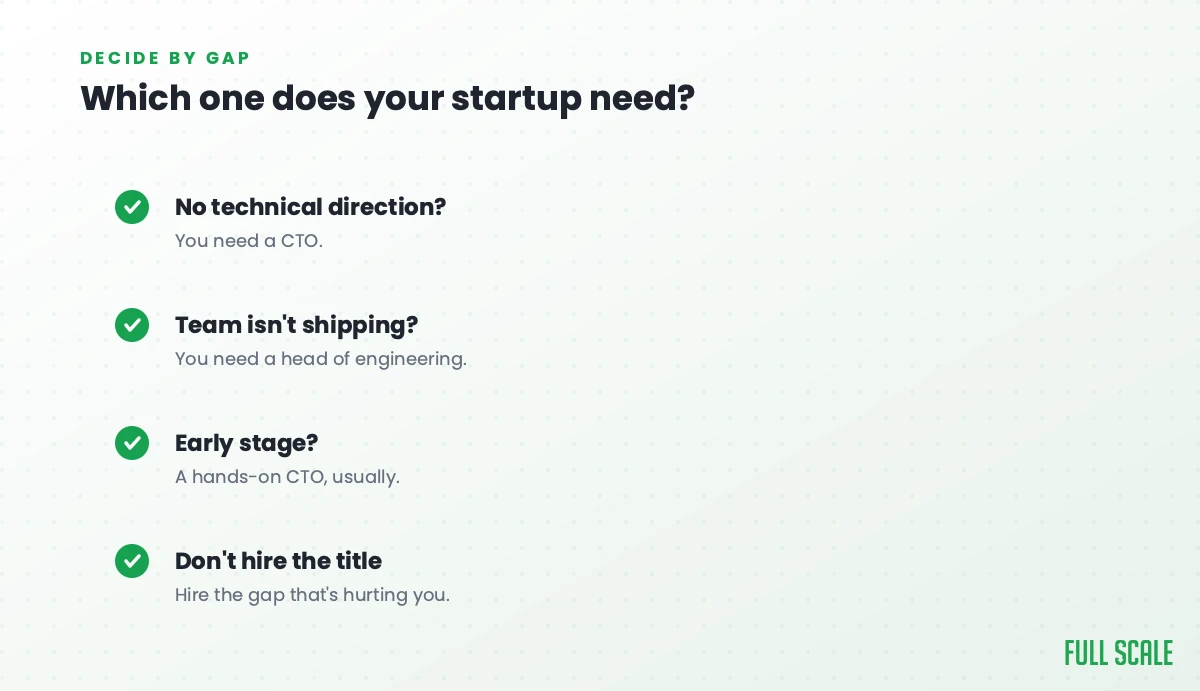
Under 15 engineers, you need one person doing both, and that person is usually you or your first senior hire. At this size you don’t need formal engineering process, because the whole team can coordinate over a sandwich. What you need is someone who can make architecture calls and also lead the handful of people writing the code. Splitting the role this early just creates two part-time leaders where you needed one full-time one.
Somewhere around 15 to 20 engineers, the seams start to show. The strategic work (board decks, technology bets, the next fundraise) becomes a full-time job. So does the people work (managing managers, fixing the hiring pipeline, keeping good engineers from leaving). One person can’t hold both anymore, and the half that usually gets dropped is the team management, because the strategy work feels more urgent. Then your best engineers quit because nobody is investing in them, and you can’t figure out why.
That’s the moment to split the role. In most companies the head of engineering then reports to the CTO, and the CTO reports to the CEO. If your CEO is technical, sometimes both report straight to the CEO as peers, though how a CEO and a CTO actually differ is its own question worth getting right. Either structure works. What kills you is leaving it ambiguous.
One more pattern I’d push back on: if you’re a non-technical founder with no senior engineer yet, the strategic gap is your biggest risk, so the CTO-shaped role comes first. You can hire a great team manager, but they can’t fill the vacuum that exists when nobody on the founding team can evaluate an architecture or interview an engineer. That is exactly the gap a fractional CTO is built to close before you are ready for a full-time hire.
The most expensive mistakes founders make here
I’ve watched founders get this wrong in the same few ways, and every one of them is costly.
The most common is promoting your best engineer into the leadership seat. Being the strongest coder on the team has almost nothing to do with being able to manage people or set strategy. Both of those are separate skills that have to be learned. You can lose your best individual contributor and gain a miserable, struggling manager in a single promotion.
The second is title inflation. Founders want a “CTO” on the cap table for credibility, so they hand the title to someone who is really a head of engineering, then are surprised when that person can’t hold their own in front of investors. Give people the title that matches the job you actually need done.
The third is hiring both at once and watching them fight over turf. Bring one in, let them define their domain, then add the second with a clear line between who owns what.
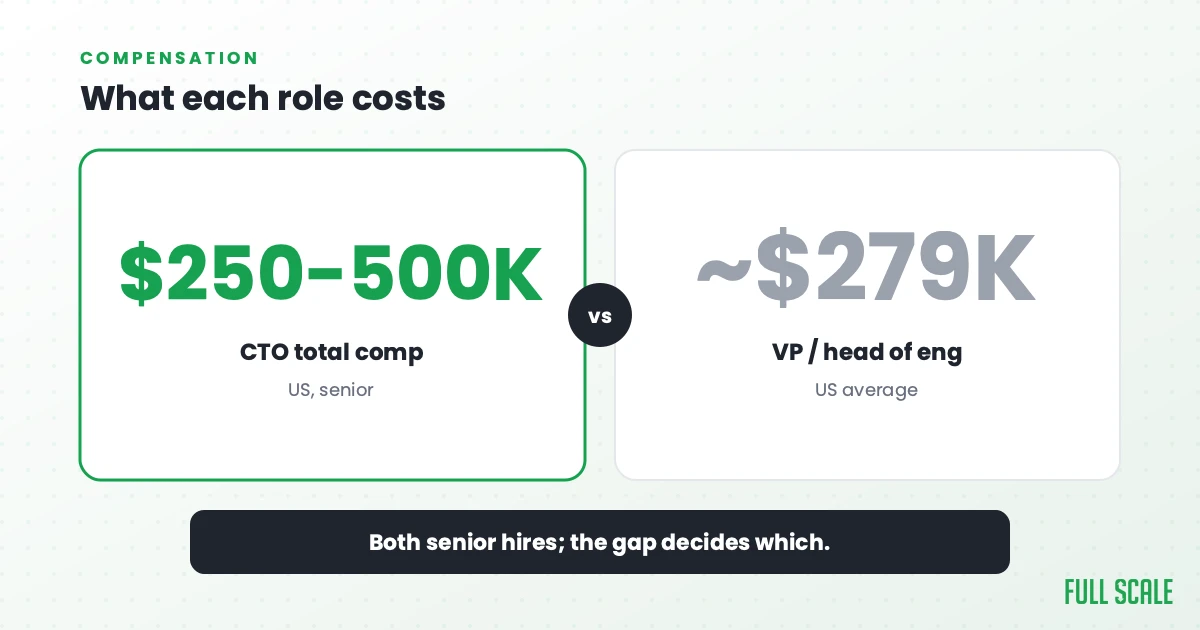
The fourth shows up in the budget. A full-time CTO in the US is a $250,000 to $500,000 total-compensation hire, and a VP of engineering runs around $279,000 on average, with the CTO usually carrying a 20% to 40% premium for the board-level work (here’s how CTO pay actually breaks down). The sticker number undersells it, too. The fully loaded cost of an employee runs about 1.25 to 1.4 times base once you add benefits, payroll taxes, equipment, and recruiting. Hiring the wrong leader, or both before you’re ready, is one of the most expensive timing mistakes a startup can make.
How AI is changing what both jobs really are
If you’re reading a head of engineering vs. CTO comparison written in 2026 and it never mentions AI, it’s already out of date.
For most of the last 20 years, the value of an engineering leader was tied to how well they understood the code. The CTO had the deepest architectural judgment. The head of engineering had run the most sprints. AI is quietly pulling that apart, because the mechanical part of the work, the typing and the boilerplate, is the part AI does best. What’s left over is the part it can’t do: deciding what’s worth building, catching the design that’s about to back you into a corner, and getting a team of people aligned and moving.
My line on this hasn’t changed.
Pure coders will be replaced by AI. Problem solvers will run technology organizations.
That changes what you’re hiring for in both roles. The CTO’s edge is no longer knowing the most frameworks; it’s judgment about which bets to make when the cost of trying things has dropped to near zero. The head of engineering’s edge is no longer having shipped the most code; it’s getting clarity and direction into a team that can now generate code faster than it can agree on what the code should do. AI also makes the judgment more important, not less, because the volume of plausible-looking output has gone up. One recent study found that 45% of AI-generated code carried a known security flaw, and the bigger models were no safer. Somebody with taste still has to be in charge.
This is the whole argument of my book, Product Driven. The skills that decide whether a team succeeds now are communication, curiosity, and courage, not raw coding throughput. When you’re choosing between a CTO and a head of engineering, or hiring either, those three are what you’re really screening for. The org-chart box matters far less than whether the person has them.
You still need technical leadership in-house
Whatever you call the role, here’s the rule I’d bet on:
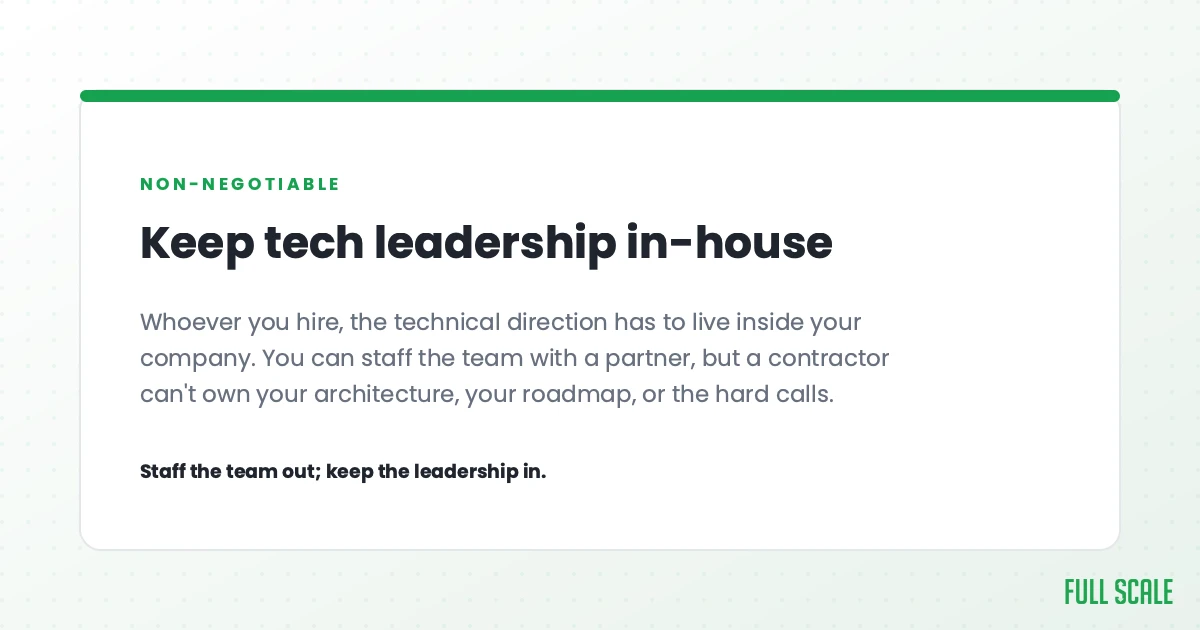
You always need technical leadership in-house.
That’s the one part you can’t outsource. The vision, the architecture calls, the accountability for what ships have to live with someone on your own team. What you don’t have to do is build the entire senior engineering org around that leader at US prices.
This is the work I do now at Full Scale. We help companies keep their CTO or head of engineering in-house and build the team underneath them with senior developers in the Philippines, as a long-term part of their own team rather than a project shop on the other side of a wall. Our developers join your standups, your tools, and your roadmap. Recruiting senior people who already have jobs and aren’t looking is one of the hardest parts of the leader’s job, and it’s one of the things we’re actually built to do, which is part of why we keep 93% of our engineers year over year and stay Great Place to Work Certified in the Philippines.
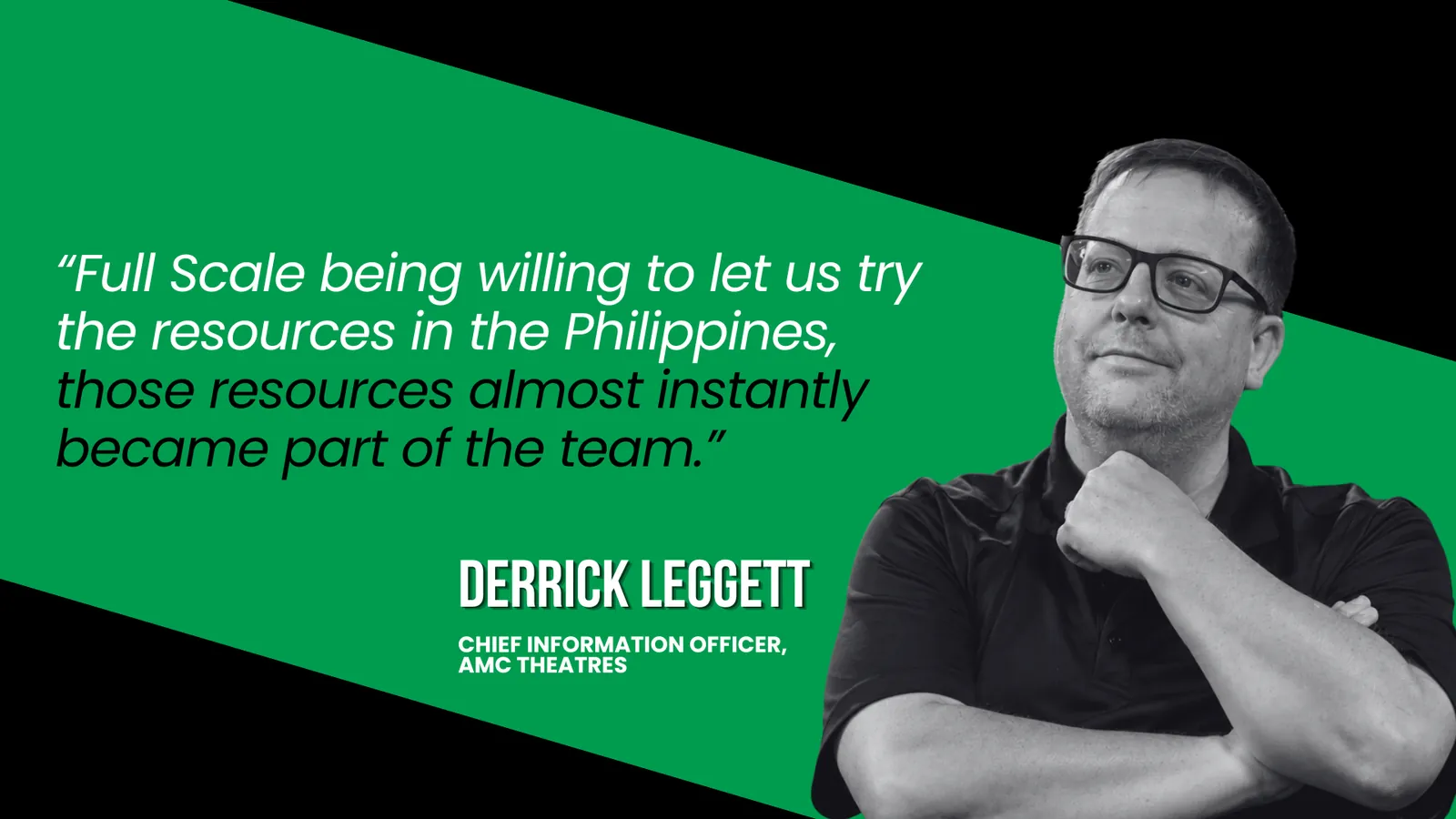
AMC Theatres is the clearest example I can point to. Their chief information officer, Derrick Leggett, runs a global engineering organization where the Full Scale developers are treated as full AMC engineers, not contractors held at arm’s length. The leadership and the standards are theirs. The team is built across borders. That’s the model that works: strong leadership in-house, a strong team wherever the talent is. Both roles live or die on engineering leadership, the ability to multiply a team rather than carry it. If you’re wondering how that CIO seat fits next to the roles in this post, I broke down what a CIO actually does separately.
If you’ve already got the leader and you need to build the team affordably, that’s an affordable staff augmentation conversation, and it’s the cheaper half of this whole problem to solve.
Frequently asked questions
Can one person be both the head of engineering and the CTO?
Yes, and under about 15 engineers they usually should be. At that size the company can’t justify two leaders, and the same person can make the architecture calls and run the small team. The roles split as you scale because the strategic work and the people-management work each grow into a full-time job, typically somewhere around 15 to 20 engineers.
Does the head of engineering report to the CTO?
In most companies, yes. The usual structure is head of engineering reports to the CTO, and the CTO reports to the CEO. At companies with a technical CEO, the CTO and head of engineering sometimes both report directly to the CEO as peers. The structure matters less than making ownership clear: the CTO owns strategy and external communication, the head of engineering owns the team and delivery.
Is a head of engineering the same as a VP of engineering?
Often, but not always. “Head of engineering” is an informal label for whoever leads the engineering organization, and at many companies that person carries the VP of engineering title. At others, the head of engineering is a director of engineering, or just the senior-most engineer running the team at an early-stage startup. The title varies by company size and stage; the function (owning the team and the shipping) is what stays constant.
Which role pays more, CTO or head of engineering?
The CTO usually does. At companies with both, the CTO typically earns 20% to 40% more in total compensation than the head or VP of engineering, mostly because of the board-level accountability and external visibility. In the US, a VP of engineering averages around $279,000 in total compensation, while a full-time CTO commonly lands between $250,000 and $500,000-plus depending on stage and equity.
Should a startup hire a CTO or a head of engineering first?
It depends on what’s broken. If you’re a non-technical founder with no senior engineering leadership, hire the CTO-shaped role first, because the strategic gap is your biggest risk. If your strategy is set but the team can’t ship reliably, hire the head of engineering first to professionalize delivery. Under 15 engineers, one person should cover both.
The bottom line
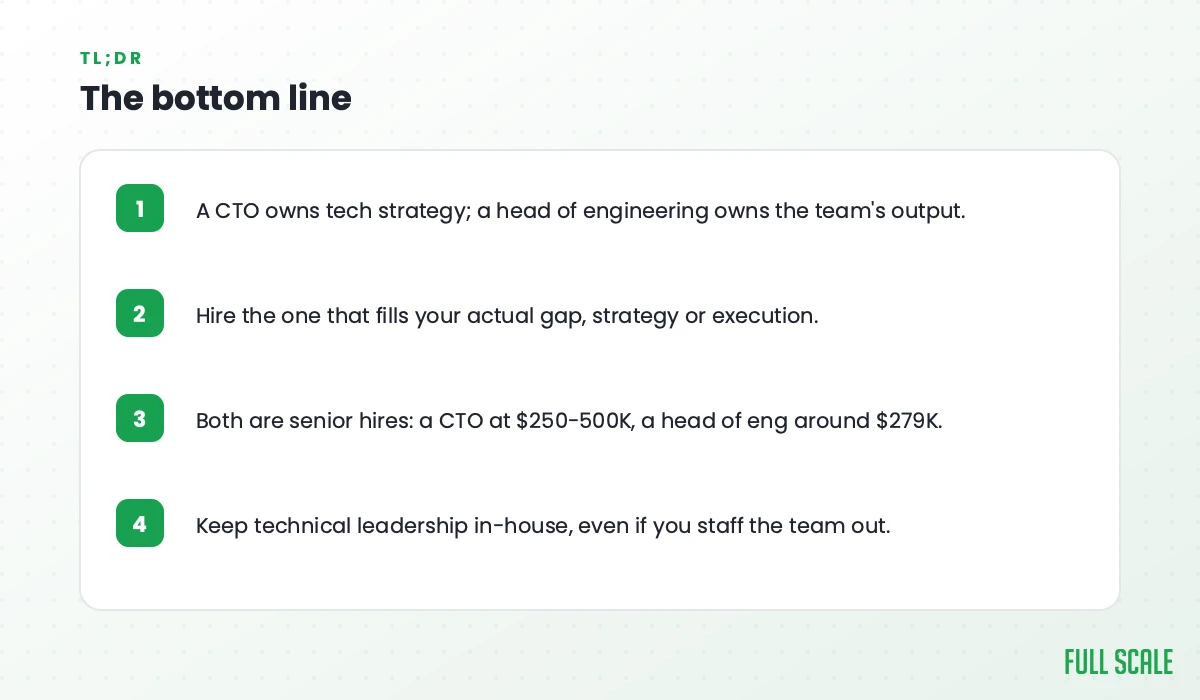
Stop agonizing over the title. Figure out which job your company needs done right now: someone to decide what to build and carry the technical strategy, or someone to run the team and make sure it ships. Early on that’s one person. As you scale past 15 or 20 engineers, it becomes two. And in 2026, whichever role you’re hiring for, you’re really hiring for judgment, communication, and the courage to make calls, because AI now handles the part that used to be the job. Building those specific skills is most of what the better podcasts for CTOs are actually about.
Keep the leadership in-house. Build the team wherever the best people are.
If you’ve got the leader and need to build a senior engineering team without paying US prices for every seat, book a quick call and we’ll talk through what your team should actually look like.