
Junior, Mid-Level, and Senior Developers in the Age of AI


In this article
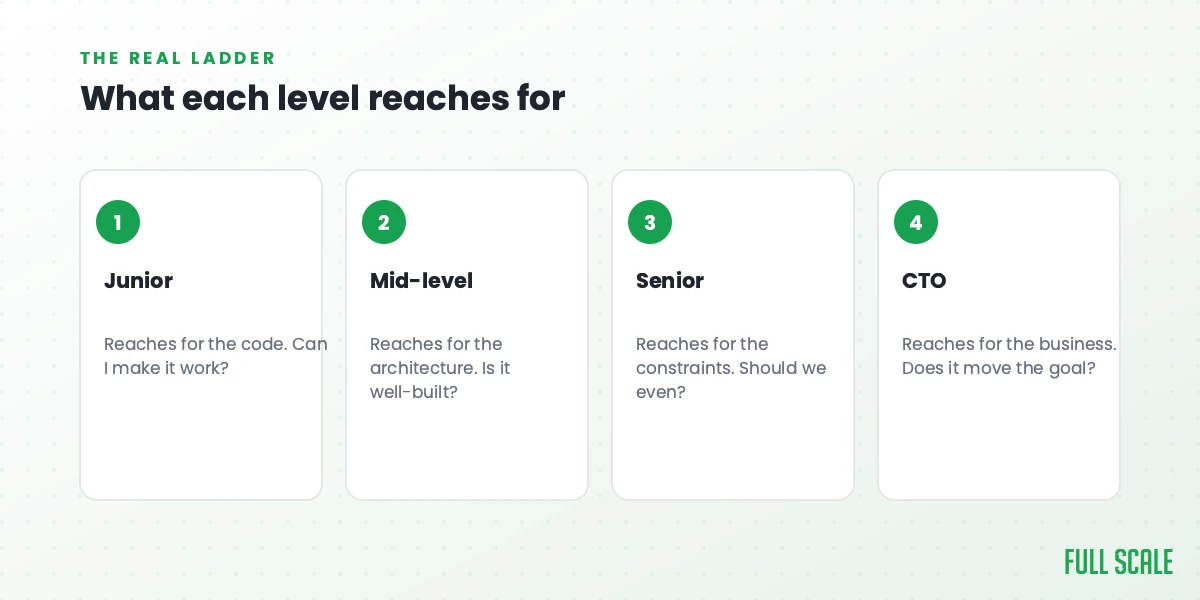
- The junior developer reaches for the code
- The mid-level developer reaches for the architecture
- The senior developer reaches for the constraints
- The CTO reaches for the business
- The levels were never really about years
- The junior developer
- The mid-level developer
- The senior developer
- And then there’s the CTO
- How AI is rewriting the ladder
- So which level should you actually hire?
- Frequently asked questions
- The title was never the point
Ask a junior, a mid-level, a senior developer, and a CTO the same technical question and you’ll get four different answers. Not because three of them are wrong, but because each one is solving a different problem. If you want the bigger picture beyond these three, here is how the full set of software engineer levels stacks up from junior all the way to CTO. The same ladder applies when you hire C# developers: match the level to the work, not the resume.
I’ve hired at every one of these levels across four companies over the last twenty years, and I’ve sat in all four seats myself. I started as a software engineer, became a CTO, and now I run Full Scale. The fastest way to understand what really separates junior vs mid level vs senior developers is to watch how each one answers the same question.
So let’s ask one.
“We need to add a real-time activity feed to our app so users can see what their teammates are doing. How should we build this?”
The junior developer reaches for the code
A junior developer hears that question as a coding challenge, and the first instinct is to reach for the most interesting tool.
“We should use WebSockets. I just read about Socket.io, or we could stand up a Node.js server with the
wslibrary. The frontend fires an event every time something happens, the server broadcasts it, and every connected client gets the update. I can have a prototype hacked together this afternoon.”
It’s all about how to build it right now. Nothing about what happens when a connection drops, what it costs to run, or whether the feature is even worth building. That’s not a knock on juniors. It’s the level. The focus is on syntax and mechanism, because that’s the part of the job they’re still mastering.
The mid-level developer reaches for the architecture
A mid-level developer has been burned by a few naive solutions, so they think bigger. Sometimes too big.
“Rolling our own WebSocket server will bite us on scaling. Let’s use managed pub/sub like Pusher or AWS IoT Core to handle the connections. On the backend we emit every action as an event into a Redis queue, a worker consumes it and publishes to the pub/sub layer, and we store the history in MongoDB for fast reads when someone logs back in.”
This is real command of infrastructure and scale. The problem is the habit of building for a million users when you have a hundred. The mid-level developer assumes the requirement is fixed and wants to build it “the right way,” which often means more moving parts than the problem actually needs. The focus moved from syntax to tools.
The senior developer reaches for the constraints
A senior developer does something the first two didn’t. They question the question.
“Before we spin up any infrastructure, how real-time does this actually need to be? If a ten-second delay is fine, we poll a new endpoint against an indexed table in the database we already have. Half a day, zero new infrastructure. If product insists on instant updates, I’d use Server-Sent Events over WebSockets, since we only need to push data to the client. And what are the permission rules? We have to filter these events by who’s allowed to see them before we broadcast anything.”
The senior is hunting for ways to avoid writing code and adding complexity. They’re thinking about security, about the maintenance bill three years out, and about whether the simplest version solves the real need. The focus moved again, this time to business value and risk.
The CTO reaches for the business
The CTO doesn’t care about the protocol at all.
“What metric is this feed supposed to move? Is it going to lift retention, or did a couple of loud customers ask for it? If it’s a real priority, I still don’t want our core team spending three weeks building and babysitting feed infrastructure when the roadmap is full. Let’s price a third-party API like Stream. If the cost fits our margins, a mid-level dev ships it in a few days on their SDK, and our senior people stay on the product only we can build.”
This is build versus buy, opportunity cost, and where the team’s hours go. The CTO treats software strictly as a way to get a business outcome. The focus is strategy and capital.
Here’s the whole spectrum in one view.
| Level | Sees the problem as | Primary goal |
|---|---|---|
| Junior | A chance to write exciting code | Make it work |
| Mid-level | An architecture puzzle to optimize | Make it scalable and modern |
| Senior | A complexity and maintenance risk | Make it simple and reliable |
| CTO | A use of capital and team time | Drive business value efficiently |
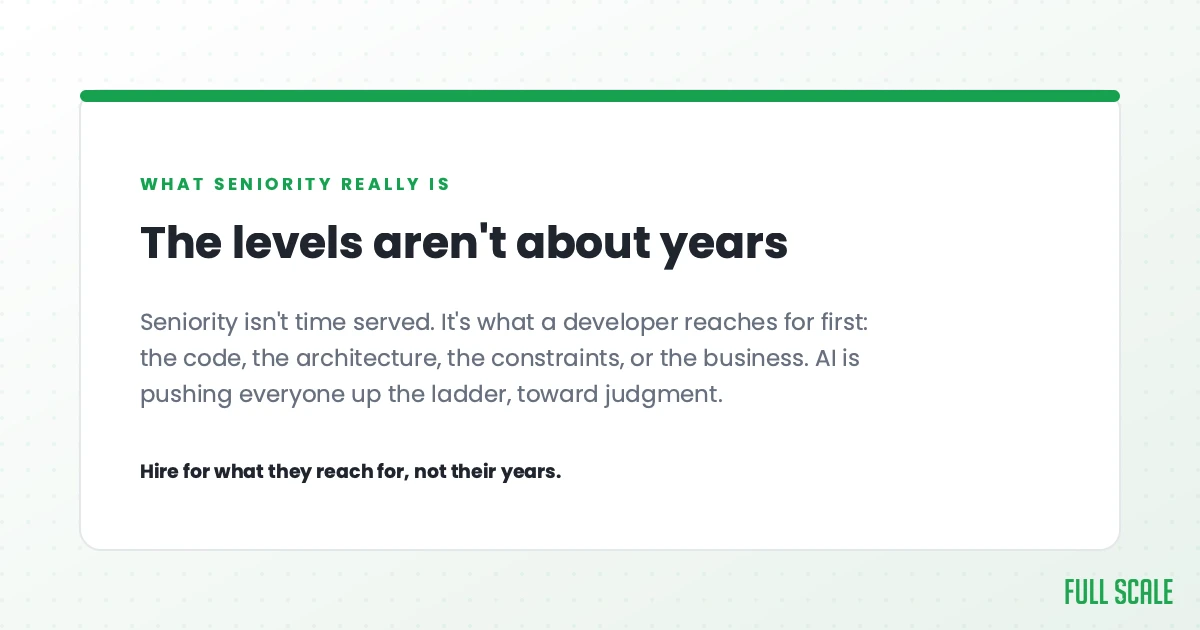
The levels aren’t really about years of experience or how much syntax you’ve memorized. They’re about how much of the problem you can see. And AI just scrambled the whole ladder.
The levels were never really about years
You’ll see neat year ranges everywhere: zero to two years is a junior, two to four is mid-level, five to eight is senior. They’re a useful shorthand and not much more. I’ve met five-year developers who still think like juniors and two-year developers who already think like seniors. The real ladder is scope. How big a problem can someone own without you holding the other end of it? If you’re trying to make that shift yourself, here is what we look for when we hire senior engineers.
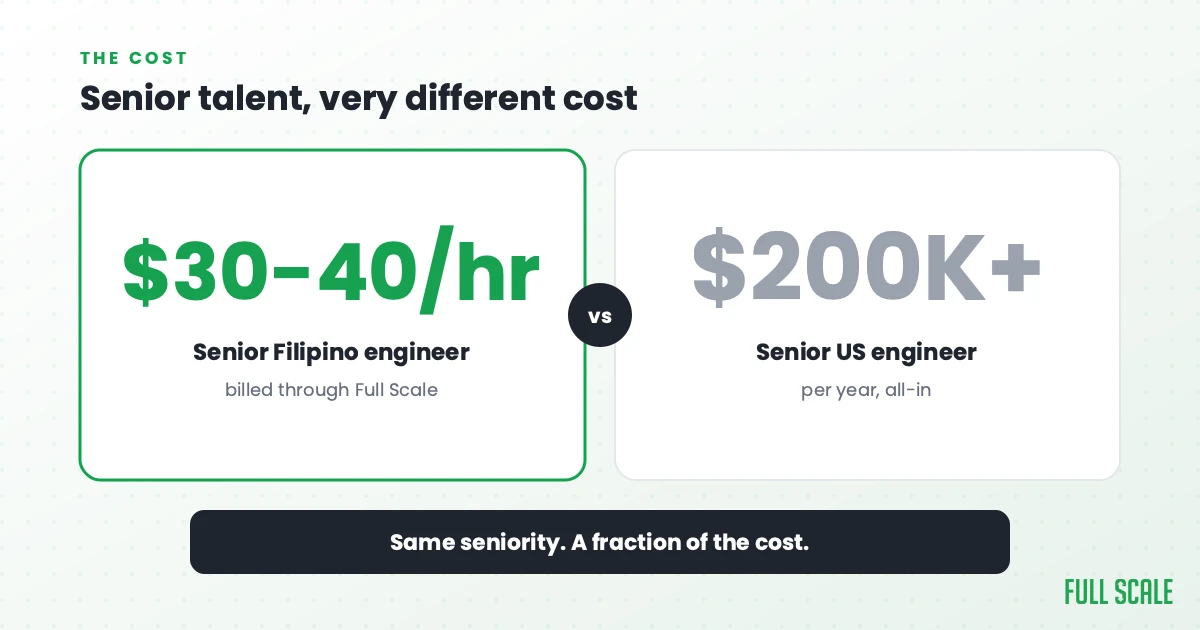
That scope question has a price tag, which is exactly why it matters to anyone hiring. The U.S. Bureau of Labor Statistics puts the median software developer salary around $133,000, and a senior with five or more years lands roughly $150,000 to $185,000 in base pay. Add benefits, payroll taxes, equipment, and overhead at the standard 1.25 to 1.4 multiplier and your real cost for one senior engineer clears $200,000 a year. When a senior costs that much, “which level do I actually need” stops being an HR question and becomes a budget question.
The junior developer
Juniors are genuinely good for a lot of work. Well-scoped tasks, clear features, and the everyday blocking and tackling that fills most backlogs. You don’t need veterans for basic blocking and tackling, and you shouldn’t pay for them. Hiring college grads also matters for building long-term talent inside your own walls, because today’s junior is the senior you don’t have to recruit in four years.
The trap is staffing a team mostly out of them.
Nothing will kill a startup faster than entry-level software developers. Not because they’re bad at their jobs, but because they don’t yet know what they don’t know. Without senior judgment above them, nobody catches the expensive mistakes until they’ve already gotten expensive.
Junior developers and AI
AI changed what a junior looks like on the surface. A junior with an AI assistant can produce code that looks like a senior wrote it. The output got better. The judgment underneath it did not.
That’s the new risk. A junior who leans on AI for everything may never build the instinct to know when the answer is wrong.
Vibe coding only works if you’ve been coding long enough to know when the AI is wrong. A junior who can’t tell good output from bad is just shipping confident mistakes faster than before.
The mid-level developer
The mid-level developer is the underrated workhorse of most teams. They ship features end to end, they don’t need their hand held, and they’re often the ones actually mentoring the juniors day to day. Pound for pound, they’re frequently the best value on the team, capable enough to own real work without the senior price tag.
AI helps this level the most. A mid-level developer who uses it well closes a big part of the execution gap with seniors. What’s left is the judgment: knowing which problem to solve, when to push back on a requirement, and when to say no. That gap is the entire game, and it’s the thing AI can’t hand you.
The senior developer
A senior developer’s value shows up before any code is written. They find the right problem first, own the architecture and the tradeoffs, and multiply everyone around them through code review and mentorship. Look back at the activity-feed example: the senior created the most value by asking whether we needed to build the thing at all. You don’t need rockstar developers nearly as much as you need rockstar requirements, and the senior is usually the one supplying them.
Senior developers and AI
Here’s the part nobody planned for. AI made writing code cheap. It did not make reviewing code cheap.
So the bottleneck moved.
Senior developers now spend their days reviewing and cleaning up an endless stream of AI-generated pull requests, from the juniors and from the AI itself. The slow, human work of deciding whether code is actually correct landed squarely on the most expensive people on the team. Relying on AI to generate code nobody fully understands creates tomorrow’s technical debt today. The hard part of software development was never the typing. It’s understanding the problem you’re trying to solve. Matching the right level to the work is also the first step in building a 10x engineering team.
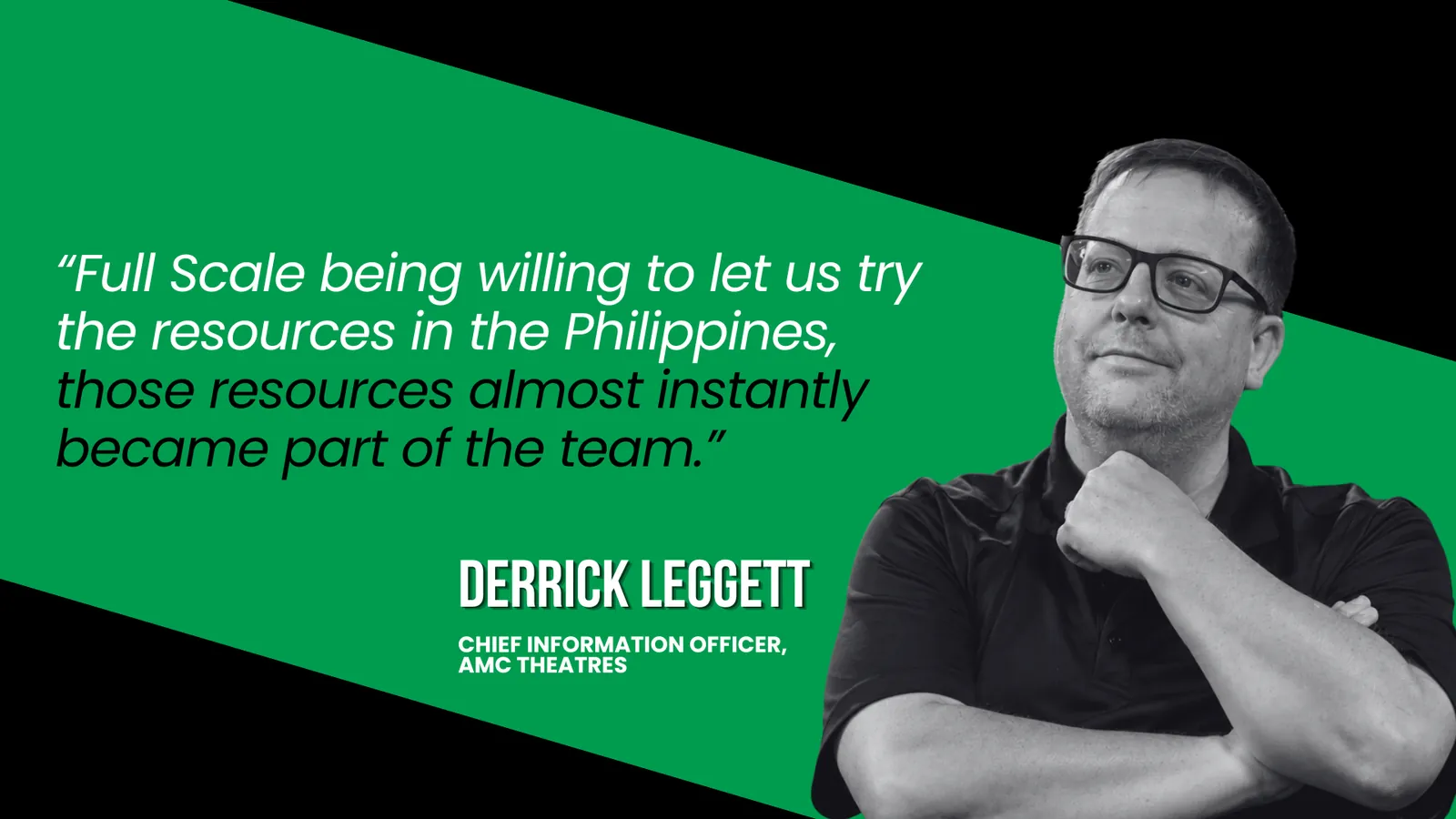
That doesn’t mean seniors should avoid AI. It means the opposite. As Derrick Leggett, the CIO of AMC Theatres, put it: “People who don’t adopt AI and learn how to use it are going to be working at 30%, 50%, 80% of what the person sitting next to them is.”
And then there’s the CTO
The CTO answers the same question with the widest lens of all. The CTO in our example didn’t weigh WebSockets against Server-Sent Events for a second. They weighed three weeks of the team’s time against everything else that time could buy, and asked whether buying beat building.
That’s the job. Software as a way to get a business outcome, not as the outcome itself.
My own path ran software engineer to CTO to CEO, and the senior-most view was never about writing more code. It was about holding more context. A CTO is really a senior developer who zoomed out far enough to see the whole business in the frame.
How AI is rewriting the ladder
The old arrangement was simple. Juniors wrote the code, seniors reviewed it and made the calls. AI now writes a lot of the code, so leaders are openly asking a question that would have sounded ridiculous two years ago: what is a junior even for?
My answer is to hire for curiosity and problem-solving, not for how fast someone produces syntax. The mechanical part of the job is the part AI does best. What’s left is human: understanding the problem, working with people, and the judgment to know when the machine is wrong. In my book Product Driven, I call these the Three C’s, communication, curiosity, and courage. Curiosity is the one I tell our engineers will keep them safe, because the tools will keep changing and staying curious about them is the job now. For front-end roles, this is how to evaluate a front-end developer without over-weighting raw coding speed. The same ladder also plays out a little differently across frontend versus backend roles, since each side rewards a different mix of skills.
Pure coders will be replaced by AI. Problem solvers will run technology organizations.
But don’t stop hiring juniors. If every company decides AI replaced the bottom of the ladder, there are no seniors left in five years. You can’t grow judgment you never hired for in the first place.
So which level should you actually hire?
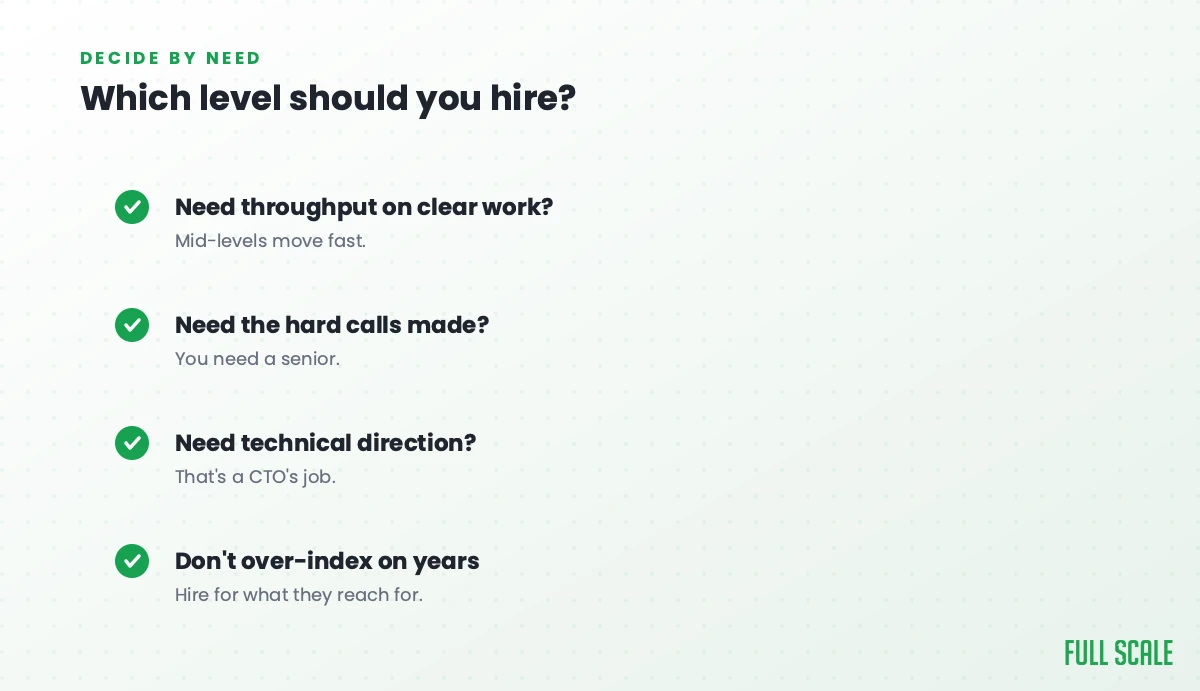
The honest answer is that it’s a mix, not a level. Match the level to the work. Scoped, well-defined work like software maintenance or a clearly specified feature tolerates juniors and mid-levels with a senior reviewing the output. Ambiguous product work, where the hard part is figuring out what to build, needs senior judgment from day one.
And don’t optimize for the cheapest body you can find. I call hiring on price alone cheapshoring, and it’s the fastest route to a pile of code nobody on the team understands. Communication and judgment beat the hourly rate every time.
This is most of what we do at Full Scale. We staff teams with the right mix of junior, mid-level, and senior developers in the Philippines, all vetted before they ever reach you. A senior Filipino engineer bills around $30 to $40 an hour through us, against the $200,000-plus all-in cost of that US senior. That gap is cost of living, not a discount on skill. If you’re trying to build a team without overloading it at one end of the ladder, offshore augmentation is one of the cleaner ways to get the mix right, and you can hire developers in the Philippines at any level you’re short on.
Frequently asked questions
What is the difference between a junior, mid-level, and senior developer?
A junior developer focuses on writing code that works and is still building core judgment. A mid-level developer works independently, ships features end to end, and starts mentoring others. A senior developer focuses on finding the right problem, owning architecture and tradeoffs, and multiplying the team through review and mentorship. The real difference is scope: how much of a problem each level can own without supervision. A competency matrix writes that scope down level by level, so two managers grade it the same way.
How many years does it take to become a senior developer?
The common shorthand is five to eight years, but years are only a proxy. What actually makes someone senior is the ability to handle ambiguity, challenge requirements, weigh tradeoffs, and own a problem end to end. Some developers reach that in three years; others never do. Judgment, not tenure, is the real marker.
Is a mid-level developer worth the cost?
Often they’re the best value on the team. A mid-level developer can own real work without the senior price tag, ships features without hand-holding, and frequently mentors juniors. For a lot of well-defined work, a mid-level developer with occasional senior review is the most cost-effective hire you can make.
Are junior developers still worth hiring now that AI writes code?
Yes, but hire them for curiosity and problem-solving rather than raw coding speed, since that’s the part AI now does well. Juniors are also how you grow your future seniors. If every company stops hiring at the bottom of the ladder because AI handles the code, there won’t be any seniors left to develop in a few years.
What does a senior developer do that a junior can’t?
A senior developer questions whether a feature should be built at all, chooses the simplest reliable approach instead of the most interesting one, anticipates how a system fails at scale, and weighs long-term maintenance cost against short-term delivery. Most of that value is created before any code is written, which is exactly what a junior isn’t yet equipped to do.
The title was never the point
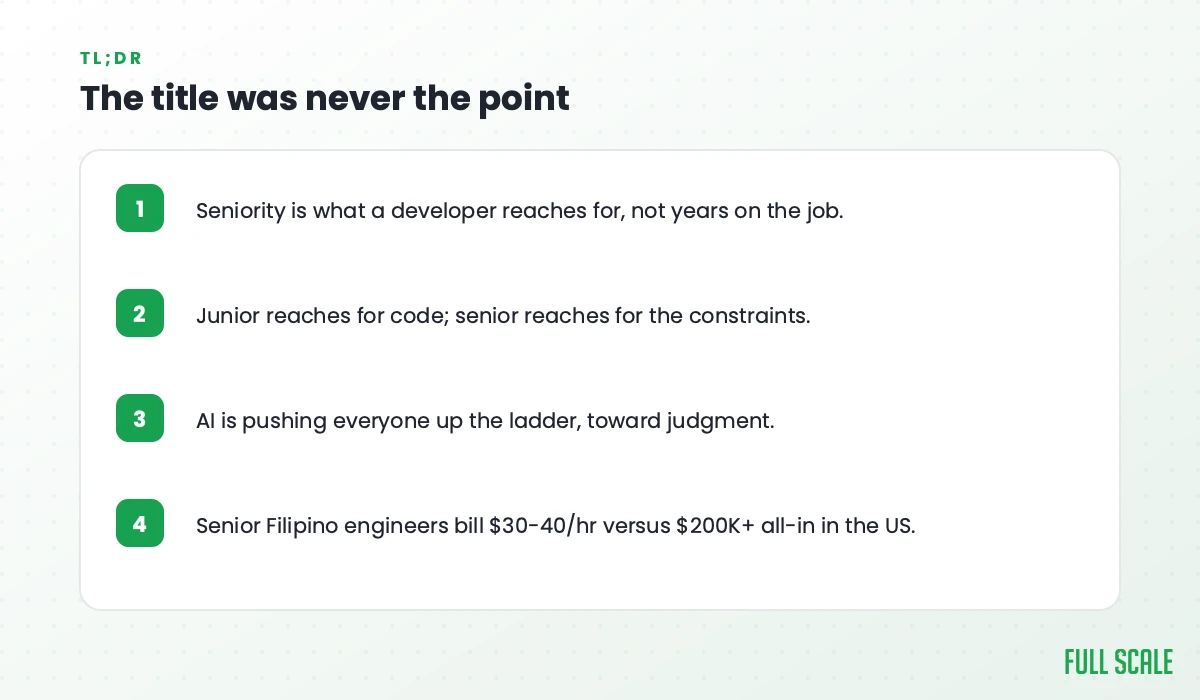
Junior, mid-level, senior, CTO. What actually separates them isn’t the badge or the year count. It’s how much of the problem they can see, and how well they understand the limits of their own answer. AI raised the floor on writing code and raised the premium on judgment at the same time. Hire for the judgment. The fourteen things we score to make that call are laid out in our engineering career ladder.