
The BPO Industry in the Philippines: From Call Centers to Code

In this article
- What is BPO?
- A short history of BPO in the Philippines
- The 1990s: where it all started
- The 2000s: the call center boom
- 2010: passing India
- The 2020s: from voice to knowledge work
- What Philippine IT-BPM actually covers today
- Why the Philippines won (and why it still wins)
- What the call center era built for software
- The headwinds the industry is facing
- Is the BPO industry good for the Philippines?
- Frequently asked questions
- The next chapter
When I started building a team in the Philippines back in 2018, I wasn’t betting on a marketing pitch. I was betting on something the country had spent almost three decades proving it could do. That scale is a big reason so many companies outsource to the Philippines.
Most people know the Philippines as the call center capital of the world. Fewer people know how the business process outsourcing (BPO) industry in the Philippines actually got there, and even fewer connect that history to what the country can do now. That scale is also why US outsourcing policy matters to the Philippines, where BPO is now a pillar of the economy.
The short version: a 30-year head start in running other companies’ operations is exactly why software development works there today.
That’s the part the cheap-labor story misses.
Quick Answer: Business process outsourcing in the Philippines started in 1992 with one of the country’s first contact centers. Government incentives in 1995 and a wave of multinational call centers in the late 1990s and 2000s turned it into a major industry. By 2010 the Philippines passed India as the world’s call center capital, and today the sector earns about $40 billion a year and employs roughly 1.9 million people.
What is BPO?
BPO stands for business process outsourcing. It means paying an outside company, usually in another country, to run a business function for you instead of handling it in-house.
That function can be almost anything that isn’t your core product. Customer support and call centers are the classic example, but BPO also covers back-office paperwork, finance and accounting, IT, and software development. The point is to hand off work that isn’t your core business so your own team can focus on what actually makes money.
In the Philippines, BPO grew from a single call center into one of the largest parts of the national economy. That climb took about three decades. Today the biggest BPO companies in the Philippines each employ tens of thousands of people.
The Philippines is one chapter of a much longer story. For where offshoring came from before it ever reached Manila, see the history of offshoring, from 1960s factory floors to today’s staff augmentation model.
A short history of BPO in the Philippines
The industry didn’t appear overnight. It grew in clear stages, each one building on the last. Here are the milestones that matter.
| Year | What happened |
|---|---|
| 1992 | One of the country’s first contact centers opens, handling basic email and customer service work. The operation later becomes part of Accenture. |
| 1995 | The government creates the Philippine Economic Zone Authority under the Special Economic Zone Act, offering tax breaks to companies that set up in approved zones. |
| 1997 | Sykes Asia arrives, often cited as the first multinational BPO to operate in the country. |
| 1999 | eTelecare launches as one of the first dedicated call centers, founded by former management consultants. |
| 2003 | Convergys opens call centers in Manila as part of a global expansion, choosing the Philippines alongside India. |
| 2010 | The Philippines is named the world’s call center capital, employing about 525,000 people and earning $8.9 billion, according to industry reporting at the time. |
| 2020-2021 | The sector holds up through the pandemic, shifts to work-from-home, and crosses the million-worker mark. |
| 2025 | The industry earns roughly $40 billion in export revenue and employs about 1.9 million people, per the IT and Business Process Association of the Philippines. |
Each phase taught the workforce something the next one needed. The 1990s built the first call floors and the laws around them. The 2000s scaled that into a real industry, and the 2010s made the Philippines the default home for voice work. By the 2020s, the work itself was climbing the skill ladder.
The 1990s: where it all started
The usual starting point is 1992, when one of the country’s first contact centers opened its doors. The work was simple by today’s standards, mostly email responses and basic service requests.
What changed the trajectory was policy. In 1995, the government created the Philippine Economic Zone Authority under President Fidel Ramos. PEZA gave foreign companies tax holidays and a smoother path to operate, as long as they located inside approved economic zones.
That single decision turned a cost advantage into an actual industry. Cheap labor existed in a lot of countries. A government that made it easy and tax-friendly to set up shop did not.
The first multinationals followed. Sykes Asia set up in 1997. eTelecare, started by former management consultants, opened in 1999. By the end of the decade, the Philippines had the legal foundation, the first big operators, and a growing pool of workers who could do the job.
The 2000s: the call center boom
The 2000s were when the industry stopped being a curiosity and became a real part of the economy.
Convergys opened call centers in Manila in 2003. More followed. The work was still mostly voice, customer support for American banks, telecoms, airlines, and retailers, handled overnight from the other side of the world.
The growth rate was steep all through the decade. Whole districts in Manila and Cebu filled up with 24-hour office towers built around the American workday. Cebu’s share of that buildout now houses most of the IT companies and BPOs operating in Cebu, split between Cebu IT Park and Cebu Business Park.
What kept American companies coming back was communication. Price was only part of the draw. Filipino agents didn’t just speak English. They sounded familiar to American callers, because they grew up on the same TV shows, movies, and brands.
That matters more than people think. Anyone who has run a support line knows the difference between an agent a customer can understand and one they can’t.
2010: passing India
For years, India was the default answer for outsourcing. It had a bigger population, an earlier start, and an established tech industry.
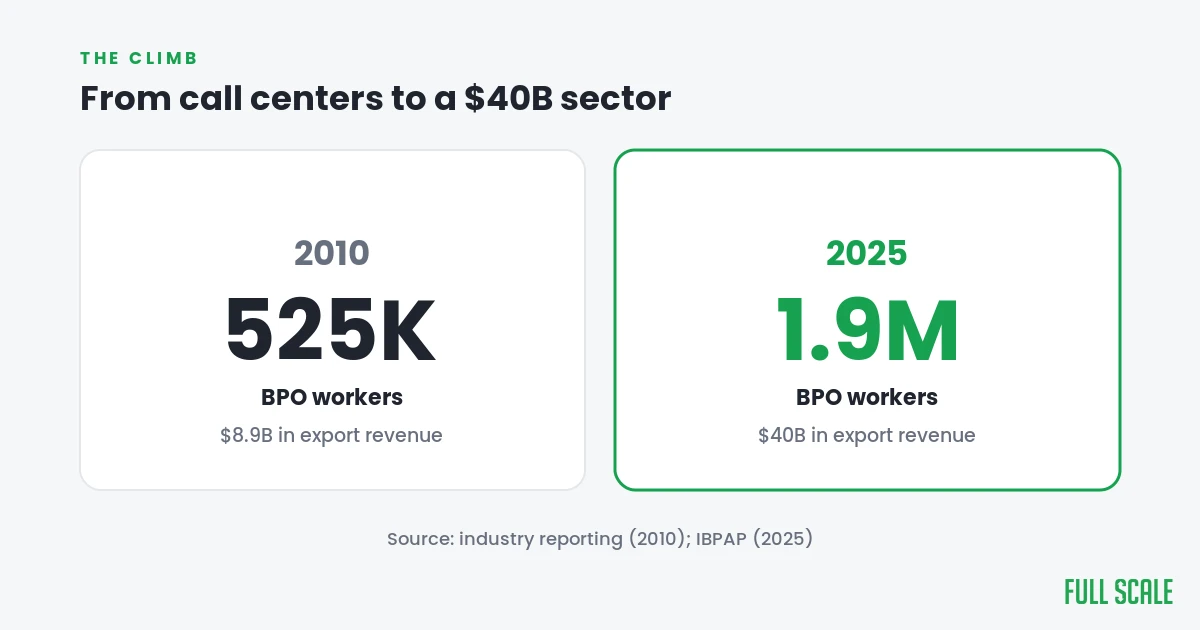
Then around 2010, the Philippines passed India in the number of call center agents and was named the world’s call center capital. The country employed roughly 525,000 BPO workers and earned $8.9 billion that year.
The win came down to voice. India kept its lead in IT services and back-office work, but for spoken customer service, the Philippines had the edge. The accent was more neutral to American ears, and the cultural fit was closer.
If you want the deeper comparison, I’ve written about the differences between hiring in India and the Philippines for software work specifically. The short version is that the same communication advantage that won the call center crown matters even more once you move past voice. It matters most of all now, given where offshore development is headed as AI reshapes the work.
The 2020s: from voice to knowledge work
Most histories of Philippine BPO stop around the call center boom. The part that matters if you build software came after it.
The pandemic could have wrecked the industry. Instead it proved the model. Hundreds of thousands of agents moved home, kept working, and the sector grew through 2020 and 2021 anyway. By 2025 it earned about $40 billion in export revenue, employed around 1.9 million people, and accounted for more than 8 percent of the country’s GDP.
The bigger shift was in the type of work, not the size.
Voice is no longer the whole story. The Philippines now does software development, IT, finance and accounting, data work, design, and other knowledge jobs that pay more and require more skill. The industry’s own roadmap targets even higher-value work and a 2.5 million-person workforce by 2028.
The industry even renamed itself to match. What people still call BPO is now usually called IT-BPM, short for information technology and business process management. The shift isn’t just branding. “Business process outsourcing” described handling a task, like answering calls. “Business process management” describes running a whole function for a company, from the software to the operations behind it. The work moved up, and the name followed.
This is the part that matters if you build software. The same country that learned to run American customer service now handles offshore development for companies around the world. The infrastructure was already there.
What Philippine IT-BPM actually covers today
“BPO” still makes people picture a call center floor, but the sector the Philippines runs now is far broader. The industry’s own name for itself, IT-BPM, spans a range of functions, and the higher-value end is where the growth is happening. That higher end, the IT in IT-BPM, is where Full Scale operates: 300+ software engineers working with US product teams since 2018.
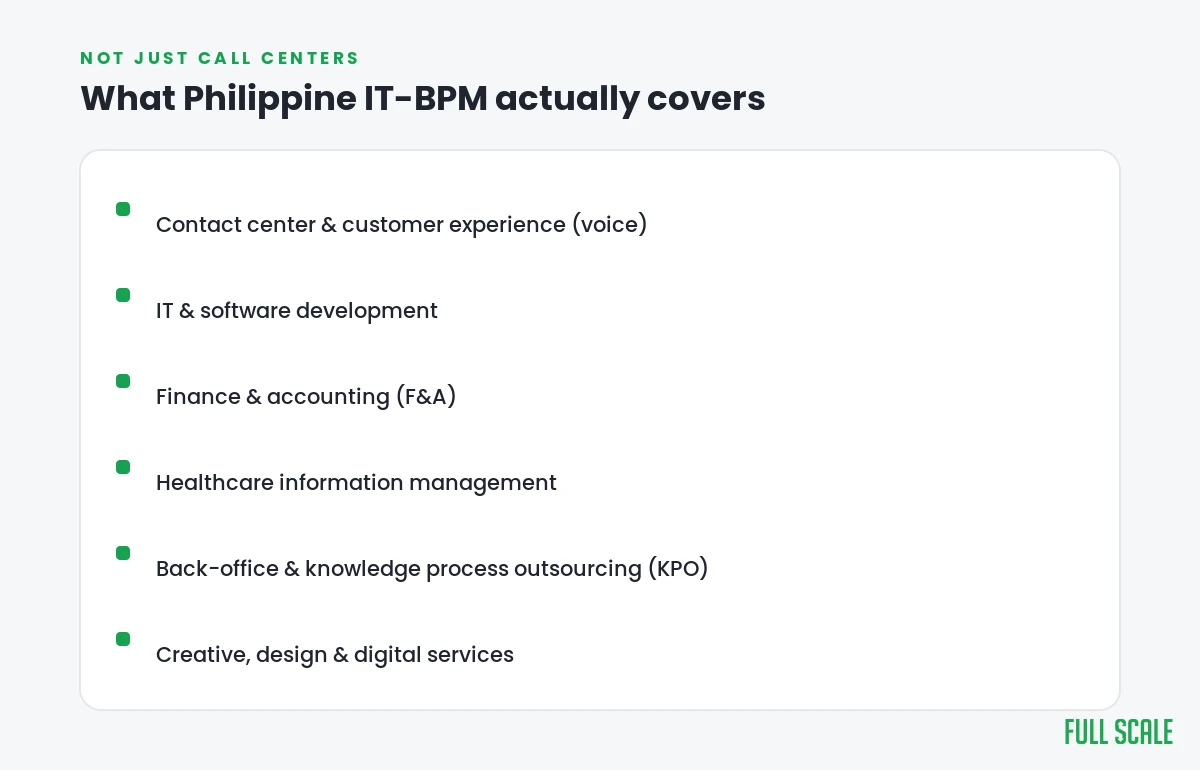
Contact centers and customer experience are still the largest slice by headcount, but the work growing fastest, and paying the most, is the knowledge work: software and IT, finance and accounting, healthcare information management, and the data-heavy back-office work that falls under KPO. That climb up the value chain is the whole reason a country known for phone support is now a serious home for engineering teams.
Why the Philippines won (and why it still wins)
The history makes more sense once you see the four things that actually drove it. None of them are an accident.
English fluency. The Philippines is the third-largest English-speaking country in the world. English is taught in school and used in business every day. There’s no language barrier, and Filipinos grow up consuming American culture, so the communication just works.
Cultural affinity. Decades of close ties with the US mean shared references, similar service expectations, and an easy working rapport. That closeness is why American callers couldn’t always tell their support agent was 8,000 miles away.
Government support. PEZA and later laws like the E-Commerce Act gave the industry tax incentives and legal footing. The state treated outsourcing as a deliberate national growth strategy and built policy around it.
Cost of living. This is the one people get wrong. Companies hire in the Philippines because of cost of living, not talent scarcity. A salary that looks modest in US dollars goes a long way in Manila or Cebu, which is why the math works for both sides.
Those four forces built the call center industry. They’re the same four that make the country a strong choice for offshoring to the Philippines today, whether the work is voice or code.
What the call center era built for software
There’s a direct line from a 1990s call floor to a 2026 software team. The call center boom built three things that high-skill remote work depends on.
It produced a workforce that’s comfortable working for foreign companies, on foreign hours, to foreign standards. It also trained a layer of local managers and team leads who know how to run that kind of operation. And over time, working remotely for an overseas employer became a normal, respected career in the Philippines.
That foundation is why software development in the Philippines isn’t starting from zero. It’s standing on 30 years of practice.
The work itself is different, of course. Writing and shipping software is harder than handling a support call, and it needs different hiring. This is also why I think the old project-shop model fails for engineering. You can’t hand a spec to a vendor and expect a great product back. Most offshore collaboration fails because people simply hand a bunch of requirements over to an outsourcing firm, then expect a successful project in return.
The version that works is staff augmentation: you hire dedicated developers who work directly for you, long-term, like your own employees. That’s the approach I lay out in Product Driven, and it’s how Full Scale runs every engagement.
This is also where Full Scale fits in the story. We’re an IT-BPM company, sitting at the IT and software end of the sector the call center years built. We don’t run phone lines, and I have laid out the actual mechanics of that split in Full Scale vs. a traditional BPO. We build and staff dedicated engineering teams in the Philippines that work directly for our clients. We’ve been on the Inc. 5000 list of fastest-growing private companies five years running, and our developer retention sits above 93 percent, because the model treats engineers as a real team instead of headcount on a spreadsheet.
If you want the broader case for the model, I’ve written up the advantages of offshoring and why so many companies outsource software development to the Philippines specifically.
The headwinds the industry is facing
None of this means the climb is guaranteed. The Philippine BPO industry has real pressures, and being honest about them is part of understanding where it’s headed.
Attrition. Turnover in the call center business is brutal, historically the highest of any industry in the country, with voluntary attrition running around 30 percent. The low-end voice work is hard, the hours are nocturnal, and people churn. It’s a big reason I built Full Scale’s software teams around retention instead, and ours sits above 93 percent.
Automation and AI. The simplest voice and data tasks are exactly the kind of work AI is starting to absorb. That’s a genuine threat to the bottom rung of the industry, and it’s the clearest argument for why the Philippines has to keep moving up into software, IT, and other work where judgment matters more than a script.
Competition. India never went away, and newer hubs in Latin America and Eastern Europe compete for the same work. The Philippines holds its edge on English fluency and cultural fit, but it has to keep earning it.
Rising costs. Success raises wages and real estate prices in the big hubs, which slowly narrows the cost gap that started everything. The answer, again, is to climb, because higher-value work supports higher wages.
The throughline is the same one running under this whole history: the low end of outsourcing is always under pressure, and the work that survives is the work that takes real skill. That’s exactly the work the Philippines has spent 30 years getting ready to do.
Is the BPO industry good for the Philippines?
It’s a fair question, and some people will tell you that outsourcing is just rich countries buying cheap labor. I took that argument seriously enough to write a full piece on the ethics of offshoring.
I see it differently, and I see it up close. Companies hire globally because of cost of living, not to exploit anyone.
That’s not a hypothetical for me. My brother-in-law in the Philippines works at Jollibee, the country’s biggest fast food chain, for about $1.25 an hour. My sister-in-law works as a virtual assistant for around $5 an hour, four times what he makes. A software job pays far more than either.
What people need more than anything is a shot. A stable career with a foreign employer, at a wage that’s life-changing locally, is a real opportunity for the person who takes it. The BPO industry created millions of those jobs and pulled a lot of families into the middle class.
The win works three ways. It’s a win for the developer who gets a real career, a win for the client who gets strong engineering at a sustainable cost, and that makes it a win for everyone running the model.
Frequently asked questions
When did the BPO industry start in the Philippines?
It started in 1992, when one of the country’s first contact centers opened to handle basic email and customer service work. The industry grew quickly after the government created tax incentives in 1995 and multinational call centers arrived in the late 1990s.
Why is the Philippines called the call center capital of the world?
Around 2010 the Philippines passed India in the number of call center agents and earned the title. The main reason was communication: Filipino agents speak fluent, neutral-accented English and share a lot of cultural common ground with American customers.
How big is the BPO industry in the Philippines today?
As of 2025 the industry earns roughly $40 billion in export revenue, employs about 1.9 million people, and makes up more than 8 percent of the country’s GDP. Industry groups project it will reach 2.5 million workers by 2028.
What is the difference between BPO and software development in the Philippines?
Traditional BPO covers voice and back-office work like customer support, data entry, and finance. Software development is higher-skill knowledge work that pays more and needs different hiring, but it draws on the same English fluency, cultural fit, and remote-work culture the call center era built.
Why do companies hire developers in the Philippines?
The main drivers are strong English fluency, cultural affinity with the US, a deep pool of experienced engineers, and a cost of living that makes competitive local wages affordable for foreign companies. Communication is usually the deciding factor over rate. It’s why Full Scale built its entire engineering bench in the Philippines, and why retention runs 93%+.
Is Full Scale a BPO company?
No, not in the traditional sense. Full Scale is an IT-BPM company that sits at the software end of the industry the call center years built: we build and staff dedicated engineering teams in the Philippines that work directly for our clients, not phone lines or back-office processing. See Full Scale vs. a traditional BPO for the actual mechanics of that split.
The next chapter
The Philippines spent 30 years proving it could run the world’s customer service. The next 30 are about running the world’s software. Full Scale made that bet in 2018, and five Inc. 5000 lists later it looks like the right one.
If you’re weighing whether to hire developers in the Philippines, that history is the real reason it works. It was never just about the rate.
Want to talk through what an offshore team could look like for your company? Schedule a call with Full Scale and we’ll walk you through it.