
React vs Angular vs Vue: How to Choose in 2026 (A Hiring-First Guide)

In this article
- The 30-second answer
- What each framework actually is in 2026
- The hiring market: the factor that should decide it
- Performance, and why it shouldn't drive your decision
- When to choose each
- The AI-era wrinkle
- The offshore reality nobody mentions
- Who builds on what
- Frequently asked questions
- The choice is about the team, not the framework
Most React vs Angular vs Vue comparisons answer the wrong question. They argue about which framework is technically best, rank them on benchmarks, and send you off with a winner. But if you’re a CTO or a founder picking a front-end framework, the technical gap between these three barely matters. All three are mature, fast enough, and capable of building almost anything. The decision that will actually shape your next three years is who you can hire, how fast, and whether the choice still makes sense when your team triples. If you are migrating off AngularJS, see our AngularJS to Angular migration guide.
I run Full Scale, and we staff React, Angular, and Vue teams for US companies as part of our website development services. I’ve watched the framework decision play out from the side that the benchmark articles ignore: the hiring market. So this guide compares the three the way a person who has to build and keep a team would, not the way a developer choosing a hobby project would.
Here’s the short version, then the detail behind it.
The 30-second answer
- React is the safe default. The largest talent pool by a wide margin, the deepest library catalog, the best AI-tooling support, and the easiest hire at every level. Its cost is freedom: it’s a library, not a framework, so a big team without conventions can make a mess.
- Angular is the enterprise choice. It hands you one enforced structure, which keeps a large or regulated org consistent. Its cost is a steeper learning curve, a smaller and shrinking talent pool, and a multi-year commitment.
- Vue is the fast, approachable middle. The gentlest learning curve, the smallest bundle, and strong developer satisfaction. Its cost in the US is hiring: the Western talent pool is small, though Vue is much bigger across Asia, which changes the math if you hire globally.
Framework choice is not a meaningful salary lever. All three pay within a few thousand dollars of each other. It’s a supply and speed-to-hire lever, and that’s how you should weigh it.
What each framework actually is in 2026
Start with current facts, because half the comparisons online are a version or two behind, and some still confuse modern Angular with the dead framework that shares its name.
React, maintained by Meta, is a UI library, not a full framework. You assemble your own stack around it: a router, a state solution, a data layer. React 19 shipped in late 2024, and the React Compiler reached its 1.0 release in October 2025, which auto-handles the memoization developers used to do by hand. React gives you the most freedom and the least structure, which is a strength for a small team and a liability for a large one without a platform team setting the rules.
Angular, maintained by Google, is the opposite: a complete, opinionated framework with one way to do most things. The current major version is Angular v22, released June 2026, and modern Angular looks very different from a few years ago. Standalone components are the default, signals are stable, and new apps run without zone.js. One caution worth stating plainly: modern Angular (version 2 and up) has nothing to do with AngularJS, the 1.x framework that reached end of life at the end of 2021. When an old article tells you Gmail or Microsoft Office “run on Angular,” that’s AngularJS, and it’s not evidence about the framework you’d choose today.
Vue, led by Evan You and a community team, sits between the two. It’s approachable like React is flexible and structured like Angular is strict, but less extreme on both. Vue 3 is current, the Composition API with <script setup> is the modern style, and a faster rendering mode called Vapor is shipping in the 3.6 beta. Vue has no Meta or Google behind it, which some buyers read as a longevity risk and others read as freedom from a corporate sponsor's priorities.
The hiring market: the factor that should decide it
This is the part the benchmark articles skip, and it's the one that matters most once you're past a prototype.
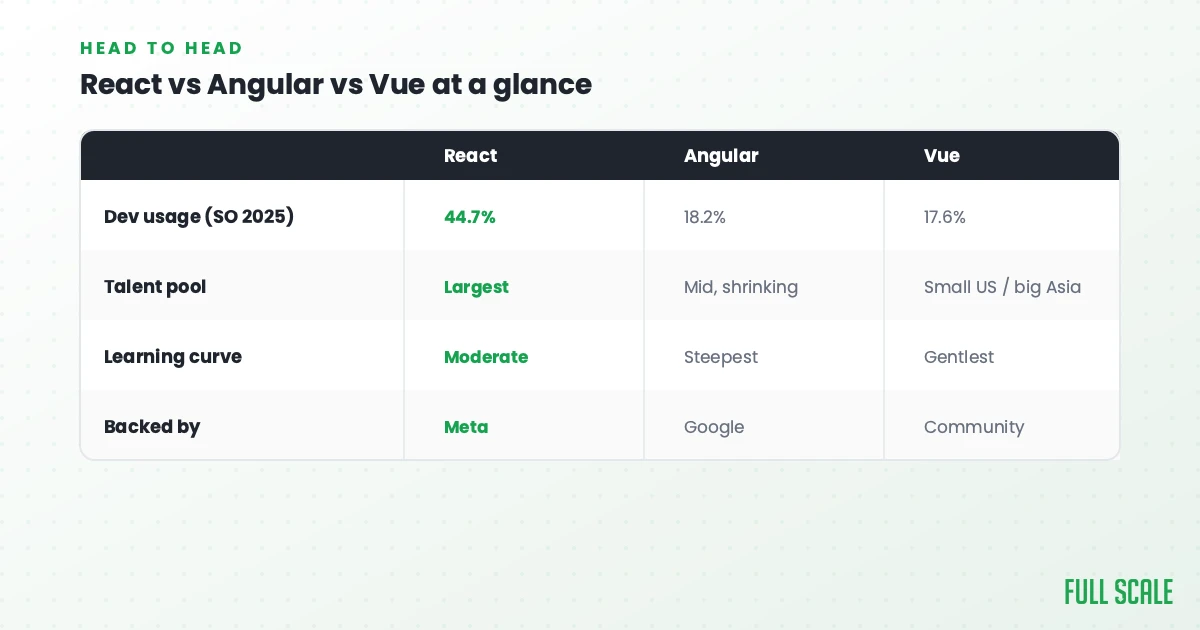
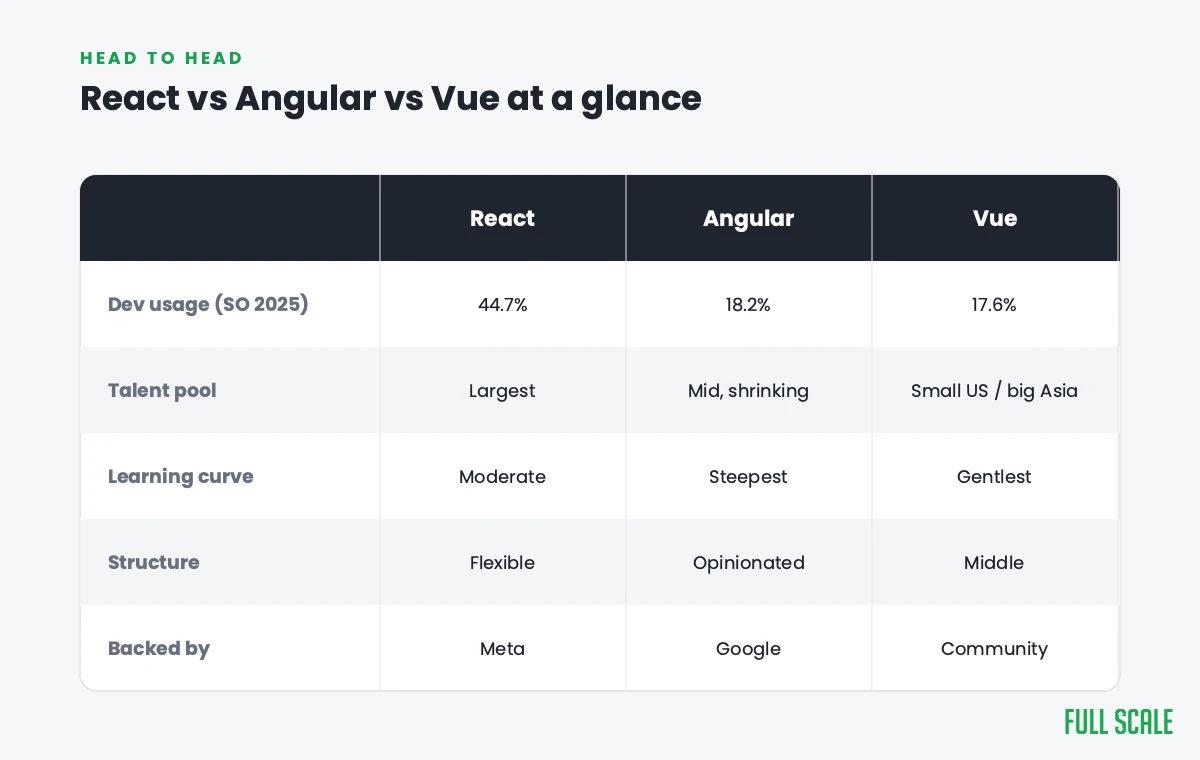
The 2025 Stack Overflow Developer Survey is the cleanest proxy for talent supply, because the share of developers using a tool is roughly the share you can hire. React sits at 44.7%, Angular at 18.2%, and Vue at 17.6%. So roughly two and a half times more developers work in React than in either of the others. Angular and Vue are close to each other globally.
The leading indicator is more lopsided. Among developers who are still learning to code, React holds 43.5% while Angular drops to 9.5%. New developers are not picking up Angular. That doesn't make Angular a bad choice, but it tells you which talent pool is growing and which is aging.
Job postings tell the same story. In the US, React openings outnumber Angular roughly two to one, and Vue roles are a small fraction of either. Senior Vue developers, in particular, take noticeably longer to find in the US market.
| React | Angular | Vue | |
|---|---|---|---|
| Developer usage (SO 2025) | 44.7% | 18.2% | 17.6% |
| Talent pool | Largest | Mid, shrinking | Small in US, large in Asia |
| Learning curve | Moderate | Steepest | Gentlest |
| Structure | Flexible library | Opinionated framework | Progressive middle |
| Backed by | Meta | Community (Evan You) | |
| Best fit | Most teams, fast hiring | Large/enterprise orgs | Mid-size apps, global hiring |
What you should take from this: salaries for the three sit within a few thousand dollars of each other, so framework choice does not change what a developer costs. It changes how many of them exist and how long the hire takes. That is the real lever.
Performance, and why it shouldn't drive your decision
If you read enough comparisons you'll see benchmark charts ranking these frameworks by render speed and bundle size. The honest ordering, from independent micro-benchmarks, puts Vue ahead of React, and React ahead of Angular, on raw runtime. On bundle size, Vue's core is the smallest at around 20 kilobytes, React with its DOM library lands around 45, and Angular is the largest.
Here's the part the charts don't say: these are micro-benchmarks, and in a real application your own code dominates the framework's overhead. The maintainers of these benchmarks say so directly. For the vast majority of business applications, a user cannot tell which of these three you used. Performance is a real tiebreaker for animation-heavy or unusually large apps, and it's noise for everything else. Don't let a benchmark chart outweigh a hiring-market reality that will affect you every quarter.
When to choose each
The decision comes down to team size, how much structure you want enforced, and where you hire.
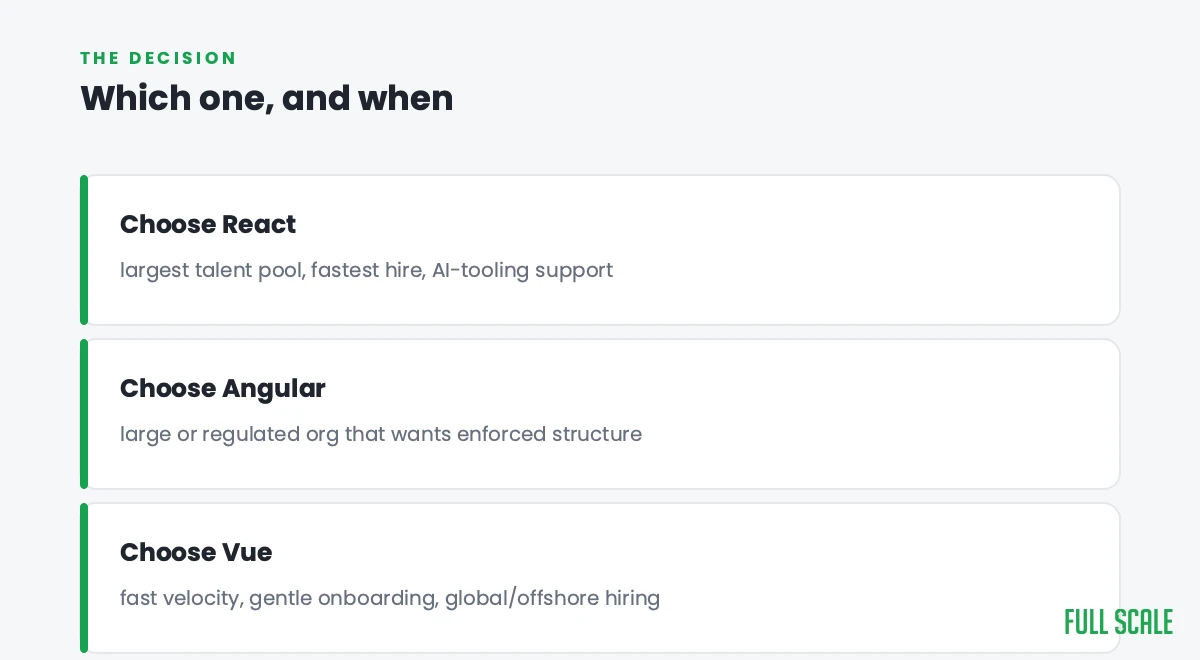
Choose React if you want the largest and fastest hiring pipeline, maximum library flexibility, and the best support from AI coding tools. It's the right default for most customer-facing products and most teams. The watch-out: past roughly fifty engineers, React's freedom needs a platform team to impose conventions, or the codebase drifts.
Choose Angular if you're a large, multi-team, or regulated organization that values enforced architecture and long-term consistency over flexibility, especially if your engineers come from a Java or .NET background. The trade-offs are real: the steepest learning curve, a smaller and shrinking talent pool, and a commitment measured in years because migrating off it is expensive.
Choose Vue if you want fast velocity on a mid-size app, the gentlest onboarding, and the smallest footprint, and either you already have Vue talent or you hire globally. The honest risk is the US talent pool, which is the smallest of the three, plus the community governance that makes some buyers nervous about the long term.
The AI-era wrinkle
There's a new factor that wasn't on anyone's list two years ago: how well AI coding tools handle each framework. AI models are trained on public code, and React has by far the most of it, so AI assistants tend to produce better, more idiomatic React than Vue or Angular. If your team leans on AI tooling heavily, that's a quiet point in React's favor.
But this cuts the other way too, and it's worth being honest about. AI is good at generating the components, which means producing the UI is no longer the scarce skill in any of these frameworks. The scarce skill is the judgment to decide what to build, to architect it so it survives growth, and to catch what the AI got subtly wrong. That judgment is framework-agnostic. It's also why we tell clients the front-end framework matters less than the developer you put on it. We wrote about what to actually screen for in a front-end developer now that AI handles the mechanical part.
The offshore reality nobody mentions
Almost every comparison treats the talent pool as if the US is the whole market. It isn't, and that changes the Vue calculation in particular.
Vue is far more popular outside the US, especially across Asia, where some of the largest technology companies build on it. If your hiring is limited to the US, Vue's small talent pool is a genuine constraint. If you hire globally or through an offshore partner, that constraint mostly disappears, and Vue's lower bundle size and gentle learning curve become easier to justify. React stays the easiest to staff anywhere because it draws from the largest developer pool in software, and a strong React hire is a short hop from any JavaScript developer. This is the lane we live in: we staff all three from the Philippines, and the framework that's hard to hire for locally is often very findable offshore.
Who builds on what
Real adoption is a useful sanity check, as long as you verify it rather than trusting a listicle.
React powers Meta's own products, plus Netflix, Airbnb, and Shopify, which built its public Hydrogen storefront framework on it. Angular runs modern apps at Forbes and Samsung, among others. Be careful with the commonly repeated Angular examples, though: Gmail, Microsoft Office, and several banks are usually cited from their old AngularJS builds, not modern Angular. Vue runs GitLab, Alibaba, Nintendo's site, the Louis Vuitton site, and BMW's US configurator. All three have serious companies behind them, so none of the three is a risky bet on longevity grounds alone.
Frequently asked questions
Is React better than Angular and Vue?
Not in a technical sense that matters for most projects. React's real advantage is its talent pool, library depth, and AI-tooling support, which make it the easiest and fastest framework to hire for and the safest default. Angular and Vue are both capable of building the same products. The right choice depends on your team, not on a benchmark.
Which is easiest to hire for in 2026?
React, by a wide margin. About two and a half times more developers use React than Angular or Vue, and React roles fill fastest. Angular has a solid but shrinking pool concentrated in enterprises. Vue is the hardest to hire for in the US, though much easier if you hire globally or offshore.
Is Angular dying?
No, but its momentum among new developers is fading. Angular usage among people learning to code is far below React's, which means its talent pool is aging rather than growing. It remains a strong, well-supported choice for large and enterprise organizations that value its enforced structure, and Google continues to ship major versions on a steady cadence.
Does the framework choice affect developer salary?
Barely. Average salaries for React, Angular, and Vue developers in the US sit within a few thousand dollars of each other. The framework you pick changes how many developers are available and how quickly you can hire them, not what they cost.
Should I pick a framework based on performance benchmarks?
Usually not. On raw micro-benchmarks Vue edges React, and React edges Angular, but these gaps are invisible to users in most real applications, where your own code matters far more than the framework. Performance is a legitimate tiebreaker for animation-heavy or unusually large apps and noise for the rest.
React vs Angular vs Vue, which should a startup choose?
For most startups, React: it's the fastest to hire for, the easiest to find contractors and agencies for, and the best supported by AI tools. A startup that already has Vue or Angular talent, or one hiring globally where Vue is plentiful, can reasonably choose differently. Match the framework to the team you can actually build.
The choice is about the team, not the framework
All three of these frameworks are good. You can build a great product on any of them, and the benchmark differences will not be what makes or breaks you. What will is whether you can staff the choice, keep it staffed, and grow it without the codebase falling apart.
So weigh React, Angular, and Vue the way you'd weigh any long-term hire: not on the spec sheet, but on availability, fit, and how it ages. React wins on availability almost everywhere. Angular earns its place in large, structured orgs. Vue rewards teams that value velocity and either have the talent or hire where it's plentiful.
If you'd rather not navigate the hiring side of that decision alone, that's what we do. Talk to us about building your front-end team, and we'll put pre-vetted React, Angular, or Vue developers in front of you who already work the way the AI era demands.