
What Is Offshore Development? The Complete Guide to Models, Costs, and Hiring

In this article
- A short history so the rest makes sense
- Offshoring vs. outsourcing vs. staff augmentation
- The three offshore models, and why only one of them consistently works
- Why the factory model breaks for software
- What modern offshore software development actually looks like
- Offshore vs. nearshore vs. onshore
- The 5 questions every CTO should ask any offshore partner
- Common objections and what’s actually true
- How to start offshoring without the usual disasters
- How Full Scale handles it
- Frequently asked questions
Quick Answer: Offshore development means hiring engineers in another country, usually the Philippines, Mexico, or Eastern Europe, to build your product for less than a US team costs. The work is identical. Only who writes it, where, and at what price changes. At Full Scale, that gap runs 50 to 70 percent while the engineers work as part of the client’s own team, not a vendor’s.
Offshore development is hiring engineers in another country to build your product. The work a developer would do in Kansas City or San Francisco gets done by a developer in the Philippines, Mexico, Poland, or somewhere else where the cost of living makes salaries lower. The output is the same code. The difference is who’s writing it, where, and at what cost. What’s shifting fastest is the job itself, which is why it’s worth understanding the future of offshore software development in the age of AI.
That’s the whole definition. Everything else you’ve read about offshoring being “a strategic relocation of business processes to optimize global resources” is the McKinsey-deck version of the same idea.
I’ve been doing this since 2018, when I started Full Scale. Before that, as a four-time founder and CTO, I tried just about every version of offshoring there is. Most of them failed. The one that didn’t is the one nobody was really selling. The Product Driven approach I lay out in my book is part of why the working version works at all. The same lesson holds for emerging specialties: I dug into the staffing reality behind virtual reality development trends, and the talent math decided what teams could actually build.
Every offshoring failure I’ve seen has the same fingerprint: a management model that never worked, dressed up in a geography label. There are smart people all over the world. The trick is being able to actually work with them.
This guide is the version of “what is offshore development” I wish I’d been able to read in 2010. It walks through what offshoring actually is, where it came from, why the standard version breaks for software, what the working version looks like, and how to tell which one you’re being sold on a discovery call.
A short history so the rest makes sense
Offshoring didn’t start with software. It started with factories.
In the 1960s, US manufacturers started moving production to Mexico under the maquiladora program. A maquiladora is a Mexican plant that imports raw materials, builds something, and exports it back to the US. The math was simple on both sides: Mexico got jobs and tax revenue, American companies got labor at a lower cost. Employment in those plants grew from a couple hundred thousand in the 1980s to over a million by the late 1990s.
The model worked because manufacturing is structured. A worker follows a process, a supervisor checks the output, quality control happens at the end of the line. The worker doesn’t need to talk to the CEO or understand the strategy. They attach part A to part B the same way every time.
Through the 1980s and 1990s, more countries got pulled in. India, China, the Philippines, Eastern Europe. The math kept working as long as the work was repetitive and the communication needs were low.
Then the internet showed up. By the 1990s, telecom got cheap enough that you could send work across the world digitally. Dell and IBM moved call centers offshore. Companies followed with back-office accounting, data entry, basic IT support. The assumption was simple: if it worked for factories, it’ll work for software.
It didn’t.
By the time anyone was willing to admit that, the model had already calcified into an industry of offshore agencies running software projects the way Mexican plants build radios. That hands-off project-shop model is exactly what breaks when you offshore the backend.
That’s the short version. For the full history, the policy shocks and the Y2K wave that actually pulled software into the mix, and the mid-2000s reckoning, see the complete history of offshoring.
Offshoring vs. outsourcing vs. staff augmentation
Offshoring is about geography, outsourcing is about who does the work, and staff augmentation is about how that work reports to you. Three terms get used like they mean the same thing. They don’t, and the confusion is responsible for most of what goes sideways.
Offshoring is about where the work happens. A US company that hires engineers in the Philippines is offshoring, whether those engineers are direct employees, contractors, or staffed through an agency. The defining feature is geography. (Full breakdown of the offshoring vs. outsourcing distinction here.)
Outsourcing is about who does the work. A US company that hires another company to handle some part of its operation is outsourcing. The other company can be down the street or on the other side of the world. The defining feature is that the work is done by an outside firm, not by employees.
Staff augmentation is about how the work gets done. A US company that adds engineers to its existing team, full-time and dedicated, is using staff augmentation. The engineers can be local or offshore. The defining feature is that they’re embedded in your team and report to your engineering manager. They aren’t handled at arm’s length by a project shop.
The reason these get tangled up is that a lot of offshore engagements are all three at once: you’re offshoring (hiring abroad), outsourcing (working with another company), and staff-augmenting (embedding engineers in your team). Staff augmentation is the version that works, and I detail it in how to structure an outsourced development team so your side stays accountable for outcomes.
The three offshore models, and why only one of them consistently works
Once you accept that “offshore” is just geography, the next question is which version of the onsite and offshore model you’re actually buying. There are three of them. Two of them lose, one of them wins, and the firms selling the losing two have no incentive to tell you which is which. I ranked how the major offshore software development companies line up on exactly that question.
Project outsourcing (the factory model)
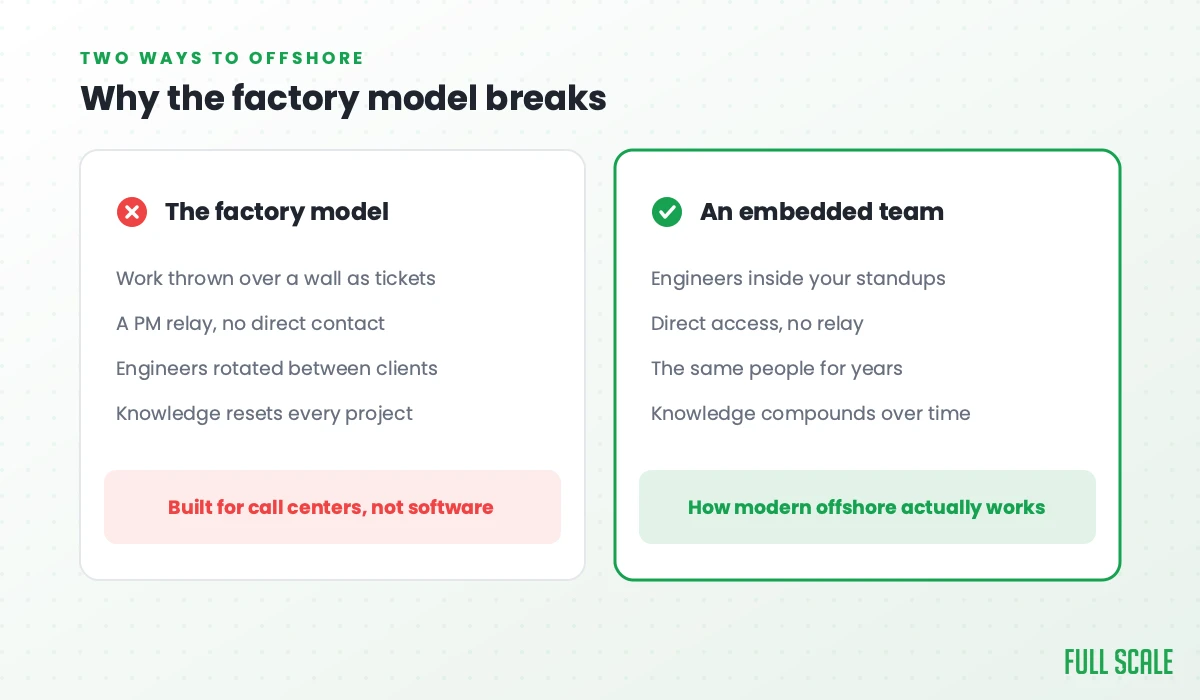
You hand a project to an agency. The agency assigns it to developers who are usually working on two or three other projects at the same time. A project manager sits between you and the engineers, “translating” your requirements into Jira tickets. You don’t talk to the engineers directly. You talk to the PM, who talks to a team lead, who talks to the engineers, and answers come back the same way.
This is the model most people picture when they hear “offshore development.” It’s also the model behind almost every horror story you’ve heard from a peer who tried offshore and got burned.
I tried this version early in my career. At Stackify, around 2012, I hired developers in St. Petersburg through an agency. The agency was professional. The developers were skilled. The output was unusable. Every requirement got rewritten three times on its way down the chain, and by the time something shipped, it didn’t resemble what we’d asked for. We’d burned six months and a real chunk of runway before I pulled the plug. I’ve written elsewhere about why I avoided offshore for a long time after that, and the Russia experience is most of the answer.
The problem wasn’t Russia. It wasn’t even the developers. It was that I was three layers removed from the people writing the code, and there was no way to get closer without the agency feeling like I was going around them.
Contractor platforms (Upwork, Toptal, marketplaces)
You hire freelancers one at a time through a marketplace. The advantage is speed. The cost is continuity. That churn is one of the hardest parts of offshore recruitment, because the best people are the ones with the most options. Freelancers take other gigs, raise their rates, disappear mid-project, or just stop responding when something better comes along.
This works for short, scoped projects with no follow-on. I’ve used it myself for one-off WordPress builds and a small Elasticsearch project at Stackify, because those were scoped deliverables with a clear end state. It does not work for the kind of work most companies need offshore engineers for, which is long-running product engineering on a system that has to keep evolving for years.
Every contractor you lose costs you the codebase context that walked out with them. After a couple of cycles you’re paying full price to teach the next person a system the last person already knew. The math is brutal once you trace it through an honest offshore cost analysis.
Staff augmentation
You hire offshore engineers as full-time, embedded members of your existing team. They report to your engineering manager. They attend your standups. They’re in your Slack, your GitHub, your Jira. The firm that placed them stays out of the day-to-day. There’s no PM “translating” anything because there’s nothing to translate. Your engineers and their engineers are the same engineers.
This is what works. It’s also what almost nobody selling offshore services is actually doing. The shift from project outsourcing to staff augmentation changes the business model entirely. The firms that still run the factory version don’t switch easily, because their margin depends on the middleman they’d have to remove.
Side by side
| Model | Who manages the engineers | Typical retention | Who controls the work | Where it actually fits |
|---|---|---|---|---|
| Project outsourcing | The agency’s PM | Low (engineers cycle in and out of projects) | The agency | One-off projects with frozen specs (rare in real software) |
| Contractor platforms | You, transactionally | Low (freelancers churn between gigs) | You, until they leave | Scoped short projects, no follow-on |
| Staff augmentation | Your engineering manager | High (engineers are full-time employees of the staffing firm) | You | Long-running product engineering, anything that has to evolve |
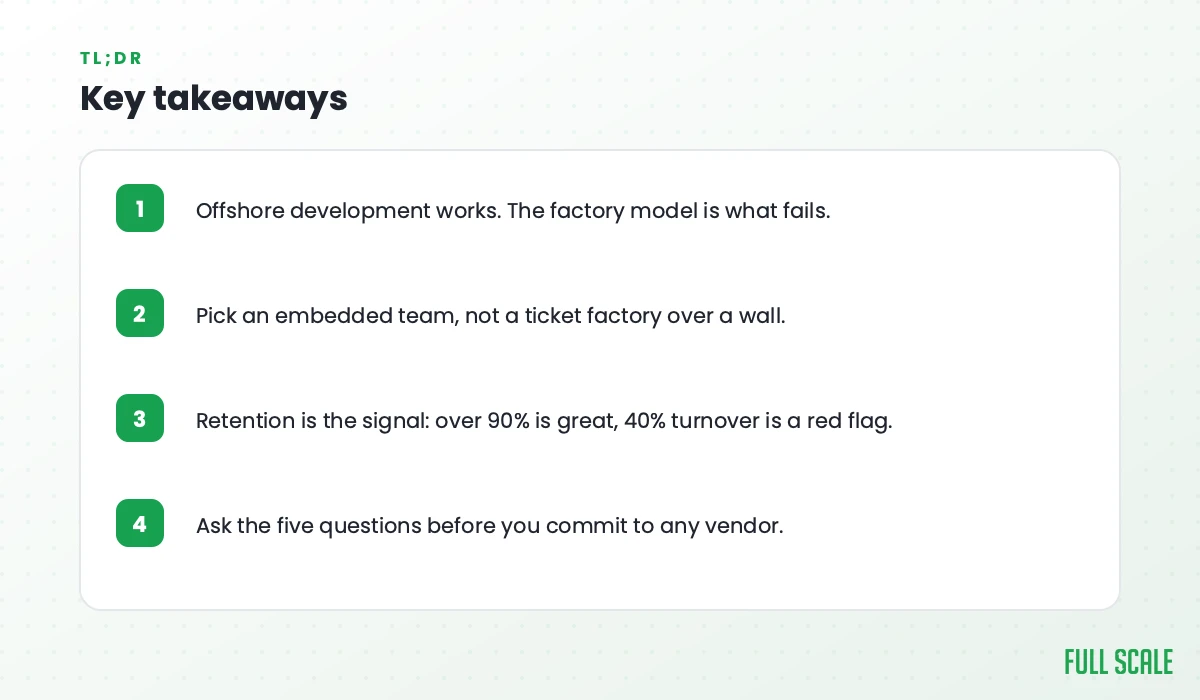
If you take nothing else from this guide, take that table. The single biggest predictor of whether your offshore engagement succeeds is which row you’re sitting in.
Why the factory model breaks for software
Software development isn’t manufacturing. Almost every failure mode of traditional offshoring traces back to people forgetting that.
A factory floor wants twenty workers doing the same task at slightly different stations. A development team wants two engineers arguing about whether the database should be relational or document-oriented. The two shapes look the same from a distance. Both are offices full of people producing something. Underneath, the work is completely different.
When an offshore agency runs a software project like a factory, three predictable things go wrong.
The PM middleman becomes the bottleneck. Every question goes through them. Every clarification adds a day. By the time a feature ships, the original answer to “what did the customer actually want” has been through five rewrites. The PM was supposed to make things faster. They make things slower, because every loop now has an extra hop.
The developers never get the context they need. They get a ticket and a deadline. So they build the thing literally, including the parts that are obviously wrong, because nobody told them they could question the spec. You can’t write good software when you don’t know what it’s for. Most of the offshore code I’ve thrown away over the years wasn’t bad code. It was code written to spec by people who didn’t know what the spec was actually trying to accomplish.
The engineers churn. Offshore agencies cycle developers between projects to keep utilization high. Whatever institutional knowledge the team built up walks out with them, and the next set has to learn your codebase from scratch. The economics of the agency reward this, even when it costs you.
Most companies who sour on offshoring are really reacting to the factory version of it. They blame the geography because the geography is what they can see. The model is invisible until you know to look for it.
What modern offshore software development actually looks like
The version that works treats offshore engineers as part of your team, not as external contractors managed through middlemen.
In practice, that means you hire engineers in the Philippines, or Latin America, or somewhere else where the cost of living makes salaries lower, and you place them directly inside your existing engineering org. They report to your engineering manager. They attend your standups. They’re added to your Slack and your code repos. They work in a time zone that overlaps with yours enough that they can talk to your senior engineers in real time. The staffing firm handles payroll, benefits, equipment, office space, recruiting, HR. You handle the engineering.
I learned the version that works almost by accident. At Stackify, after the Russia engagement collapsed, I tried setting up a small team in the Philippines in 2018. I hired the first few engineers as direct contributors instead of through an agency. They attended our standups, they reviewed each other’s pull requests, they pushed back on bad specs the same way our Kansas City team did. Within a year there were 20 of them. They contributed to our eventual 2021 exit in a meaningful way, and the cost difference was the only reason Stackify could afford to keep building at the pace it needed to.
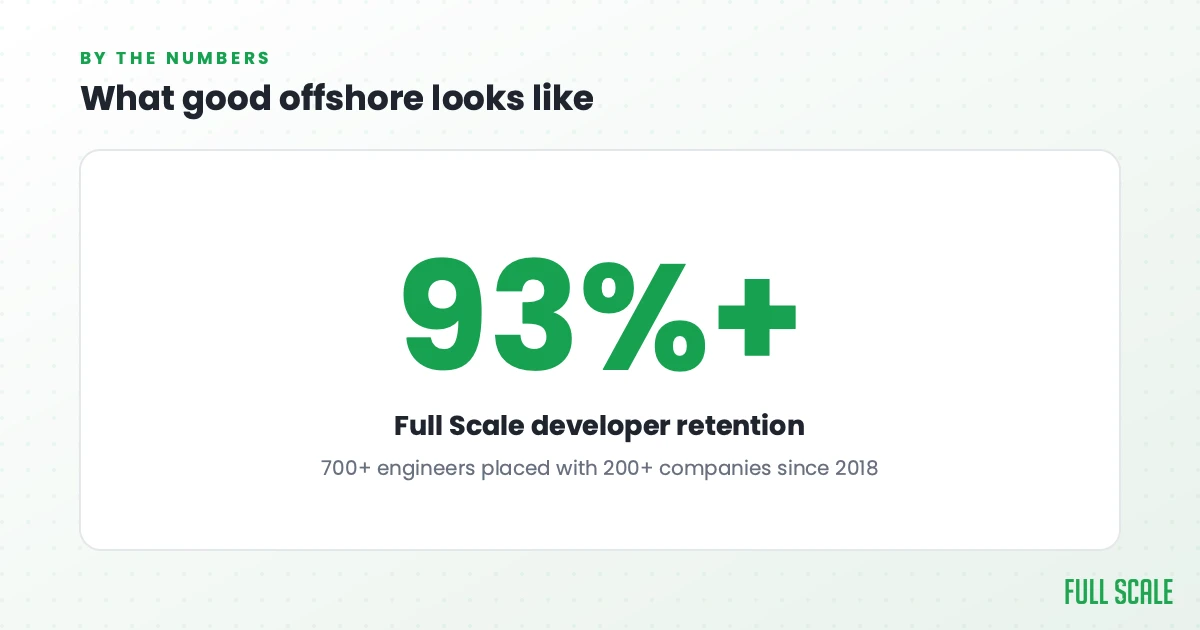
That experience turned into Full Scale. Friends who’d watched what we were doing at Stackify started asking how to set up the same thing. The “company” started as a favor and ended up as a business. We’ve placed over 700 engineers with more than 200 tech companies since 2018, and our developer retention runs over 93%, in a part of the industry where most firms are rotating engineers in and out every year or two. According to the Bureau of Labor Statistics Job Openings and Labor Turnover Survey, US tech turnover sits in the 13-15% range annually. Offshore agencies that try to do this on the cheap typically run much higher than that.
Retention is the part that compounds. After two years, an embedded offshore engineer knows your codebase as well as any senior you’ve ever hired. By year five, they’re often the most senior person in the room. Our oldest tenure at Full Scale is north of seven years. That’s the kind of relationship a project shop literally cannot offer you, because it isn’t what they’re optimized for. (We’ve written a longer piece on what an offshore team actually is and how to structure one for teams thinking about this for the first time.)
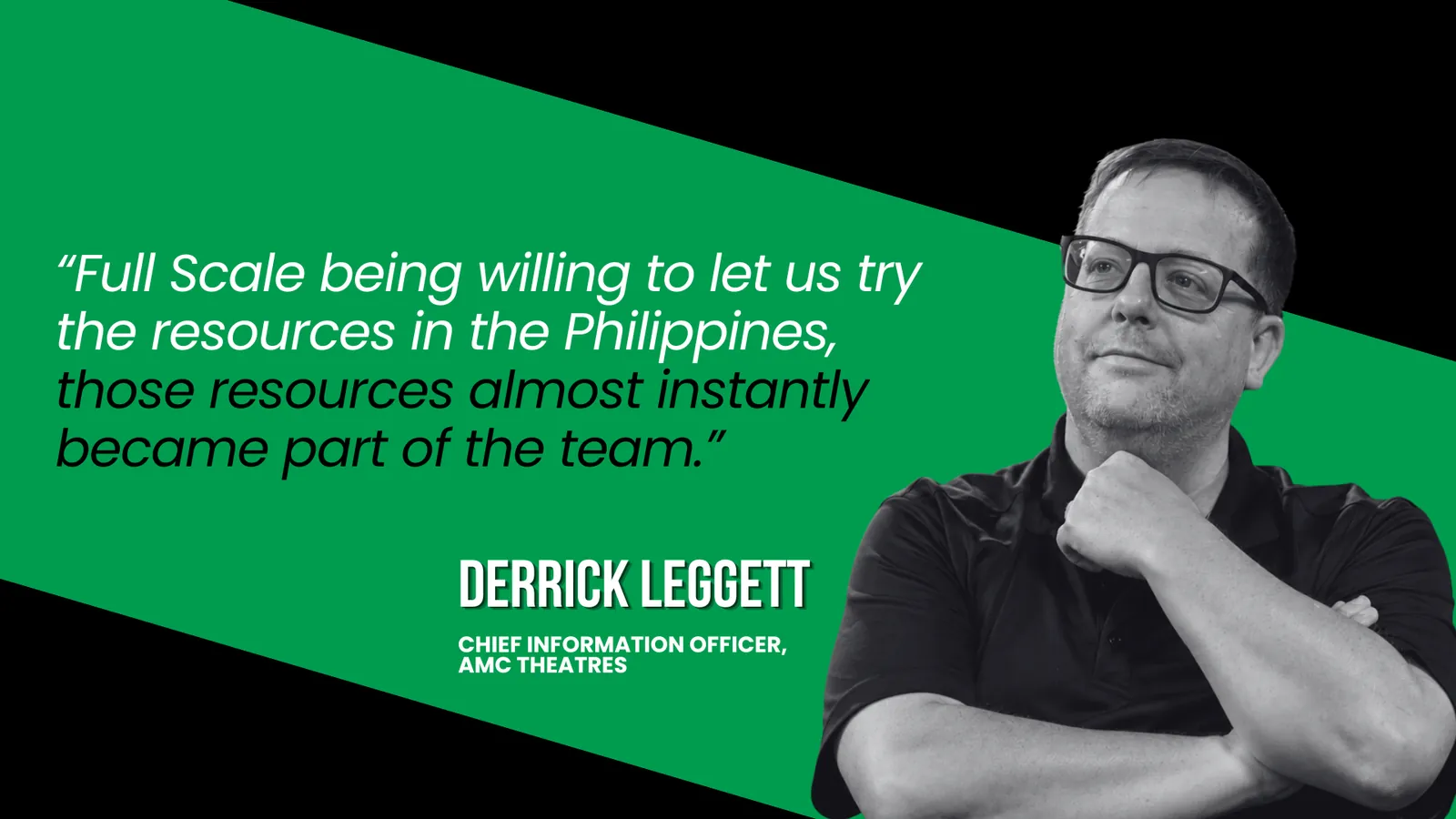
The clearest example I can point to publicly is AMC Theatres. Derrick Leggett, AMC’s CIO, has built a global engineering organization where developers in the Philippines work as full AMC engineers. They run real production systems, they’re on call when something breaks at 3 a.m., and they get treated as core team members, not vendors. AMC is one of the largest entertainment companies in the world. They aren’t using offshore to “save money on the cheap stuff.” They’re running their actual engineering org this way.
Offshore vs. nearshore vs. onshore
Onshore, nearshore, and offshore differ mainly in time zone overlap and cost, not in skill. Once you’ve picked the right model, the next question is geography, and three options exist that trade off against each other in predictable ways.
| Model | Time zone overlap | Typical cost vs. US | When it fits |
|---|---|---|---|
| Onshore (same country) | Full | Highest | Compliance-bound work that has to happen in a specific jurisdiction. Government contracts. Some healthcare. Some defense. |
| Nearshore (neighboring country) | Most of a workday | Moderate savings | Real-time pair-programming culture, frequent in-person visits, regulatory work that needs adjacent time zones |
| Offshore (Asia, Eastern Europe) | A few hours | Largest savings, largest talent pool | Long-running product engineering, anything where 3-4 hours of overlap is enough |
I picked the Philippines for Full Scale, and I picked it deliberately. The Philippines is special.
There’s no language barrier. Filipinos grow up speaking English and consuming American culture. The Philippines is the third-largest English-speaking country in the world by population. Filipinos dominate service jobs around the world for a reason. They want to do a great job and have a lot of fun doing it. That’s the perfect personality for building a remote team that has to communicate well across distance.
The time zone difference between the Philippines and the US is real, but it’s smaller than people think. Most of our clients run a half-day overlap pattern: the Philippines team works a normal Philippine schedule that has three to four hours of overlap with US business hours. The overlap is plenty for standups, design reviews, and the kind of real-time conversations that matter. Async tools (Slack, Jira, GitHub) handle everything else.
Some clients prefer the full overlap. We staff that too. A “graveyard shift” where the engineers in Manila work 9 p.m. to 5 a.m. local time so they’re online during full US business hours. Some clients want an async-first setup with one daily standup overlap. The schedule is something you choose, not something the model imposes on you.
Nearshore (Mexico, Latin America) is a legitimate option, especially if your culture is built around live pair programming and you don’t want to give up the time zone overlap. The cost savings are smaller. The talent pool is smaller. But it’s a real choice and I’d never tell someone they’re wrong to pick it. I’ve personally hired developers in Uruguay and Colombia myself, back in the Stackify days, so the contrast isn’t theoretical for me. The full offshore vs. nearshore comparison covers the country-by-country tradeoffs in more depth.
The honest answer is that the right country depends on your team. I picked the Philippines because the communication is top notch and the people we work with care about the product the same way the in-house engineers do. For a deeper dive into why the country specifically works, see our guide to offshoring software development to the Philippines.
The 5 questions every CTO should ask any offshore partner
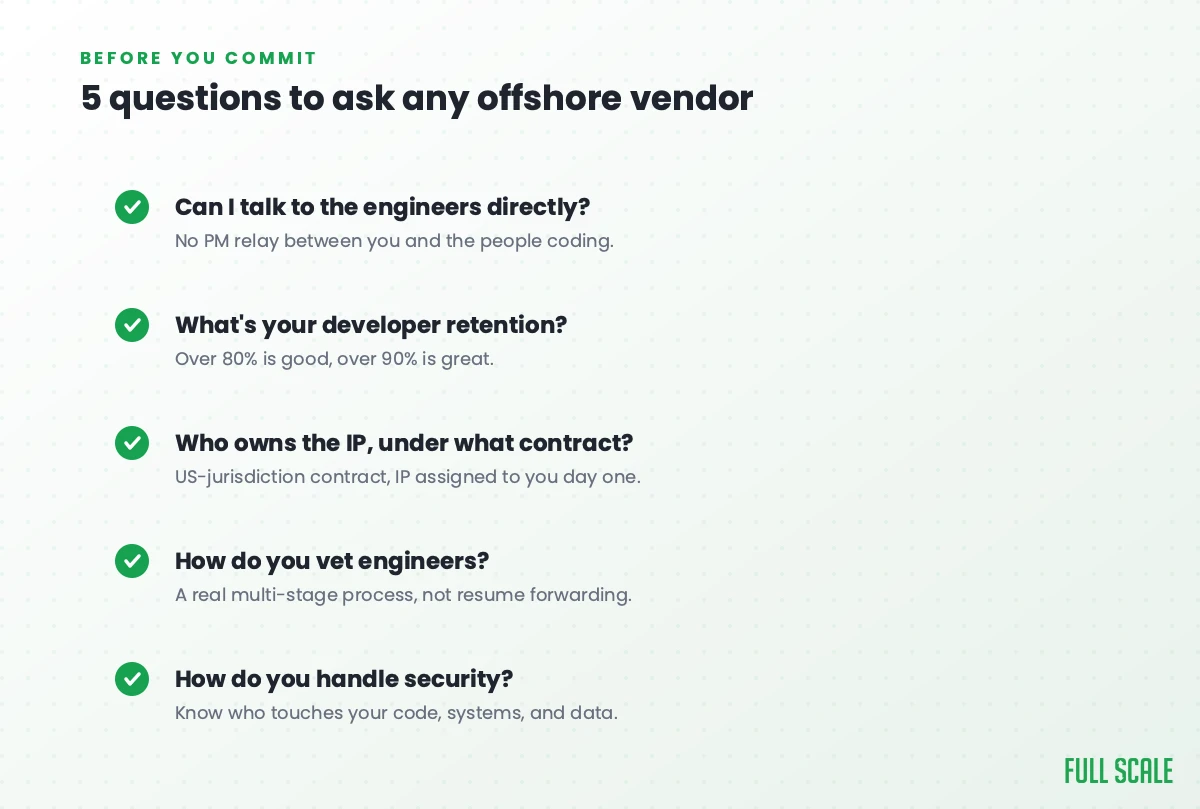
These five questions separate staff augmentation partners from project shops, and most firms hate answering them directly. Ask them anyway when you’re evaluating offshore firms. We’ve also published a longer due diligence checklist for the procurement-grade version of this conversation.
1. Who manages the developers day to day?
The only acceptable answer is “you do, with our help on HR and admin.” If the answer involves a project manager, an account manager, or a delivery lead managing the engineers on your behalf, you’re being sold the factory model. Walk away.
This is the single highest-signal question on the list. Every other question is downstream of this one. If the firm puts a PM between you and your engineers, the PM is the product. The engineers are billing units behind the PM.
2. What’s your developer retention rate?
A good answer is a number, stated confidently, that’s at least 80%. A great answer is over 90%. If the firm can’t give you a number, or if they hedge, that itself is the answer. The math is brutal: a firm running 40% annual turnover is replacing two out of every five engineers every year, and every replacement costs you context.
Full Scale’s retention runs over 93%. We treat the engineers as full-time employees with career paths, not as contractors cycled between client engagements. That’s why the number is what it is.
3. Are the contracts under US law or through a foreign subsidiary?
If the contract routes through a subsidiary in another country, your IP exposure increases the moment anything goes wrong. The clean structure is a US entity that signs the contract, employs the engineers locally through its own foreign subsidiary, and assigns all IP to you in writing. We use that structure at Full Scale specifically because it keeps the legal layer simple.
Firms that route everything through foreign-entity contracts will tell you it doesn’t matter. It matters the day you have a dispute.
4. Can I interview the actual developer before signing?
The right answer is yes. You should talk to the engineer who would be assigned to your team, not the sales engineer pitching you and not the PM who’d be coordinating on your account. If the firm won’t let you, you’re being sold a black box. If they will, you can usually tell within ten minutes whether the engineer is going to be a useful team member or just a body in a chair.
This question also reveals whether the firm has a real bench of engineers ready to interview, or whether they’re going to hire someone after you sign and hope they work out.
5. Where is the pricing transparent?
Most offshore firms guard their rates like a state secret, then quote you a number on a sales call that you have no way to compare against anything. The model is built on opacity. Full Scale publishes our pricing on the website because we don’t think it should be a secret. A senior Filipino engineer through us bills the client at $30-$40 per hour. The engineer earns $15-$30 per hour locally, depending on experience, with our senior engineers at the top of that range. That’s about 50-70% less than the fully-loaded cost of an equivalent US senior, who’d typically run around $180,000 a year all-in. The math is simple, and we’d rather argue about the value of the engagement than about whether you got the right rate.
If a firm won’t tell you what the engagement costs until you’ve sat through three sales calls, ask yourself what else they’re not telling you.
Common objections and what’s actually true
The five objections below are the ones every CTO raises on a discovery call. Most of them are real concerns about the factory model that got copy-pasted onto offshore generally. The fix in every case is the same: pick the right model and the objection mostly disappears.
“Communication will be terrible.”
Communication problems come from the project-outsourcing model, where the agency’s PM filters everything between you and the engineers. Take the PM out and the communication problem mostly goes away.
The Philippines specifically has a strong English-speaking culture. English is taught from grade school, business is conducted in English, and the country ranks in the top tier globally for English proficiency. Most of our clients say that within a month of starting, they can’t tell which of their engineers are in Manila and which are in their home office without checking Slack.
What does cause communication trouble is hiring through a firm where the engineers don’t actually talk to the client. Every interaction routes through a “technical project manager” because the agency’s other engineers either have weak English or work under cultural rules about not speaking to clients directly. You end up with a team you can’t actually communicate with, and a middleman in the way of every decision. Blame the agency for that one. The geography didn’t do it.
“Offshore developers leave constantly.”
Contractor platforms and project shops have high turnover. Embedded staff augmentation doesn’t. If the engineers are full-time employees with a career path, they don’t leave the way contractors do.
The math comes back to retention. A firm with 40% turnover is going to feel chaotic regardless of where the engineers are. A firm with 90%+ retention is going to feel like a real team regardless of where the engineers are. The geography is downstream of the employment model. The Stack Overflow Developer Survey consistently shows that compensation and growth opportunity drive developer tenure more than any other factor. That holds in Manila exactly the way it holds in Manhattan.
“I’ll lose control of the work.”
You only lose control if you let someone else manage the engineers. In staff augmentation, you manage them. The staffing firm handles HR, payroll, equipment, and the administrative parts that aren’t engineering. Code reviews, sprint planning, technical decisions, and priority calls are all yours. That lack-of-control objection comes from the project-outsourcing model. It has nothing to do with where the engineers live.
If anything, embedded offshore engineers give you more control than the project model, because you can actually direct them. They’re a member of your team. You ask, they do.
“Time zones will kill productivity.”
Zero overlap kills productivity. Most offshore engagements aren’t zero overlap. The Philippines runs three to four hours of overlap with US business hours under the default schedule, and we’ll staff full US-hours overlap if you need it. We’ve also seen smart teams use the time zone difference as an advantage. Work that needs review or QA can be queued in the US afternoon and reviewed in the Manila morning, so the team is making progress even when half of it is asleep.
The rule we use with our clients is simple: if your team works well remotely, it will work well globally too. Most of the time-zone fear comes from companies that hadn’t built strong remote-work practices in the first place.
“Offshore can’t handle complex work.”
This was the most common objection ten years ago. It hasn’t held up.
Most of our clients run their core product engineering through the embedded model. Some run their entire backend infrastructure offshore. AMC runs production systems that handle real revenue with engineers in the Philippines on the on-call rotation. The “offshore can only do the easy stuff” belief comes from companies that hired junior engineers through a project shop and got junior-engineer output. The fix isn’t to give up on offshore. The fix is to hire senior engineers and treat them like senior engineers.
How to start offshoring without the usual disasters
If you’ve worked through the model question and the partner question and you’re ready to actually try this, here’s the playbook I’d run.
Start with a pilot of two or three engineers
Don’t bet the company on the first engagement. Pick a piece of work that’s real but not on the critical path, and staff two or three engineers on it. Run the pilot for ninety days. You’re testing whether your team is set up to integrate remote engineers at all. If your local team won’t add them to Slack, won’t run standups with them, won’t include them in design reviews, the engagement is going to fail no matter how good the engineers are.
Integrate them on day one
The fastest way to kill an offshore engagement is to treat the engineers as outsiders. They should be in your Slack on day one. They should attend daily standups by week one. They should ship their first pull request by week two. The longer the integration takes, the more “us vs. them” culture sets in, and once it sets in, it’s hard to fix. We’ve published a full 90-day integration guide that walks through the cadence in detail.
Treat them like teammates because they are teammates.
Measure what actually matters
The metrics worth tracking are pull requests merged, features shipped, and code quality. The metrics that get most teams in trouble are hours logged and lines of code. Engineers can game any activity-based metric within a sprint. Outcomes are harder to fake.
This is the same management principle you’d use with a US team. Offshore is not different. Stop measuring it like it is.
Know when not to offshore
Some companies shouldn’t offshore. If you have a regulatory requirement that engineering happens inside a specific jurisdiction, offshore is off the table. If your team culture genuinely depends on 100% in-person collaboration and you don’t want any remote engineers in the mix at all, the model isn’t going to work for you. If you’re not willing to manage the engineers directly and you’d rather hand a project to an agency and hope, you should probably hire a local agency to hold your hand instead.
For most software companies, none of those apply. The question isn’t whether to offshore. It’s how to offshore well.
How Full Scale handles it
We started Full Scale in 2018 because I’d been through every wrong version of offshoring and didn’t want to keep losing money to it. We hire developers in the Philippines and place them directly into our clients’ engineering teams. There’s no PM layer. The developers report up through the client’s engineering manager. We handle recruiting, vetting, equipment, office space, payroll, HR, and the legal layer. The client handles the engineering work. The full service description lives on our offshore software development page.
We call it a win-win-win. A win for the engineer (a real, long-term career with US-grade work), a win for the client (top-tier engineering at a fraction of US fully-loaded cost), and that makes it a win for Full Scale.
The numbers behind that: over 700 developer placements with more than 200 tech companies. Over 350 employees in the Philippines. Developer retention over 93%. Recognized on the Inc. 5000 list five years in a row. And transparent pricing on the website, because we’d rather argue about value than argue about what the rate is.
A Full Scale engagement can start in as little as 7 days from first call, depending on bench availability, with full onboarding into your codebase running about 14 days after that. Either way, it beats the 60-to-90-day local hire most CTOs are used to. The all-in cost of a senior engineer through us is roughly half of fully-loaded US senior cost, and on the high end of what a senior engineer earns locally in the Philippines. We pay competitive local rates because the firms that don’t are the ones with 40% turnover.
If you want to see how this would work for your team, the next step is to book a discovery call. We’ll walk through your engineering needs, your stack, and what an embedded offshore engineer would look like inside your existing team.
Frequently asked questions
What is the difference between offshoring and outsourcing?
Offshoring describes where the work happens (engineers in another country). Outsourcing describes who does the work (an outside company instead of your employees). The two overlap when the outside company you hire happens to be in another country, but you can offshore through your own subsidiary (no outsourcing) and you can outsource to a local firm (no offshoring). Mixing the terms up is one reason buyers end up with the wrong model.
How much does offshore software development actually cost?
A senior offshore engineer through a staff augmentation firm typically runs about 50 to 70 percent less than the fully loaded cost of an equivalent US senior. At Full Scale, the client billing rate for a senior Filipino engineer is $30 to $40 per hour. The engineer earns $15 to $30 per hour locally, depending on experience. A senior US engineer fully loaded (salary, benefits, equipment, office, payroll taxes) typically runs around $180,000 a year, or roughly $90 an hour (per BLS Occupational Employment Statistics for software developers plus standard benefit-load multipliers). The savings are real, and they compound over a multi-year engagement.
Why does traditional offshore software development fail so often?
Because most offshore agencies still run software projects the way manufacturing plants ran factory lines. The model assumes work can be standardized and managed through middlemen, which is true for assembly lines and not true for code. The result is delayed projects, high turnover, and a lot of expensive rework. The fix is the model, not the geography.
What is staff augmentation, and how is it different from traditional offshoring?
Staff augmentation means hiring offshore developers as embedded members of your existing engineering team instead of handing a project to an outside agency. The developers attend your standups, use your tools, report to your engineering manager, and stay for the long term. There’s no PM layer between you and them. Most of the failures of traditional offshoring disappear when you switch to this model.
How long does it take to hire an offshore software developer?
Through a staff augmentation firm with a vetted bench, a developer can start in as little as 7 days from first call, with full onboarding running about 14 days after that. Through a traditional offshore agency that has to assemble a project team, two to three months is more typical. The speed difference comes from how the firm is set up. Geography has almost nothing to do with it.
Can offshore developers handle complex technical work?
Yes. Most of the offshore engineers we place are working on core product engineering, backend infrastructure, mobile apps, and production systems with real uptime requirements. The “offshore can only do the easy stuff” belief comes from companies that hired junior engineers through a project shop. Senior offshore engineers handle the same complexity as senior US engineers, because they are senior engineers.
How do you manage time zone differences with an offshore team?
Most Full Scale clients run a half-day overlap. The Philippines team works a normal Philippine schedule, which gives three to four hours of real-time overlap with US business hours. That’s enough for standups, design reviews, and any conversation that benefits from being live. Asynchronous tools handle everything else. Some clients prefer full US-hours overlap, which we staff as a graveyard shift. The schedule is something you pick based on how your team actually works, not something the model imposes.
How do you protect IP when offshoring?
IP protection lives in the contract structure. The geography is downstream. Use a US-based contract where US IP law applies, signed by a US entity that employs the engineers through its own foreign subsidiary. Assign all IP to the client in writing. Standard NDAs apply. The firms that route every contract through a foreign subsidiary are the ones to be careful with. Full Scale uses the US-entity structure specifically because it keeps the legal layer simple, even when the engineers are 8,000 miles from Kansas City. Get that structure right and you can hire offshore developers with the same legal footing as a US hire, not a workaround.
What does offshore development mean?
Offshore development means hiring engineers in another country to build your product. The work a developer would do in Kansas City or San Francisco gets done by a developer in the Philippines, Mexico, Poland, or somewhere else where the cost of living makes salaries lower. The output is the same code. The difference is who’s writing it, where, and at what cost.
What is an offshore development company?
An offshore development company connects you with engineers based in another country, usually through one of two models: project outsourcing, where the firm manages a full team and delivers finished features, or staff augmentation, where individual engineers join your team directly and report to your engineering manager. The model matters more than the label, since two firms both selling “offshore development” can mean completely different working relationships. At Full Scale, it means staff augmentation.