Top Omaha and Lincoln Startups

In this article
There is a fifty-mile stretch of I-80 between Omaha and Lincoln that quietly produces more real software companies than most people would ever guess. These are not pitch decks. They have revenue, customers, and in a couple of cases billion-dollar valuations.
I have started a handful of companies over the years, and the thing I pay closest attention to now is where the next ones come from. Lately I kept running into Nebraska names, so I went looking. What I found was good enough that I wanted to write it down.
The problem with most of these lists is that they are just names pulled off a database. A logo, a one-line description, and no signal about which company has actually built anything. I wanted to know which ones were real, so every company below had to earn its spot with real press or real funding, every dollar figure traces to public reporting, and every company links to its own site so you can go see for yourself.
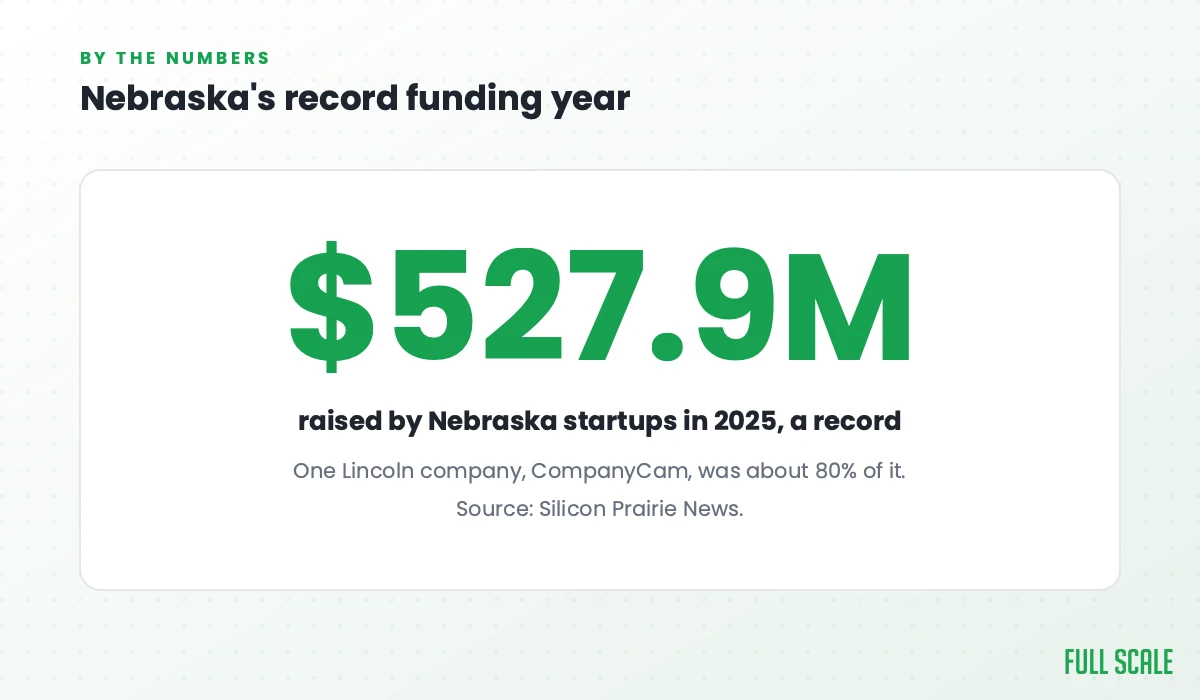
A few ground rules, because they matter here more than usual. Omaha and Lincoln are two different cities about fifty miles apart, so I have labeled which is which rather than blur them into one. And the money is real but young: Nebraska companies raised a record $527.9 million in 2025, though one Lincoln company accounted for about 80 percent of it. So read the funding section as a map of momentum, not a leaderboard.
I broke what I found into four groups. The companies pulling in money right now. The early ones I would bet on. The ones that already sold or went public. And the group that surprised me most, the big names you would never guess trace back to Nebraska.
Who’s raising money right now
Sorted by round size, largest first. Keep an eye on the investor names as you scroll: Nelnet and Invest Nebraska turn up on deal after deal, and between them they have seeded a large share of what gets funded in the state.
CompanyCam (Lincoln) is the headliner, and it is not close. The job-site photo app for contractors raised a $415 million round in 2025 led by B Capital at a $2 billion valuation, making it Nebraska’s first unicorn. Founder Luke Hansen built it out of his family’s roofing business, and his round alone was most of the venture money that came into the state that year.
Virtual Incision (Lincoln) raised about $76 million across a 2024 Series C and an extension, led by Endeavour Vision. It builds MIRA, a miniaturized surgical robot that earned a first-of-its-kind FDA authorization and was later tested aboard the International Space Station. It came out of the University of Nebraska’s innovation campus.
Marble Technologies (Lincoln) is already profitable, which is rare for a company that just closed a $30 million Series A in 2026, most of it from Nebraska investors. It uses AI and food-grade robotics to automate meatpacking lines, which in a state this central to beef is about as fitting as it gets.
Workshop (Omaha) raised a $12 million Series A in 2023 led by McCarthy Capital, and added more in 2025. It builds internal-communications software used by big companies to run their employee email. Its CEO, Rick Knudtson, also co-founded Flywheel, which you will see again further down.
Upwell (Omaha) automates the billing and collections side of freight and logistics, the unglamorous money plumbing that every trucking company would rather not think about. Vertical Venture Partners led a $6.5 million seed in 2025; Charley Dehoney is the CEO.
Nestimate (Lincoln) is fintech for retirement income, helping advisors put annuity options inside 401(k) plans. S3 Ventures led a $3 million seed in 2025, with TIAA Ventures in the round. Kelby Meyers founded it.
Sentinel Fertigation (Lincoln) raised $2.5 million to go with an earlier seed round. Founder Jackson Stansell built satellite-based software that tells corn farmers exactly when to apply nitrogen, which saves money and keeps fertilizer out of the groundwater.
Cattler (Lincoln) raised $2 million in 2026 led by Homegrown Capital. It is an operating system for feedlots and the beef industry. The company started in Argentina and moved its US base to Lincoln, so it is Lincoln-based rather than Lincoln-founded.
Alpaca (Omaha) was built by Karen Borchert to measure and support educator well-being, something most schools say they care about without really tracking it. Nelnet and Invest Nebraska led a $1.8 million seed in 2025.
Fleet Defender (Omaha) raised a $1.3 million pre-seed in 2025. Founder Terry Reinert builds AI cyber-defense for fleet and safety-critical vehicles, the kind of thing that matters as trucks and equipment get more connected and more hackable.
DARO (Lincoln) raised a $1.1 million seed in 2025 led by Invest Nebraska. Kristen Bernhard founded it to do whole-herd molecular pathogen surveillance for hog operations, catching disease before it spreads through a barn.
Grapple (Omaha) lets non-technical people pull data out of Salesforce, QuickBooks, and spreadsheets into one dashboard without writing a query. Jack Sellwood is the founder, and Invest Nebraska and Nelnet led a $1 million pre-seed in 2026.
Young companies worth watching
Everything in this bucket is early-stage. Each one has shipped something real and earned coverage, but none has raised a big round yet. Plenty of them will stall out inside a couple of years. That risk is the whole point: this is a list of bets, not a victory lap.
CodeBuddy (Lincoln) raised an $872,000 seed in 2025 and opened its first office in Lincoln. It pairs AI tools with human mentorship so non-technical founders can actually ship software.
Driive (Lincoln), built by Quinn Small as an AI scheduling agent for home-service trades, pulled in about $783,000 in a pre-seed round. One of the backers is Luke Hansen, the CompanyCam founder from the top of this list.
Impower Health (Omaha) raised a $500,000 round in 2026 led by Boomerang Ventures. It came out of research at the University of Nebraska Omaha and turns a treadmill into a gait-measurement diagnostic tool.
Set Your Sites (Lincoln) is campground-management software, built by Stacy and Dustin Dam for check-in, reservations, and on-site Wi-Fi. It is a niche the bigger players ignored, and a $500,000 pre-seed in 2025 is helping them take it.
Nave Analytics (Lincoln) raised a $400,000 pre-seed in 2024. Jessi Korinek built irrigation-decision software for farmers that works off satellite data instead of in-field sensors.
Andover Analytics (Omaha) is bootstrapped and came through Techstars’ first Greater Omaha cohort. It tracks real-time smartphone resale prices across Back Market, Swappa, eBay, and Walmart so phone resellers know what to pay.
Service Stories (Omaha) turns the work orders a service business already generates into marketing content built for search and AI answers. Its founder, Joe Toscano, is a former Googler who appeared in the documentary “The Social Dilemma.”
Quantum Qool (Omaha) has raised around $2 million in early funding for deep-tech work using ultrafast lasers to manage heat in electronics, batteries, and spacecraft. It is the kind of hard-science bet most metros this size never see.
University Medical Devices (Omaha) raised a $1.6 million seed to launch a self-contained nasal-specimen collection device, a spinout from the University of Nebraska Medical Center.
There is more underneath all of this. Techstars ran its first two Greater Omaha cohorts in 2025 and 2026, and the University of Nebraska-Lincoln’s student startups each pulled in $100,000 of early backing. Not all of them will make it, but the pipeline is real and it is new.
The graduates: companies that already made it
Every company in this section began as a small Nebraska bet and ended in an acquisition or a public listing. That is the part that should get a founder’s attention. It means the corridor finishes companies, not just launches them, and several of these founders went on to fund the next wave directly.
West Corporation (Omaha), now Intrado, was founded in 1986 by Gary and Mary West. It went public in 1996, ran a huge share of the country’s conference calls and 911 traffic, and was taken private by Apollo for about $5.1 billion in 2017.
Flywheel (Omaha) built managed WordPress hosting for designers and agencies starting in 2012. WP Engine acquired it in 2019 and kept the Omaha office. Its co-founder Rick Knudtson went on to start Workshop, up in the funding bucket, which is exactly the kind of second act a healthy startup scene produces.
Hayneedle (Omaha) grew from a single hammock website into one of the largest online home-goods retailers in the country. Jet.com bought it for around $90 million in 2016, and Walmart bought Jet soon after. One of its founders, Mark Hasebroock, later started Dundee Venture Capital and has been funding Omaha startups ever since.
Solutionary (Omaha) was one of the early national managed-cybersecurity companies. Japan’s NTT acquired it in 2013.
Buildertrend (Omaha) builds construction-management software used by tens of thousands of homebuilders and remodelers. Bain Capital led a major growth investment in 2020, and the company used it to buy its biggest competitor and become the category leader. It was bootstrapped out of a basement first.
Proxibid (Omaha) built an online auction marketplace for heavy equipment, machinery, and collectibles, incubated at a University of Nebraska Omaha tech center. TA Associates acquired it and merged it into London-based Auction Technology Group in 2020.
Spreetail (Lincoln) started in a basement reselling off-lease computers on eBay in 2006 and grew into a major e-commerce and logistics operation, raising $208 million along the way, one of the larger raises in state history.
Opendorse (Lincoln) is the technology behind a big share of the college sports name-image-likeness economy. Co-founded in 2012 by former Nebraska linebacker Blake Lawrence, it now works with more than 100,000 athletes.
Quantified Ag (Lincoln) put biometric sensors on cattle ear tags and sold to Merck Animal Health in 2020.
Nobl (Lincoln) built patient-rounding software for hospitals and was acquired by NRC Health in 2024.
Bulu (Lincoln) started as a subscription-box company and became a private-label fulfillment operation, acquired by The Avid Group in 2025 while keeping its name and Lincoln headquarters.
Big tech names you didn’t know are from Nebraska
Here is the group I enjoyed researching most. You already know these names. What almost nobody knows is that they trace back to Nebraska.
ACI Worldwide (Elkhorn) is the one that surprises people most. The payments software it has built since 1975 helps move trillions of dollars a year through ATMs and card networks worldwide, and the public company that makes it still runs from an Omaha suburb.
Hudl (Lincoln) started as a class project by three University of Nebraska-Lincoln students in 2006. It is now the video and analytics platform behind a huge slice of sports coaching worldwide, with thousands of employees, and it is still headquartered in downtown Lincoln.
Nelnet (Lincoln) is a New York Stock Exchange company and one of the largest student-loan servicers in the country, with a growing fintech and payments arm. It is also, as you have probably noticed by now, the investor quietly backing half the young companies on this list.
Werner Enterprises (Omaha) looks like an old-school trucking company, and it is one of the largest US truckload carriers. It is also a real technology operator, running an in-house logistics platform called Werner EDGE built on AI, telematics, and the cloud. It started across the river in Council Bluffs, Iowa, in 1956 before moving to Omaha.
Monolith (Lincoln) is a clean-hydrogen and carbon-black company that won conditional approval for a $1 billion US Department of Energy loan and backing from the likes of BlackRock. Its global headquarters is in Lincoln, with a plant down the road in Hallam.
Data Axle (Omaha origins) began in 1972 as American Business Information, when Vinod Gupta borrowed $100 and started compiling business lists out of phone books in Omaha. It grew into a data company worth hundreds of millions before moving its headquarters to Dallas in 2019, but the $100 phone-book story is pure Omaha.
Why this corridor keeps producing
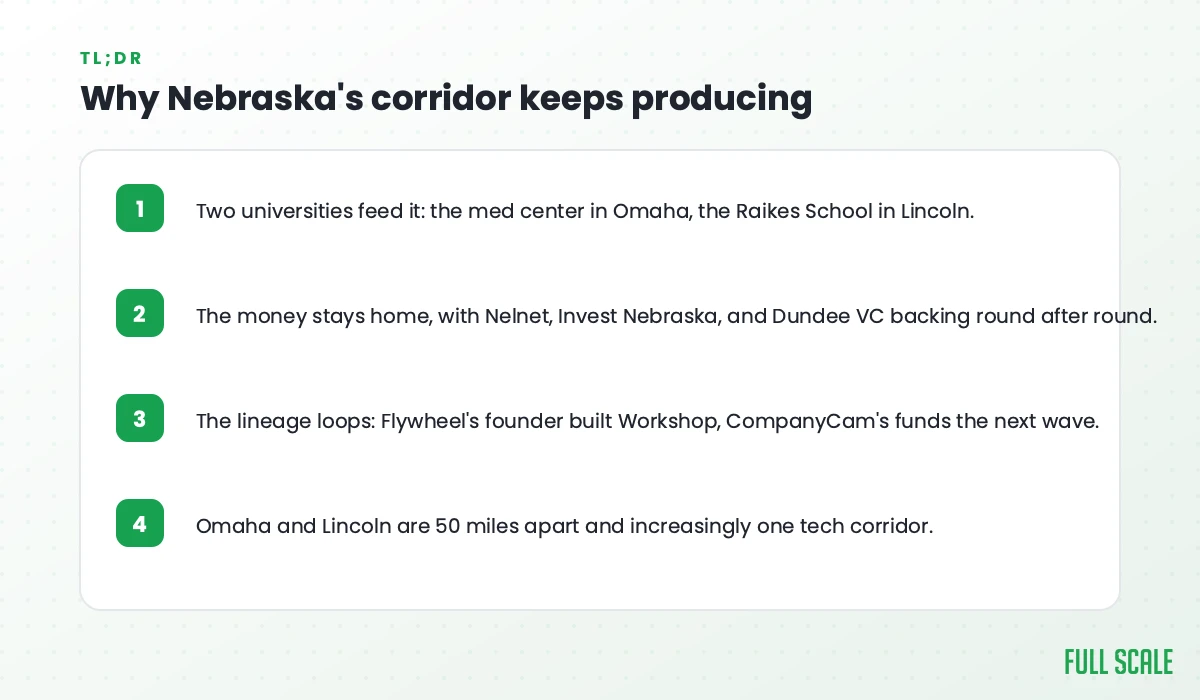
A few things stood out once I had the whole list in front of me. The universities feed it, with the medical center in Omaha and the Raikes School in Lincoln turning out founders and spinouts. The money stays close to home, with Nelnet, Invest Nebraska, Dundee Venture Capital, and a handful of others showing up round after round. And the lineage loops back on itself in a way you rarely see: Flywheel’s founder went on to start Workshop, Hayneedle’s founder went on to start a venture fund, and CompanyCam’s founder is now writing checks into the next batch of Lincoln startups.
The coastal noise just is not here, and the people building seem to prefer it that way.
I run Full Scale now, and we are a Midwest company by choice. We stand up software teams for other companies, and a few of the companies on this list are ones we have helped do exactly that. I have a real soft spot for founders who looked at the map and decided the Bay Area was not a requirement for building something that lasts. If that is you in Omaha or Lincoln, or you need engineers to get there, reach out. I would like to hear what you are building.
And if you are running something in the corridor that should be on this list and isn’t, that one is on me. Send me a note and I will fold it into the next update. I keep finding more, which is the best problem a list like this can have.