
Offshore Team Management: How to Manage and Work With Offshore Developers

In this article
- Why Most Offshore Teams Fail (and Why It Has Nothing to Do With Offshore)
- What You Actually Need in an Offshore Engineer in 2026
- How to Work With Offshore Teams: The Model That Makes the Rest Possible
- Twelve Practices for Managing Offshore Teams That Actually Work
- The weekly gut check: are these practices actually working?
- The First 90 Days Decide the Next Three Years
- Red Flags That Mean You Picked the Wrong Offshore Partner
- Frequently asked questions
- Wrap-Up: Engineering Leadership Beats Geography Every Time
Quick Answer: Managing an offshore development team well comes down to leadership, not geography: get the product vision out of your head, talk to every engineer directly instead of routing through a lead, protect a real overlap window, and treat the team like your own instead of an offshore vendor. The most common mistake, whether the team is in Pakistan, the Philippines, or anywhere else, is chasing the cheapest hire and skipping the management work that makes any team, remote or local, actually perform.
A startup founder called me this week about a problem he thought was about offshore. His team in Pakistan is fast. When he tells them what’s broken, they fix it quickly. But the software is full of bugs, the codebase keeps falling apart, and he can’t figure out why a team that fixes things fast still ships software that keeps breaking. A lot of it comes down to Filipino work culture and how it differs from a direct American style.
I told him the team in Pakistan is fine. The problem is engineering leadership. Nobody told them quality matters more than velocity, nobody told them to slow down, and they’ve been treated like a help desk for the codebase, so that’s exactly how they behave. It is also the heart of how to tell whether an offshore team is actually productive: judge what they ship and whether it holds up, not how busy they look.
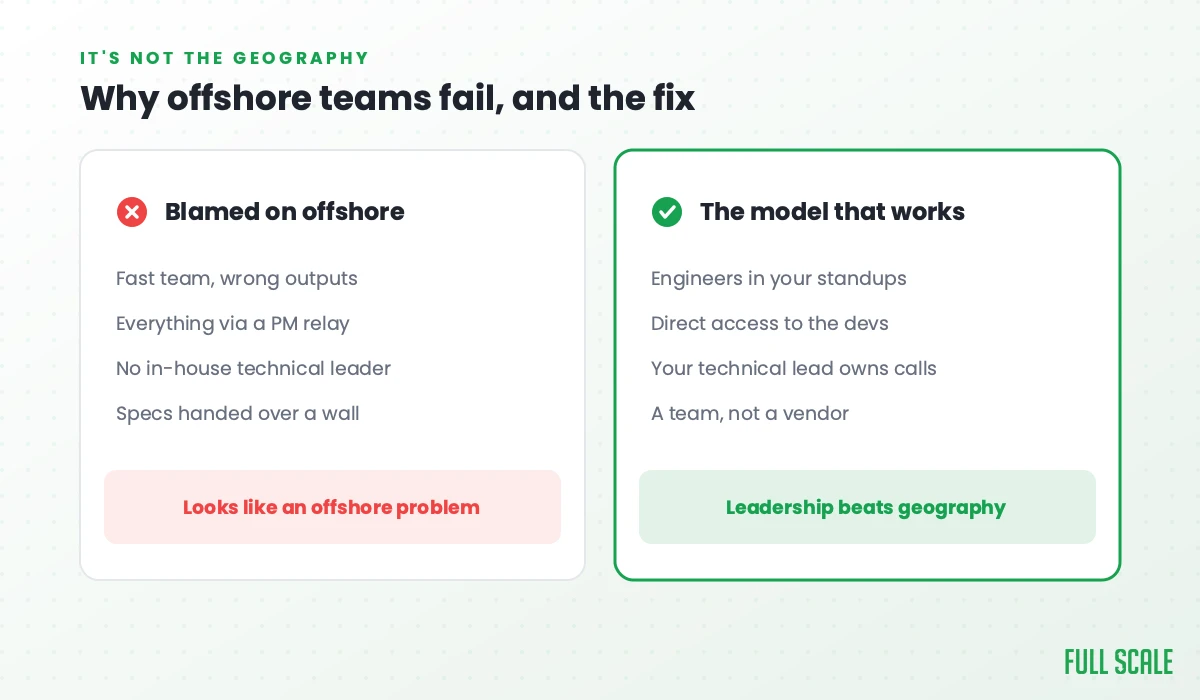
That same conversation could have happened with a team in Kansas City, Bangalore, Vilnius, or the next office down the hall. Most of what gets blamed on “offshore” has nothing to do with where the team sits.
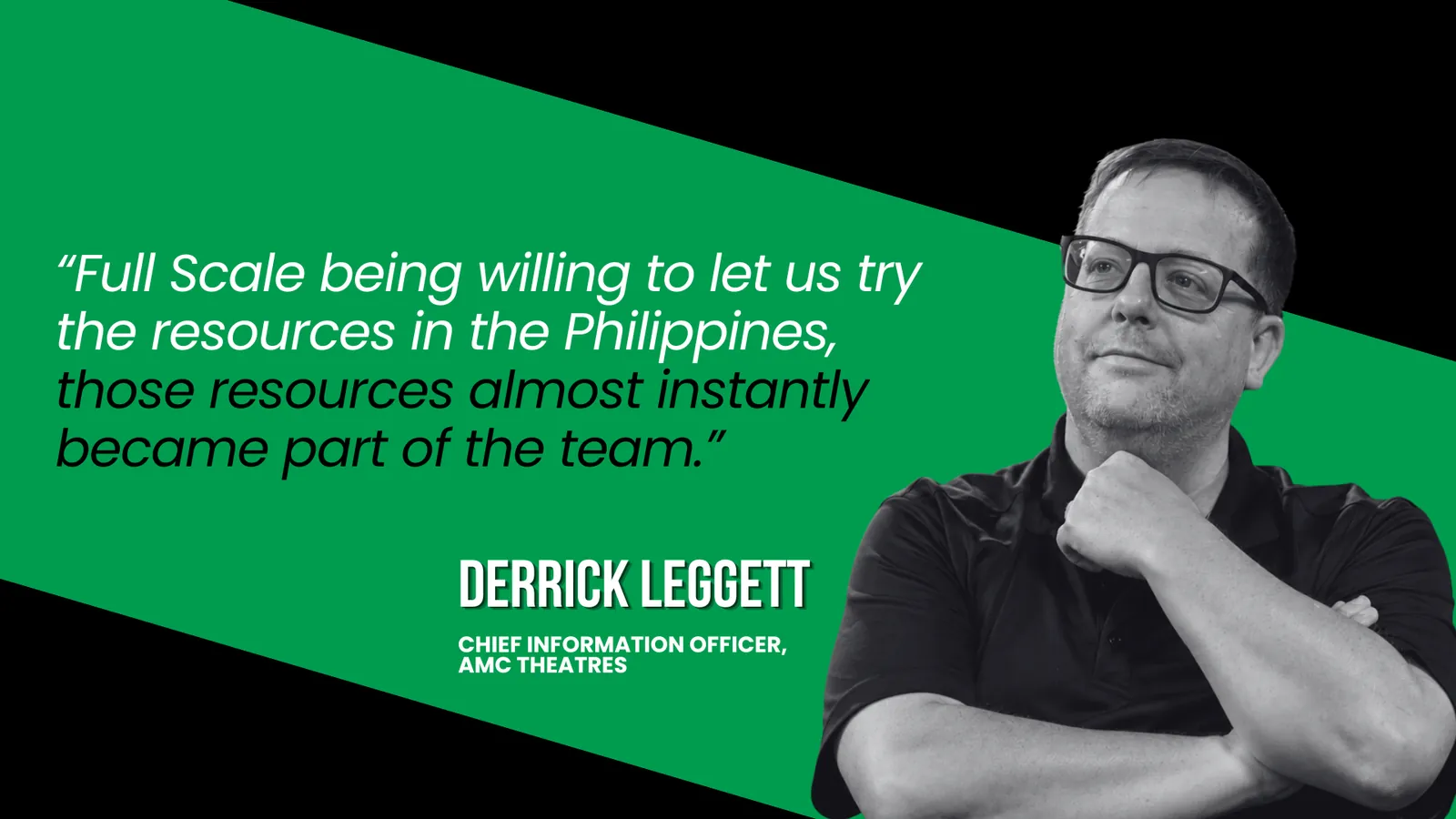
This guide is built on what I’ve learned running offshore teams since my Stackify days, and now as CEO of Full Scale, where we’ve placed over 700 engineers in the Philippines with companies like AMC Theatres and dozens of other product-led companies. It covers what really breaks offshore engagements, what kind of engineer you actually need in 2026, the model that makes the rest possible, the twelve day-to-day practices that separate good engagements from bad ones, and the red flags that tell you you picked the wrong partner.
Why Most Offshore Teams Fail (and Why It Has Nothing to Do With Offshore)
Talk to a hundred founders who tried offshore and got burned, and you’ll hear the same complaints every time. The communication problems on offshore teams were real, quality was uneven, developers kept turning over, and bugs piled up faster than the team could fix them. The story is so consistent it sounds like a script.
Then go look at how those same companies run engineering internally. The communication is bad with their US engineers too. They lose local hires to turnover at roughly the same rate. They don’t have quality systems in place. The offshore engagement just amplified weaknesses that were already there in how they run engineering.
Two founders I’ve talked to this year illustrate the point.
The first is the one I opened with. He’s got a team of fluent-English, smart engineers in Pakistan at low rates, and he treats them like a fix-it crew. When something breaks, he tells them, they fix it fast, and the same bugs keep coming back. He assumed the answer was a different offshore partner. The real answer is to lead the team he already has differently. He needs to give them a goal instead of a ticket, tell them quality matters more than speed, and stop treating them as a help desk so they can start behaving like engineers who own the codebase. A few honest metrics that predict how a team will perform would have surfaced the quality problem months before the bugs did.
The second was frustrated with his team in Lithuania. They did the work and shipped what he asked for, but they almost never had meetings with him. He never felt like his company, the thing he had poured his life savings into, was a priority to them. He didn’t expect them to care as much as he did. He wanted them to feel like they were on his team, and they didn’t, because nobody had ever built that relationship.
Same root cause in both cases, on opposite ends of the world. The offshore part wasn’t doing the damage. The engineering leadership was missing, and an offshore team made that more visible than a US team would have. It’s the same theme that runs through the most common offshore development team mistakes, and nearly all of them are self-inflicted. The cheapest early-warning system we have found for it is reading daily reports for shape.
If your offshore engagement is failing, the first place to look is your own leadership, your processes, and how you’ve set the team up to succeed. The second is whether you picked a vendor that builds for that, or one that profits from confusion. (More on the vendor question at the end.)
What You Actually Need in an Offshore Engineer in 2026
The biggest shift in offshore software development over the last two years is about the work itself. The kind of engineer you could get away with hiring five years ago is now getting replaced by AI.
Order-taker engineers are dying. The ones whose job was “implement this ticket exactly as specified, don’t think about it, ship it” can’t compete with Claude, GPT, and Copilot. AI does that work, faster, cheaper, and without complaint. If your offshore strategy was “find people overseas who execute on tickets,” that strategy is collapsing in real time.
What survives is the engineer who does the work AI can’t. That work is figuring out what to build in the first place, navigating ambiguity in a half-defined business goal, deciding what’s actually worth shipping this quarter, and owning the outcome when the customer uses it. The engineer who does that work thinks like a product person who happens to write the code.
| What you used to hire offshore for | What you need to hire offshore for in 2026 |
|---|---|
| Implementing tickets to spec | Owning outcomes from a goal |
| Coding what the PM tells them | Proposing how to solve a problem |
| Adding features | Deciding what’s worth adding |
| Bug-fixing on request | Building software that doesn’t break |
| Following the architecture you wrote | Helping you design the architecture |
The 2026 offshore engineer is closer to a product engineer than a code monkey. If you’re hiring offshore the same way you hired in 2018, you’re hiring the wrong people for the work that’s left.
Hire people you trust, who do good work, who you actually want on your team. The best offshore engineers feel a little more like family than contractors. Anything less than that gets eaten by AI. Which is why hiring a good offshore developer is not enough unless you treat them like part of the team.
If you remember one thing from this article, it should be that. Everything below assumes the people you’re hiring belong on your team.
How to Work With Offshore Teams: The Model That Makes the Rest Possible
I’ve covered why most offshore projects fail and the team structure that actually works in depth elsewhere, so I’ll be brief here. The structural choices you make about how to engage an offshore team matter more than any single tactic in this article.
The biggest decision is whether you go with staff augmentation or a traditional project shop.
| Staff augmentation (what works) | Project shop (what usually doesn’t) | |
|---|---|---|
| Who the engineers work for | One client, full-time, long-term | Multiple clients, rotated to maximize billable hours |
| How you communicate | Direct access to every engineer | Through one or more project managers |
| What they’re invested in | Your product, your outcomes | The next ticket on the queue |
| Billing model | Fixed monthly per engineer | Hourly / time and materials |
| Annual turnover | 5 to 10% | 40%+ |
The middleman model is the silent killer of offshore engagements. When your only line into the team runs through a project manager, every clarification turns into a 48-hour game of telephone, context gets lost between layers, and the engineers writing your code never hear your voice. I wrote a whole post on why project managers can undermine offshore development because I’ve seen it kill so many engagements.
If you’re going to hire offshore engineers, hire offshore engineers. Get them into your Slack, your Jira, your standups, your release planning meetings. Treat them like the senior team members they are. Skip the layer of account managers and PMs who exist to filter the relationship.
You’ll still want an in-house product manager and a technical leader (a CTO, VP Engineering, or a strong tech lead) on your side. They set the vision, they own priorities, and they make the architectural calls. But the people writing the code should be talking to your product team directly, without a translator in between.
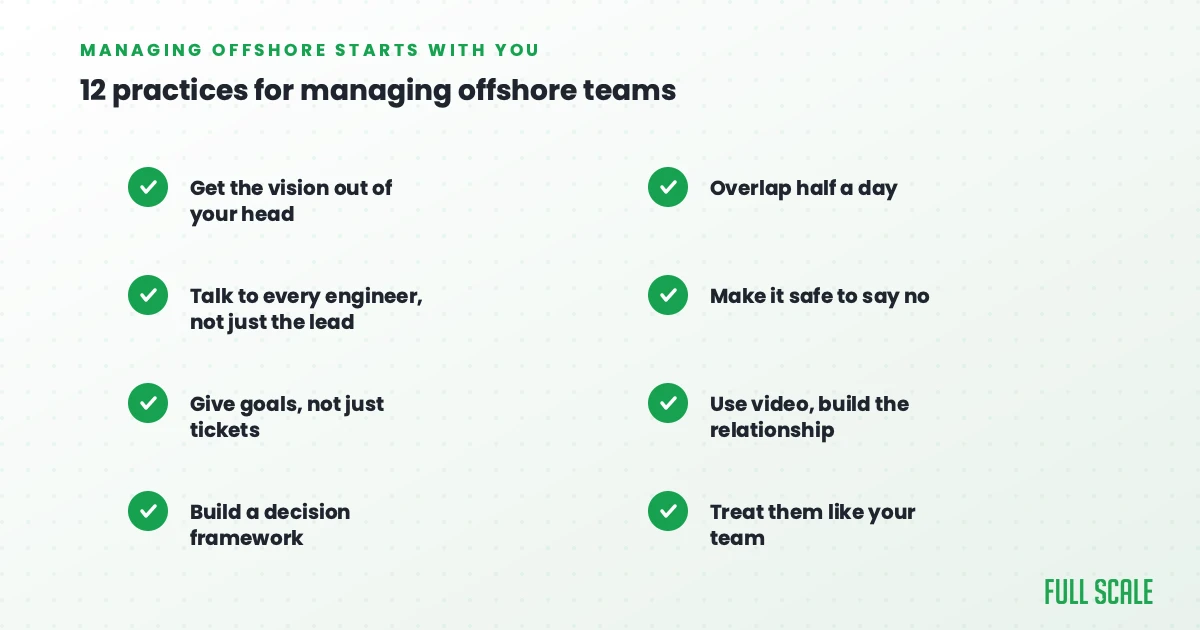
Twelve Practices for Managing Offshore Teams That Actually Work
These are the day-to-day habits that separate offshore engagements that ship from offshore engagements that struggle. Most of them aren’t about offshore specifically. They’re about leading a software team well, and they apply double when the team isn’t in the same building.
1. Get the Product Vision Out of Your Head
The single hardest job of a startup founder is getting the product vision out of your head and into your team. To you, it all seems obvious. You know what you want to build, you can picture the finished product, and you just want it done. Nobody else can read your mind.
I write a lot about this in my book, Product Driven. As a leadership team, you have to spend real time training every engineer on what you’re building and why, and you have to do it constantly. The vision gets repeated, demonstrated, and reinforced through every sprint. Saying it once in onboarding and assuming the team remembers won’t work.
This matters more with a remote team, offshore or not, because you don’t have an office where vision spreads by osmosis. Two engineers can’t overhear you arguing with the head of sales about a feature. They can’t watch you sketch on a whiteboard. If they’re going to share the vision, you have to put it in front of them, deliberately, all the time.
2. Talk to Every Engineer, Not Just the Lead
One of the biggest mistakes I see founders make is only talking to the project manager or the tech lead on the offshore side. The rest of the team never hears the vision directly. They get a filtered version, days late, secondhand.
Every engineer on the team should be hearing your priorities, your reasoning, and your context, from you. They need to be able to ask questions in real time. They need to validate their assumptions before they spend a week building something off-target. If a junior engineer has a question about why the product makes a certain trade-off, the answer shouldn’t have to be relayed through three people.
This is also how you find out who on the team can take initiative and who is just executing tickets. Until you’ve talked to each of them, you don’t actually know your team.
3. Give Them Real Work, and Give Them Goals Instead of Tickets
If your team can’t handle hard work, you’ve got the wrong team. Don’t give offshore engineers the leftover tasks nobody else wants. Don’t hand them tickets that have been pre-broken-down into three-hour chunks. That’s how you train order-takers, and order-takers are the engineers AI is replacing first.
Instead, hand them goals. Tell them what you’re trying to achieve for the customer and let them propose the architecture, the breakdown, and the trade-offs. Encourage them to push back when you’re wrong. The Pakistan founder I opened with had a team that could fix any bug he pointed at, when what he actually needed was a team that would build software with fewer bugs to begin with. That requires giving them enough rope to own the outcome themselves.
There are highly skilled developers all over the world. Set your expectations high and treat them like it.
4. Build a Decision Framework So You’re Not the Bottleneck
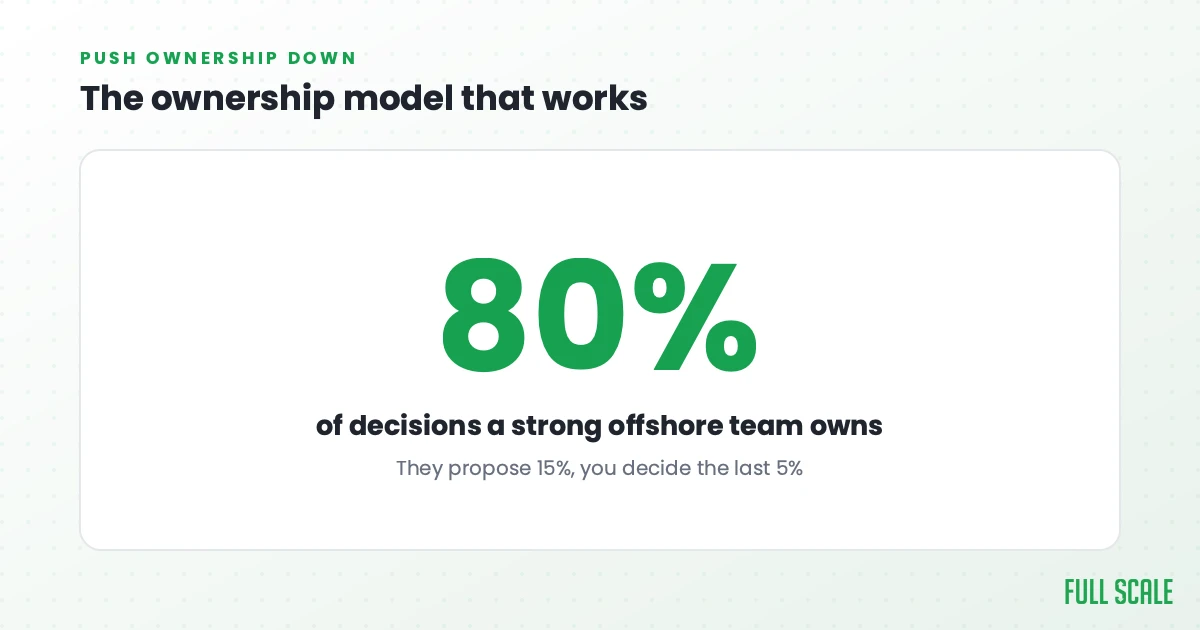
If every decision waits for you, work stalls every time you go heads-down on a fire. The fix is a clear decision framework that tells the team what they can decide on their own, what they propose for your review, and what genuinely needs you in the room.
A simple version I’ve written about in detail in our CTO guide is the 80/15/5 model.
| Tier | Scope | Your time |
|---|---|---|
| Team owns (about 80% of decisions) | Code structure, bug fixes, testing approach, refactoring, implementation details | Zero. You see results. |
| Team proposes (about 15%) | New features, library changes, process improvements, minor architecture | 1 to 2 hours per week of async review |
| You decide (about 5%) | Major architectural shifts, breaking changes, new products, big cost decisions | 30 minutes per week, strategic |
Document this in a wiki and reference it constantly. The first month feels awkward. After that, the team self-manages most of what used to land in your inbox.
5. Overlap Your Schedules (Half a Day Is Usually Enough)
This is one of the practical realities of offshore work, and it’s also one of the easiest filters for picking a vendor. At Full Scale, most of our engineers in the Philippines have about half a day of overlap with their US team’s normal hours. That’s enough for daily status meetings, for breakout calls when something needs deeper work, and for the 1-on-1s that actually build the relationship, right in the range that research on offshore team productivity says works best.
The big struggle with offshore comes when the vendor doesn’t shift the team’s schedule to client time. US engineers do not want to take meetings at 8 or 9 p.m. with their counterparts in India or the Philippines, so those meetings stop happening. Once the meetings stop, the team gets disconnected, questions pile up, and the engagement starts feeling like the Lithuanian-team story I told earlier.
Whoever the vendor is, Full Scale or otherwise, they should be shifting their team’s schedule to your hours instead of asking your US engineers to take late-night calls. If a vendor’s model expects the schedule pain to land on your team, that’s a sign their model isn’t built for real integration.
6. Simplify Your Communication
Most offshore engineers speak excellent English. Filipino engineers in particular score near the top globally on English proficiency. That doesn’t mean your communication shouldn’t be cleaner than it is with native speakers.
Limit your vocabulary, avoid metaphors and pop-culture references that won’t travel, and get to the point quickly. State the obvious. If you say “we should sunset this feature,” you might mean kill it, you might mean wind it down over six months, or you might mean redirect users elsewhere. Be specific about which. Overexplaining is free, and being misunderstood by a remote team can cost you a week of wasted work.
7. Make It Safe to Say No
Here’s the one that catches most managers off guard. On a high-context team, a “yes” is often just politeness. It means “I respect you and I’ll try,” not “I commit to this.” Same with “no blockers” when there clearly are some. Saying no, or admitting they’re stuck, can feel disrespectful, so a strong engineer will quietly overcommit instead.
That isn’t a skill gap. It’s a communication-culture difference, and it’s one of the most common reasons an offshore team looks like it’s failing when it isn’t.
The fix is on you. Stop asking yes-or-no questions, because they just get you a yes. Ask people to walk you through their approach, or play the task back in their own words. Then make it safe to disagree, and reward it when they do. We break the whole dynamic down in our guide to Filipino work culture on software teams.
There’s a name for the instinct behind all this. In a lot of high-context cultures, asking question after question, or being the one who always speaks up, can make you look like a pabida, the show-off who has to be the center of attention. Nobody wants to be that person, so the safe move is to nod and go quiet. A move our CSMs coach gets around it without asking anyone to change who they are: at the end of a call, have the developer summarize what they understood and ask “did I get that right?” It surfaces the same questions, but as an alignment check instead of a spotlight grab, so it costs them nothing socially.
8. Hire Engineers Who Can Own Ambiguity
Tip 3 is about what work to give them. This is about who you hire in the first place. Hire engineers who can take a vague problem and turn it into a working solution without needing a spec.
I’ve hired developers in Cebu who came from companies like IBM. One of them is one of the smartest engineers I’ve ever worked with, and he’s also been one of the best values I’ve ever gotten for the money. The rate in the Philippines is low because the cost of living is low, not because the talent is. Set the bar high and hire as if you’re hiring for your local team.
9. Use Video, Build the Relationship
Daily standups by Slack and phone work. Video works better. Video shows you the human on the other side of the screen, lets you read mood, and builds the relationships that make the rest of this work.
I do almost every recurring meeting with the team on video. I joke around with them, ask about their families, and learn what they’re working on outside the job. That kind of investment used to feel optional. With AI eating the order-taker tier of engineering, it’s now one of the most important things you can do, because the engineers who stick around for years are the ones who feel like part of your team.
For quick async stuff, I use short Loom recordings instead of writing a paragraph nobody reads. A 30-second screen recording of you doodling on a mockup explains more than 300 words of Slack ever will.
10. Weekly Meetings Are the Floor
The Lithuanian-team founder I talked about earlier had developers he barely spoke to. That’s how you end up with a team that feels nothing for your company.
At a minimum, hold weekly meetings with your offshore team. In practice, you should be touching base far more often than that, with the usual mix of daily standups, weekly retros, a monthly all-hands, and quarterly planning sessions. The exact cadence depends on the team and the work, but weekly is the floor. Below that, the relationship erodes, and a team that doesn’t feel like yours stops behaving like yours.
11. Treat Them Like Your Team, Not an Offshore Team
The single biggest mistake I see is the “us versus them” mentality. Don’t keep your offshore engineers at arm’s length. Include them in everything. The same instinct drives how you motivate an offshore team: people who feel like part of the company do their best work.
- Bring them into company-wide announcements and meetings.
- Pull them into product strategy discussions, including the ones you’d usually only have with US team members.
- Recognize their wins publicly the same way you recognize US wins.
- Don’t refer to them as “the offshore team” in mixed company.
When your offshore engineers feel like full members of the company, they show up that way. When you keep them at vendor distance, they behave the way vendors behave, which is to do what you ask and not much more.
12. Eventually, Go Meet Them in Person
This isn’t a requirement, but it’s one of the highest-impact things you can do if you’re building a long-term dedicated team. There’s nothing better for the relationship than spending a few days face-to-face with the people writing your code.
AMC Theatres is a great example. They sent seven of their top executives to our office in Cebu City to spend time with their dedicated team there. They didn’t just sit in a conference room. They did activities, ate together, got to know each engineer as a person. AMC has dedicated teams in both the Philippines and India, and every year they visit both. They understand that culture is built in person, even when most of the work happens on video.
For a 3-month engagement, skip the trip. For a team that’s going to be with you for years, plan a visit at least once a year. There’s no other relationship investment that pays off as well.
The weekly gut check: are these practices actually working?
The twelve practices above are what you do. This is how you know they’re landing. When your team is down the hall, you feel the momentum without trying. When they’re offshore, that signal disappears, and most leaders never replace it. So they can’t answer the only question that matters after they’ve invested in an offshore team: is this working?
Once a week, sit down by yourself and answer five questions. Not a status report for anyone else. A private check on whether the team is making progress and whether you’re getting a return on it. I call it the Focus Five, and the full version lives on my blog.
- What did the team accomplish last week? A momentum check, not a task list. Did we move, or tread water?
- What did we learn? Shipping a lot and learning nothing is possible. So is shipping nothing and learning the approach won’t work.
- Are we still building the right thing? The easiest question to skip. Would it matter to a real user if you shipped it tomorrow?
- What help does the team need, and did anyone go quiet? Blockers are cheap to clear early and expensive later. On an offshore team, a developer often won’t raise one directly, so you have to go looking. This is where the communication gap with Filipino teams shows up first.
- What can we cut? Focus is a weekly decision. Saying no is how you protect the yes.
It reads short, but the point is the loop. Run it every week and you catch a stalling offshore team while it’s still cheap to fix. It takes some courage to answer honestly, and that courage, pointed at yourself, is where getting better actually starts.
The First 90 Days Decide the Next Three Years
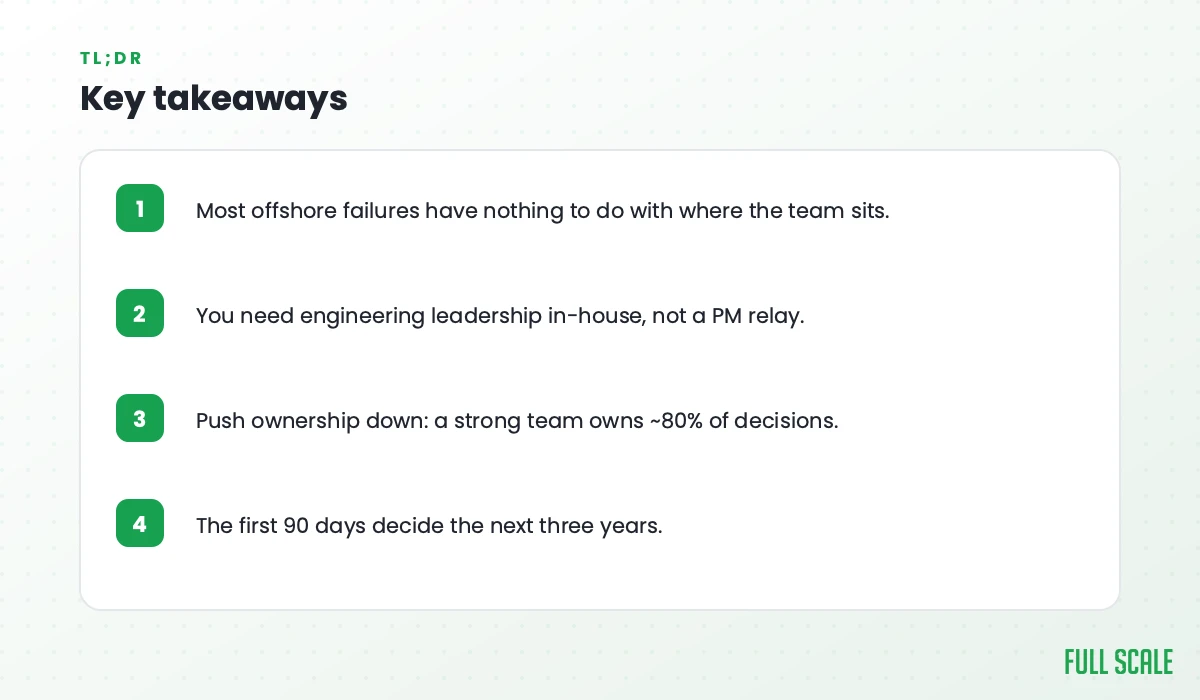
Most offshore engagements that fail were doomed in the first month. Most that succeed got the first 90 days right. There’s a longer guide here, but the short version fits in a table.
| Phase | Days | What you’re focused on |
|---|---|---|
| Pre-arrival | 1 to 15 | Document your dev environment, set up access, write down your coding standards, prep onboarding materials. Most teams skip this and pay for it later. |
| Integration | 16 to 45 | Cross-team standups, first small projects with clear scope, lots of pair-programming, early wins that build confidence on both sides. |
| Acceleration | 46 to 90 | Transfer feature ownership to the offshore team, include them in architectural reviews, set up cross-location code reviews, measure delivery and quality. |
The single biggest thing most founders skip in week 1 is writing down their decision framework, their coding standards, and their definition of done. Whatever you have in your head, write it down before the team starts. You’ll thank yourself in month three.
Red Flags That Mean You Picked the Wrong Offshore Partner
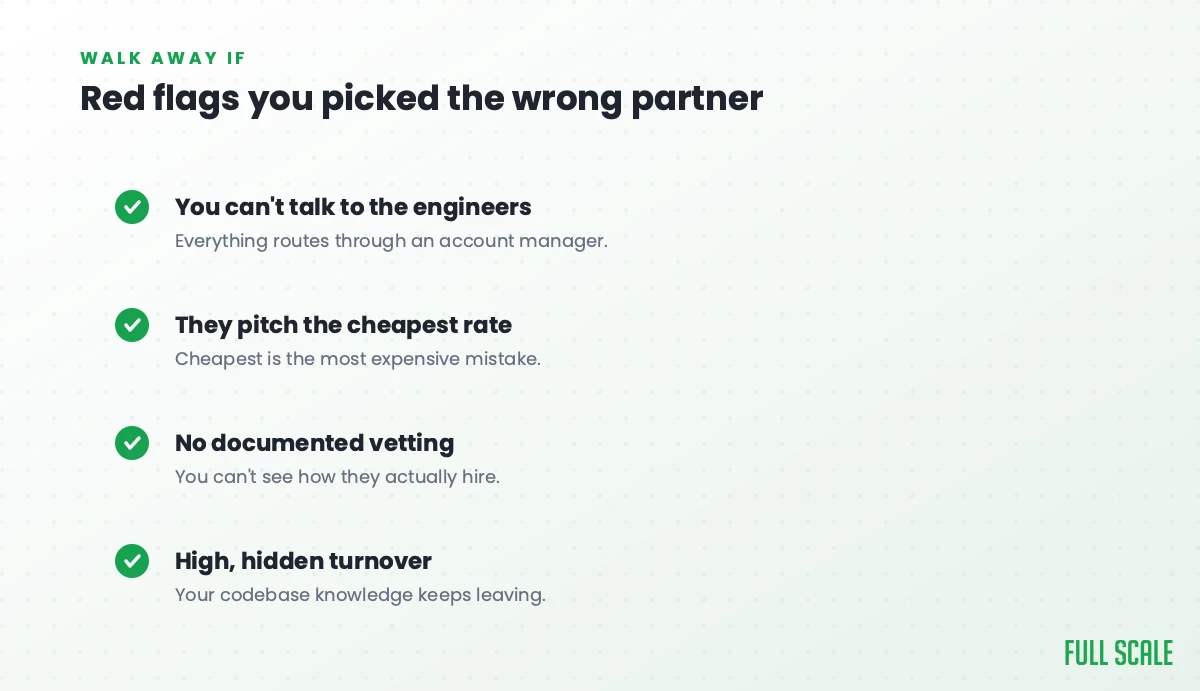
Some of what I described above just isn’t possible with certain vendors. If your offshore partner is structured to make these practices impossible, no amount of effort on your side will fix the engagement. Watch for these:
| Red flag (run) | Green flag (good sign) |
|---|---|
| Project manager required between you and engineers | Direct access to every engineer on the team |
| Junior engineers offered to “save you money” | Senior engineers with 5+ years of experience |
| Hourly or time-and-materials billing | Fixed monthly rate per engineer |
| No documented onboarding or decision framework | A clear playbook for the first 90 days |
| Vendor expects your US team to take 8 p.m. calls | Vendor shifts their team’s schedule to your hours |
| Engineers are split across multiple clients | Each engineer is dedicated to one client |
| Project-based contracts only | Staff augmentation with month-to-month flexibility |
| Annual turnover above 25% | 90%+ retention after 12 months |
If you’re evaluating a vendor right now, the single best question to ask is this: “What happens when I’m dealing with a production crisis for 48 hours and can’t be on calls? How does the offshore team keep working?”
The wrong answer is “they’ll wait for your input” or “the PM will handle it.” That tells you the engagement is going to fall apart every time you have a real fire. The right answer is “they have a decision framework that covers most of what comes up, they keep moving, and they catch you up async when the crisis ends.” That tells you the vendor actually built for the way your job works.
Frequently asked questions
What tools work best for managing an offshore development team?
The tools matter less than using them consistently across the whole team. A shared ticketing system (Jira, Linear), a single source of truth for decisions (Notion, Confluence), video for anything that needs nuance (Loom, Zoom), and one chat tool everyone actually checks (Slack). The failure mode is not missing tools, it is running two sets, one for the local team and one for the offshore team, which quietly recreates the separation you are trying to avoid.
What team-building activities actually work for offshore developers?
Shared work builds more trust than a scheduled game night. Pair programming sessions, a demo where engineers show their own work instead of a manager presenting it, and casual video calls with the camera on build real rapport over time. The forced-fun activities that work for a local office tend to fall flat over a screen; what holds an offshore team together is the same thing that holds any team together, being genuinely included in the decisions and the credit.
Wrap-Up: Engineering Leadership Beats Geography Every Time
The Pakistan founder I opened with thought he had an offshore problem and what he actually had was an engineering leadership problem. The Lithuanian-team founder thought he had a cultural distance problem, and it was the same thing wearing a different disguise. Almost every offshore failure story I’ve heard, once you dig into it, turns out to be a leadership problem with offshore standing in as the scapegoat.
The good news is that engineering leadership is something you can fix. Start by getting the vision in front of every engineer on the team, not just the lead. Give them goals instead of tickets, and trust them to figure out the rest. Hire people who can own ambiguity, build the decision framework that lets them move without you, and overlap your schedules enough to actually have the conversations that matter. Use video for the recurring meetings, hold them at least weekly, treat the team like part of your company, and once a year or so, go shake their hands.
Do all that and the offshore part stops being a story. The team is just your team, which is how it should have been from the start.
If you want to go deeper on the engineering leadership side, my book Product Driven covers in detail how to build engineering teams that own outcomes instead of executing tickets. It’s the foundation everything in this article sits on, and you can grab a free copy on the book page.
When you’re ready to build (or fix) your offshore team in the Philippines, book a discovery call with Full Scale and we’ll walk through what a dedicated team for your stack would look like.