
What Is Software Development as a Service? Shared or Dedicated Resources

In this article
- What "software development as a service" (SDaaS) actually means
- There's a dedicated-team version, and a shared-pool version pretending to be one
- The one question that tells you which one you're buying
- SDaaS, IT outsourcing, and staff augmentation are one model wearing three labels
- What the honest version actually costs, and what it comes with
- When software development as a service is the wrong call
- Frequently asked questions
Quick Answer: Software development as a service (SDaaS) is a subscription model where you pay an ongoing fee for dedicated developers instead of hiring a project shop or building an in-house team from scratch. It's usually staff augmentation with new branding — the real question isn't what SDaaS means, it's whether the vendor gives you a specific, dedicated engineer or an allocation from a shared pool.
Every "as a service" model since Salesforce made "SaaS" a household acronym has followed the same script. Take something companies used to buy outright, wrap it in a subscription, and sell it as a category instead of a product. NIST's own definition of software as a service is refreshingly plain: the provider runs the application, you just use it. Software development got the same "as a service" treatment a few years ago, and now half the outsourcing industry calls itself "software development as a service." I run a company that sells exactly this. I can tell you what's actually in the box.
What "software development as a service" (SDaaS) actually means
Strip the branding and SDaaS is a simple idea: instead of hiring a dev shop to build one thing and hand it off, or hiring your own engineers one at a time, you pay an ongoing fee for developer capacity you can scale up or down as your roadmap changes. You're buying access to engineers, month over month, for as long as you need to keep building. Nobody hands you a finished app at the end of it.
That's it. That's the whole category. Everything past that sentence is a vendor deciding how to package it.
The engagement usually looks like this: you tell the vendor what skills you need, they staff you with developers who fit, those developers work your roadmap under your direction, and you pay monthly instead of per milestone. It's closer to hiring than to commissioning a project. It's also, if you've been paying attention to the outsourcing world for more than five minutes, exactly what staff augmentation has been called for the last two decades.
There's a dedicated-team version, and a shared-pool version pretending to be one
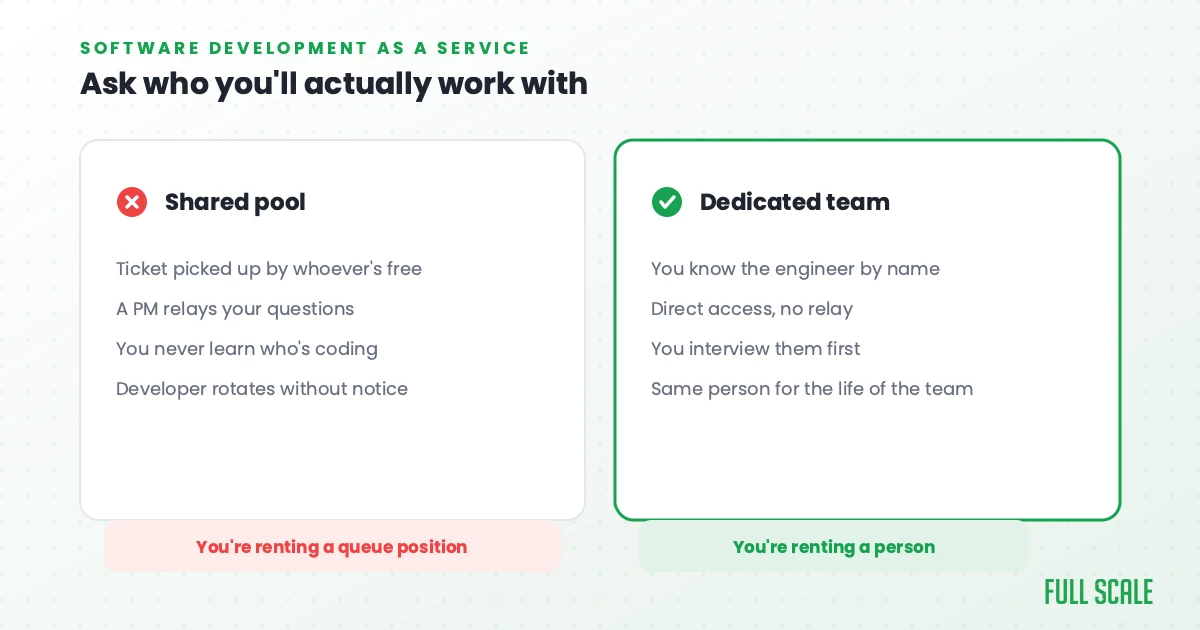
Here's what almost nobody selling "software development as a service" will say about their own product: the term describes two very different arrangements, and vendors have every incentive to blur the line between them.
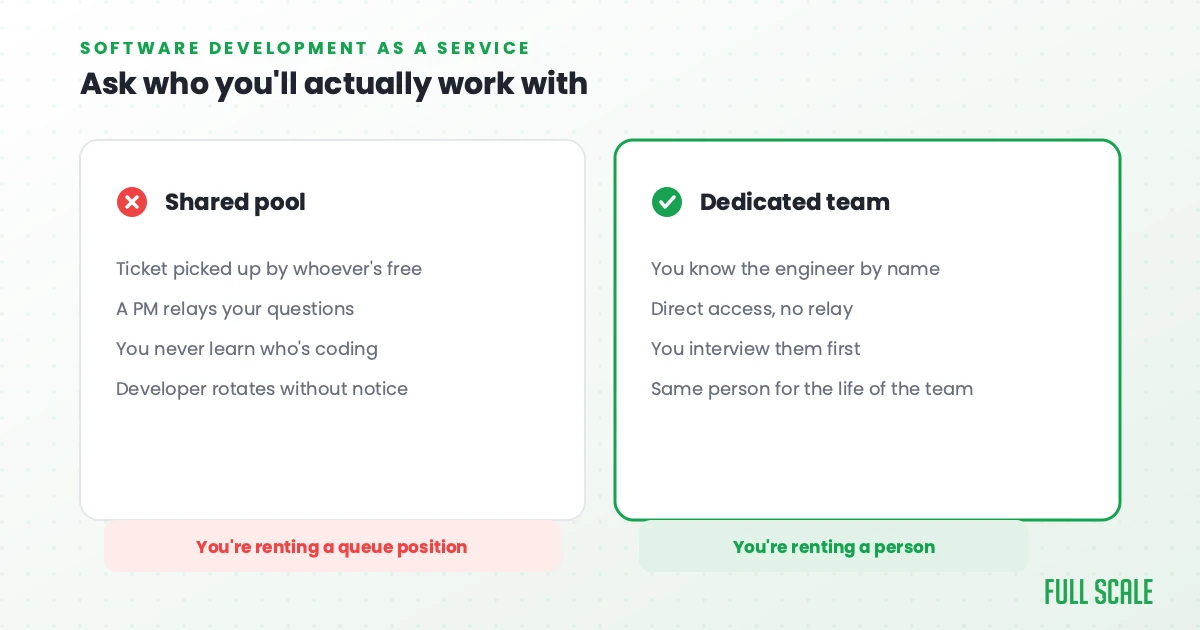
Version one: a dedicated team. You get specific, named engineers who work only on your product. You know who they are. You can talk to them directly, every day, in your own Slack and your own standups. If one of them leaves, you know because your team got smaller, not because a report changed.
Version two: a shared pool. You get "access to a team" that also happens to be working three other clients' backlogs that week. Your ticket gets picked up by whoever's free. There's a project manager who fields your questions and relays them to whichever developer is currently assigned. It's a barbershop where the barber gets assigned to you at random, and it still costs more than the walk-in special. You're renting a queue position, not a person.
Both get marketed as software development as a service. Both get called "subscription-based" and "flexible" and "scalable." Only one of them is actually staff augmentation. The other one is a managed service wearing a staff-aug costume, and the costume is the whole sales pitch.
The one question that tells you which one you're buying
Ask this before you sign anything: who specifically will I be working with day to day, and can I meet them first?
A vendor running the dedicated-team model answers that immediately, with a name, a resume, and usually an interview you get to run yourself before committing. A vendor running the shared-pool model gets vague. You'll hear "our team will handle it" or "you'll have a dedicated point of contact." Notice that's a point of contact, not a point of code. That's the tell. If the answer is a role instead of a person, you're buying allocation, not a developer.
It's the test I'd actually run on my own vendors. I've watched enough outsourcing relationships go sideways to know the breakdown almost always starts in the same place: a single relay point between you and the person actually writing your code. Ask who's on the other end before you find out the hard way.
SDaaS, IT outsourcing, and staff augmentation are one model wearing three labels
Vendors will happily explain the differences between these three terms, usually right before selling you all three under one contract. Here's the honest version.
IT outsourcing is the broadest bucket: infrastructure, help desk, business process work, and sometimes software development, all handled by a vendor who owns the outcome and hands you a result. You describe what you want, they build it, you get a deliverable.
Staff augmentation is developers who join your team, work your backlog, and answer to your product manager. You're buying capacity you direct yourself, not an outcome handed to you at the end.
Software development as a service is staff augmentation with a subscription wrapper and, more often than not, a fresher website. The pricing model looks the same, the day-to-day work looks the same, and the only real question is which of the two versions above you're getting.
None of this is a knock on any single term. It's a warning that the label tells you almost nothing. The contract terms tell you everything.
What the honest version actually costs, and what it comes with
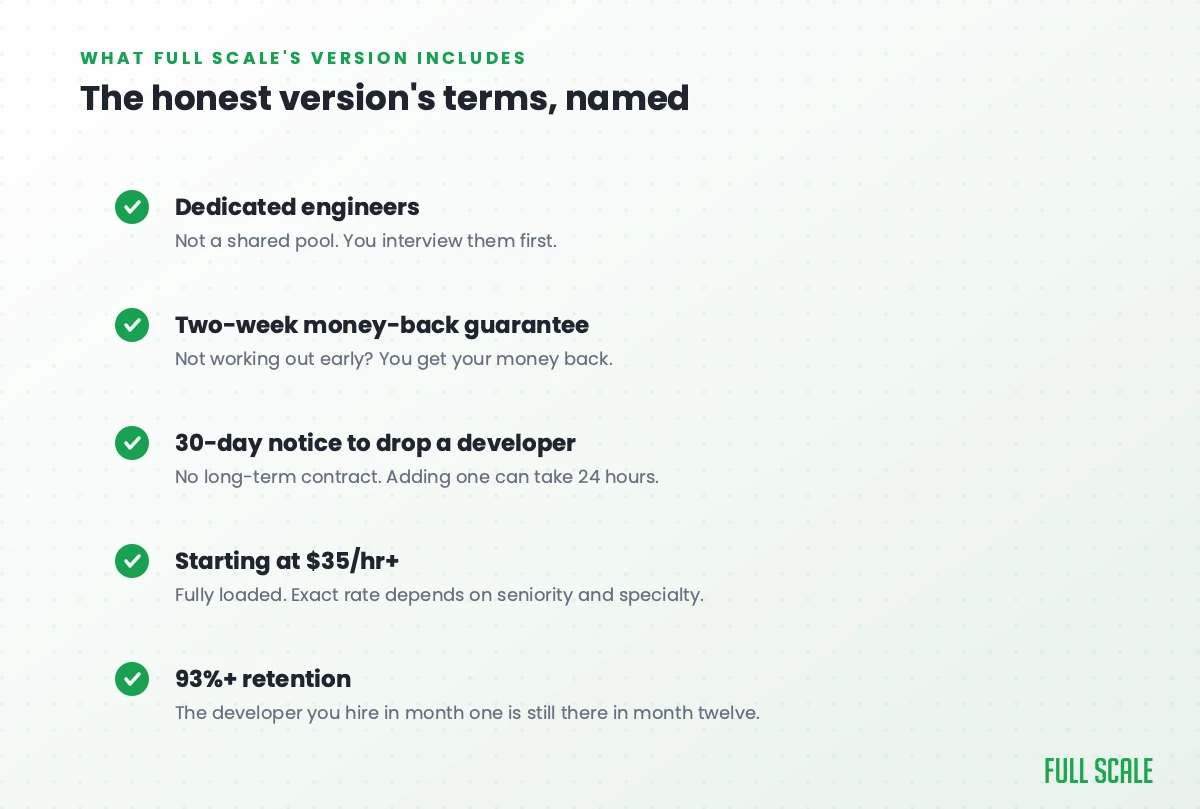
At Full Scale, this is the staff augmentation model we run, and I'd rather name our own terms than make you guess at generic ones:
- Dedicated engineers, not a shared pool. You know who's on your team, and you interview them before you commit.
- A two-week money-back guarantee. If it isn't working out in the first two weeks, you get your money back. That's the only money-back promise we make, and it's two weeks, not one.
- 30-day notice to drop a developer, with no long-term contract. That notice period only applies to removing someone. If your bench has the right skills available, we can add a developer to your team in as little as 24 hours.
- Starting at $35/hr+, fully loaded. The exact rate depends on seniority and specialty, but that's the floor.
- 93%+ retention. The developer you hire in month one is still the developer you have in month twelve, which matters more than almost anything else on this list.
That last one is the whole point of the Product Driven philosophy we train every engineer on: a developer who's still on your product a year from now can actually own it, not just take tickets against it.
I bring up the exact numbers because SHRM's own benchmarking puts the average cost to hire one employee at over $4,100, before you've paid them a single salary or trained them on your codebase. A subscription model only makes sense if it actually removes that cost and risk. If a vendor's version of "software development as a service" still leaves you re-explaining your product to a new face every few months, you haven't escaped the hiring problem. You've just outsourced it to someone with worse incentives than you had.
When software development as a service is the wrong call
I'd be lying if I said this model fits everything, and I'm the guy selling it. It's the right call when you're building something you'll keep building for years. You need a team that sticks around for the roadmap, not just the next release.
It's the wrong call for a small, well-scoped, one-off build: a marketing site, a one-time data migration, a WordPress project you'll never touch again. I've outsourced exactly that kind of work myself, to a fixed-bid shop, because paying for an ongoing dedicated team to do a two-week job is a great way to overpay for nothing. If your project has a defined finish line, hire a project shop for that specific statement of work. Save the dedicated-team subscription for the work that doesn't end.
And if the entire pitch you're hearing is "it's cheaper," slow down. Cost is a legitimate reason to look at any of these models. Cost as the only reason is how you end up cheapshoring your way into the cheapest available body instead of the right one.
Frequently asked questions
Is software development as a service the same as staff augmentation?
Functionally, yes, in most cases. Both mean developers who join your team and work under your direction on an ongoing, month-to-month basis rather than a fixed project. "Software development as a service" is newer marketing language for a model the industry has run for two decades under other names, including staff augmentation and dedicated development teams. What actually varies isn't the label, it's whether you get a dedicated engineer or a shared pool.
Is software development as a service the same as IT outsourcing?
Not quite. IT outsourcing is the broader category and often means handing off a scope of work for a vendor to deliver as a finished result. Software development as a service is closer to hiring: you direct the work yourself, month to month, instead of receiving a deliverable at the end.
What does software development as a service typically cost?
Pricing is usually per-developer, billed monthly, and varies by seniority, specialty, and where the engineers are based. At Full Scale, engagements start at $35/hr+ fully loaded. Be wary of a flat, unexplained "service fee" with no breakdown of who's actually staffed on your account. That's often a sign you're paying for a shared pool, not a dedicated one.
What happens if it isn't working out with an SDaaS vendor?
That depends entirely on the contract, which is exactly why you should ask before signing rather than after. Full Scale's terms: a two-week money-back guarantee if it's not a fit early on, and 30 days' notice to drop a developer after that, with no long-term contract locking you in either way.
Ready to see the dedicated-team version in practice instead of reading about it? Schedule a call with Full Scale and meet the engineer before you commit to anything.