
Offshore Outsourcing: What 20 Years of Hiring Engineers Abroad Taught Me


In this article
- What offshore outsourcing actually is
- The three flavors of offshore outsourcing
- Why companies outsource offshore in the first place
- The downsides nobody puts in the sales deck
- The three models, ranked by how often they blow up
- Where in the world to outsource
- How to actually make offshore outsourcing work
- How to choose an offshore outsourcing company
- FAQ
Quick Answer: Offshore outsourcing means paying a company or team in another country to do work your own staff would otherwise do, usually to cut cost or reach talent you cannot find at home. For software, it works when the offshore engineers act like part of your team, through staff augmentation or a dedicated team, and it fails most often as a hands-off project hand-off. Full Scale's dedicated developers in the Philippines start at $35 an hour.
I have been hiring engineers outside the United States since before it was fashionable. At VinSolutions, the company I co-founded and later sold, I leaned on developers overseas to keep up with demand. At Stackify, my developer tools company, I ran a backend with around 2,000 sharded databases, and a good chunk of that work happened with engineers who were not sitting in my office. Then I started Full Scale, where I have spent years building software teams in the Philippines for other companies. For concrete examples, see the companies that outsource software to the Philippines.
So when someone asks me whether offshore outsourcing works, I do not reach for a survey stat. I answer with scars. If you are weighing whether offshoring is still viable under current US policy, the legal picture is clearer than the headlines suggest.
Here is the short version. Offshore outsourcing works. The cheap, hands-off version of it almost never does. The thing that decides the outcome is not the country, the time zone, or the hourly rate. It is the model you choose and how involved you stay. I learned that the expensive way, and this is the guide I wish someone had handed me in 2010.
What offshore outsourcing actually is
Offshore outsourcing is paying a company or team in another country to do work your own employees would otherwise do. The “offshore” part means the work happens in a different country, usually one where labor costs less. The “outsourcing” part means an outside party does it instead of someone on your payroll. Done right, the advantages of outsourcing your IT show up as lower cost, deeper talent, and faster hiring at the same time. For a .NET team, that faster hiring usually means you hire C# developers offshore on a dedicated model.
People mix up a few terms here, so let me untangle them. For the fuller breakdown of where CTOs usually get this wrong, see our guide to offshoring vs. outsourcing.
- Outsourcing means handing work to an outside party, in any country, including your own.
- Offshoring means moving work to another country, whether you hire there directly or through a vendor.
- Offshore outsourcing is the overlap of the two: an outside vendor, in another country.
- Nearshoring is the same idea with a closer country, like a US company using Mexico.
Common destinations are the Philippines, India, Poland, and several countries across Latin America. The work itself runs from call centers and IT outsourcing services to software engineering. If you want the broader debate on whether any of this is a good idea, I dug into that in is outsourcing good or bad.
The three flavors of offshore outsourcing
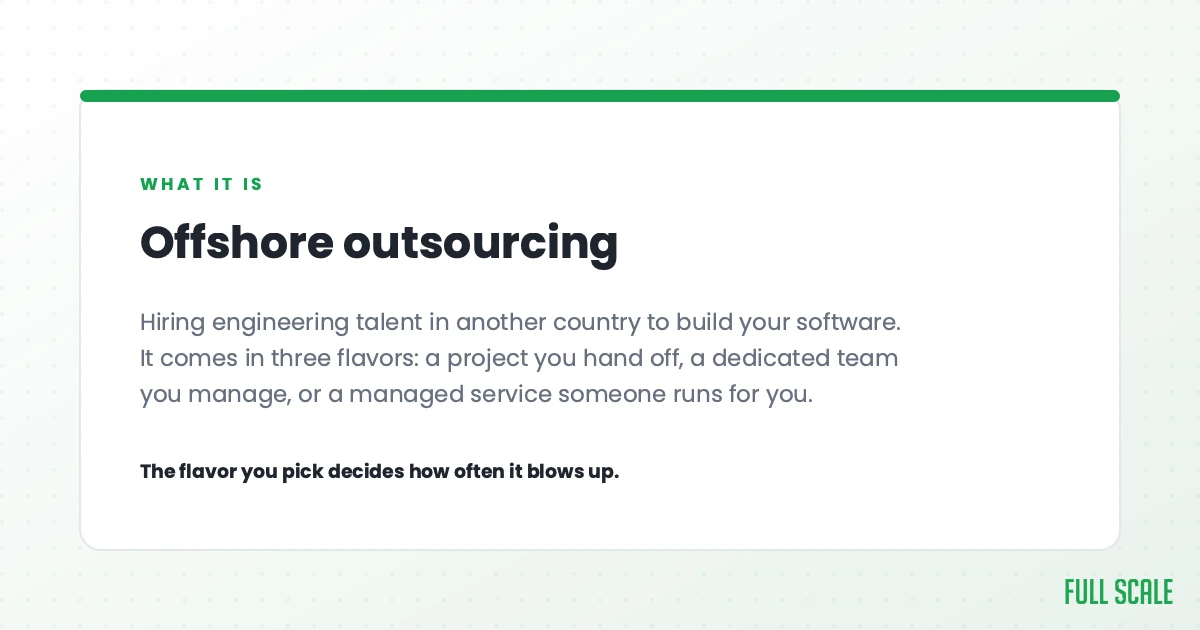
Offshore outsourcing covers three very different kinds of work: business process outsourcing, IT outsourcing services, and software development. Most articles blur them into one word.
The first is business process outsourcing, or BPO. This is call centers, customer support, data entry, and back-office accounting. It is what built the offshore industry, and it is still the biggest slice of it.
The second is IT outsourcing services, covering infrastructure and operations. Think help desks, network management, and system administration, the kind of work a managed services provider handles.
The third is software development, which is my world. It is engineers writing and shipping your actual product, not answering phones or resetting passwords, and it covers everything from web platforms to offshore app development for mobile.
I am going to spend most of this guide on that third kind, because it is the one I have lived and the one where generic advice falls apart fastest. A call center and a product engineering team need completely different things to succeed, and treating them the same is how good companies end up with bad software.
Why companies outsource offshore in the first place
The honest answer is usually money, and there is no shame in that.
A senior software developer in the US is expensive. Once you add salary, benefits, payroll taxes, and recruiting fees, a senior engineer in a major US market runs you $180,000 to $250,000 all in. The US Bureau of Labor Statistics puts the median software developer salary around $130,000 before you load all of that on top, and in hot markets it climbs well past that.
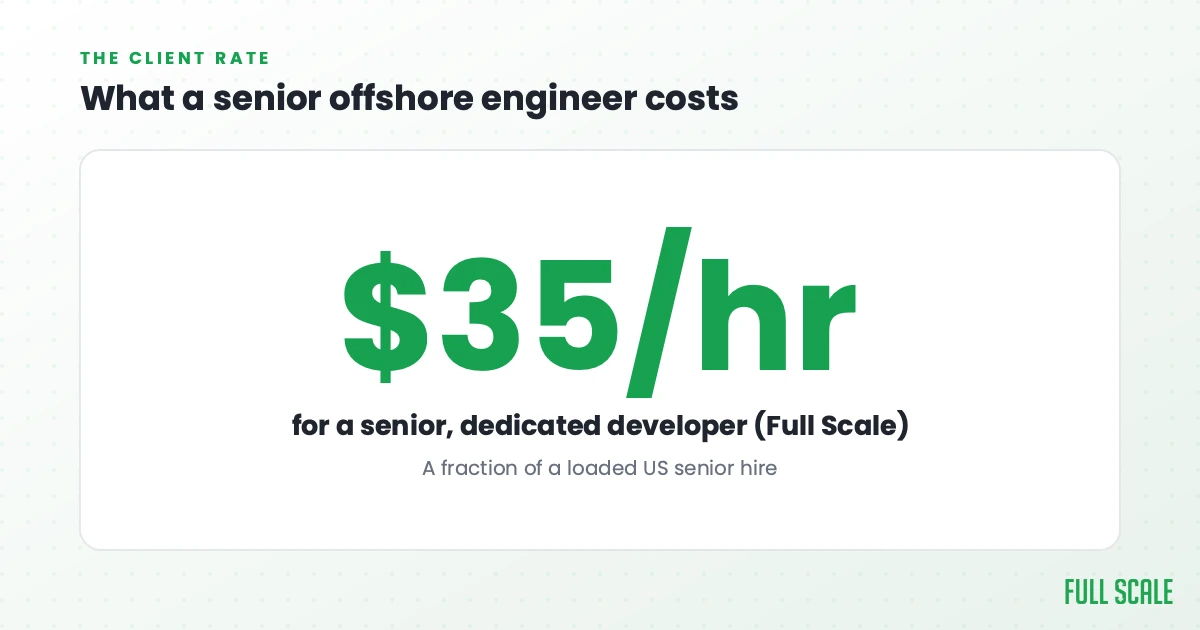
An equally strong engineer in the Philippines can cost a fraction of that. At Full Scale, our clients pay around $35 an hour for a senior, dedicated developer. That is not a junior, and it is not a typo. I break down the full cost of hiring developers in the Philippines, and the rest of my case for it, in more detail elsewhere.
Cost is the headline, but it is not the only reason. Deloitte’s Global Outsourcing Survey has found for years that cutting cost is the top driver, followed by freeing internal teams to focus on core work and reaching talent faster.
That talent point is real. US engineering hiring has not gotten easier, and the Stack Overflow Developer Survey shows just how global the developer workforce already is. The other quiet advantage is time zone coverage. With a team in Asia, work keeps moving while your US team sleeps, and a bug filed at 6pm can be fixed by morning. You also get room to scale a team up or down without the drama of US hiring and layoffs.
If sticker shock on US hiring is what brought you here, I also wrote about how IT recruiters charge up to six months of salary for a single placement, which is its own argument for looking abroad.
The downsides nobody puts in the sales deck
Offshore outsourcing has a failure rate, and pretending otherwise would make me a liar.
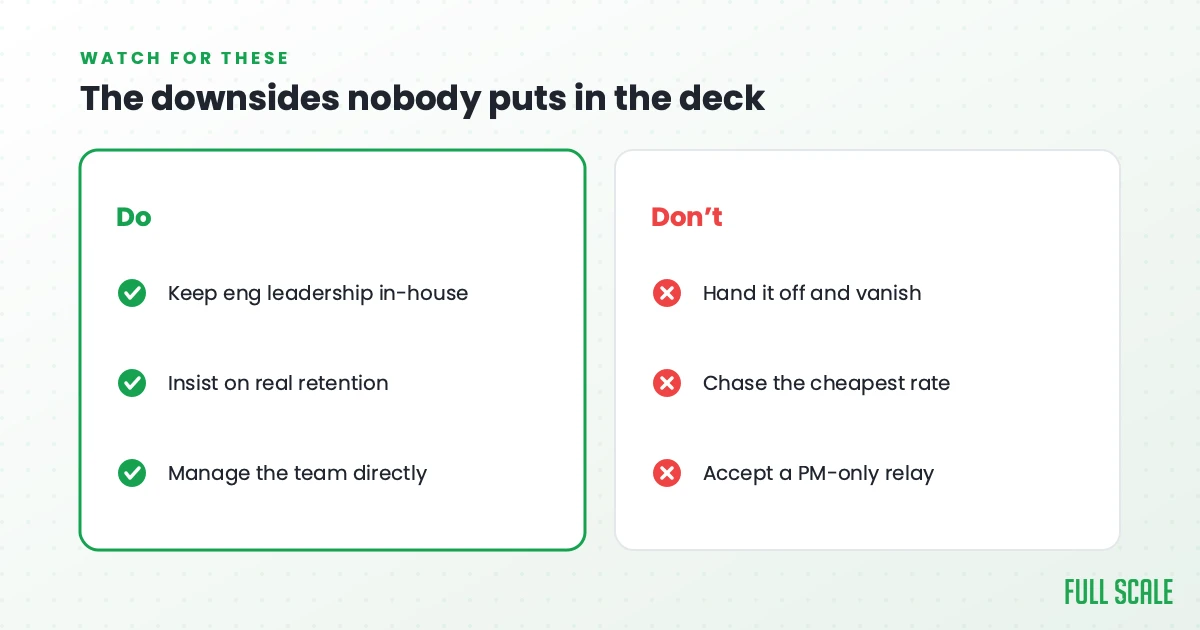
I have watched freelancers take a deposit and disappear in the middle of a sprint. I have had a body-shop vendor bill me for ten people when maybe three were doing real work. I have shipped code that technically met the spec and was useless, because nobody on the other side understood what we were actually building.
The risks that have bitten me, roughly in order:
- Communication gaps, usually because a project manager sits between you and the people writing the code.
- Turnover, because the cheap shops treat engineers as interchangeable and engineers leave when they feel that way.
- Quality you cannot see until it is too late to fix cheaply.
- Intellectual property and security exposure, which I covered in detail in the risks of outsourcing.
None of these are reasons to avoid offshore outsourcing. They are reasons to walk away from the cheap, hands-off version that creates them. When I dug into why offshore projects fail, almost every failure traced back to structure, not geography.
The three models, ranked by how often they blow up
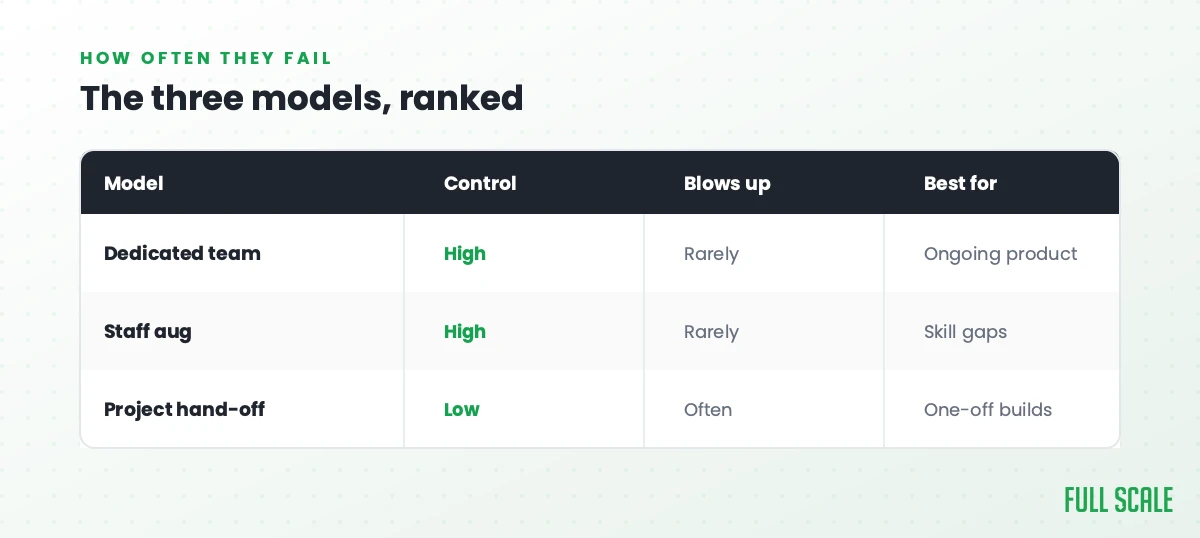
There are three common ways to buy offshore software work, and project hand-offs fail most often while staff augmentation and dedicated teams hold up best. Most guides skip this part.
Project-based outsourcing is the first. You hand a vendor a spec, they go quiet, and they hand you software months later. This is the model that fails most often, because the incentives run backwards: the vendor earns more when the project drags on, and you have no real visibility while it does.
Staff augmentation is the second. You add offshore engineers to your existing team and manage them like your own people. They join your standups, your code reviews, and your Slack channels. This is the model I trust, and it is the one I built Full Scale’s staff augmentation around. I went deeper on the offshore version of it in offshore staff augmentation.
Dedicated teams are the third. This is a step beyond staff augmentation: a full squad that works only on your product, often with its own lead, still plugged into your process. If you are weighing that structure, I broke it down in what an offshore team really is.
The pattern across all three is simple. The more the offshore engineers feel like your own employees, the better the work gets. Hold them at arm’s length like an outside vendor and the quality falls off with the distance.
Where in the world to outsource
Country matters less than model, but it still matters.
India built the offshore software industry and has scale and depth that nobody else can match. The Philippines, where I focus, won me over for different reasons: English that genuinely sounds American, a cultural fit with US business, and lower turnover than I saw elsewhere. The Philippines is the third-largest English-speaking country in the world, and you hear it on the first call.
I hired in both India and the Philippines back at Stackify, and I wrote up what four Stackify hires taught me about India versus the Philippines. The short version is that India is unbeatable on scale and the Philippines edged it on communication and retention for my teams. Neither answer is wrong. It depends on what you are optimizing for, and I made the fuller case for outsourcing software development to the Philippines separately.
Latin America is worth a look when real-time overlap with US hours is your single biggest priority.
How to actually make offshore outsourcing work
After years of getting this right and wrong, my playbook comes down to a handful of things.
Treat them like employees, not a vendor. The biggest predictor of success I have seen is whether you fold the offshore engineers into your team or hold them at arm’s length.
Protect a few hours of daily overlap. You need at least three or four hours where everyone is online at the same time, or decisions stall for a full day at a time.
Insist on dedicated engineers. An engineer split across five clients is not really yours, and it shows in the work.
Run real agile instead of a status-report relationship. I wrote about running agile with offshore teams because the ceremonies matter more across a time zone, not less.
This is also the heart of the Product Driven approach I lay out in my book. Engineers who understand the product they are building, not just the ticket they were handed, are the ones worth keeping.
How to choose an offshore outsourcing company
Once you have settled on a model, picking the company is mostly about cutting through the sales theater.
I would ask every vendor the same questions:
- Are these dedicated engineers, or shared resources spread across other clients?
- Who manages them day to day, you or me?
- What is your developer retention rate?
- Can I interview the engineers before they join?
- How do you handle intellectual property and security?
I keep a ranked list of the top offshore software development companies current for exactly this reason. Full disclosure: I built Full Scale’s offshore software development model around the answers I wished vendors had given me, and it has landed us on the Inc. 5000 five years running. When AMC Theatres needed to scale their .NET engineering, what worked was dedicated developers who operated like part of their team, not a project shop on the other end of a contract.
FAQ
What is offshore outsourcing?
Offshore outsourcing is paying a company or team in another country to do work your own staff would otherwise handle, usually to lower costs or reach talent you cannot find at home. It combines outsourcing, which means using an outside party, with offshoring, which means moving the work abroad.
What is the difference between offshoring and offshore outsourcing?
Offshoring means moving work to another country, which you can do by opening your own office there and hiring directly. Offshore outsourcing specifically means a third-party vendor in another country does the work, so you are not the employer of record for those people.
What are offshore IT outsourcing services?
Offshore IT outsourcing services cover the technical work a company hands to a team in another country, from software development to infrastructure and operations like help desks and network management. For an engineering team, software development is the part that moves the product, and I trust staff augmentation or a dedicated team you manage directly to deliver it. If you want a vendor for that part, start with outsourcing software development.
What are the main advantages of offshore outsourcing?
The biggest advantage is cost, since a senior engineer abroad can cost a fraction of a US hire. Close behind are access to talent that is scarce at home, time zone coverage that keeps work moving overnight, and the flexibility to scale a team up or down quickly.
What are the biggest risks of offshore outsourcing?
The common risks are communication gaps, high turnover at low-cost shops, quality problems you cannot see until late, and intellectual property exposure. Most of them come from a weak offshore engagement model rather than from the country itself.
How much does offshore outsourcing cost?
Rates vary by country and skill, but offshore software engineers often run $15 to $40 an hour compared with $80 or more for an equivalent US contractor. At Full Scale, clients pay around $35 an hour for a dedicated senior developer in the Philippines.
Which country is best for offshore outsourcing?
There is no single best country. India offers unmatched scale, the Philippines is strong on English fluency and retention, and Latin America wins on US time zone overlap. The right choice depends on whether you are optimizing for cost, communication, or working hours. If the Philippines is your pick, see this rundown of software outsourcing Philippines vendors, sorted by engagement model.
Is offshore outsourcing worth it for a small company?
Yes, and often more than it is for big ones, because a small company feels the cost savings right away and one strong offshore hire can change its trajectory. The key is to use staff augmentation or a dedicated developer you manage directly, not a hands-off project shop. That one choice is the difference between a hire that pays off and one that becomes a cautionary tale, so take real care shopping for offshore developers for hire even for that first role.