

Software testing services from a team that actually builds software
Software testing services and QA outsourcing from senior Filipino QA engineers who read your code, sit in your standups, and find the bugs that black-box testers miss. We staff manual testers, automation engineers, SDETs, and performance specialists for SaaS, fintech, and enterprise teams, on a dedicated model that works like part of your team rather than a vendor behind a wall. Senior QA engineers start at $35 an hour.
QA teams trusted by enterprises, scale-ups, and Fortune 500s

Previously founded VinSolutions ($150M+ exit) and Stackify
Bad testing has cost me real customers. That's why we sell testing the way we do
Two failures shaped how I think about QA. At VinSolutions, weak testing on a billing flow cost us a customer. At Stackify, an untested release of our own monitoring product took our dashboards down, which is a special kind of embarrassing when monitoring is the product. In both cases we had testers. What we didn't have was a testing function: someone who owned coverage, knew where the product was fragile, and had the standing to hold a release.
That's the gap most companies are trying to close when they outsource software testing, and it's why the standard models disappoint. A test factory runs the scripted passes you hand it and mails back a spreadsheet; nobody there knows your product or notices the bug the script wasn't written for. A project agency parachutes in, tests one release, and leaves with everything it learned. The knowledge that makes testing effective compounds over time, and both models throw it away.
So we built our software testing services on the model we use for engineers: dedicated QA people, embedded in your team, on your product for years. They're trained on the Product Driven framework from my book, they own both the automated regression suite and the exploratory work scripts can't do, and they carry the quality bar at release time. AG Mednet runs testing for clinical trial software this way through us, at a cost where one nearshore developer's budget covers two QA engineers. If you want a testing partner that gets smarter about your product every month instead of starting over every project, that's what this page is offering.
What you're actually buying: release confidence
Nobody outsources testing because they want more test cases. They outsource it because releases have become a coin flip: the suite is green, and production still breaks. The fix isn't more testers running more scripts. It's a testing function that knows your product, owns a coverage map, and can tell you before a release what's protected and what's a gamble.
That's the service. Dedicated QA engineers embed in your team, stand up the automated regression gate, run the exploratory passes scripts can't, and carry the go/no-go call at release time, with the judgment trained in through the Product Driven framework from Matt's book.
A testing program, not a pile of test cases
Outsourced testing fails when the deliverable is activity: cases executed, hours logged, spreadsheets returned. Our engagements are built around a coverage map tied to your release cadence. You can see which user flows are protected by automated regression, which get exploratory passes each release, and which risks you've explicitly accepted. When something ships broken, the question is answerable: was this covered, and if not, why not.
Testing sized for the AI code flood
Your developers are shipping more code than ever because AI writes half of it. Attention per line is falling exactly as volume rises, and code review alone can't hold that gate. A standing regression suite plus scheduled exploratory testing is the layer that catches what review misses. Our QA engineers use the same AI tooling to keep suite maintenance cheap, so coverage grows with your codebase instead of falling behind it.
Read Product Driven, the bookOther than the fact that they're not physically here with us, you would think that they've always been working with us.
The embedded QA team behind AG Mednet
AG Mednet ships clinical trial software, where a missed bug can stall a drug submission. Their embedded Full Scale QA team owns that testing, at a cost where one nearshore developer's budget covers two QA engineers.

Software testing services for the work that actually catches bugs
Most QA conversations skip past the actual work. Do you need a senior manual tester who can own exploratory passes and release sign-off, an automation engineer who can stand up a Playwright suite from scratch, a performance specialist who can load test your APIs, or all of the above on the same team? As a software testing services and QA outsourcing company that bills for hours rather than fixed-bid projects, our QA engineers ship across all of it. Here are the software testing services we get hired for most often.
Playwright automation and end-to-end testing
Playwright is the default for new automation work. Our QA engineers write maintainable suites with page objects, fixtures, and traces, run them in CI across chromium, firefox, and webkit, and shard them so a full regression pass fits inside the release window. We migrate teams off legacy Cypress, Selenium, or record-and-replay tools when the existing suite has stopped paying for itself.
Manual and exploratory testing
Real users do not follow a script. Senior manual testers on the bench run structured test passes against the acceptance criteria and unstructured exploratory passes against the parts of the product that automation cannot reach: visual regressions, content-layout edge cases, multi-step user journeys, and the stuff a PM forgot to spec. Bug reports come with video, traces, and exact repro steps.
Performance and load testing
Load testing with k6, JMeter, or Gatling against your real APIs. We model traffic patterns from production, run sustained load and spike tests, and report on the latency, throughput, and error rates that actually matter for your SLOs. Performance specialists on our bench have shipped load testing programs for fintech APIs, ticketing systems, and SaaS platforms.
API and security-aware testing
Contract testing, schema validation, and security-aware QA on REST and GraphQL APIs. Our QA engineers work in Postman, RestAssured, and Playwright API tests, and they know how to catch the unauthorized access, broken object level authorization, and input validation issues that show up on every OWASP top 10. We coordinate with dedicated penetration testing partners when the project needs it.
Mobile QA on iOS and Android
Native iOS and Android testing on the same bench. Mobile QA engineers cover device matrices, gesture flows, push notification paths, deep links, and the platform-specific edge cases that only show up on a real device. They work with Appium, XCUITest, Espresso, and Playwright for mobile web on top of full manual passes on real hardware.
QA strategy and test infrastructure
Standing up a real QA function: defining the test strategy, picking the tooling, building the CI pipeline for tests, designing the bug triage workflow, and writing the documentation that lets the next QA hire ramp in days instead of weeks. This is the work most offshore shops skip because it does not bill by the script.
Hire dedicated QA engineers, two ways
Most clients start with a single dedicated QA engineer and grow into a full QA team. When you hire an offshore testing team this way, you get full-time testers in the Philippines who sit on your standups, work your hours, and ship coverage against your release calendar. Both options are our staff augmentation model at the core: dedicated, long-term QA engineers embedded in your team rather than freelancers, shared resources, or a project shop on the side.
Dedicated QA engineer
Full-time, exclusive, sits on your standups.
- Full-time QA engineer assigned only to your project
- Works your hours, your tools, your CI pipeline
- Joins your standups, reports to your engineering lead
- We handle payroll, HR, equipment, retention
- Two-week money-back guarantee
Dedicated QA team
A full offshore testing team, embedded as one pod.
- 2-10 QA engineers staffed together as one pod
- Mix of manual, automation, SDET, and performance roles
- Operates as a QA team inside your product org
- Scale up or down by a head with 30 days notice
- Account manager you can escalate to in the US
The test factory model is the problem, not the testers
Most QA outsourcing is structured to fail: a vendor you email builds to, testers who rotate between clients, and a deliverable measured in cases executed instead of bugs that mattered. The six failure modes below are the ones clients bring to us after a bad vendor experience, and each one is a structural choice, not bad luck.
Testing to a spreadsheet, not to your product
The test factory runs exactly the cases you handed it, and nothing else. Six months in, nobody there can tell you where your product is fragile or which module generates the incidents. An embedded team accumulates that knowledge release after release, and it's the knowledge that finds the bug the script wasn't written for.
Automation that rots between projects
Project-based QA vendors build a suite, hand it over, and leave. Nobody maintains it, selectors go stale, the suite goes red, and the team turns it off. A regression suite is a living asset that needs an owner on every release, which is why our automation engineers stay on the account instead of rotating to the next project.
Bug reports you can't act on
Outsourced testing lives or dies on the handoff. A report without exact repro steps, environment details, expected vs. actual, and a trace or video is a complaint, not a bug report, and it costs your developers three rounds of follow-up. Report quality is a standing requirement of our engagements, checked by the client success manager, not left to individual habit.
Coverage nobody can describe
Ask most testing vendors what's protected and you get a case count. Ask what happens if you refactor checkout and you get silence. Every Full Scale engagement maintains a coverage map tied to your user flows, so 'are we safe to ship' has an answer grounded in what was actually tested.
Chasing case counts instead of risk
Vendors billed on volume test the cheap things thoroughly and the important things shallowly. Risk-based testing inverts that: the flows that would cost you customers get tested deepest, on every release, and the low-risk corners get sampled. That prioritization takes product understanding a black-box vendor never builds.
Nobody empowered to hold a release
A testing service that just reports status is a rubber stamp. The value shows up the day someone says this release is not ready and can defend why. Our QA engineers own release sign-off as part of the engagement, and they're trained to hold that position in the meeting where it's unpopular.
When you shouldn't outsource your testing at all
Outsourced software testing is a fit for a specific situation: a real product, a real release cadence, and more testing work than the team can carry. If you're in one of the four cases below, we'd rather point you at the cheaper answer than sign you up and hope.
The product changes too fast to test formally
Pre-product-market-fit, when the app is rebuilt weekly, a standing testing program is overhead. Smoke tests by the founding engineer are the right amount of QA. Outsourced testing starts paying for itself when there's a release cadence to protect and users who notice regressions.
Your testing legally has to stay on US soil
Certain DoD contracts, ITAR-covered systems, and a narrow slice of regulated workloads require US persons on US soil. If your test data touches those domains, offshore testing services are off the table no matter the vendor, and we will tell you that on the call, not after the contract.
You need a one-time pass, not a program
A single mobile app certification, a one-week pre-launch sweep, or an audit of an existing suite is freelancer or specialist-agency work. Our model earns its value as the team's product knowledge compounds across releases, and a fixed one-time scope never runs long enough for that to happen.
There isn't a full-time job's worth of testing
If your release cadence generates ten hours of test work a week, a dedicated full-time QA engineer will sit idle or drift into work you didn't budget for. Fractional QA services exist for exactly that situation, and we're honest that we are not one.
Eight QA specializations, one staffing partner
Most product teams need more than one role. Hire dedicated manual testers, Playwright automation engineers, SDETs, and performance specialists from a single vetted bench. Mix and match seniorities as the project requires.
Manual QA Engineers
Senior manual testers who own exploratory passes, structured regression runs, and release sign-off. Strong at writing test plans from a Figma file or spec, finding the bugs automation cannot reach, and filing reports the dev team can fix without follow-up.
Playwright Automation Engineers
Automation specialists who write maintainable Playwright suites with page objects, fixtures, and CI integration. They have shipped suites that run in under 10 minutes across chromium, firefox, and webkit, and they migrate teams off legacy Cypress and Selenium codebases.
SDETs (Software Development Engineers in Test)
Engineers who write production-grade code in the same language as your app and use it to test it. They build test frameworks, harnesses, and tooling, and they own the boundary between unit, integration, and end-to-end coverage. Polyglot in TypeScript, Python, Java, and C#.
Performance Test Engineers
Specialists in load, stress, and soak testing with k6, JMeter, and Gatling. They model production traffic, report on latency and throughput against your SLOs, and partner with engineering to fix the bottlenecks the tests find rather than throwing reports over a wall.
Mobile QA Engineers
Native iOS and Android testers who cover device matrices, gesture flows, push notifications, deep links, and platform edge cases. Fluent in Appium, XCUITest, Espresso, and real-device testing on Sauce Labs and BrowserStack.
API and Security-Aware Testers
QA engineers who can test REST and GraphQL APIs at the contract and schema level, and who know enough about the OWASP top 10 to catch the broken access control and input validation bugs that show up before a real security audit.
QA Automation Architects
Senior engineers who design the entire QA pipeline: tool selection, framework architecture, CI/CD integration, parallelization, reporting, flake mitigation, and the documentation that keeps the next hire productive. They are the people you hire when you want a real QA function, not a checklist.
QA Leads and Test Managers
QA leadership for product teams big enough to need it: defining the test strategy, owning release sign-off, partnering with product and engineering on quality gates, and managing a pod of testers. The people who turn a group of testers into a real QA team.
QA expertise tuned to your industry
Since 2018 we've run testing for products in nearly every industry that ships software, and the test plan changes shape with the domain: what sits in the always-test tier, what gets load-tested, and what a regulator will eventually ask to see. We match testers to industries where they've already shipped coverage, because domain knowledge cuts ramp-up in half.
SaaS & Scale-ups
For SaaS products, the testing program centers on the flows that touch revenue: signup and onboarding, billing and plan changes, and the admin console. Regression suites verify role-based access and tenant isolation on every release, because those are the bugs that turn into churned accounts and failed SOC 2 audits rather than support tickets.
Playwright by default, plus every other tool QA needs
Playwright is the default for new browser automation work, and most of our QA engineers ship in it daily. Whether you want to hire QA testers for a manual program, hire automation engineers to stand up a Playwright suite, or outsource software testing on a legacy Selenium codebase that needs a rewrite, the bench covers every layer of the stack. Pick what you need. We will match a QA engineer fluent in it.
A real testing program for the cost of one US hire
QA outsourcing is priced per dedicated engineer, starting at $35 an hour fully loaded. The math that gets clients on the phone: a two-person testing pod, one senior manual tester plus one automation engineer, runs about the same annual cost as a single senior US SDET at $110K to $160K plus overhead. One budget line buys the whole function instead of one seat.
- Full-time, dedicated QA engineers, never a shared pool
- Coverage assessment and test plan as part of ramp-up
- Automated regression suite built and maintained in your CI
- Manual and exploratory passes on your release cadence
- Payroll, HR, equipment, benefits handled by us
- Two-week money-back guarantee, then 30 days' notice to cancel
Full Scale has made the Inc. 5000 five years in a row and is Great Place to Work certified. We have been doing this since 2018, and pricing isn't the only reason clients stay with our software testing company, it's the easiest reason to call.
The reason offshore QA works here
You can also hire dedicated developers in the Philippines across every stack we staff, alongside QA, with the same vetting bar, retention numbers, and engagement model.
Bug reports you never have to decode
The Philippines is the third-largest English-speaking country in the world, and a testing handoff is mostly written communication. Repro steps, expected-vs-actual, and release notes arrive readable the first time, which is half of what makes outsourced QA usable.
Testing that runs while you sleep
The 12-15 hour time difference is an asset for a testing function: full regression passes run overnight and results are waiting when your developers log in. Most of our QA engineers also shift their hours toward the US business day, giving 3-4 hours of live overlap for triage and release sign-off.
Two decades of QA depth
The Philippines has run software QA at scale since the early BPO era, and Cebu and Manila keep feeding the pipeline with thousands of CS and IT graduates a year. That history means real depth across manual testing, automation, performance, and SDET roles, not a market learning QA on your product.
Direct answers in release meetings
Filipino engineers grow up on US software and US business norms, which shows up where a testing service needs it most: bug reports that say what broke, and a tester willing to tell you a release isn't ready. Cultural alignment here isn't marketing, it's what makes the quality bar hold.
Full Scale vs the other ways to hire a QA engineer
Every hiring path has trade-offs. Here is how a dedicated QA engineer from our software testing company compares against the alternatives most teams consider first when they want to hire QA engineers.
| Feature | Full Scale | Freelancer / Upwork | Testing agency | US recruiter / FTE hire |
|---|---|---|---|---|
| Pre-vetted senior QA bench | ||||
| Playwright fluency by default | varies | |||
| Time to first hire | 7 days | 1-3 days | 2-4 weeks | 6-12 weeks |
| Dedicated full-time, not shared | ||||
| Founder-led product oversight | ||||
| Sits on your standups, your tools | ||||
| Long-term retention | 93%+ | low | varies | varies |
| Two-week money-back guarantee | ||||
| Handles payroll, HR, equipment | ||||
| US-based account management | n/a | |||
| Typical fully-loaded cost vs US | ~40-50% | varies | ~70-90% | 100% |
How we take over your testing
Outsourcing your QA shouldn't start with a headcount request. It starts with an honest read on what's covered today and what keeps breaking. Here's how an engagement actually begins, and how we hire engineers before they ever touch your product.
Discovery call
30 minutes with our team. We learn your product, your release cadence, where the incidents come from, and what testing exists today: manual only, a rotting automation suite, or nothing. You leave knowing what a right-sized testing program would look like and what it would cost.
Coverage assessment & test plan
We map what's currently tested against how your product actually breaks: which user flows are protected, which automation is real versus decorative, and where the biggest uncovered risks sit. That becomes a test plan tied to your release cadence, not a generic checklist.
Meet your QA team
We propose the team the plan calls for, usually a senior manual tester plus automation coverage, from our pre-vetted bench. You interview them yourself, including a real bug-hunt exercise if you want one, and pass on anyone you don't believe in.
One contract, zero offshore admin
Sign once with Full Scale. We employ the QA engineers in the Philippines and carry payroll, equipment, benefits, and HR, so you take over a testing function without taking on an offshore entity.
First regression pass
The team joins your standups, gets repo and CI access, and runs the first meaningful test pass in week one. From there the regression suite gets built or repaired release by release, with a client success manager watching that ramp-up doesn't stall.
Real QA engineers, named and vetted
A sample of the QA engineers on our team. These are real Full Scale developers working remotely from across the Philippines, and you'll meet candidates like them during your interview round.

A senior QA engineer with 8 years of experience across Playwright, Manual Testing, and Automation Testing.

A senior QA engineer with 20 years of experience across Playwright, Manual Testing, and Automation Testing.

A senior QA engineer with 7 years of experience across Manual Testing, Automation Testing, and Test Design.

A senior QA engineer with 7 years of experience across Selenium, Manual Testing, and Automation Testing.

A senior QA engineer with 11 years of experience across Manual Testing, API Testing, and Test Planning.

A senior QA engineer with 20 years of experience across Manual Testing, API Testing, and Test Design.
The numbers behind a QA staffing partner that actually works
From the people we actually staff teams for
With Full Scale, we transformed the commercial real estate landscape. Their team's proficiency in agile delivery and proactive communication accelerated our product release.
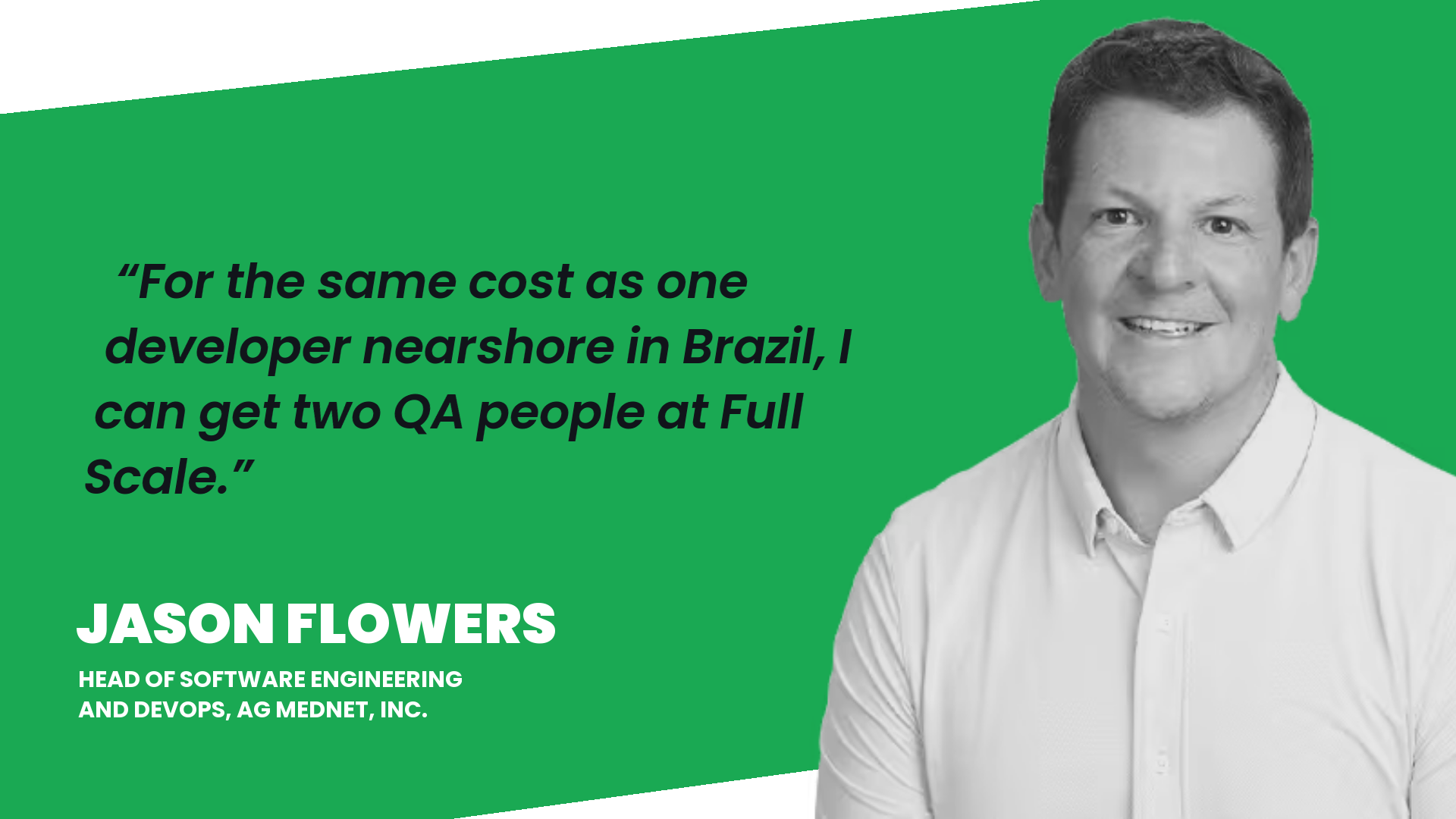
For the same cost as one developer nearshore in Brazil, I can get two QA people at Full Scale. We get the quality testing we need at a fraction of the cost.
Deeper guides to product hiring and QA
Offshore software testing
How offshore QA scales test coverage without slowing your releases.
Software testing in the Philippines
Why the Philippines is a strong base for senior QA and test talent.
Nearshore vs offshore
When each model wins, from a CEO who has run both.
Outsourcing vs offshoring
The distinction most CTOs get wrong, and why it matters.
What offshore development really costs
The real numbers behind offshore rates and total cost.
The ROI of offshore development
The math behind 50-70% development cost reductions.
Everything you wanted to know about software testing services and QA outsourcing
Hire a dedicated QA engineer who has actually shipped quality before
Book a 30-minute discovery call with the software testing company that supplies dedicated QA engineers and full software testing services from the Philippines. We'll learn what you're building, walk you through which manual testers, Playwright automation engineers, SDETs, or performance specialists are on the bench, and you'll meet candidates within a week. You won't get pressure or a sales pitch on the call.