
Legacy Application Modernization: How to Choose the Right Approach (and When Not To)

In this article
- What legacy application modernization actually means
- The R’s of modernization, as a decision, not a list
- Rewrite versus refactor: the call that decides the budget
- When not to modernize at all
- How to modernize without a big-bang cutover
- AI changed the economics of modernization
- Why modernization projects fail
- Frequently asked questions
- The decision is the work
Almost every guide to legacy application modernization will hand you the same list of options, the “R’s,” and then leave you exactly where you started: staring at an aging system with no idea which option is yours. The hard part was never naming the approaches. It’s deciding which one each part of your system is actually on, and being honest about the parts you should leave alone. That decision, made well or made badly, is what separates a modernization that pays for itself from a year-long rewrite that ships nothing. For the .NET case specifically, see .NET Framework to .NET Core migration.
I’ve made that call from the inside more than once. I ran roughly 2,000 sharded SQL Server databases at Stackify, and I scaled VinSolutions to a nine-figure exit on essentially one big database server before microservices were the default answer. The lesson from both was the same, and it’s the one most modernization content skips: the expensive mistake is rebuilding what you should have left alone, or band-aiding what you should have rebuilt. So this guide is the decision framework, not just the menu. I run Full Scale now, and we staff the engineers who do this work, so I’ll also be straight about who actually does it and what it costs. For the AngularJS case specifically, see AngularJS to Angular migration.
Quick Answer: Legacy application modernization means updating aging software so it's secure, maintainable, and able to carry new features, usually without a full rewrite. The real work is deciding which of six approaches, rehost, replatform, refactor, rebuild, replace, or retire, fits each part of the system, since most systems need different answers for different pieces, and refactoring incrementally beats a rebuild far more often than the industry admits. Full Scale staffs the senior engineers who make that call and do the work of modernizing it, joining your team instead of handing back a black box.
What legacy application modernization actually means
Legacy application modernization is the work of updating aging software so it’s secure, maintainable, and able to carry new features, without necessarily throwing it away. A system earns the “legacy” label once it has become hard to change, expensive to run, risky to touch, or impossible to hire for, and that friction is now slowing the business down. Age alone has nothing to do with it.
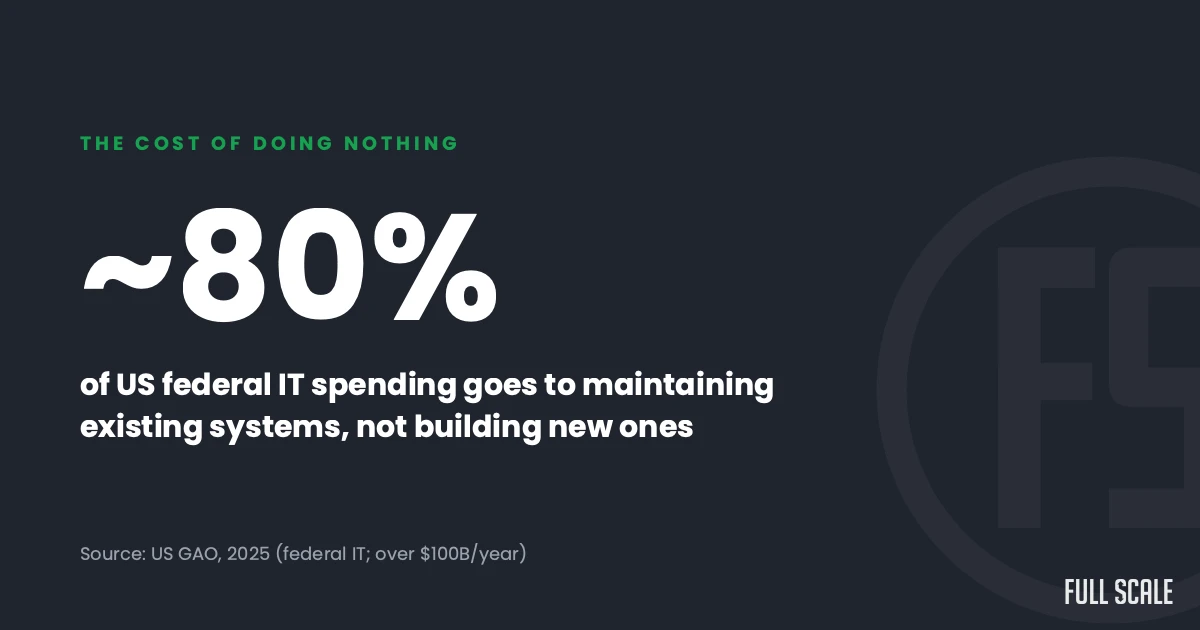
The cost of ignoring it is real and measurable in the one place it’s been studied carefully: the US federal government spends over $100 billion a year on IT, and roughly 80% of that goes to operating and maintaining existing systems rather than building anything new, according to the GAO. That’s federal IT specifically, not every company, but the shape of it holds everywhere. The longer a system sits unmodernized, the larger the share of your budget and your engineers’ time gets swallowed by keeping it alive.
The goal of modernization is to get that ratio back, so your team spends its hours on what moves the business instead of what props it up. New code is a means to that, never the point.
The R’s of modernization, as a decision, not a list
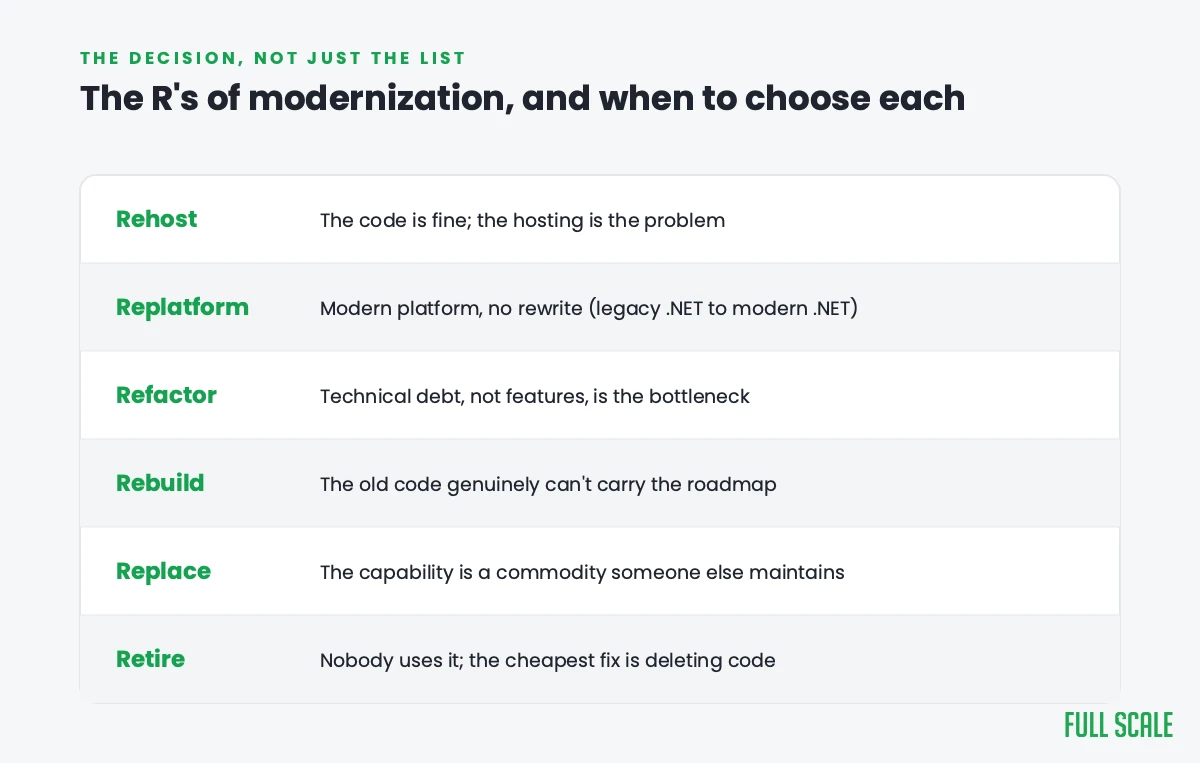
The industry frames the approaches as the “R’s.” Gartner laid out five in 2010; AWS expanded them to six and later seven for cloud migration. The labels matter less than the decision behind them, so here are the six that cover the real choices for an existing application, and the honest “choose this when.”
| Approach | What it means | Choose it when |
|---|---|---|
| Rehost | Move it to new infrastructure, code mostly unchanged | The code is fine; the hosting or hardware is the problem. Fastest, lowest risk. |
| Replatform | Move to a modern runtime or managed service with light changes | You want the benefits of a current platform without a rewrite, like legacy .NET Framework onto modern .NET. |
| Refactor | Restructure the code without changing what it does | The system works but is too hard to change. Technical debt, not features, is the bottleneck. |
| Rebuild | Rewrite the component from scratch on a modern stack | The old code genuinely can’t carry the roadmap and a clean rebuild costs less than fighting it. |
| Replace | Swap it for an off-the-shelf product | The capability is a commodity someone else maintains better than you can. |
| Retire | Turn it off | Nobody uses it. The cheapest modernization is deleting code. |
One caution, because it trips people up: “refactor” means different things in different frameworks. I’m using it in the plain engineering sense, restructuring the code without changing its behavior. The work scales from a quick rehost at the cheap, low-risk end to a full rebuild at the expensive, high-risk end, and most real systems need different R’s for different parts. The job is to map each piece to the right one, not to pick a single strategy for the whole thing.
Rewrite versus refactor: the call that decides the budget
The most consequential, and most frequently botched, decision in this whole exercise is rewrite versus refactor. Rewriting feels clean. A fresh codebase, modern stack, none of the old baggage. It is also, more often than not, a trap.
Joel Spolsky called rewriting from scratch “the single worst strategic mistake” a software company can make, and his reason has aged perfectly: old code has been used, which means it has been tested. Every weird conditional you’re tempted to delete is usually a bug fix someone shipped in response to a real problem you’ve since forgotten. Throw the code away and you throw away years of accumulated, hard-won corrections, then spend the next year rediscovering them one production incident at a time. The classic cautionary tale is Netscape, which rewrote its browser from scratch and left a multi-year gap in the market it never recovered from.
Refactor by default. Rebuild only when you can name the specific thing the old code structurally cannot do that the business actually needs. “It looks dated” is not that thing. “It can’t support multi-tenancy and the architecture makes adding it impossible” is. I make the fuller case for when a rewrite is actually the cleaner path, and how to blend the two, in refactor vs rewrite.
When not to modernize at all
Here’s the part the rest of the field won’t tell you, because most of it is written by people who sell modernization: sometimes the right answer is to leave the system alone.
If a system still does its job, isn’t blocking the roadmap, isn’t a security liability, and you can still hire people to maintain it, then modernizing it is spending money to solve a problem you don’t have. A stable, boring, well-understood system that quietly works is an asset, not a liability, even when the code looks old. We’ve watched companies burn a year and a budget rebuilding something a small refactor would have fixed, or worse, rebuilding something that needed nothing at all. We bill for the engineering team, not for a fixed-bid project, so we’d rather tell you to leave a system alone and keep your trust than sell you a modernization you regret.
How to modernize without a big-bang cutover
When you do modernize something substantial, the riskiest possible way to do it is the all-at-once switch: build the replacement in the dark for a year, then flip everyone over on a Friday night and pray. That’s how modernizations take down the business.
The safer pattern has a name: the Strangler Fig, described by Martin Fowler. You put a stable interface in front of the old system and migrate one piece at a time, routing traffic to the new component only once it’s proven, while the old path keeps running underneath. The new system grows around the edges of the old one until the old one can be safely retired. It delivers value incrementally, it keeps the system running the whole time, and it means a problem with any single piece is a contained rollback instead of a company-wide outage. For most real projects, this is how the work actually gets done.
I learned this on one of my first big projects, back in 2002. A lab I worked for was paying Cerner about a million dollars a year for an aging AS/400-based laboratory information system, and our IT manager, Dan Spragle, was just crazy enough to think we could build our own replacement in .NET. We did, but the reason it worked was the approach, not the ambition. We went module by module, building the new system around the old one as the core, and the hard part was judgment: figuring out exactly how much work to start doing in the new system and stop doing in the old, while keeping the two integrated the whole way. By the time we reached the final cutover, we had carved the old system down so far that the “big bang” left to do was small enough to survive. Had we tried to replace the whole thing in a single day, the business disruption and the flood of inevitable bugs would have been overwhelming. It took a couple of years, and it worked. That’s the strangler pattern, even though I didn’t have a name for it at the time.
AI changed the economics of modernization
The hardest and most expensive part of modernizing an old system has always been understanding it: undocumented code, original authors long gone, behavior nobody can fully explain. That cost is what made so many modernizations not worth attempting. AI changed it.
In 2026, the mature, low-risk use of AI in modernization is comprehension. Engineers now use large language models to read, map, and document legacy code far faster than anyone could by hand, and the tooling has caught up: GitHub Copilot app modernization went generally available for Java and .NET in late 2025, AWS Transform handles framework upgrades and mainframe analysis, and IBM’s watsonx Code Assistant for Z translates COBOL toward Java. A concrete example from our own work: at SOTA Cloud, a cloud dental-imaging company we staff, one of our engineers used AI to reverse-engineer a proprietary dental file format that had no documentation at all, the kind of problem that used to stall a project for months.
The honest limit matters as much as the capability. Veracode found that 45% of AI-generated code carried a known security flaw, and the bigger models were no safer. AI makes understanding and rewriting old code dramatically cheaper, which lowers the bar for when modernization is worth it. It does not remove the senior engineer who decides what to change and reviews what the AI produced. If anything, it makes that judgment more valuable, not less.
Why modernization projects fail
Modernization projects fail for reasons that are almost never about the technology, and they’re predictable enough to design around. These are the seven I see most often:
- Nobody made the R decision up front, so a refactor quietly became a rewrite halfway through and the budget went with it.
- The team doing the work didn’t understand the business the system runs, so they rebuilt the wrong things and missed the load-bearing ones.
- A big-bang cutover replaced a working system overnight instead of migrating it piece by piece.
- The people who did the work left when the project ended, taking the only understanding of the new system with them.
- The team chased 100% feature parity, trying to make the new system do everything the old one did, exactly, when a large share of those features are used by almost nobody.
- They modernized something that should have been left alone. Sometimes the right answer is to do nothing: if a system still does its job, isn’t blocking the roadmap, isn’t a security liability, and you can still hire people to maintain it, modernizing it is spending money to solve a problem you don’t have.
- Nobody defined what success looks like, and “modernize the platform” is not a goal you can finish or measure.
That last one is why the staffing model matters more than it looks. The traditional agency approach hands modernization to a team you never meet and gives it back as a finished black box. We work the other way: Full Scale engineers join your standups, your repo, and your reviews, and they modernize the system alongside your own developers, so the knowledge stays in-house when the work is done. If you want the team that does this, that’s our legacy modernization services. The deeper engineering version of the rebuild-versus-refactor argument lives in our piece on software re-engineering, and if your modernization is really a monolith-decomposition question, start with monolith vs microservices. For a specific stack jump, we have step-by-step guides for .NET Framework to .NET, AngularJS to React (or to Angular), Vue 2 to Vue 3, and upgrading your PHP version.
Frequently asked questions
What is legacy application modernization?
Legacy application modernization is updating aging software so it’s secure, maintainable, and able to support new features, through approaches that range from rehosting it on new infrastructure to refactoring the code to rebuilding a component from scratch. The aim isn’t new code for its own sake; it’s reducing the share of your budget and engineering time that goes to keeping an old system alive instead of moving the business forward.
Should we modernize, rewrite, or replace our legacy system?
It depends which part you mean, because most systems need different approaches for different pieces. Rehost or replatform when the code is fine and only the platform is dated; refactor when technical debt is the bottleneck; rebuild only when the old code genuinely can’t carry the roadmap; replace when the capability is a commodity; and retire what nobody uses. Rebuilding what a refactor would have fixed is the most common way modernization budgets get wasted.
What is the Strangler Fig pattern?
It’s an incremental approach, described by Martin Fowler, where you put a stable interface in front of the legacy system and migrate one piece at a time, routing traffic to each new component only once it’s proven while the old system keeps running. It avoids the risk of a big-bang cutover by letting the new system grow around the old one until the old one can be safely retired.
How does AI change legacy modernization?
AI makes the hardest part, understanding old and undocumented code, dramatically faster, which lowers the cost and risk of refactoring and rebuilds and changes the math on which systems are worth modernizing. Tools like GitHub Copilot app modernization and AWS Transform now assist directly. But AI-generated code carries its own security and quality risks, so a senior engineer still has to decide what to change and review what the AI produced.
How long does legacy modernization take?
It depends entirely on the approach. A rehost can be weeks; a full rebuild of a core system runs many months to over a year. The honest answer is that timeline is set by which R’s the work involves and how much of the system is in scope, which is exactly why deciding that up front, rather than discovering it mid-project, is the difference between a predictable project and a runaway one.
When should you not modernize a legacy system?
When it still does its job, isn’t blocking the roadmap, isn’t a security risk, and you can still hire to maintain it. A stable system that quietly works is an asset even when the code looks old. Modernizing it anyway spends money to solve a problem you don’t have, and a partner who bills for the work has every incentive not to tell you that.
Can you modernize a legacy application without a full rewrite?
Yes, and in most cases you should. Rehosting, replatforming, and refactoring all modernize a system without rewriting its behavior from scratch, and the Strangler Fig pattern lets you migrate a legacy application piece by piece while the old system keeps running. A full rebuild is the exception you have to earn by naming a specific thing the old code structurally cannot do, not the default path.
Is there a real legacy application modernization case study?
Two, from firsthand experience. In 2002, we replaced a Cerner AS/400-based lab system with a .NET rebuild using the Strangler Fig pattern, module by module, over about two years, instead of a single risky cutover. More recently, at SOTA Cloud, a dental-imaging company we staff, one of our engineers used AI to reverse-engineer a proprietary file format that had zero documentation, the kind of problem that used to stall a modernization project for months.
The decision is the work
Legacy application modernization comes down to a series of judgment calls, which part to rehost, which to refactor, which to rebuild, and which to leave alone, made before anyone writes a line of code. The technology is the easy part. Get those calls right and the work pays for itself in budget and velocity recovered. Get them wrong and you’ve funded a rewrite that shipped nothing.
If you’d rather make those calls with engineers who’ve made them before, that’s what we do. Talk to us about your legacy system, and we’ll tell you honestly which parts to modernize, which to leave alone, and what a team to do it looks like.