
In-Demand IT Jobs in the Philippines (2026): Real Roles, Real Pay Bands

In this article
Quick Answer: The most in-demand IT jobs in the Philippines right now are software engineers, cloud and DevOps engineers, QA and test automation engineers, data engineers, and security specialists, with cloud, security, and specialized data roles paying the most regardless of years of experience. Full Scale’s own pay data across 350+ Philippine employees puts senior engineers at ₱100,000 to ₱150,000 a month, well above the entry-level number most salary sites quote as an average.
Ask ten job boards what’s “in demand” in Philippine IT and you’ll get the same recycled list of buzzwords. Here’s what’s actually true: real hiring data, real pay bands, and the roles genuinely worth chasing right now, not just the ones that sound impressive on a LinkedIn headline.
The Philippine IT Job Market, By the Numbers
The IT and Business Process Association of the Philippines (IBPAP) projects the industry will approach $42 billion in revenue and close in on 1.97 million jobs in 2026. That’s the whole IT-BPM sector, voice work included, so it overstates pure software roles. But the software-specific slice is real too. According to the Philippine Statistics Authority’s 2024 Annual Survey of Philippine Business and Industry, computer programming and consultancy alone employed 90,573 workers, more than half of the entire information and communications sector’s workforce.
None of that means every graduate walks into a good job. It means the demand is real, the roles below are where it’s concentrated, and the pay gap between “average” and “actually good” is bigger than most job seekers realize.
Top In-Demand IT Jobs in the Philippines
- Software Engineer. Software engineers design and build the applications, websites, and platforms that businesses run on. This is the single largest category of IT hiring in the country, and the one with the widest pay spread between entry-level and senior.
- Cloud / DevOps Engineer. As companies move more infrastructure to AWS, Google Cloud, and Azure, engineers who can design, deploy, and secure that infrastructure are hard to find. That scarcity also makes them among the best-paid developers in the country.
- Security Engineer. Every company on this list is a target now, and most Philippine IT teams grew up without a dedicated security function. Engineers who can harden systems, run audits, and respond to incidents are in short supply everywhere, and the Philippines is no exception.
- QA / Test Engineer. As release cycles get faster, companies need dedicated QA engineers to catch what automated tests miss, not developers testing their own code as an afterthought.
- Project Manager. Every distributed engineering team needs someone managing timelines, resources, and stakeholder communication across a time zone gap. Strong PMs with real software delivery experience are consistently in demand.
- Data Engineer / Data Analyst. Data roles are newer to the Philippine market but growing fast, as more companies want decisions made off real usage data instead of a gut feeling in a Slack thread.
- Mobile Developer. Every product company needs its app on both stores, and developers who can actually ship and maintain iOS and Android apps stay scarce. We hire these ourselves, and good ones do not stay on the market long.
- Business Analyst. Business analysts translate business problems into technical requirements, the connective tissue between what a client wants and what a dev team actually ships.
One role you won’t see on this list: “prompt engineer.” Eighteen months of hype later, nobody is hiring for it. AI fluency simply became part of the bar for every role above. The engineers getting hired, and promoted, are the ones who use AI tools to move faster and catch what the tools get wrong. Learn the tools. Just don’t put “prompt engineer” on your resume and wait for the offers to roll in.
What These Roles Actually Pay
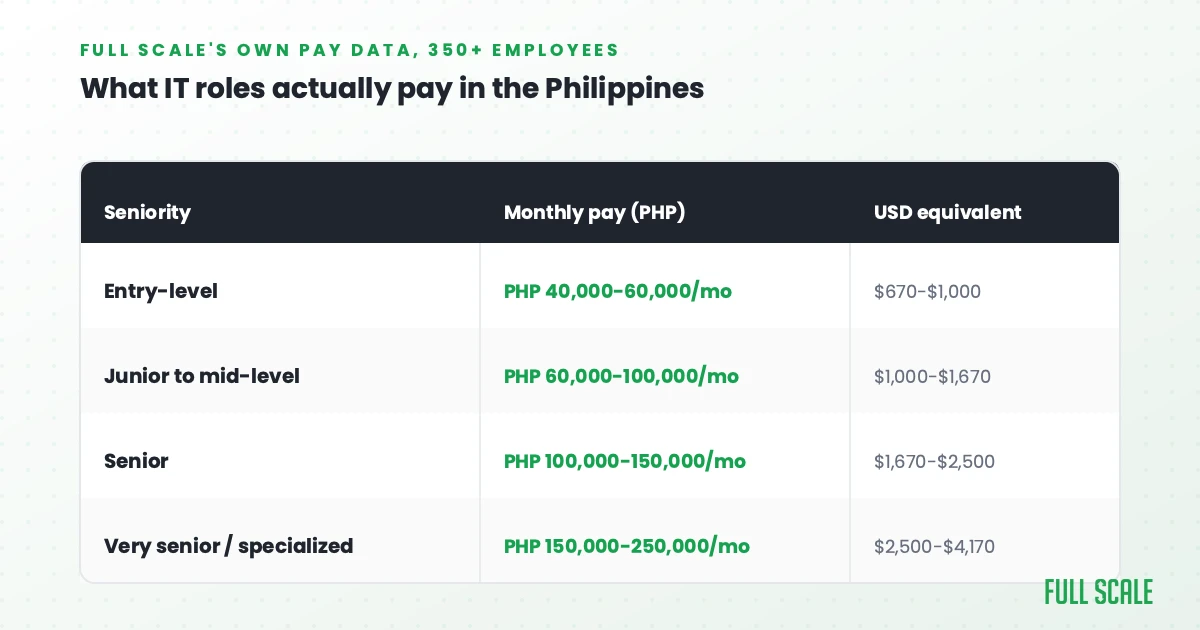
Public salary sites (Indeed, Glassdoor, Jobstreet, PayScale) all cluster around ₱40,000–₱60,000 a month for a “software engineer, Philippines” search. That’s an entry-level number doing duty as an average. Here’s what Full Scale actually pays by seniority, based on our own pay data across 350+ Philippine employees:
- Entry-level: ₱40,000–₱60,000/month (about $670–$1,000)
- Junior to mid-level: ₱60,000–₱100,000/month (about $1,000–$1,670)
- Senior: ₱100,000–₱150,000/month (about $1,670–$2,500)
- Very senior or specialized: ₱150,000–₱250,000/month (about $2,500–$4,170)
The premium roles (cloud, DevOps, security, real data engineering) land at the top of that range regardless of years of experience, because fewer people can actually do the work. A generalist with ten years of experience can still get outbid by a specialist with five, and that’s not unfair, it’s just what “scarce” means.
Where to Find These Jobs
You don’t have to live in Manila or Cebu to land one of these roles anymore. A growing number of companies hire fully remote across the Philippines, which means your job search shouldn’t be limited by your address, and your options shouldn’t be limited by what’s hiring locally.
If you’re set on a specific city, we broke down IT job hiring in Manila and IT job opportunities in Cebu separately. If it’s employers you’re mapping rather than openings, we keep a running list of the major IT companies in Cebu too. If remote is the goal, and for most of these roles it should be, read our guide to legitimate IT work-from-home jobs in the Philippines first, because the WFH listings are where the scams live. The usual boards (Jobstreet, LinkedIn, Kalibrr) carry most of the real volume. And yes, we’re hiring for several of these roles ourselves.
From a Full Scale developer
“I joined as a junior developer. Within a year I was leading feature development. The mentorship and training here actually prepare you for the next level.”
Jimvirle C., Senior Software Developer (PHP)
Frequently asked questions
What is the most in-demand IT job in the Philippines?
Software engineer is the largest and most consistent category of IT hiring in the country, with the widest pay spread between entry-level and senior. The premium corners of the market are cloud and DevOps engineering, security engineering, and real data engineering, where scarce skills push pay to the top of the range regardless of tenure.
What is the highest-paid IT job in the Philippines?
Specialized senior roles pay the most: cloud and DevOps engineers, security engineers, and experienced data engineers regularly land in the ₱150,000–₱250,000 a month range at strong employers. A specialist with five years of experience routinely out-earns a generalist with ten.
Is IT a good career in the Philippines in 2026?
Yes. The industry keeps growing, remote work means you no longer need to live in Manila or Cebu to access the best employers, and pay for senior and specialized roles keeps climbing. The honest caveat: AI tools are raising the bar at the entry level, so the earlier you build real, demonstrable skills, the better.
Can you get an IT job in the Philippines without a degree?
A degree still opens doors at large enterprises, but most product companies and offshore development firms hire on demonstrated skill: what you’ve built, how you solve problems, and how you communicate. A strong portfolio and real project experience decide far more interviews than a diploma does.
Which IT skills are most in demand in the Philippines right now?
Cloud platforms (AWS, Azure, Google Cloud), test automation, data tooling, and security skills top the list. Across every role, fluency with AI-assisted development tools has quietly become table stakes rather than a differentiator.
Do certain programming languages pay more than others in the Philippines?
Less than you would think. The language on a resume matters far less than seniority and specialization: a senior cloud, security, or data engineer out-earns a mid-level generalist regardless of which language shows up in the job title, because the scarce skill is what commands the premium, not the syntax. If you are optimizing for pay, chasing a specialization (cloud, DevOps, security, data engineering) is a better bet than chasing a specific language.
Build Your Career With Full Scale
Full Scale hires software developers, QA engineers, and project managers across the Philippines to work as real, embedded members of US client engineering teams, not rotating “resources” on a bench. Every role is remote and permanent, open to candidates anywhere in the country.
Full Scale is hiring
We hire for the roles above (developers, QA engineers, and project managers) in permanent, fully remote positions across the Philippines.
What you get as a Full Scale developer:
- Health insurance from day one, with three dependents covered free, plus group term life insurance
- Company laptop, equipment, and a work-from-home allowance
- Structured mentorship, a real training budget, and clear paths from junior to senior to lead
- Permanent employment, not project-based contracts
Full Scale developer retention runs 93%+. We’re also Great Place to Work® Certified in the Philippines, two years running: 95% of our employees say it’s a great place to work, versus 65% at a typical Philippine company. And we’re #15 on Great Place to Work’s Southeast Asia Best Workplaces in Technology 2026 list. Employees run their own clubs, and once a year the company shuts down, paid, for CSR Day, a day of volunteer projects across the Philippines that employees propose and lead themselves. See open roles and apply directly.