
The Developer Shortage in 2026: AI Killed the Order Taker, Not the Engineer

In this article
- How AI Changed the Math of Hiring Developers
- The Order Taker Is Already Being Replaced
- The Engineers Who Actually Got More Valuable
- Why “Senior” Isn’t Enough by Itself
- Why Traditional Hiring Still Can’t Find These Engineers
- What Actually Solves the New Tech Talent Shortage
- When This Model Isn’t Right
- Stop Hiring for the Job AI Already Took
- Frequently Asked Questions About the Developer Shortage in 2026
Quick Answer: Yes, there is a developer shortage in 2026, but it’s not the shortage anyone keeps writing about. Headline software engineer hiring is softer than it was in 2022, with tech layoffs continuing and AI tools writing a large share of new code. The real tech talent gap now is product-thinking engineers who can run the whole software development lifecycle from requirements to QA, not just close tickets from a spec. Those engineers are worth more than they’ve ever been, and almost no traditional hiring pipeline finds them.
Everyone has a take on the software developer shortage and most of them are stale. The deeper reality is that most software development talent lives outside the US, which reframes the whole debate. In the Philippines that talent is spread across the whole country, not just Manila, Cebu, or Davao.
The “shortage is over, look at the layoffs” crowd is reading the wrong number, and the “shortage is worse than ever” crowd is reading a different wrong number. Both groups are still arguing about whether companies need more developers, and that question stopped being interesting two years ago.
I’ve been building software companies for more than 20 years. I co-founded VinSolutions and sold it for about $150M, founded Stackify and sold that too, and now I run Full Scale, where we’ve built engineering teams for more than 60 tech companies. Across all of it, I’ve watched the hiring market shift four or five times. The shift happening right now is the biggest one yet, and it isn’t really about supply.
The developer shortage in 2026 is a shortage of judgment, not a shortage of code.
How AI Changed the Math of Hiring Developers
If you’re hiring engineers the same way you did in 2023, you’re solving a problem that no longer exists.
The Stack Overflow 2025 Developer Survey found that 84% of developers now use or plan to use AI tools in their workflow, and 51% of pros are using them every single day. GitHub Copilot alone has crossed 20 million cumulative users, with a controlled study showing developers complete coding tasks 55% faster when Copilot is on. AI is no longer a tool a few engineers experiment with on the side. It’s the default daily workflow on most teams.
That math has consequences nobody seems to want to say out loud.
If one engineer using AI can ship what used to take an engineer plus a junior helper, you don’t need to hire as many engineers. The economics of staffing a team have changed underneath the entire industry, and most hiring managers haven’t caught up. They’re still posting “we need three more React developers” requisitions, then wondering why the team isn’t shipping faster after the hires land.
The hires aren’t the bottleneck anymore. The bottleneck is whether your engineers can decide what to build.
The Order Taker Is Already Being Replaced
Here’s what’s actually happening in the entry-level market.
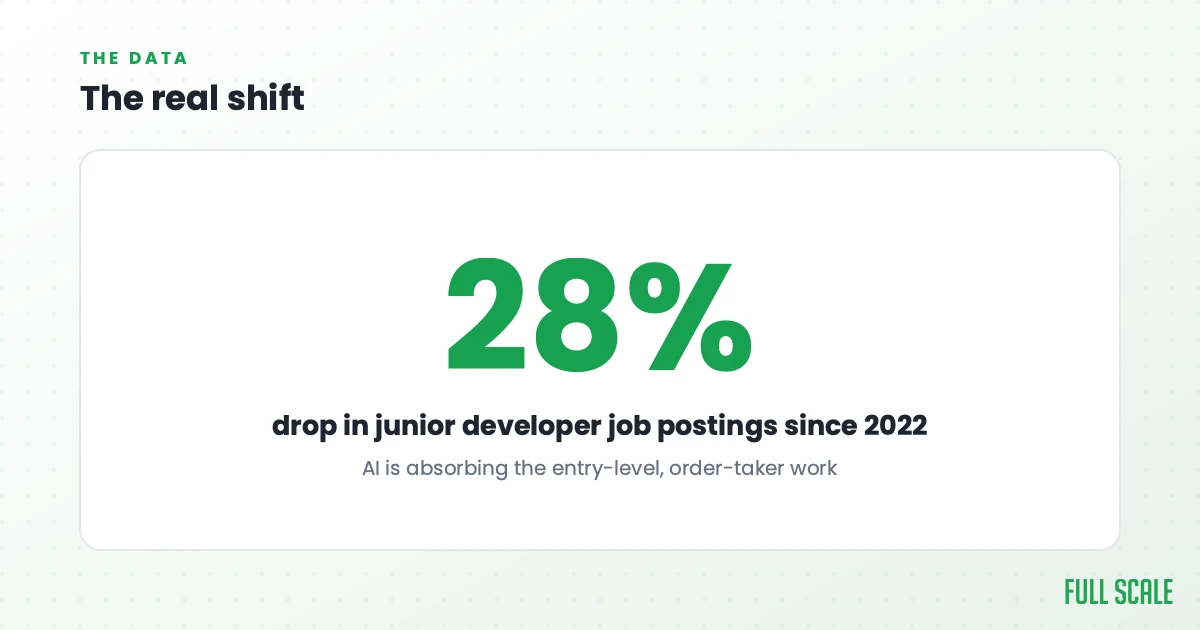
Junior developer job postings are down about 28% from their 2022 peak according to IEEE Spectrum’s analysis of the entry-level labor market, and they haven’t recovered. The share of juniors and grads in IT employment has dropped from about 15% to 7% over three years. MIT Technology Review called it a looming crisis in entry-level work, and they weren’t being dramatic. The same collapse shows up across the broader 2026 IT staffing trends, where new-grad hiring at the big tech companies is down 65% from 2019.
Tech announced 52,050 layoffs in Q1 2026 alone, the highest first-quarter total since 2023. Analyst rollups attribute about a quarter of those cuts directly to AI and automation. The rest are cost discipline, but the cost discipline became possible because the work got cheaper to do. Headline programmer hiring softened in the same window, and the engineering talent shortage that’s still here looks different in shape from the one we were tracking in 2022.
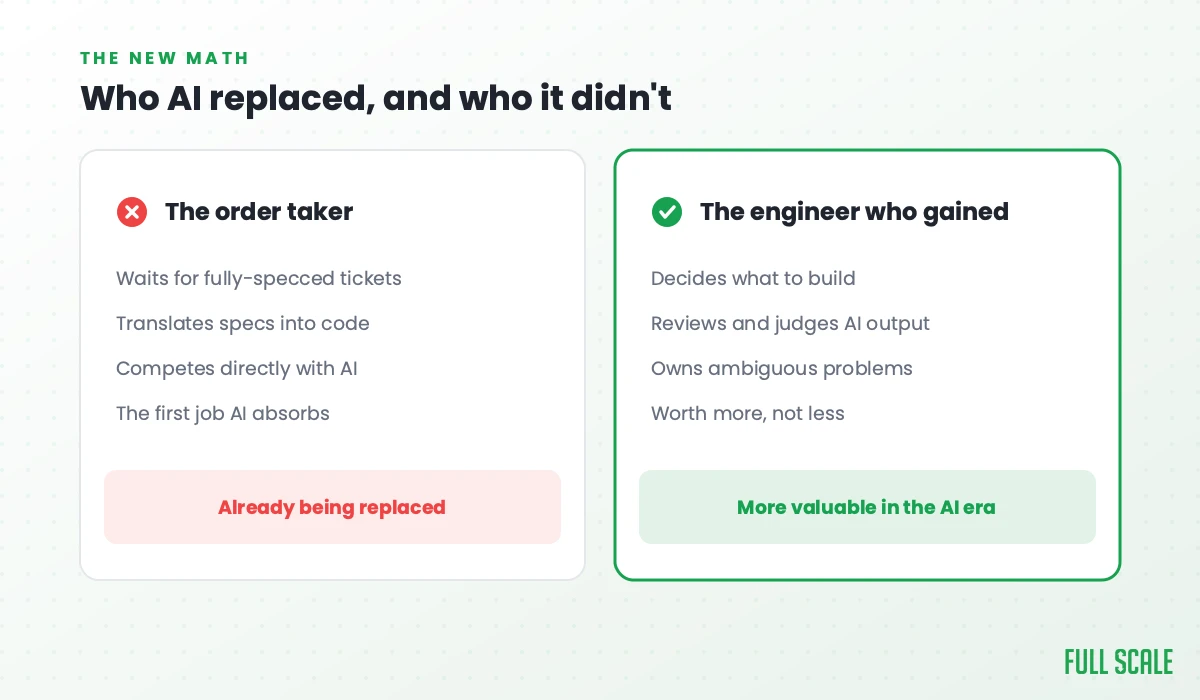
When I look at who’s getting hit hardest, the pattern is consistent across every team I’ve talked to. The engineers losing their jobs are the ones whose work looked like this: read the ticket, write the code, hand it back. They didn’t write the spec, they didn’t run QA, and they didn’t decide what to build. They were the middle of an assembly line.
An AI is a much cheaper middle of an assembly line than a $150,000 engineer.
It’s not that these developers were bad at their jobs. Most of them are perfectly competent. They’re just doing work that the technology now does for 30 cents an hour and ships in seconds.
The brutal version of this is that a lot of teams that used to have ten engineers now have six engineers and a stack of AI tools, and they’re shipping more. That’s not a hypothetical. I’ve watched it happen at companies in our network throughout 2025 and into this year.
The Engineers Who Actually Got More Valuable
Then there’s the other side of this market, the side nobody outside engineering leadership is paying attention to.
If you can run the entire software development lifecycle yourself, you’ve never been more in demand.
I mean the full thing. The engineer talks to the customer or reads the feedback to figure out what’s actually needed. They write the requirements, push back on the PM when the spec is wrong, and pick the architecture before any code gets written. They write the code, review what the AI produces, and write the tests themselves instead of waiting for QA to find the bugs. After launch, they watch the analytics and decide what gets built next. That engineer is the entire pipeline in one person, with AI as a force multiplier inside their workflow.
That engineer doesn’t get replaced by AI. They use AI to outproduce an entire team. Infrastructure ownership follows the same pattern: the DevOps engineer who architects your pipeline and writes Terraform that survives a second engineer is harder to replace than ever, which is why teams increasingly choose to hire DevOps engineers from the Philippines to get that judgment at offshore rates.
This is the thesis behind Product Driven, the book I wrote in 2025 about how engineering leadership has to change. The argument is simple. Companies don’t need more code, they need more code that solves the right problem. The engineers who can identify the right problem and ship the solution end-to-end are the ones who matter now. Everyone else is competing with a tool that costs a fraction of their salary.
The numbers back this up. The U.S. Bureau of Labor Statistics still projects software developer employment growing 15% from 2024 to 2034, much faster than the 3% average across all occupations. They project 129,200 openings per year. Those numbers haven’t dropped despite the layoffs, which tells you what the BLS is actually measuring. It’s counting engineers who build things, not assembly-line coders, and that demand is structural. Some of that demand now comes from outside traditional product teams, as marketing turns into an engineering function that needs a martech developer more than another campaign manager.
The real shortage is of developers who own outcomes.
Why “Senior” Isn’t Enough by Itself
This is where most hiring conversations go off the rails.
The instinct, when you can’t find the right engineers, is to filter harder on seniority. You ask for ten years of experience instead of five, a staff title instead of senior, a big-tech logo on the resume. The thinking is that if regular engineers are losing ground to AI, the senior ones must be the ones to hire.
It’s not that simple. A senior engineer who spent 15 years being a great order taker is in the same trouble as a junior engineer who spent two years being a great order taker. The seniority just bought them a bigger salary on the way out.
What separates the engineers who get more valuable from the ones who get replaced has nothing to do with years on a resume. The differentiator is whether they were already operating like product owners before AI showed up. Did they push back on bad requirements? Were they thinking about the customer before they were thinking about the code? When the spec was wrong, did they ship it anyway, or did they say something?
I’ve hired hundreds of developers over the years and the pattern is clear: the engineers who thought about the user are the ones whose careers got better in 2025, and the ones who waited for someone to tell them what to do are the ones whose careers got worse.
You can hire for seniority, but you can’t hire for product ownership, at least not through a normal recruiting pipeline. It’s a mindset that either shows up in someone’s first three weeks or doesn’t. And once you know what you’re looking for, finding it is harder than anything else in hiring right now.
Why Traditional Hiring Still Can’t Find These Engineers
Every hiring pipeline I’ve ever used was designed to filter for skill. Filtering for judgment didn’t fit the funnel. It forced me to rethink how to assess developer skills from scratch.
Recruiters work on placement fees, which means their incentive is to put a body in a seat. Tech recruiters charge up to six months of salary, and the placement is what triggers the payout. Retention has nothing to do with it. The funnel looks at resumes for keyword matches and screens candidates on years of React or Python or AWS on a job description. Nothing in that process surfaces whether someone can think about the customer.
Big tech filters even harder on credentials. The interview loops measure algorithmic recall and system design fluency, which are both useful skills but tell you nothing about whether the candidate will figure out that the feature shouldn’t be built at all.
Job descriptions don’t help. Read any senior engineer posting from a Fortune 500 and the bullets are stacks and frameworks and tools. The accountabilities, when they exist, are about velocity and code quality. The thing that actually matters now, the ability to own outcomes from start to finish, is mentioned in maybe one in ten postings, and usually as a throwaway line.
So the funnel produces what the funnel was built to produce: senior engineers who can write code in the listed stacks. Some of them will turn out to be product-thinking engineers by accident. Most won’t. The conversion rate is brutal.
What Actually Solves the New Tech Talent Shortage
I built Full Scale to fix this specific problem, though I didn’t know in 2018 that AI would make it worse. The model still works, and the reasons it works are different now than they were then.
The company hires senior engineers in the Philippines and trains them on product thinking from day one. The training is the part that nobody else does. Most offshore models hire engineers and rent them out as coders, which is exactly the role AI is now taking over.
Our developers train on the Product Driven approach from my book, combined with the full modern AI toolkit (GitHub Copilot, Claude, Cursor). They get good at AI pair programming the right way, by understanding every line the AI suggests before it ships. The training covers what most engineering jobs never teach: when to push back on a bad spec, how to keep the customer in the design conversation, and what owning a feature actually looks like when you’re the engineer shipping it end-to-end.
The Philippines is the third-largest English-speaking country in the world, which means the communication overhead that killed most offshore experiments in the 2010s doesn’t apply. The country also ranks #3 globally for AI talent behind only the U.S. and India, and the local industry is investing about $25M a year in upskilling its workforce on AI. Cebu City alone now has a TESDA-accredited AI training facility that opened in January 2026.
These engineers ship like full team members because they think like full team members. They’re in your Slack and your standups, with direct access to your tech lead and no project manager in the middle. They argue with the PM when the spec is wrong, they write the tests themselves, and they catch bugs before QA does. This is the version of “engineer” that the new market actually rewards, and they cost about half of what you’d pay for the equivalent in the U.S.
Full Scale has been on the Inc. 5000 five years running, with about 93%+ developer retention. The retention is the proof that the model works. Engineers stay when they’re treated like engineers instead of like contractors.
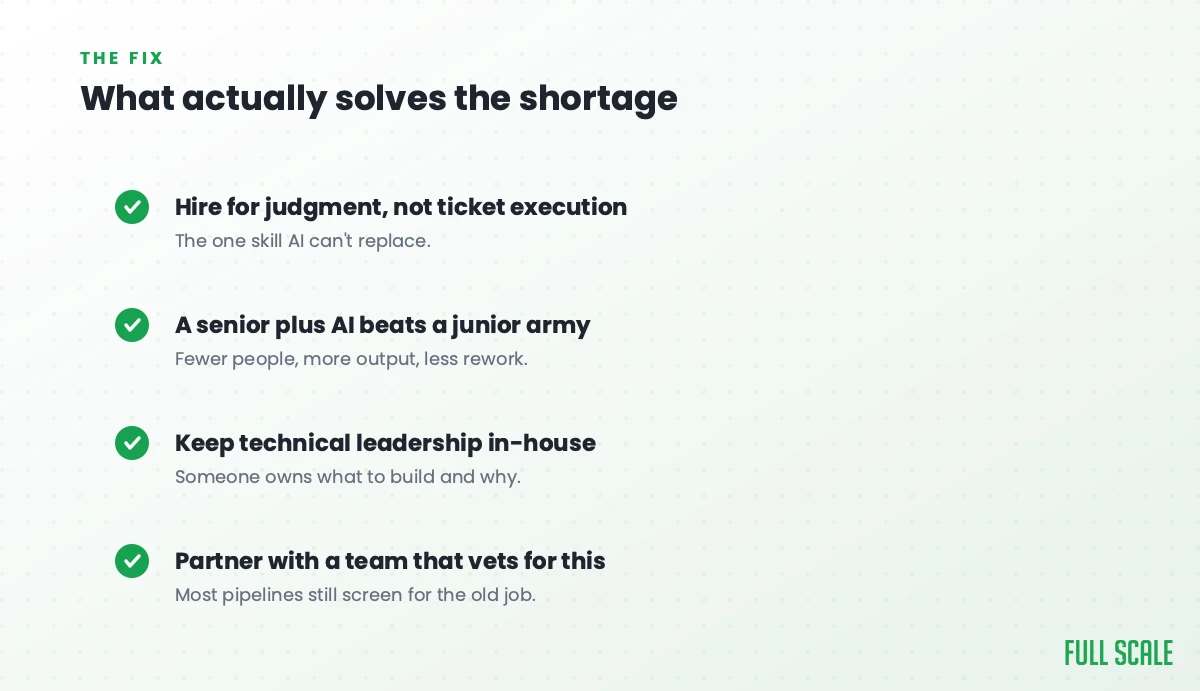
The teams winning this market hire for outcomes and layer AI on top of people who can deliver them.
When This Model Isn’t Right
I try to be honest about who Full Scale doesn’t help.
If you have no internal technical leadership, no model works. Someone on your side has to know what good engineering looks like, what to ask for, and how to evaluate the output. Without that person, the strongest engineers in the world will still produce work that misses the mark. That isn’t a problem you fix by hiring more engineers. You fix it by hiring or appointing a technical leader first, even a fractional one.
If your industry has compliance restrictions that prohibit non-U.S. developers, this model won’t fit. Some regulated workloads in defense, federal, or specific financial categories require U.S. citizens or onshore-only workflows. Check before the conversation starts.
If your team needs same-room collaboration for the work to function, time zone overlap isn’t a substitute. We get four hours of overlap with U.S. teams every day, which handles standups and structured collaboration well, but it isn’t the same as sitting next to someone. Most teams don’t actually need same-room work to ship, but some do, and you should know which one you are.
And if you’re looking for a two-week experiment to “try out offshore,” this isn’t the right fit. Building a team that owns outcomes takes more than a sprint, and the engagement works when both sides treat it like a real hire from day one.
Stop Hiring for the Job AI Already Took
Posting more requisitions doesn’t solve the developer shortage in 2026. Companies have to change what they’re hiring for in the first place. AI took the order-taker role, and it’s not coming back. The engineers who matter now are the ones who can do the whole job, and they’re harder to find than ever because every hiring funnel was built to filter for the wrong thing.
Full Scale builds dedicated engineering teams that work that way by default. We hire senior developers, train them on product ownership, integrate them directly into your workflow, and get them shipping their first pull request inside the first week. The engagement is month-to-month, with no long contracts. If you’re tired of hiring the same engineer five times and still not shipping, book a discovery call.
Frequently Asked Questions About the Developer Shortage in 2026
Is there a developer shortage in 2026?
Yes, but the shape of the software engineer shortage has changed. Headline developer hiring is softer than it was in 2022, with tech layoffs continuing into 2026 and entry-level job postings down 28% from their peak. The shortage of software engineers that actually matters now is product-thinking developers who can run the full software development lifecycle and use AI tools to multiply their output. That talent is scarcer than ever, and traditional hiring pipelines don’t surface it well.
Will AI replace developers in 2026?
AI is replacing one specific kind of developer: the order taker who writes code from a fully specified ticket and doesn’t make decisions about what to build or why. That role is being absorbed by AI tools at an aggressive pace. Engineers who own outcomes from requirements through QA are seeing demand grow rather than shrink. The honest answer is that AI is replacing a specific behavior rather than the profession itself. We dig into the details in how AI is changing software development.
Why are entry-level developer jobs disappearing?
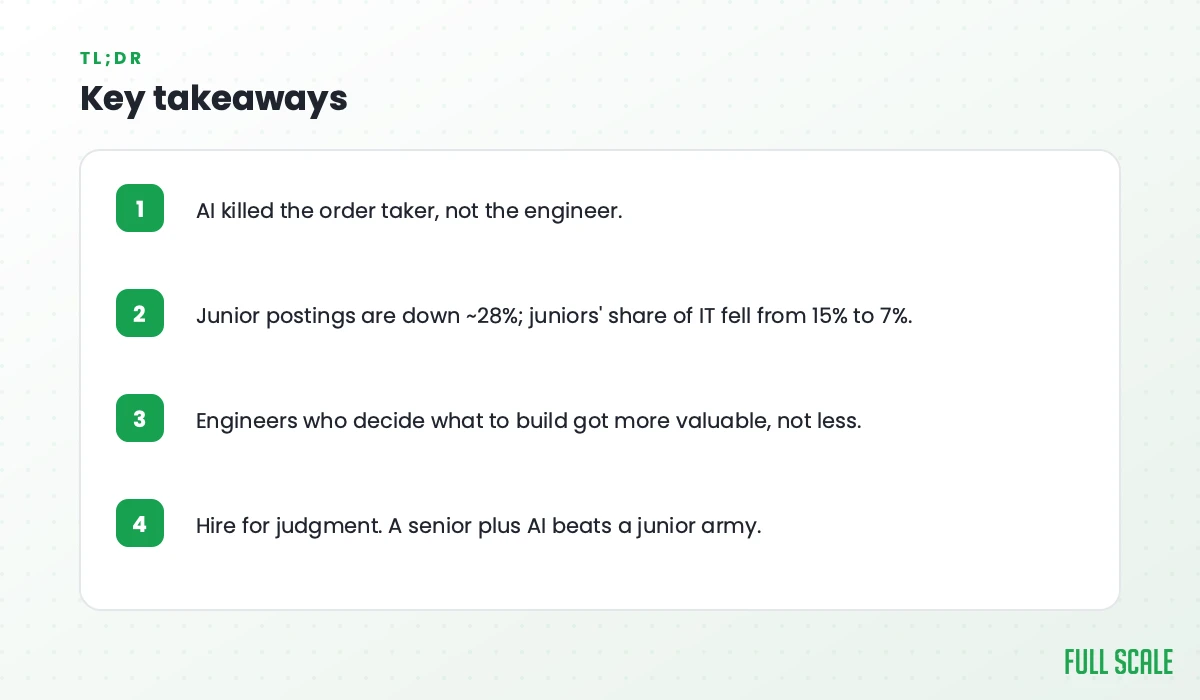
Entry-level work is concentrated in the kinds of tasks AI does best: writing boilerplate, scaffolding, simple feature work, and routine bug fixes. When one engineer with Copilot can do what used to take a senior plus a junior, the junior role goes first. The share of juniors in IT employment has fallen from 15% to 7% in three years, and most of that drop comes from cuts at the bottom of the experience ladder rather than from retirements at the top.
What kind of developers are companies actually trying to hire in 2026?
The pattern across the 60-plus companies in our network is consistent. They want engineers who can talk to the customer, write the requirements, pick the architecture, write the code, review the AI’s output, write the tests, and ship the result. The job title is still “senior software engineer,” but the underlying definition shifted. They’re hiring for someone who builds product, end to end.
Does hiring offshore solve the AI-era developer shortage?
It can, but only if the offshore model is built around product ownership. Traditional outsourcing, where developers sit behind a layer of project managers and just write code from specs, has the same problem AI does. It produces order-taker output. The offshore model that works in 2026 puts developers directly into your team, gives them context and ownership, and trains them to think about outcomes instead of just hitting acceptance criteria. That’s what Full Scale’s Philippines model is built for.
How long does it take to hire a product-thinking engineer locally?
Most companies take four to six months from posting a senior role to first day on the job, and then another three months for the new hire to ramp. By the time they’re producing, you’re nine months from when you decided to hire. Through a pre-vetted offshore pipeline with developers already trained on product ownership, that timeline drops to about a week from decision to first pull request. The pipeline already exists, which means you’re selecting from people rather than searching for them. Keeping that pipeline current is why we train engineers on AI whether or not a client asks us to.
What’s the connection between this shortage and the book Product Driven?
The book is the playbook for why this shortage exists and how to solve it. Most companies still hire and manage engineers as if their job were to write code, when the actual job is to build products that work. Teams that operate this way produce more, retain better, and weather AI-era disruptions far better than teams that don’t. The book covers the framework, and Full Scale applies it to every developer it places. You can get a free copy at fullscale.io/product-driven.