
AngularJS to React Migration: Moving Off a Dead Framework Without a Big-Bang Rewrite

In this article
AngularJS, the original Angular 1.x, reached end of life on December 31, 2021. Google stopped supporting it, which means no security patches and no fixes, and the talent pool for it shrinks every year. Plenty of teams have decided their move off AngularJS is to React rather than to modern Angular, and that’s a defensible call. But it’s important to be honest about what this migration actually is: AngularJS and React are different frameworks, so this isn’t an upgrade, it’s a rewrite. The good news is that a rewrite doesn’t have to mean a big-bang, and the teams that do this well never stop shipping.
I run Full Scale, and we staff the front-end engineers who do these migrations. Here’s the honest version of how an AngularJS to React migration works, and how to keep it from becoming the year-long rewrite that ships nothing.
Quick Answer: An AngularJS to React migration is a full rewrite, not an upgrade, since the two frameworks share no official migration path or automated converter. The reliable way to do it is incrementally: run AngularJS and React side by side in the same app using the Strangler pattern, migrate route by route or component by component starting with the highest-pain pieces, route traffic to each React piece once it's proven, and retire AngularJS only once nothing depends on it. Full Scale staffs the front-end engineers who run these migrations without ever stopping ongoing feature work.
Why move off AngularJS at all
The pressure is real and one-directional:
- No security support since 2021. AngularJS is end of life. Every vulnerability found since is unpatched in your app.
- A shrinking talent pool. Few engineers want to build a career on a dead framework, and the ones who still know it deeply are getting expensive.
- A frozen toolchain. The libraries and tooling around AngularJS stopped moving, so you’re stuck on old, unmaintained dependencies.
- You’ve likely outgrown it. AngularJS predates a lot of what modern front-end development takes for granted, and the gap to a current stack keeps widening.
Why this is a rewrite, and why that’s okay
Migrating from AngularJS to modern Angular has an official upgrade path. Migrating from AngularJS to React does not, because they’re fundamentally different frameworks with different mental models. There’s no automated converter that turns AngularJS controllers and directives into idiomatic React components. You’re rebuilding the front end.
That sounds scary, and the conventional wisdom rightly warns that rewrites are where projects go to die. But a rewrite done incrementally is a different animal from a rewrite done all at once. The disaster case isn’t “rewrite,” it’s “rewrite everything and flip the switch on one day.” The whole game here is avoiding that. If you want the fuller version of when a rewrite is the right call versus refactoring in place, we lay it out in refactor vs rewrite.
The incremental plan: run both frameworks at once
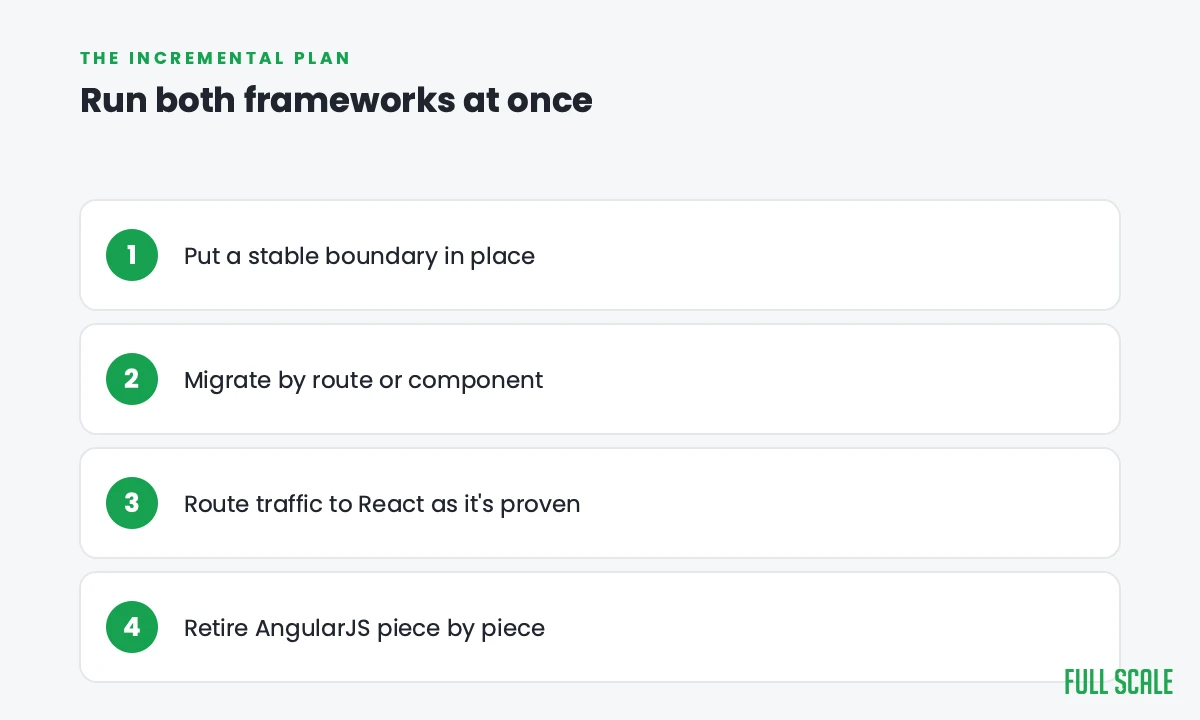
The reliable way to do an AngularJS to React migration is to run AngularJS and React side by side in the same application and migrate piece by piece. This is the Strangler pattern, and it’s the difference between a migration that ships value every week and one that disappears for a year.
The shape that works:
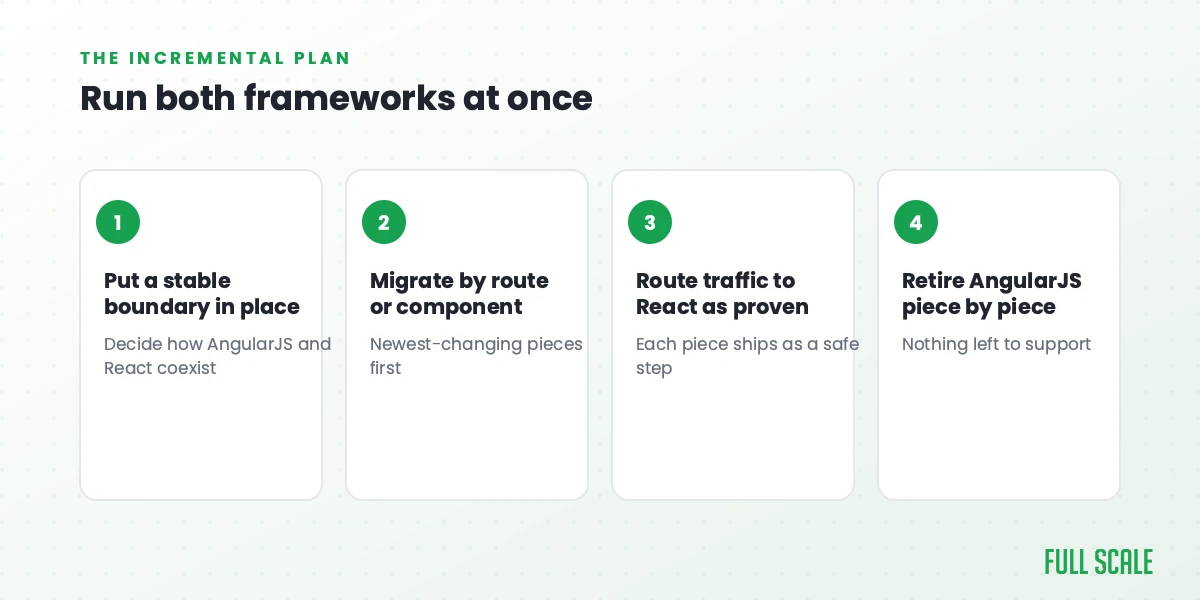
- Put a stable boundary in place. Decide how AngularJS and React will coexist, whether you wrap React components inside the AngularJS app, hand whole routes to React, or stand up a new shell that mounts both. The point is a clear seam where the old and new meet.
- Migrate by route or by component, newest-changing first. Move the parts under active development or causing the most pain first, so the migration delivers value immediately instead of at the end.
- Route traffic to React as each piece is proven. Users keep using a working app the whole time; each migrated piece is a contained, reversible step rather than a company-wide gamble.
- Retire AngularJS once the last piece is gone. The old framework gets strangled out gradually until there’s nothing left to support.
Done this way, a migrated piece is a small, safe deployment, and a problem with any one piece is a quick rollback instead of an outage.
Shed dead weight while you’re at it
A rewrite has one underrated upside a straight upgrade never offers: you don’t have to bring everything across. Old applications accumulate features almost nobody uses, and an AngularJS to React migration is your chance to leave that dead weight behind instead of faithfully rebuilding it. Done well, the migration isn’t “rebuild everything AngularJS did,” it’s “rebuild what still earns its place.” That reframing is often what makes the rewrite affordable.
How AI changes an AngularJS to React migration
AI helps more than you’d expect for a cross-framework rewrite. It’s genuinely good at reading an AngularJS controller or directive, explaining what it does, and drafting an equivalent React component, which takes a real bite out of the most tedious part of the work. For a migration where there’s no automated converter, that assisted translation saves a meaningful amount of time.
The limit is firm, though. A framework rewrite is full of architectural decisions, how state is managed, how data flows, how the new component tree is shaped, that AI can’t make well on its own, and AI-generated code carries real bug and security risk. So AI speeds up the per-component translation while senior engineers own the architecture and review the output. The broader set of ways these projects fail is in application modernization challenges.
Who should do the work
An AngularJS to React migration is a strong case for adding experienced engineers to your team rather than handing it to an outside shop, because the new React app has to be owned and extended by your people for years after the migration ends. Full Scale places senior React developers who work in your repo and your standups and do the migration alongside your team, so the knowledge stays in-house. If you’re building out the React side of the team, our React developer job description is a good place to start.
Frequently asked questions
Is AngularJS still supported?
No. AngularJS, the original Angular 1.x, reached end of life on December 31, 2021, and Google no longer provides security patches or fixes. Running it leaves any newly discovered vulnerability unpatched, and the talent pool and surrounding tooling continue to shrink.
Is migrating from AngularJS to React an upgrade or a rewrite?
It’s a rewrite. AngularJS and React are different frameworks with different mental models, and there’s no official upgrade path or automated converter between them, unlike moving from AngularJS to modern Angular. You rebuild the front end in React, which is why doing it incrementally rather than all at once matters so much.
Can you migrate from AngularJS to React incrementally?
Yes, and it’s the recommended approach. You run AngularJS and React side by side in the same application and migrate route by route or component by component, routing users to each React piece as it’s proven. This Strangler pattern keeps the app working throughout and makes each step a safe, reversible deployment.
Should I migrate AngularJS to React or to modern Angular?
Both are valid. Moving to modern Angular has an official upgrade path and is less of a clean-slate rewrite; moving to React is a full rewrite but may fit your team’s skills and direction better. The decision should come down to your team’s expertise and where you want the product to go, not just the migration mechanics.
How long does an AngularJS to React migration take?
Because it’s an incremental rewrite, the timeline scales with the size of the app and how much you choose to bring across. Migrating piece by piece means you ship value continuously rather than waiting for a single finish line, and deliberately dropping unused features can shorten it considerably.
A rewrite, done in pieces, is not a gamble
Moving off AngularJS is a rewrite, and that word scares people for good reason. But the projects that fail are the ones that rewrite everything in the dark and flip the switch on one day. Run both frameworks side by side, migrate piece by piece, drop the dead weight, and the rewrite becomes a series of small, safe steps instead of a single bet.
If you’d rather do it with engineers who’ve migrated production AngularJS apps before, that’s what we do. Talk to us about your migration, and we’ll tell you honestly what it’ll take.