
How to Write a Tech Startup Business Plan in the AI Era

In this article
- The written plan lost its place at the front of the line
- The prototype is the new first impression, with one big catch
- What still belongs in writing
- The hard part is the one thing AI didn’t touch
- From prototype to product: where engineers come back in
- Frequently asked questions
- You’ve validated the idea. Now build the real thing.
When I started my first company, the business plan was the price of admission. You wrote thirty pages, you printed it, and you walked into a room hoping the document did the talking. Four startups later, I can tell you that almost none of that matters the way it used to.
The business plan isn’t dead. But its job has changed, and most of the advice still floating around hasn’t caught up.
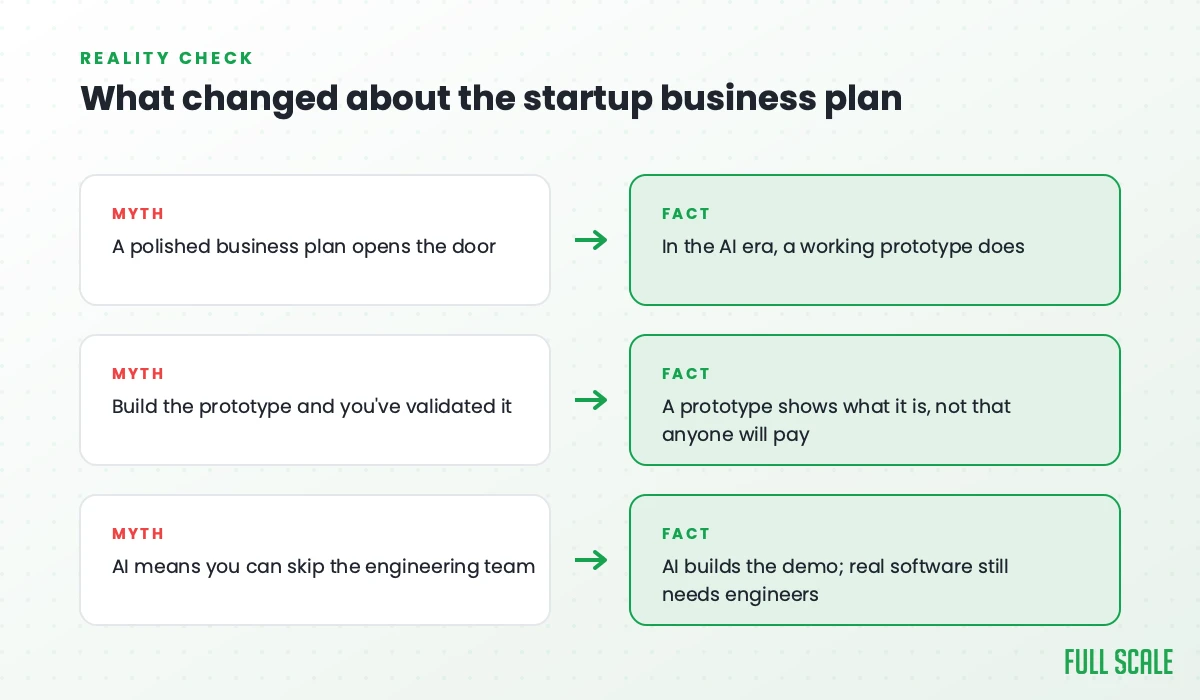
Here’s what changed. AI made building software fast and cheap. So the first thing people want to see now isn’t your plan. It’s the thing working. Investors, early customers, even your own future hires expect a clickable prototype, not a slide that says “imagine if.” If you show up with a polished forty-page plan and no product to touch, you look slower than the founder down the street who built a rough version over a weekend. The same logic now drives starting a SaaS company: prove demand before you raise.
This post is about how to write a tech startup business plan when a working prototype is the new first impression. We’ll cover what still belongs in writing, what the prototype now does instead, and the one part of all this that AI hasn’t touched at all.
The written plan lost its place at the front of the line
For decades, the business plan was the artifact you led with because building anything real was slow and expensive. You couldn’t show the product, so you described it. The document stood in for the thing.
That trade is gone. AI tools can stand up a working prototype in days, sometimes hours. When building is cheap, describing what you’re going to build stops being impressive. Anyone can describe. The question every investor and customer now asks, whether they say it out loud or not, is simple.
Why are you telling me about it instead of showing me?
This is the shift that reorders everything. The plan used to be the proof. Now the prototype is the proof, and the plan is the supporting document that answers the few questions a prototype can’t.
I want to be careful here, because this is where founders overcorrect. A prototype makes your idea real enough to react to, which is valuable. But it is not a business plan, and it is definitely not proof that anyone will pay you. It’s just not the whole job, and we’ll get to why.
The prototype is the new first impression, with one big catch
Build the prototype. Genuinely. In 2026 it’s the strongest opening move you have, and skipping it to polish a document is a mistake.
But understand exactly what you’re holding when you’re done. Here’s the truth about “vibe coding.” It only works if you’ve been coding long enough to know when the AI is wrong. A prototype you assembled from AI output looks like a product and behaves like a demo. Under the hood, it usually isn’t built to survive real users, real data, or real money moving through it.
I describe it like this: you can slap a bunch of things together and build your little shack, but it might catch on fire. The shack is great for showing the idea. It is not where you house customers.
So the prototype does two real jobs:
- It replaces the part of the plan that used to describe the product. Nobody needs your written feature list when they can click the feature.
- It pressure-tests your own thinking. The moment you build it, you discover the assumptions you were hand-waving past in the document.
What it does not do is validate demand, settle your business model, or tell you whether the thing is worth building at all. Treating a working prototype as proof that people want it is the most expensive mistake I see new founders make. Building was never the bottleneck. Knowing what to build, and whether anyone will pay for it, still is. A business plan can’t tell you whether you have actually found product-market fit; only paying customers can.
What still belongs in writing
A prototype answers “what is it?” It can’t answer the questions that actually decide whether you have a company. Those still go in writing, and they’re shorter and sharper than the old template ever was.
Think of the modern plan as the handful of things the prototype leaves open:
| The old plan had a section for… | In the AI era… |
|---|---|
| A long product description | The prototype shows it. Cut the prose. |
| Executive summary | Still useful, but write it as a one-page memo, not a cover letter. Write it last, and humanize AI writing so it reflects your own thinking rather than sounding machine-generated. |
| Market analysis | Keep it. Who is this for, how many of them are there, and why now. A prototype can’t tell you this. |
| Competitive analysis | Keep it, but be honest. “Why us, and why won’t a bigger company just copy this?” |
| Financials and pricing | Keep it. How you make money and what it costs to build the real version, not the shack. |
| Go-to-market | Keep it, and make it the centerpiece. This is the part everyone skips and the part that decides everything. |
Notice what survives. The plan has become a short, honest answer to the business questions a demo can’t reach: who it’s for, why now, how it makes money, and how you’ll actually get it in front of people.
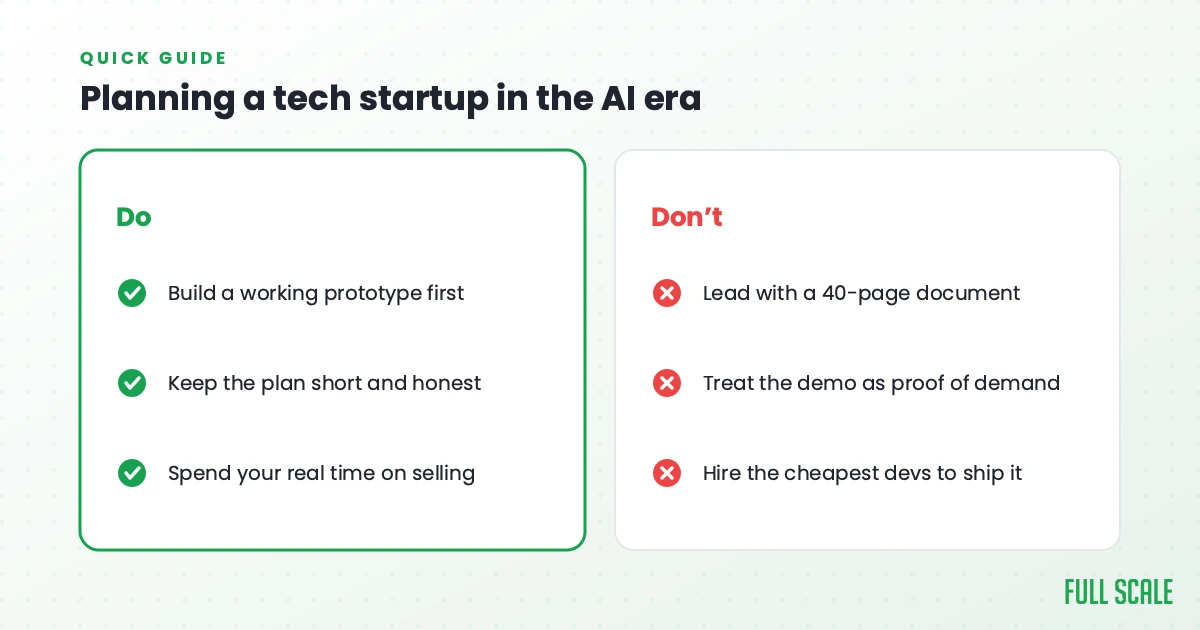
If your plan is more than a few pages, you’re probably writing the part the prototype already handles. Keep it concise. Nobody wants to read a fifty-page plan, and in 2026 nobody will, because they’re too busy clicking your demo.
The hard part is the one thing AI didn’t touch
Here’s the part nobody wants to hear. AI made building cheap, which means it removed the one excuse builders used to hide behind. We used to say building was slow and expensive, so we spent our time building. Now building is fast, and the only mile left is the one builders are allergic to.
I call this the AI last mile: talking to customers and selling. That mile didn’t get shorter. It got more exposed, because the building no longer takes up your time.
Writing code was never the hard part. Finding a product people can’t live without is. A prototype and a plan are both ways of avoiding the conversation where you ask a real person to pay you and they say no. The founders who win are the ones who have that conversation early and often, while the rest are still tuning their demo.
So when you write your plan, spend the most time on the section that scares you: distribution and sales. How does a stranger find out you exist, and why do they hand you money. If you can answer that, the rest is execution. If you can’t, no prototype will save you.
Founders who have gone through a startup accelerator often credit the program's structured sales and distribution coaching as the turning point that forced them to answer this question honestly before they ran out of runway.
From prototype to product: where engineers come back in
The reframe so far might read like you don’t need a real engineering team anymore. You build the prototype with AI, you write a short plan, you go sell. The opposite is true.
The moment a customer says yes, the shack has to become a building. The AI-assembled prototype has to be rebuilt as software that handles real users, real security, real data, and the load that comes with success. That’s not a prompt. That’s engineering, and it’s where most AI-first startups stall.
This is also where founders make the next expensive mistake: hiring the cheapest developers they can find to “just finish it.” I call that cheapshoring, offshoring for cost alone, and it produces exactly the kind of code that catches fire later. Pure coders will be replaced by AI. Problem solvers, the engineers who understand your product and push back when the spec is wrong, are the ones who turn a prototype into a company.
That’s the gap Full Scale fills. We give founders dedicated, senior engineers in the Philippines who work directly on your product as part of your team, through staff augmentation rather than a hand-it-over project shop. Since 2018 we’ve placed more than 700 engineers with US tech companies, at a fully loaded rate of about $35 an hour and a 93%+ retention rate. When your AI prototype proves there’s something real, that’s the team that builds the version customers can actually rely on.
If you want the deeper version of how all this fits together, the product-thinking discipline behind it is the subject of my book, Product Driven. The short version is the one I keep coming back to. Customers don’t buy cool code. They buy cool products.
Frequently asked questions
Do tech startups still need a business plan in 2026?
Yes, but a much shorter and sharper one. The written plan no longer describes your product, because a working prototype does that better. The plan now exists to answer the business questions a demo can’t reach: who the product is for, why now, how it makes money, what it costs to build for real, and how you’ll get it in front of customers. A few honest pages beat a forty-page document nobody reads. A strong plan also makes the case for whichever of the funding options for startups you decide to pursue.
Should I build a prototype before writing a business plan?
In most cases, build the prototype first or alongside the plan. AI tools make a clickable prototype fast and cheap, and it’s the strongest first impression you can make with investors and early customers. Just don’t mistake the prototype for the plan or for proof of demand. It shows what the product is. It doesn’t prove anyone will pay for it.
Can I use AI to build my startup’s product?
For a prototype, absolutely, and you should. For the production product customers depend on, AI gets you a fast draft that still needs real engineering oversight. AI-assembled code tends to look finished while hiding problems with security, data, and scale that surface once real users arrive. Use AI to move fast early, then bring in experienced engineers to build the version that survives success.
What’s the most important part of a tech startup business plan?
Go-to-market: how customers find you and why they pay. AI made building cheap, so building is no longer the bottleneck. The hard, unglamorous work of reaching customers and selling to them is what now separates startups that survive from ones that don’t. Spend the most time on the section that scares you most, and that’s usually the sales one.
You’ve validated the idea. Now build the real thing.
A prototype proves the idea is worth building. Turning it into software customers can trust is a different job, and it’s the one we do. Talk to Full Scale about building your engineering team.