When NOT to Use Staff Augmentation: 3 Scenarios Where You Should Hire Locally Instead
✅ When Should You NOT Use Staff Augmentation?
You should NOT use staff augmentation in these 3 scenarios:
- ❌ No technical leadership: No CTO, VP Engineering, or senior developer to review code and provide architecture decisions
- ❌ Team too small: Fewer than 3 in-house developers to provide mentorship and maintain coding standards
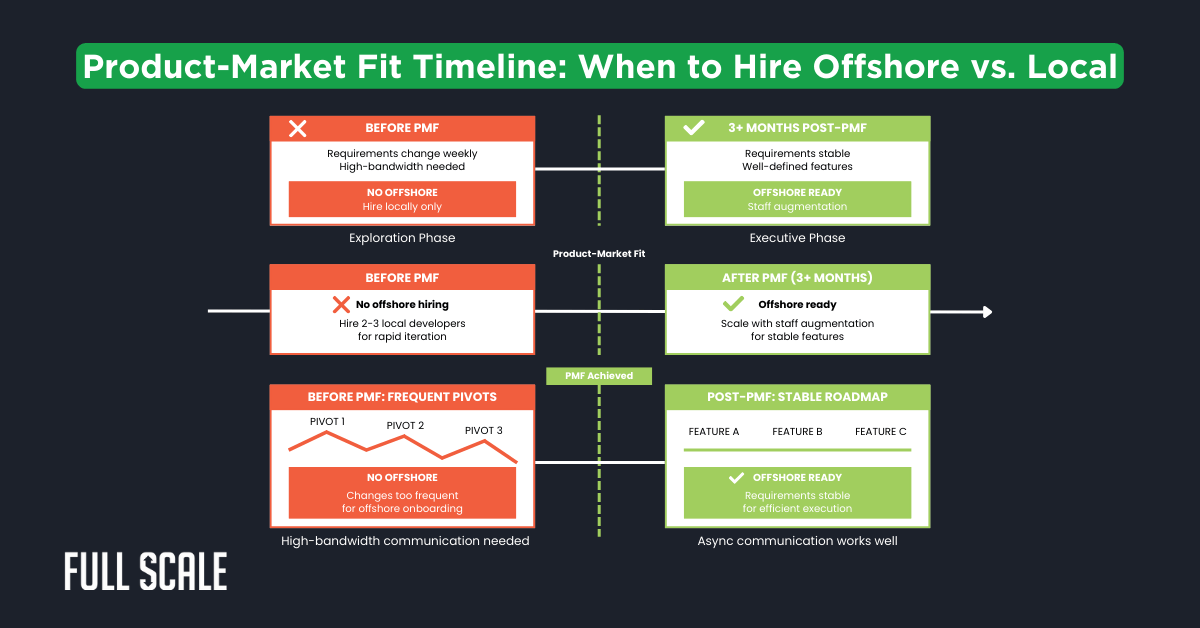
- ❌ Pre-product-market fit: Requirements change daily and you need high-bandwidth communication for rapid iteration
✓ The bottom line: Staff augmentation works when you have structure, stability, and technical leadership. Without these, hire locally first.
This article will talk you OUT of hiring us.
I’m Matt Watson, CEO of Full Scale. As of 2025, I’ve turned down over $500,000 in potential contracts because companies weren’t ready for staff augmentation.
Most offshore companies take anyone’s money. Bad fit? Not their problem.
We’re different. We turn away 20% of inquiries (2024 data). Why? Because when staff augmentation fails, it’s expensive—and we’d rather be honest upfront than deal with a disaster 3 months later.
Here’s when NOT to use staff augmentation—and what to do instead.
Scenario 1: You Have No Technical Leadership (Don't Call Us. Hire a CTO First.)
The number one reason staff augmentation fails? No one on your team can actually manage developers. NO technical leadership, is when NOT to use staff augmentation.
Here’s what that looks like:
- You’re a non-technical founder building an MVP
- You hired a few developers, but no one reviews their code
- You can’t tell if the work is good or if you’re being sold technical debt
- You don’t know what questions to ask in standup meetings
Non-technical founders need a full-time CTO, VP of Engineering, or senior developer to provide architecture decisions, code review, and technical direction.
Why Staff Augmentation Fails Without Technical Leadership
According to Deloitte’s 2024 Global Outsourcing Survey, companies with internal technical leadership have 2.3x higher success rates with offshore development.
Without a technical leader, you can’t:
- Evaluate developer quality. You won’t know if you’re hiring senior talent or junior developers pretending to be senior.
- Review code. Bad code ships to production. Technical debt compounds. Fixing it later costs 10x more.
- Make architecture decisions. Your offshore developers will build what you ask for—even if it’s the wrong solution.
- Provide technical direction. Developers need context. Without it, they build features that don’t align with your product vision.
According to the 2024 Stack Overflow Developer Survey, 87% of developers say code review is essential for maintaining quality. Without technical leadership, you can’t do code review. Your offshore team becomes a black box.
What to Do Instead
Don’t hire offshore developers yet. Hire locally first:
- Hire a full-time CTO or VP of Engineering. Someone who can own architecture, review code, and manage technical direction.
- Hire 2-3 senior developers locally. Build a core team that understands your product and can mentor offshore developers later.
- Establish coding standards and processes. Document how your team works before adding offshore capacity.
Once you have technical leadership in place, consider staff augmentation to scale your team.
⚠️ Real Example: The $60K Mistake
A non-technical founder hired 3 offshore developers to build his MVP. Six months and $60,000 later, he brought in a CTO to review the code.
Verdict: The entire codebase had to be rewritten. No tests. No documentation. Spaghetti code everywhere.
✅ What He Should Have Done:
Hired 1 senior local developer ($60K) → Built MVP correctly → Found PMF → Then scaled with offshore team.
Instead, he paid twice—once for bad code, once to fix it. Total cost: $120,000.
Don’t be that founder. Get technical leadership first. Staff augmentation second.
Scenario 2: Your Team Is Too Small (You Need at Least 3 In-House Developers First)
Staff augmentation doesn’t work with tiny teams.
If you have fewer than 3 in-house developers, don’t add offshore capacity yet. Here’s why.
Why Team Size Matters for Staff Augmentation
According to GitLab’s research on remote work, the first 3-5 employees define your company culture and processes. When you’re that small, everyone needs to be in the same room (or time zone) to establish how your team works.
Here’s what happens with teams smaller than 3:
- No code review capacity. Code review requires at least 2 people per feature. With only 1-2 developers, there’s no one to review offshore work.
- Knowledge silos. Your offshore developers become the only people who understand critical parts of your codebase.
- Communication overhead. A 2-person team can’t absorb the coordination costs of adding offshore developers.
- No mentorship. Junior offshore developers need senior guidance. A 2-person team can’t provide that.
According to McKinsey research on developer productivity, teams lose 35% productivity when communication loops exceed 4 hours. With offshore developers in different time zones, that 4-hour loop becomes 16+ hours for small teams without structure.
The Hiring Roadmap: When to Go Offshore
| Team Size | What to Do | Cost Savings Potential | Why |
|---|---|---|---|
| 0-2 developers | ❌ Hire locally only | N/A | Need to establish culture, processes, and coding standards |
| 3-5 developers | ⚠️ Consider staff augmentation | 40-50% | Enough structure for code review and mentorship |
| 6+ developers | ✅ Staff augmentation works well | 50-60% | Established team can absorb offshore developers easily |
What to Do Instead
If you’re under 3 developers, focus on local hiring first:
- Hire your first 3 developers locally. Build your core team. Establish how you work.
- Document everything. Coding standards, architecture decisions, deployment processes. Write it down.
- Set up asynchronous workflows. If local devs can’t work async, offshore devs definitely can’t.
Once you have 3+ in-house developers with documented processes, then consider adding offshore capacity.
Scenario 3: You're Pre-Product-Market Fit (Wait Until Requirements Stabilize)
This is the mistake I see most often. Startups that haven’t found PMF try to scale with offshore developers.
It never works.
Why Pre-PMF Startups Shouldn’t Use Staff Augmentation
Pre-PMF means your requirements change daily. You’re iterating fast, pivoting often, and figuring out what customers actually want.
Here’s why offshore developers struggle in this environment:
- Requirements change while they sleep. Your offshore developers finish their day. You have 3 customer calls that change everything. They wake up to completely different priorities.
- Communication loops kill iteration speed. Fast iteration requires instant feedback. With offshore developers, that feedback loop becomes 16+ hours instead of 16 minutes.
- Onboarding churn is expensive. Pre-PMF startups change direction every 2-3 weeks. By the time offshore developers understand the current direction, you’ve pivoted again.
- High-bandwidth communication is impossible. Pre-PMF requires whiteboarding sessions, rapid prototyping, and constant collaboration. Async communication doesn’t work.
One founder told me, “We onboarded offshore developers 3 times in 6 months because we kept pivoting. Each onboarding costs us 2 weeks. We would have been better off hiring locally and moving faster.”
What to Do Instead
Pre-PMF startups should hire locally for speed. Here’s the playbook:
- Hire 2-3 local developers who can iterate fast. Prioritize speed over cost.
- Wait until 3 months post-PMF. Once requirements stabilize, consider offshore.
- Use offshore for stable, well-defined features. Not for rapid experimentation.
Once you’ve found PMF and requirements are stable (3+ months of consistent priorities), then staff augmentation makes sense. Read our beginner’s guide to offshore development when you’re ready.
🎯 Real Example: A Foudner's Pivot Problem
A healthcare SaaS founder hired 4 offshore developers before finding PMF.
Month 1: Patient scheduling → Month 2: Telehealth video → Month 3: Billing integration. Three pivots. Three onboarding cycles.
Cost: $45,000 in developer costs. 6 weeks of onboarding time. Zero features shipped.
✅ What She Should Have Done:
Hired 2-3 local developers ($30K/month) → Found PMF in 4 months ($120K total) → Then scaled with 8 offshore developers. Same $45K budget would have gotten her halfway to PMF with a local team.
The happy ending: She eventually came back to us after finding PMF and successfully scaled to 8 offshore developers. Full Scale still works great—just not before PMF.
Learn more: How offshore development helped one founder achieve a startup exit (after finding PMF).
📊 Full Scale Staff Augmentation: Key Statistics (2024-2025)
Data from 500+ developer placements since 2018
The Decision Framework: Should You Use Staff Augmentation?
Use this framework to decide if staff augmentation is right for your company right now.
The 3-3-3 Readiness Rule
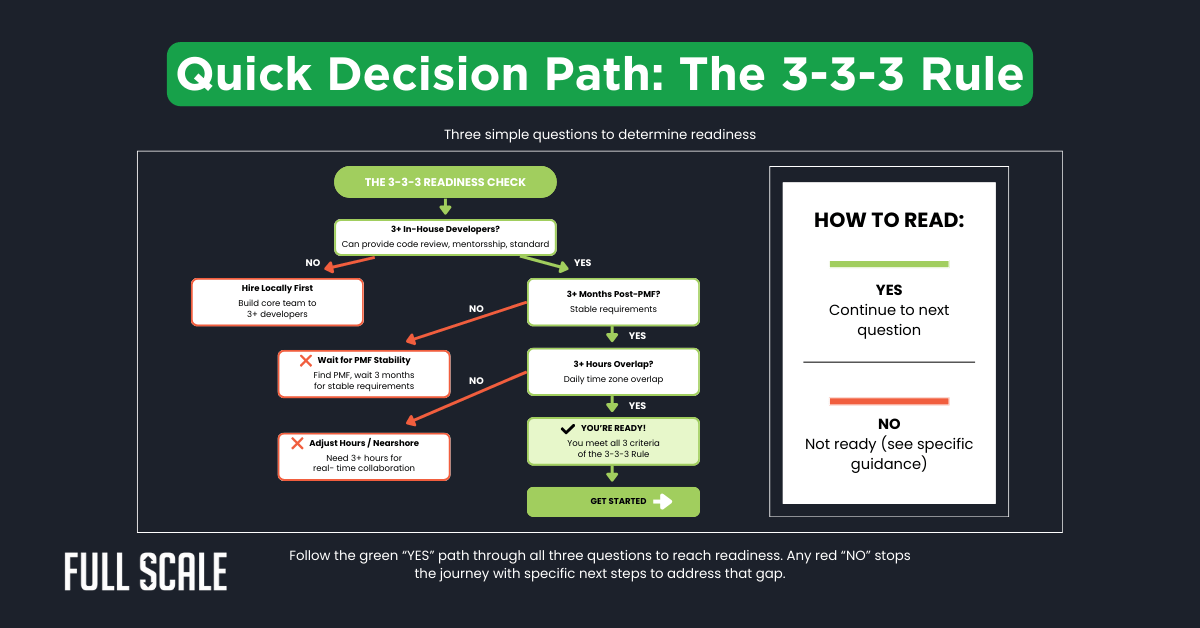
We created the 3-3-3 Readiness Rule to help companies self-assess. If you pass all 3 criteria, you’re ready for staff augmentation.
The 3-3-3 Readiness Rule
Check each box as you meet the criteria:
You have at least 3 full-time in-house developers who can provide code review, mentorship, and maintain coding standards.
You've found product-market fit and requirements have been stable for at least 3 months.
You have at least 3 hours of daily overlap with your offshore team's working hours.
Self-Assessment: Are You Ready?
📋 Is Your Company Ready? Take the 3-3-3 Assessment
Answer 3 quick questions to find out if you meet all the criteria:
1 How many full-time in-house developers do you currently have?
2 How long has it been since you achieved product-market fit?
3 How many hours of daily overlap can you manage with offshore teams?
When Staff Augmentation DOES Work (And How to Do It Right)
If you passed the 3-3-3 Rule, you’re ready. Here’s when staff augmentation works brilliantly:
✅ You Have Technical Leadership + Structure
You have a CTO or VP of Engineering who can:
- Review code from offshore developers
- Provide architecture guidance
- Make technical decisions
- Mentor junior offshore developers
✅ Your Team Is 3+ Developers with Documented Processes
You’ve built a core team that:
- Has established coding standards
- Uses documented workflows
- Can onboard new developers efficiently
- Works asynchronously when needed
✅ You’re Post-PMF with Stable Requirements
Your product:
- Has found market fit
- Has stable, well-defined requirements
- Doesn’t pivot every 2 weeks
- Has a clear roadmap for the next 6+ months
When these conditions are met, staff augmentation delivers massive value. You get:
- 40-60% cost savings vs. local hiring (as of 2025)
- Access to senior talent you couldn’t afford locally
- 7-14 day time-to-hire vs. 90+ days for local recruitment
- Scalability—add 5 developers in a month when you need them
Read our guides on successful offshore integration:
💚 Success Story: How One SaaS Company Scaled from 2 to 12 Developers in 6 Months
When this FinTech startup landed three major enterprise clients in Q1 2024, they faced an immediate problem: their roadmap required 10+ developers, but they only had 5. Local hiring in San Francisco was taking 90+ days per developer, and they needed to ship enterprise features in 6 months to meet contract deadlines.
Their CTO had tried traditional project outsourcing two years earlier—it failed miserably due to communication barriers and developers who disappeared mid-project. He was skeptical about offshore again.
Despite his skepticism, this company met all criteria:
- ✅ 5 in-house developers (well above the 3+ threshold) who could provide code review and mentorship
- ✅ 3 years post-PMF with stable requirements—no major pivots in 18 months
- ✅ 4-5 hours daily overlap between San Francisco (PST) and Philippines team (PHT)
This company succeeded because they met all three readiness criteria before starting. They had the team structure, product stability, and time zone overlap needed for offshore developers to thrive.
Read More Success Stories →Final Thoughts: When NOT to Use Staff Augmentation
Here’s the truth most offshore companies won’t tell you: timing matters more than talent.
You can hire the best offshore developers in the world. If your company isn’t ready—no technical leadership, tiny team, or pre-PMF chaos—it will fail.
That’s why we turn away 20% of inquiries (2024 data). We’d rather tell you “not yet” than take your money and watch you struggle 3 months later.
If you passed the 3-3-3 Rule: You’re ready. See transparent pricing and book a free consultation to discuss your offshore team strategy.
If you didn’t pass: That’s okay. Most companies need 6-12 months to get ready. Focus on hiring local technical leadership, building your core team to 3+ developers, and stabilizing requirements post-PMF.
Come back when you’re ready. We’ll still be here—and your offshore team will succeed because you took the time to build the right foundation first.
Want to learn more about what makes offshore development successful when the timing is right? Read 8 common offshore software development challenges and why your team might hate offshore development (and how to fix it).
Don't Let Slow Hiring Hold You Back
Companies that meet the 3-3-3 criteria typically hire their first developers within 14 days. How much does every week of delay cost you?
Fast doesn’t mean rushed. We maintain a 95% retention rate because we match the right developers to the right teams.
No. Teams with fewer than 3 in-house developers typically lack the structure for code review, knowledge transfer, and maintaining standards across a distributed team.
According to GitLab’s remote work research, the first 3-5 employees define your company culture and processes. If you’re that small, everyone needs high-bandwidth communication to establish how your team works.
Start with local hiring until you have 3+ in-house developers, then consider staff augmentation.
You’ll waste time and money on constant onboarding while requirements change daily.
Pre-PMF startups need high-bandwidth communication for rapid iteration. According to McKinsey’s research, the 4-hour communication loop problem becomes worse with time zones—offshore developers wake up to completely different priorities than what they worked on yesterday.
Wait until requirements stabilize (3+ months post-PMF) before adding offshore developers.
Not successfully. Without technical leadership, you can’t evaluate developer quality, review code, make architecture decisions, or provide technical direction.
According to Deloitte’s 2024 Global Outsourcing Survey, companies with internal technical leadership have 2.3x higher success rates with offshore development.
Hire a full-time CTO, VP of Engineering, or senior developer first. Then consider staff augmentation once you have someone who can manage technical quality.
Use the 3-3-3 Readiness Rule:
- 3+ in-house developers for code review and mentorship
- 3+ months post-product-market fit with stable requirements
- 3+ hours of daily time zone overlap for real-time collaboration
If you pass all three criteria, you’re ready for staff augmentation. If not, wait until you meet all three before hiring offshore.
The 3-3-3 Readiness Rule is Full Scale’s framework for determining staff augmentation readiness:
- 3+ in-house developers (for code review and team structure)
- 3+ months post-PMF (for stable requirements)
- 3+ hours time zone overlap (for real-time collaboration)
Companies meeting all three criteria have the highest offshore success rates (95% retention, 2.3x better outcomes according to industry research).
If you don’t meet all three, focus on building your foundation first before considering offshore development.