Staff Augmentation Case Study: How An E-Commerce Startup Scaled from 2 to 12 Developers in 6 Months
Most staff augmentation case study articles read like marketing brochures. All sunshine. Zero honesty about what actually went wrong.
This one’s different. We’re sharing the real story of an e-commerce startup that needed to scale its engineering team fast.
They had two developers and a product roadmap with 47 features. Their CEO’s stance? “Offshore? Absolutely not.”
Six months later, they had 12 developers and saved $390K annually. That CEO? He asked, “Why didn’t we do this sooner?”
Here’s every detail—the wins, the stumbles, and the numbers. This staff augmentation case study captures what worked, what didn’t, and why most offshore models fail while this one succeeded.
📗 What You'll Take Away from This Article
- A month-by-month timeline for scaling from 2 to 12 developers
- The real cost breakdown: local hiring vs. staff augmentation
- How integration actually works (Slack, standups, code reviews)
- Why 11 of 12 developers stayed after 18 months (92% retention)
- The honest challenges—and exactly how they were solved
- A self-assessment: Is your company ready for this approach?
The Challenge: Growth Outpacing Team Capacity
This e-commerce platform was growing at a 300% year-over-year revenue. Their engineering team was not.
Two developers held together a platform serving thousands of daily transactions. The pressure to scale the engineering team capacity was immense.
The product roadmap had 47 features queued. They shipped two per quarter. At that pace, their backlog would take six years to clear.
Their CTO spent 60% of his time recruiting instead of building. The business was growing. The team wasn’t.
Something had to change—fast. They needed a way to scale their engineering team without a 2-year recruitment cycle.
Why Local Hiring Wasn't Working
Local developer hiring wasn’t just slow. It was mathematically impossible for their timeline and budget.
The average time-to-hire for a senior developer in the U.S. is 90 days. They needed 10 developers. That’s 900 days—2.5 years of recruiting—to fill their team.
According to Stack Overflow’s 2024 Developer Survey, 67% of senior engineers receive multiple offers before even posting their resumes. This startup was competing with Google and Netflix for the same talent.
They made three offers. All three candidates chose larger companies. The salary competition was brutal—senior React developers commanded $180K+ locally.
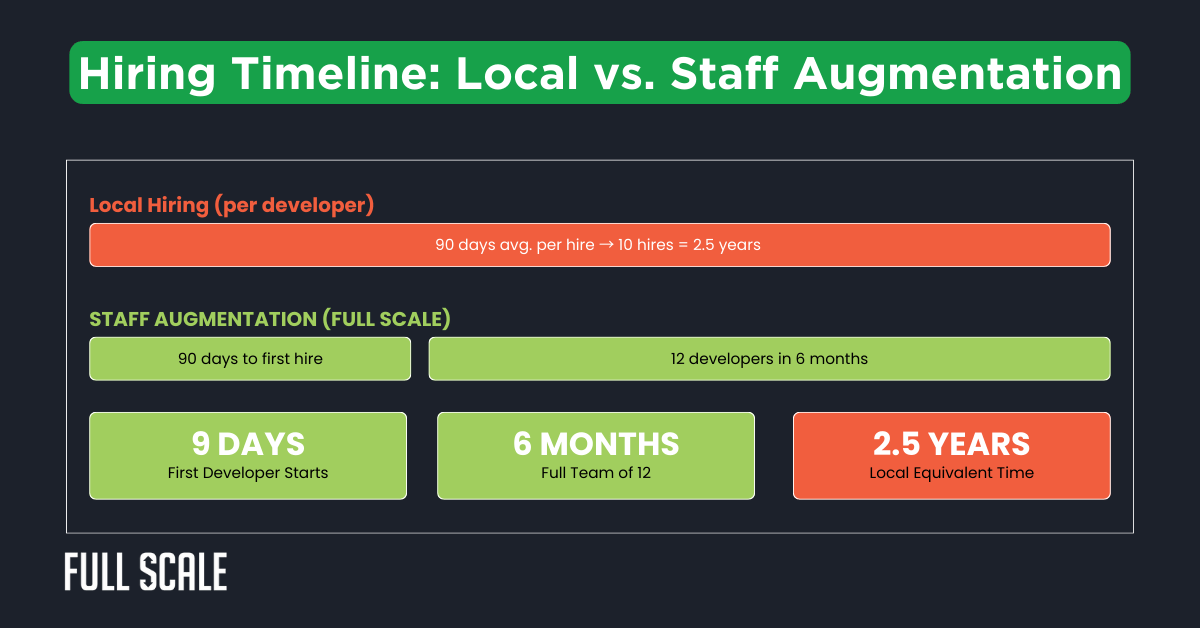
The timeline gap is not incremental. It’s structural. Pre-vetted talent pools eliminate the 60-90 day recruitment lag that kills momentum.
The Decision: Why They Chose Staff Augmentation
The CTO evaluated four approaches over six weeks. He compared staffing agencies, freelancer platforms, project outsourcing, and staff augmentation.
Freelancers offered speed but zero long-term commitment. Project outsourcing added middlemen between the CTO and the code. Staffing agencies charged 20-25% markups with no integration support.
Staff augmentation won because it solved three problems at once: speed, control, and retention. Developers join your team directly.
No project managers as middlemen. No communication layers. Just direct access to your remote developers.
The CEO’s initial reaction: “Offshore? Absolutely not.” Three months later, after seeing the results, he asked a different question entirely.
Understanding the real cost differences between offshore and local development helped their CFO approve the pilot. They started with two developers to test the model before committing.
| Factor | Staffing Agency | Freelancers | Project Outsourcing | Staff Augmentation |
|---|---|---|---|---|
| Time to First Hire | 30–60 days | 3–7 days | 4–12 weeks | 7–14 days |
| Developer Control | Partial | Low | Very Low | Full / Direct |
| Integration Depth | Moderate | Minimal | Separate team | Fully embedded |
| Retention Rate | ~65% | ~40% | ~60% | 95% |
| Cost Transparency | Markup-based | Variable | Project-based | Flat monthly rate |
| Long-Term Scalability | Moderate | Poor | Moderate | Excellent |
The clear winner across every metric that mattered to the CTO: staff augmentation with direct integration.
The Staff Augmentation Case Study Timeline: Month by Month
Here’s the part competitors never share. Not a polished timeline—the real one. What happened each month, including the parts that weren’t perfect.
This month-by-month engineering team scaling breakdown shows exactly how integration worked in practice.
Month 1: First Two Developers
Day 1-7: Offshore onboarding, environment setup, and Slack integration. Day 9: First remote developer joined the daily standup. By week two, both developers were committing to production.
The CTO was skeptical. Then the first senior React developer solved a performance bottleneck in week two that the team had fought for three months. Skepticism disappeared.
Month 2: Scaling to 6 Developers
Four more joined: two senior backend engineers, one frontend specialist, and one QA. The integration pattern from Month 1 became repeatable.
Sprint velocity increased 2.1x. The offshore senior backend engineer became the team’s go-to for AWS infrastructure questions—not because of geography, but expertise.
Month 3: Culture Solidifies
Virtual coffee chats and shared Slack jokes dissolved the “us vs. them” barrier. They established a 4-hour daily overlap window (7 am PT = 11 pm Manila).
“By month 3, our U.S. and Philippines developers were indistinguishable in Slack. The only way you'd know the difference was the timestamp on their messages.” — Client CTO
Month 4-5: Scaling to 12
Six more developers joined, including two mobile specialists (iOS/Android) who were impossible to find locally. Teams are organized into squads by feature area.
Zero turnover through month five. The team structure held. Code quality stayed consistent because every developer followed identical review standards.
Month 6: Full Team Operational
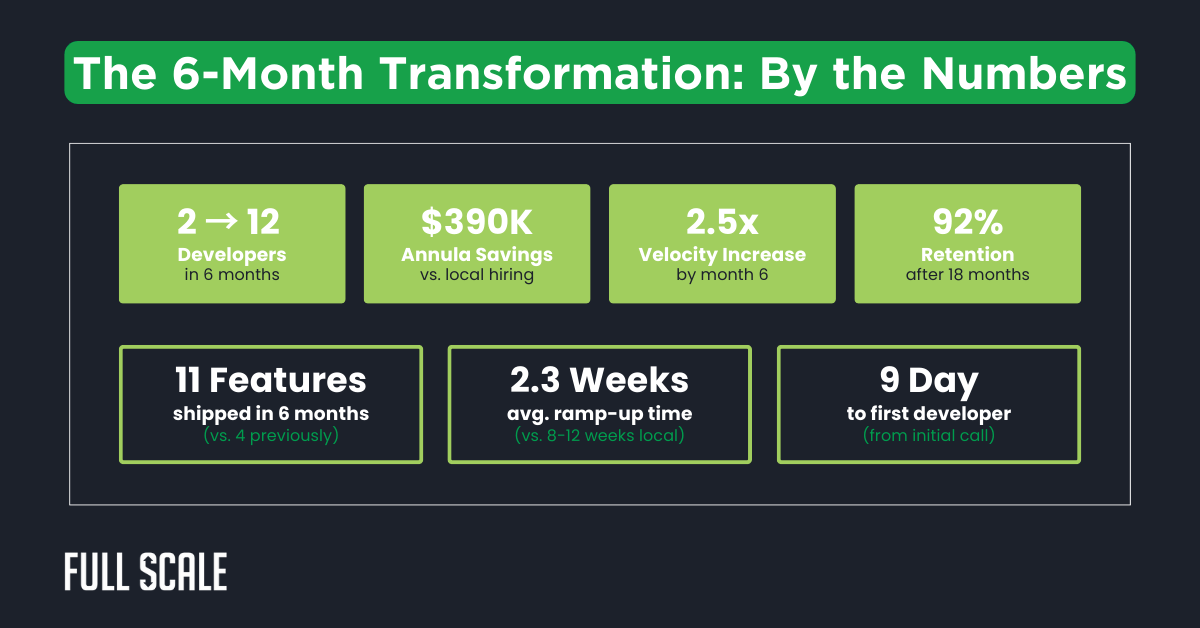
Twelve developers running at full capacity. They shipped 11 features in six months vs. four in the prior six months.
A feature estimated at six months of backlog was shipped in five weeks. Here’s what the staff augmentation results looked like across every metric.
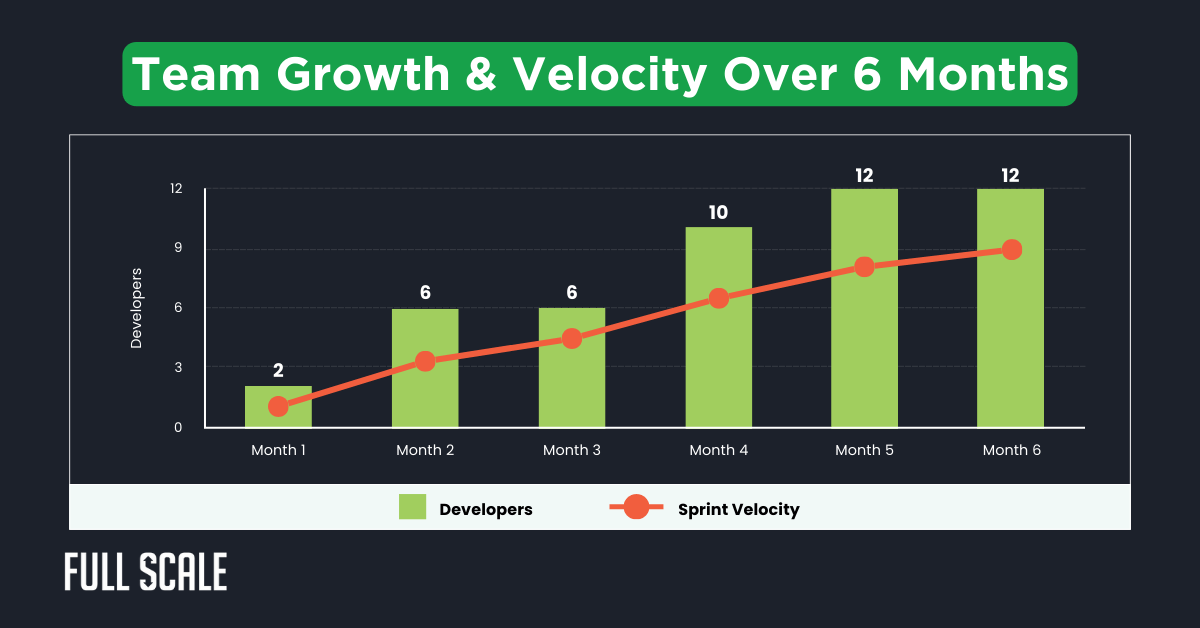
Notice velocity didn’t just increase with headcount—it accelerated. Proper developer hiring and onboarding processes compound returns over time.
The Results: Numbers That Matter
Case studies without numbers are just stories. Here are the staff augmentation results that mattered to the CTO, CFO, and board.
These results reflect 18 months of tracking, not a cherry-picked snapshot.
Velocity & Output
- Sprint velocity increased 2.5x by month six (measured in story points)
- 11 features shipped in 6 months vs. 4 in the prior period
- Technical debt actually decreased—more QA capacity caught issues earlier
- Platform migration, estimated at 4 months completed in 6 weeks
Cost Savings
The CFO’s requirement was simple: prove we’re saving money without sacrificing output. Here’s the math.
| Metric | Local Hiring Plan | Staff Augmentation (Actual) |
|---|---|---|
| Developers Hired | 3 (budget limit) | 6 senior developers |
| Avg. Annual Cost per Dev | $180,000 | $75,000 (fully loaded) |
| Total Annual Cost | $540,000 | $450,000 |
| Net Annual Savings | — | $390K saved (double capacity) |
| Time to Hire | 90 days per developer | 9 days to first developer |
| Hiring Fees | 20–25% per placement | $0 recruiting fees |
Pricing based on Full Scale's transparent monthly rates . No hidden fees.
Retention & Quality
- 11 of 12 developers are still with the company after 18 months (92% retention)
- Compare to the tech industry’s 40% annual turnover for local developers (Bureau of Labor Statistics)
- One developer requested a mentorship role—a sign of career investment, not churn
Time-to-Productivity
- Average ramp-up time: 2.3 weeks (vs. 8-12 weeks typical for local hires)
- Code contributions by week two across all developers
- 71% faster time-to-productivity compared to industry benchmarks
What Made This Work (And Why Most Offshore Fails)
This staff augmentation case study didn’t succeed because of luck. It succeeded because the model was engineered for integration, not delegation.
Most offshore development fails because companies use project outsourcing—a model designed to minimize offshore team integration. Staff augmentation services take the opposite approach.
Here are the four pillars that made this e-commerce developer hiring success repeatable:
- Direct Access: No middlemen. The CTO managed offshore developers directly—through Slack, standups, and code reviews
- Pre-Vetted Talent: Only 3% of Full Scale applicants pass screening. Speed came from the talent pool, not lowered standards
- Shared Tools & Rituals: Same Slack workspace, same Jira board, same daily standup. No separate “offshore” processes
- Career Investment: Full benefits, growth paths, and long-term employment. Developers aren’t treated as disposable contractors
Full Scale’s developer retention methodology is what keeps the 95% retention rate consistent across 500+ placements since 2017.
Challenges We Overcame (The Honest Part)
Anyone who tells you offshore is seamless from day one is lying. The difference is how fast you solve problems, not whether they exist.
Here’s what actually went wrong—and how it got fixed.
Time zone coordination (Week 1): The first standup scheduling attempt was a mess. 8 am PT doesn’t translate intuitively to Manila time. The fix was simple: a dedicated 4-hour overlap window with async handoffs outside that window.
One bad fit (Month 3): One developer had strong technical skills but didn’t match the team’s communication style. Full Scale replaced them within 11 days—zero disruption. Compare that to starting a local recruitment cycle from scratch.
U.S. team resistance (Week 1-3): The existing two developers were skeptical. “Will they really be as good?”
Then the offshore senior backend engineer solved an AWS bottleneck that the team had fought for two months. Skepticism vanished overnight.
Key Stats That Define This Staff Augmentation Case Study
This approach isn’t theoretical. The data backs it up—and the timing is urgent for e-commerce companies.
Three statistics from authoritative sources put this case study in context:
- Global e-commerce sales reached $6.42 trillion in 2025, with 62% of e-commerce businesses planning to hire within six months (BigCommerce, 2025). The demand for developers isn’t slowing.
- 67% of senior engineers receive multiple offers before posting resumes (Stack Overflow 2024 Developer Survey). If you’re relying on job postings alone, you’re fishing in an empty pond.
- AI-exposed e-commerce roles are growing wages 2x faster than non-AI roles, with 35,000+ AI-related e-commerce jobs posted in Q1 2025 (BigCommerce). The talent war intensifies every quarter.
Should Your Company Consider This Approach?
Staff augmentation isn’t for everyone. Honest assessment builds trust—so here’s both sides.
This self-assessment will help you decide if this approach fits your specific situation.
When it’s NOT right: If you need extreme same-timezone overlap (EU hours only) or have physical security clearance requirements, look elsewhere. If you want a “set and forget” contractor arrangement—this model isn’t for you either.
Why Partner with Full Scale
If these numbers resonate, here’s who delivered them. Full Scale has built teams for 60+ tech companies since 2017.
💚 Why Growing Tech Companies Choose Full Scale
- 95% developer retention rate—35 points above the 60% industry average
- Direct Integration Model—your developers, your Slack, your standups. No middlemen
- Pre-vetted talent pool of 1,000+ developers—only 3% of applicants pass screening
- U.S.-based contracts with full IP protection under American law
- Transparent monthly pricing—one flat rate, no hidden fees or recruiting charges
- 500+ successful placements across e-commerce, FinTech, HealthTech, and SaaS
- Month-to-month flexibility—no long-term lock-in contracts
- Founded by Matt Watson, serial CTO with a nine-figure exit who built Full Scale to solve his own offshore hiring frustrations
Learn more about how Full Scale fixed the six biggest problems in offshore development.
Scale Your Team. Skip the Headaches.
Ready to explore if staff augmentation fits your engineering team? Get a custom timeline and cost analysis for your hiring needs. No sales pitch—just honest assessment.
From initial consultation to the first developer joining the daily standup: 9 days. This included technical vetting, cultural fit interviews, and onboarding logistics. Full Scale maintains a pre-vetted pool of 1,000+ developers. That eliminates the 60-90 day recruitment lag of traditional hiring.
For six offshore senior developers, the annual cost was $450K vs. $540K for just three local hires—a net savings of $390K while doubling capacity. This includes all benefits, infrastructure, and management. Pricing details are available on Full Scale’s pricing page.
They established a 4-hour overlap window (7 am-11 am Pacific = 11 pm-3 am Manila). Core collaboration happened during overlap: standups, code reviews, and architecture discussions. Async handoffs covered everything else. Time zones became an advantage, enabling nearly 24-hour development cycles.
11 of the original 12 developers remain after 18+ months (92% retention). One left for personal family reasons. Compare this to the tech industry’s 40% annual turnover. The retention comes from Full Scale’s focus on career growth, full benefits, and treating developers as long-term team members.
Staff augmentation provides dedicated developers who integrate directly into your team, follow your processes, and report to your leadership. Project outsourcing assigns a separate team managed by the vendor, with communication filtered through project managers. The key difference: control and integration vs. hands-off delegation. Learn more about how offshore models compare.
Not only would they repeat it—they’re actively hiring four more developers now. The CTO now calls offshore “our competitive advantage,” not a cost measure. Their current strategy: offshore-first for 80% of roles.