Software Engineer Salary in the Philippines: What It Really Costs to Hire One (2026)

In this article
- What the data says about a software engineer salary in the Philippines
- What I actually pay, by experience level
- What pushes a developer into the top pay band
- The number that actually matters: cost to hire, not salary
- Cheap is a benefit, not a strategy
- So how do you actually hire one?
- Frequently asked questions
- The takeaway
If you are a founder or an engineering leader, you are not reading this to plan your own career. You are trying to figure out what a Filipino developer actually costs before you commit to hiring one. That is a budgeting question, and most of the pages ranking for software engineer salary philippines answer a different one. Filipino pay only looks low against US numbers; zoom out and developer salaries track the local cost of living almost everywhere.
They report an average. One monthly number, blended across every experience level and every employer in the country. That number is real, but it will not tell you what a good senior engineer costs, and it will quietly mislead you on both ends.
I have been offshoring to the Philippines since 2017. Full Scale now has 350+ employees there, spread across the country, from entry-level developers to specialists. So I want to give you two things at once: what the public salary data says, and what I actually pay and charge after years of doing this.
What the data says about a software engineer salary in the Philippines
Start with the public sources, because they are the proof you can check yourself. Here is what the major aggregators report for 2026, all converted to Philippine pesos (PHP) per month so you can compare them side by side.
- Indeed puts the average base salary at about ₱40,800 per month.
- Glassdoor reports a median total pay near ₱44,000 per month, with most salaries between ₱33,000 and ₱75,000.
- Jobstreet lists a typical range of ₱50,000 to ₱60,000 per month.
- PayScale shows an average base of about ₱40,000 per month, with entry-level developers closer to ₱26,000 and early-career engineers around ₱36,000.
- Levels.fyi runs much higher, from about ₱90,000 a month at the median to ₱128,000 at the 75th percentile, with senior engineers around ₱180,000, because its data skews toward multinationals and big-tech pay.
Look at the spread. Four of those sources cluster around ₱40,000 to ₱60,000 a month, which, to save you the math, is less than $1,000 a month. But those numbers are not accurate for the senior talent you would actually be hiring, and that is exactly why I am pointing them out before I give you the real ones. The real numbers are in line with Levels.fyi, which runs from ₱90,000 up to ₱180,000 a month for senior engineers. That gap is the whole story: the low cluster is an entry-level number wearing an all-levels label, and the high one is closer to what a good engineer actually costs. The same gap shows up whether you look up a software developer salary in the Philippines or IT salaries more broadly, and the average always understates senior pay.
What I actually pay, by experience level
I do not usually publish what we pay people. The only reason I am doing it here is that the low estimates floating around are so far off they will wreck your budget, and Levels.fyi is the source closest to reality.
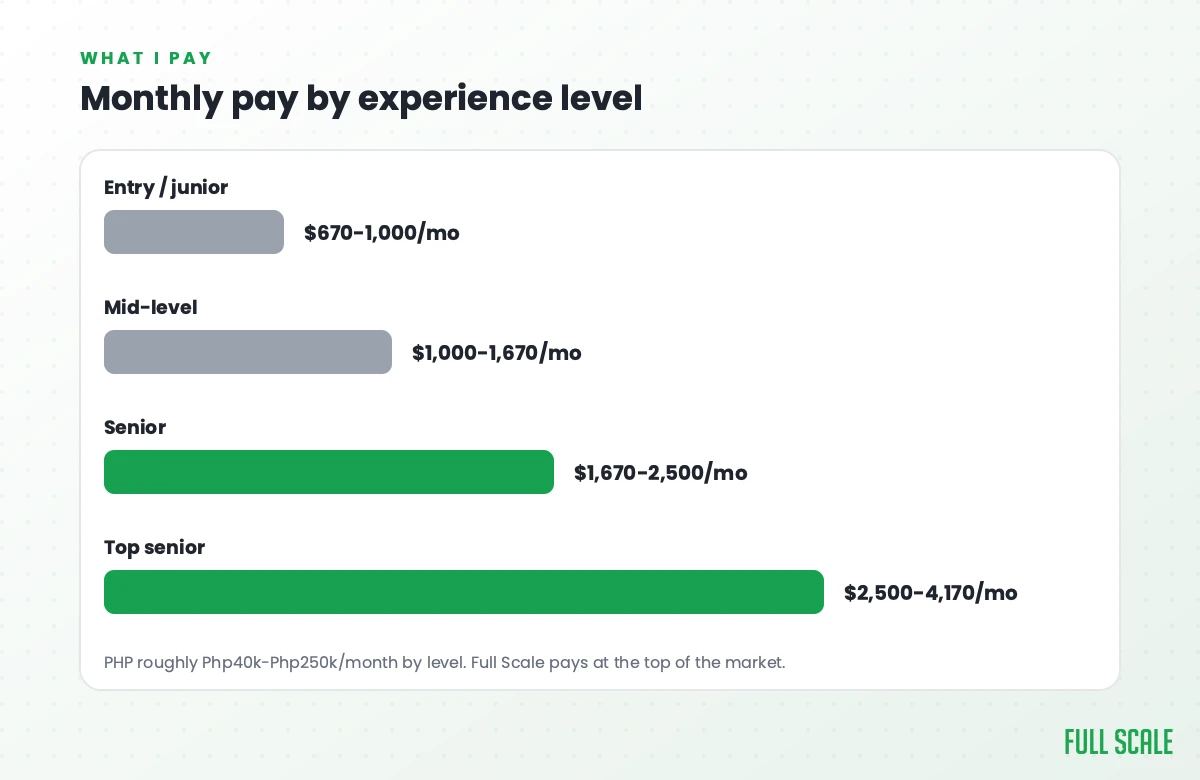
Here are Full Scale’s own estimates, by seniority, in pesos per month, with rough US dollar figures at about ₱60 to the dollar. These are pay figures, not a fully loaded cost. They leave out 13th-month pay and the other statutory benefits you owe on top, which I will get to in a minute.
- Entry-level: ₱40,000 to ₱60,000 a month (about $670 to $1,000).
- Junior to mid-level: ₱60,000 to ₱100,000 a month (about $1,000 to $1,670).
- Senior: ₱100,000 to ₱150,000 a month (about $1,670 to $2,500).
- Very senior or specialized: ₱150,000 to ₱250,000 a month (about $2,500 to $4,170).
The peso has been weak in 2026, so treat those dollar figures as approximate. They move with the exchange rate.
Notice where the public averages land. The ₱40,000 to ₱50,000 monthly figures from Indeed, Glassdoor, and Jobstreet sit right in my entry-level band, which is exactly why a single “average” misleads you on a senior hire.
The senior money is a different story. A senior Filipino engineer at ₱100,000 to ₱150,000 a month lines up with the upper end of Levels.fyi and the senior figure from SalaryExpert, about ₱95,000 a month for engineers with eight or more years. Specialized roles run higher still.
Location moves the number too. Hiring in Metro Manila runs about 20 to 30 percent higher than hiring in the provinces for the same role. With 350+ people spread across the Philippines, I see that spread constantly, and it is one of the reasons we do not concentrate hiring in the capital.
What pushes a developer into the top pay band
Seniority is one reason an engineer lands in the ₱150,000-plus band. The other is skills, and it is the same handful of scarce skills that command a premium everywhere, not just in the Philippines.
The premium goes to engineers with deep cloud and DevOps experience, the AI and machine learning skills everyone is suddenly hiring for, real data engineering, security depth, and the senior backend and architecture judgment to design a system rather than just code a ticket. A specialist in any of those costs more than a general full-stack developer at the same years of experience, because fewer people can do the work.
There is a quieter skill that moves pay just as much, and it is the one I screen hardest for: communication. An engineer who asks the right question, flags a bad spec, and writes clearly is worth more than one who only types fast, and that gap is widening as AI takes over the mechanical parts of the job.
The number that actually matters: cost to hire, not salary
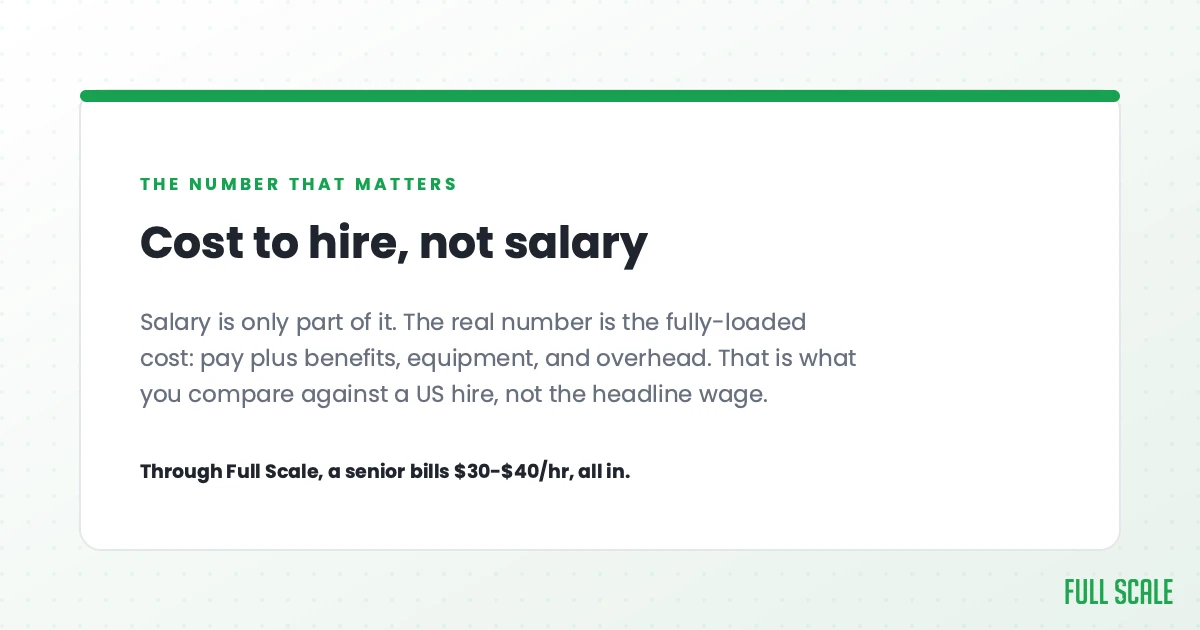
Salary is what the developer earns. Cost to hire is what you spend. Those are not the same, and the gap is where offshore either makes sense for you or does not.
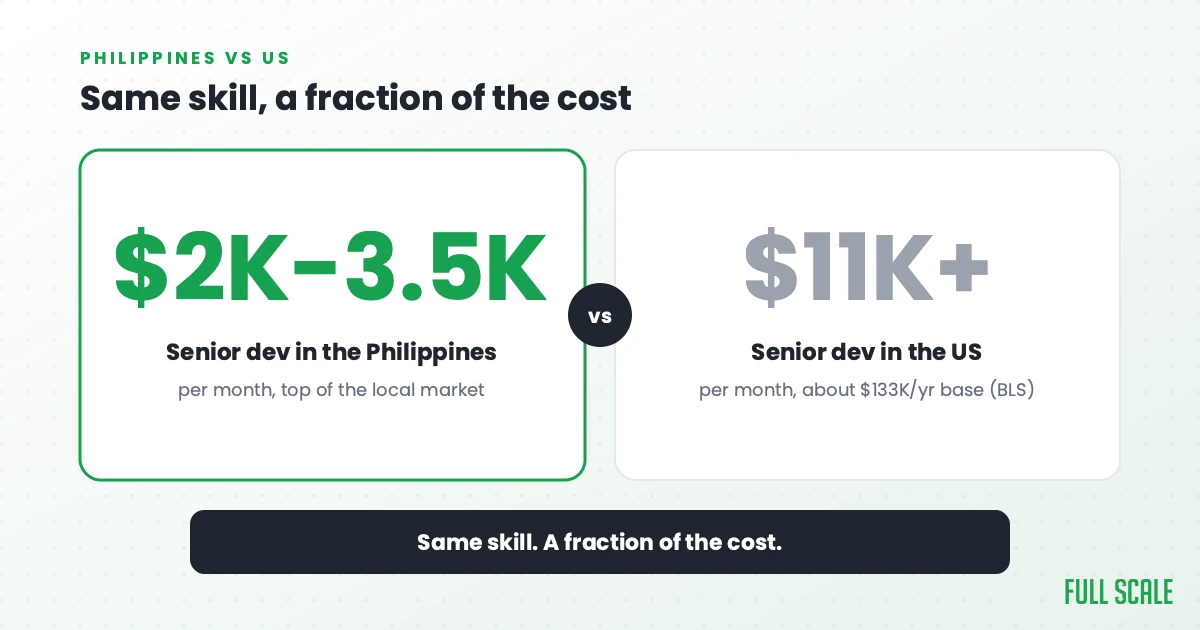
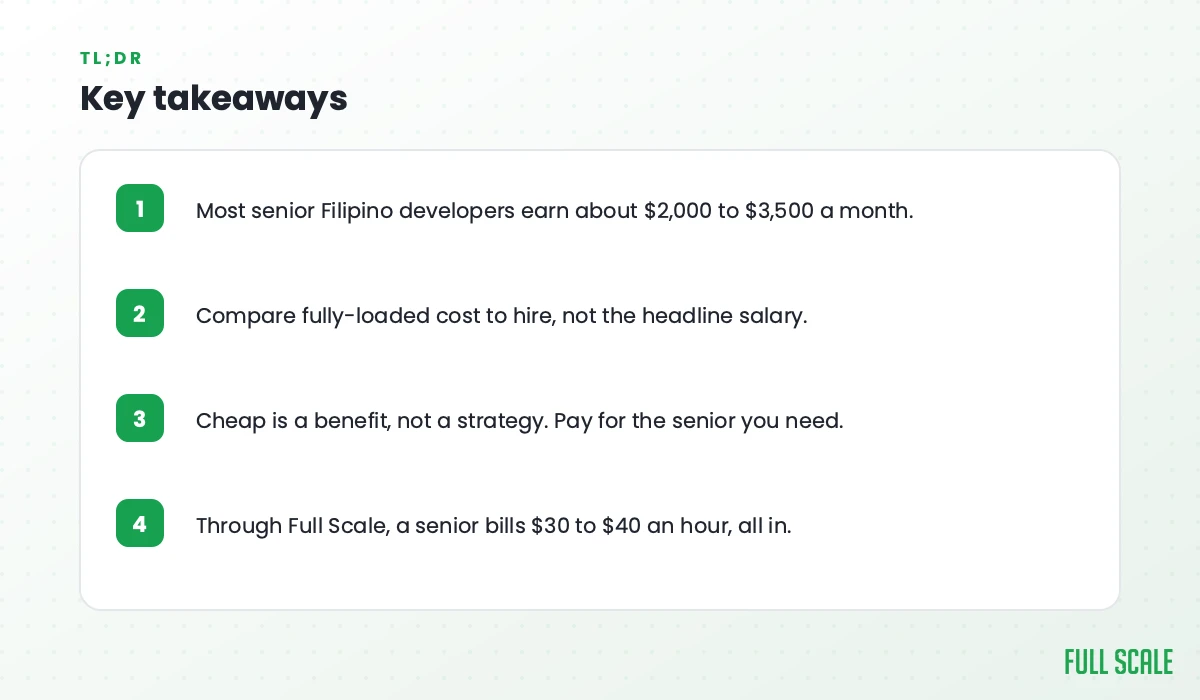
Most good senior developers in the Philippines make around $2,000 to $3,500 a month. That is their pay, and it does not include benefits or the overhead that comes with employing someone.
A chunk of that overhead is required by law. The Philippines mandates a 13th-month salary, a bonus paid every December equal to one month’s pay. That alone adds about 8 percent on top of the monthly number, before you count health coverage, government contributions, equipment, or the cost of recruiting and managing the person.
Now compare it to the US. The Bureau of Labor Statistics puts the median US software developer base salary near $133,000 a year, about $11,000 a month, and senior engineers run higher. Add benefits, payroll taxes, and overhead, and a fully loaded US employee costs 1.25 to 1.4 times the base, which pushes a senior engineer past $17,000 a month.
Even after the 13th-month bonus and benefits, a senior engineer in the Philippines costs a fraction of the $17,000 a month a US senior runs, at the same level of skill. The arbitrage is cost of living, not talent. With the developer shortage keeping US hiring slow and expensive, that math is why so many teams look offshore to reduce their software development costs without dropping a level of seniority.
Cheap is a benefit, not a strategy
Here is where I have to push back on my own pitch. If the only reason you are hiring offshore is to pay the lowest possible rate, you are about to make an expensive mistake. I call it cheapshoring.
You optimize for the cheapest invoice, you hire the cheapest body you can find, and you get a freelancer who disappears mid-sprint or a project shop that ships something you have to rebuild. You get burned once and swear off offshore for good. The rate was never the problem. The decision order was.
The order that works is communication first, then cost, then country. Software development is about communication more than anything else, and that is where most offshore engagements actually fail. The pay rate on the invoice has almost nothing to do with whether the engineer asks the right question when the spec is wrong.
There is a human side to this too, and it matters. The wages that look low from a US spreadsheet are life-changing locally. My brother-in-law in the Philippines works at Jollibee for about $1.25 an hour. My sister-in-law works as a virtual assistant for about $5 an hour, four times his pay. Some American observers call an engineering salary at these rates exploitation. They have it backwards. A real engineering job that pays many times what fast food or VA work does is the best opportunity on the board, which is exactly why good people stay.
So how do you actually hire one?
Two paths. I will be honest about both.
Do it yourself
You can absolutely go direct. OnlineJobs.ph is built for hiring Filipino workers, Jobstreet is the big local job board, LinkedIn job posts reach working professionals, and Upwork covers freelancers worldwide. Post a role, sort through applicants, run your own interviews, and handle the offer yourself.
What you save in fees you spend in time and risk. You are now the recruiter, the HR department, the payroll processor, and the manager handling a 14-hour time difference. Post a job and you will get flooded with applicants, and a lot of them have applied to a hundred other roles in the last six months and landed none of them, so you have to weed through all of that yourself. You will learn Philippine labor law, 13th-month pay, and local contracts the hard way. You will also eat the cost when a hire you screened alone does not work out. We avoid that by growing our own pipeline through partnerships with Cebu universities.
Try it. Good luck. Come back when you are tired of it.
Hire through a partner like Full Scale
The other path is to let someone who already runs a 350-person engineering operation in the Philippines do the hard parts. That is what staff augmentation is: we recruit, manage, and retain the developers, and they work as part of your team, on your standups, in your Slack, accountable to your roadmap. This is staff augmentation rather than handing a project to a vendor, so the engineer answers to you, not to an account manager.
The value is not a low rate. Cost is only one of the reasons companies outsource development to the Philippines, and the bigger one is that finding, running, and keeping good developers is the hard part of offshore. It’s also what tells you which outsourcing companies in the Philippines are worth hiring and which just quote a low rate.
The single most important thing I have learned in 25 years of hiring is that the best developers are not looking for a job. They already have one, and they are good enough that nobody is letting them go. You cannot wait for those people to apply, because they never will. You have to go recruit them away from where they work today.
That is the part we are built around. We have several full-time recruiters working every day to find the best engineers in the country and pull them away from their current employers, on top of the referrals our 350+ people bring us. Our ability to recruit is one of the most valuable things we do. Our developer retention is 93 percent, in a country where call-center attrition runs 30 percent or worse. We are Great Place to Work Certified in the Philippines two years running, with 95 percent of employees saying it is a great place to work versus 65 percent at a typical local company. Retention is not a soft metric here. The people who stay know your systems, and that continuity is worth more than shaving a few dollars off an hourly rate.
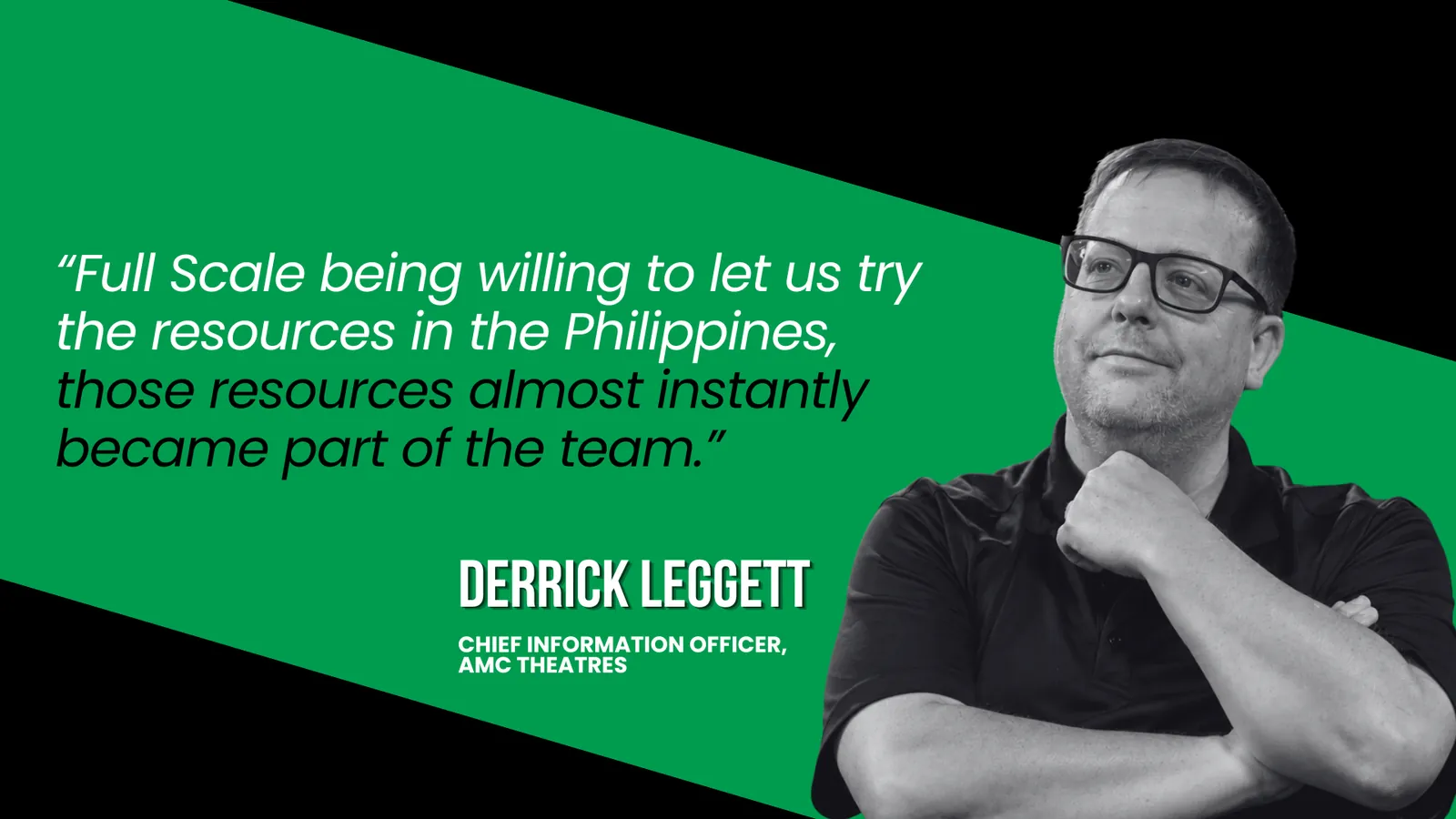
It works at real scale. AMC Theatres runs Full Scale engineers inside their own teams, and their CIO, Derrick Leggett, describes it plainly: “It’s a fully integrated team. It’s just some of the people happen to be living in the Philippines.” That is the model when it is done right, and it is the opposite of the walled-off vendor most people picture when they hear offshore.
If you want the deeper version of how I think about building product-driven engineering teams, it is in my book, Product Driven.
Frequently asked questions
What is the average software engineer salary in the Philippines?
Public sources put the average around ₱40,000 to ₱60,000 per month. That average is weighted toward entry-level and early-career developers, so treat it as a floor, not the cost of a senior hire.
What is the senior software engineer salary in the Philippines?
A senior Filipino engineer earns roughly ₱100,000 to ₱150,000 a month, and very senior or specialized roles run ₱150,000 to ₱250,000. That is well above the headline averages, because those averages blend in junior talent.
How much does an entry-level software engineer make in the Philippines?
Entry-level developers earn about ₱40,000 to ₱60,000 a month. That band matches what most salary aggregators report as the national “average,” which is why the average understates senior pay.
Does hiring in Manila cost more?
Yes. Hiring in Metro Manila runs about 20 to 30 percent higher than hiring in the provinces for the same role. Spreading hiring across the country, rather than concentrating it in the capital, keeps costs reasonable without sacrificing talent.
Do you pay extra benefits on top of salary in the Philippines?
Yes. The Philippines requires a 13th-month salary, a mandatory bonus paid every December equal to one month’s pay, which adds about 8 percent to the annual cost. You also owe health coverage and government contributions on top of the headline monthly figure, so budget above the salary itself.
Is it cheaper to hire a developer in the Philippines than in the US?
Yes, substantially. You can hire skilled global talent for 50 to 80 percent less than US rates. The savings come from cost-of-living differences, not from lower skill, which is why the decision should still start with communication and fit.
The takeaway
The software engineer salary in the Philippines is not one number. It is a range that runs from about ₱40,000 a month for an entry-level developer to ₱250,000 for a specialist, and what you pay depends on seniority, location, and whether you are hiring direct or through a partner.
If you want to do the recruiting, managing, and retention yourself, the job boards are right there. If you would rather skip that and get a senior engineer integrated into your team in about two weeks, that is what we do. Hire developers in the Philippines with Full Scale and we will handle the hard parts.