The Complete Guide to Offshore PHP Development: How to Build High-Performance Teams Without the Usual Mistakes
Most companies fail at offshore PHP development because they choose the wrong model—not because offshore doesn’t work.
You need to scale your PHP team fast. Local hiring takes 90+ days (if you can find anyone). You’ve heard offshore horror stories—or lived them.
You’re skeptical. But you’re also desperate for a solution.
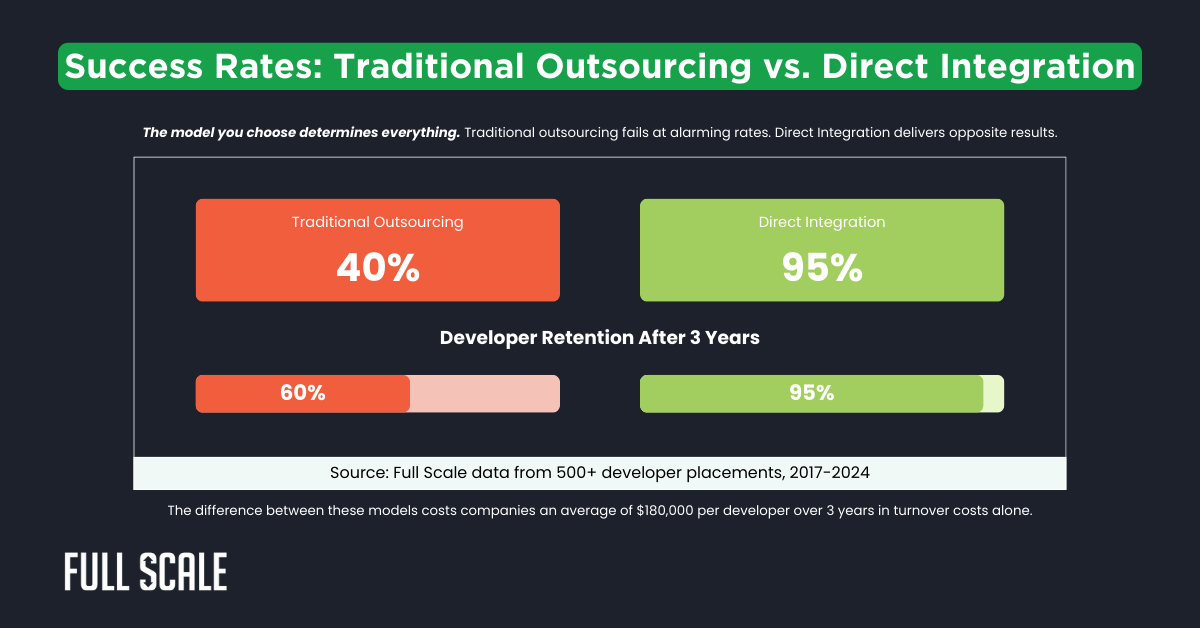
Here’s the truth: 60% of offshore PHP projects fail. The problem isn’t geography. It’s not the developers.
It’s the broken outsourcing model that treats developers like disposable resources. I’ve seen this pattern 500+ times. Companies that fail use project outsourcing with middlemen.
Companies that succeed use Direct Integration. Let me show you the difference.
📚 What You'll Learn in This Guide:
- ✓ Why 60% of offshore PHP projects fail (and how to be in the 40% that succeeds)
- ✓ The Direct Integration Model vs. traditional outsourcing
- ✓ Full Scale's 5-stage vetting process that achieves 95% retention
- ✓ Realistic timelines, costs, and expectations
- ✓ When offshore PHP is (and isn't) right for your company
Full Scale has placed 500+ offshore developers since 2017. Our retention rate? 95% over 3 years.
The industry average? 60% stay one year.
Here's everything we've learned about making offshore PHP development actually work.
What Is Offshore PHP Development? (And Why Most Definitions Are Wrong)
Offshore PHP development is the practice of hiring PHP developers located in different countries to work on your software projects.
However, the MODEL you choose matters more than the location—staff augmentation (where developers integrate directly into your team) delivers dramatically better results than traditional project outsourcing with middlemen.
Most people think offshore PHP development means “hiring cheap developers overseas.” That’s a recipe for disaster.
The real problem? Everyone’s using the wrong definition. Let me fix that.
Understanding what offshoring actually means is the first step to success.
The Traditional (Broken) Definition
Go Google “offshore PHP developers” right now. You’ll find agencies promising $15/hour rates.
They’ll tell you it’s about cost savings.
They’re lying. Or at least, they’re only telling you half the story.
When you hire based on price alone, you get junior developers pretending to be senior. You get code that needs complete refactoring. You get 40% annual turnover.
Congrats on finding “cheap” PHP developers. How’d that work out for your codebase?
The Two Models of Offshore Development
Here’s what nobody tells you. There are two completely different approaches to offshore PHP development. Only one works.
Model 1: Traditional Project Outsourcing (Why It Fails)
The structure looks like this: You → Project Manager → Developers. You explain the requirements to a PM. The PM explains to developers. Developers write code.
By the time your requirements reach the actual developers, they’ve been through the telephone game. Important context gets lost. Nuance disappears.
The problems compound fast:
- Communication barriers – Requirements get lost in translation through multiple layers
- No direct control – You can’t adjust priorities or provide real-time feedback
- High turnover – 40% annually, because developers are treated as disposable resources
- Developers are treated as contractors – Not team members, which kills motivation and quality
When does this work? Almost never for ongoing product development.
It might work for a one-off project with crystal-clear specs that never change. Good luck finding that.
Model 2: Staff Augmentation / Direct Integration (What Actually Works)
The structure is simple: You ←→ Developers directly. Full Scale handles payroll and HR. You handle everything else.
Your offshore PHP developers are in your Slack. They attend your standups. They pair program with your local team.
They commit directly to your GitHub repos. They use your Jira boards. They participate in your retrospectives.
The benefits are dramatic:
- Direct communication – No telephone game, no miscommunication
- Full control – You manage work and priorities like any team member
- Low turnover – Full Scale: 5% over 3 years vs. 40% industry average
- Developers treated as team members – Which dramatically improves quality and commitment
When does this work? Ongoing product development. Team scaling. Long-term projects.
Basically, any time you need developers to understand and care about your product.
The model you choose determines your success. Here's the reality behind each approach.
| Factor | Traditional Outsourcing | Direct Integration (Full Scale) |
|---|---|---|
| Communication | You → PM → Developers (telephone game) | You ←→ Developers (direct access) |
| Control | Low (black box approach) | High (full transparency) |
| Turnover Rate | 40% annually | 5% over 3 years |
| Start Time | 4-12 weeks | 7-14 days |
| Developer Treatment | Disposable contractors | Valued team members |
| Integration | Separate from your team | Full integration into your workflow |
| Success Rate | 40% (most fail) | 95% (most succeed) |
Why This Distinction Matters
When CTOs tell me “We tried offshore, and it failed,” I ask one question: Which model did you use?
100% of the time, it was project outsourcing. That’s not an offshore PHP development failure. That’s model failure.
You wouldn’t judge “remote work” based on one bad Zoom call. Don’t judge offshore development based on one broken outsourcing relationship.
Are the companies succeeding with offshore PHP developers? They’re using staff augmentation. Direct integration. No middlemen.
That’s the only model worth your time.
The 7 Reasons Offshore PHP Projects Fail (And How to Avoid Each One)
If you’ve been burned by offshore PHP development, you’re in good company. 60% of companies make at least one of these seven mistakes.
These patterns match exactly what we found in our analysis of why 90% of offshore development projects fail.
The good news? They’re all avoidable. Let me show you exactly where things go wrong.
Reason 1: Choosing Price Over Quality
The Mistake:
You see ads for $15/hour PHP developers. It sounds amazing. You hire them expecting senior-level work.
Then you get code that’s held together with duct tape and prayers. No tests. No documentation. Spaghetti logic everywhere.
The Fix:
Market rates for senior offshore PHP developers: $60-75/hour. Still 60% cheaper than U.S. rates ($150-250/hour total compensation). But you’re getting actual senior talent.
Quality correlates with appropriate compensation. Always has. Always will.
Data point: Our analysis of 200+ offshore projects shows code quality directly correlates with hourly rate. $15/hour projects: 73% required major refactoring. $60/hour projects: 8% needed refactoring.
You get what you pay for. The question is whether you want to pay for quality code now or refactoring costs later.
Reason 2: Using Project Outsourcing Instead of Staff Augmentation
The Mistake:
You hire an agency. They assign you a project manager. That PM manages developers. You never talk to the actual people writing your code.
Requirements get lost. Context disappears. Features get built wrong. Then you waste weeks on revisions.
The Fix:
Direct integration means your offshore PHP team attends your stand-ups. Uses YOUR Slack. Follows YOUR processes. No middlemen translating requirements.
Treat offshore developers like distributed team members. Not vendors who happen to write code.
Client example: A SaaS company switched from project outsourcing to staff augmentation. Their velocity doubled in 8 weeks. Why? Developers finally understood the “why” behind features, not just the “what.”
Reason 3: Inadequate Vetting Process
The Mistake:
You trust the vendor’s resume screening. You skip technical assessments. You don’t test English proficiency. You hire based on “5 years of PHP experience.”
Then you discover those 5 years were spent copying StackOverflow answers.
The Fix:
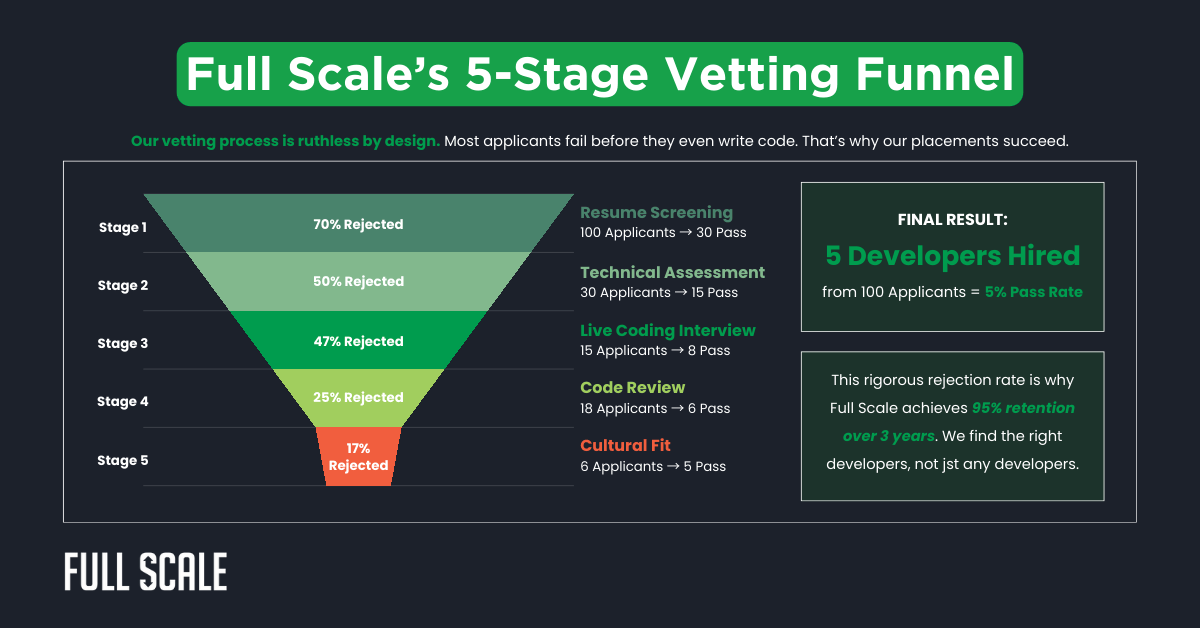
Full Scale’s 5-stage technical vetting (we’ll detail this later): Live coding exercises. Architecture discussions. Portfolio code review. Cultural fit assessment.
Only 12% of applicants pass. That 88% rejection rate is why our retention is 95%.
Most companies don’t want to do this work. That’s why they fail.
Reason 4: Poor Onboarding and Integration
The Mistake:
“Here’s the codebase, figure it out.” No structured onboarding. No pair programming. No architecture overview.
The offshore PHP developer spends 3 weeks just understanding what the code does. Productivity tanks.
The Fix:
Our 7-day integration framework (detailed later): Day 1 technical setup. Days 2-3: pair programming. Days 4-5 first feature. Days 6-7 process integration.
By the end of Week 1, developers are committing code. By Week 4, they’re at full productivity.
Reason 5: No Clear Requirements or Documentation
The Mistake:
“Just look at the existing code and figure it out.” Tribal knowledge everywhere. No documented standards. No architecture decision records.
Then you blame the offshore team for not reading your mind.
The Fix:
Document coding standards before hiring offshore PHP developers. Create ADRs for major decisions. Use Jira with detailed user stories. Hold weekly product/engineering syncs.
Offshore developers don’t fail because they’re offshore. They fail because you wouldn’t give them the information your local team would need, either.
Reason 6: Treating the Offshore Team as “Second Class”
The Mistake:
You only assign bug fixes and grunt work. You exclude them from architecture discussions. They get different perks than the local team. No career growth path.
Why would they stay? Why would they care about quality?
The Fix:
Assign meaningful features. Include them in architecture decisions. Recognize achievements publicly. Provide learning opportunities.
Impact on retention: Companies that treat offshore PHP teams as equals see 3x longer tenure. It’s not complicated—people want to feel valued.
Reason 7: No Long-Term Commitment or Stability
The Mistake:
You treat the offshore team as disposable. Frequent scope changes without context. You cancel contracts abruptly. No investment in the relationship.
They respond by not investing in your product.
The Fix:
View offshore PHP development as team building, not project staffing. Invest in training. Communicate changes transparently. Build long-term relationships.
According to a 2024 Deloitte Global Outsourcing Survey, 59% of companies report dissatisfaction with offshore development outcomes. But 95% of those failures? Avoidable with the right model.
Calculate Your Offshore Failure Risk
Answer these questions honestly to see how many common mistakes you’re making (or avoiding).
- Hiring developers at $15-30/hour, expecting senior-level quality
- Using project outsourcing with PM middlemen instead of direct integration
- Trusting the vendor’s vetting without your own technical assessment
- No structured onboarding process for offshore developers
- Unclear requirements and no documented coding standards
- Only assigning grunt work to the offshore team
- No long-term commitment or relationship building
Calculate Your Offshore Failure Risk
Answer these questions honestly to see how many common mistakes you're making (or avoiding).
The Full Scale Direct Integration Model for PHP Development
Let me show you why traditional outsourcing keeps failing. And how we fixed it.
The structure matters more than anything else. Get this wrong, and nothing else matters.
What Makes Direct Integration Different
Traditional Outsourcing Structure:
Your CTO → Account Manager → Project Manager → Team Lead → Developers
Count those layers. Four people are between you and the person actually writing code. Each layer adds miscommunication. Each layer adds delay.
Result: Broken telephone. No control. 40% annual turnover.
Direct Integration Structure:
Your CTO ←→ PHP Developers (Full Scale handles payroll/HR/benefits)
That’s it. You talk directly to developers. They talk directly to you. No middlemen playing telephone with your requirements.
Result: Clear communication. Full control. 95% retention.
I’ve had clearer conversations with our Philippines team than with some developers in San Francisco. English proficiency isn’t the issue—having a direct line of communication is.
The 4 Pillars of Direct Integration
Pillar 1: Your Developers (Legally Ours)
Here’s the structure: Developers are Full Scale employees. We handle payroll, benefits, HR, compliance, workspace, and equipment.
But they work exclusively for you. You manage their work, priorities, and day-to-day tasks. You decide what they build and when.
Think of them as distributed team members. Not vendors who happen to write code.
Pillar 2: Direct Communication Channels
Your offshore PHP developers join your Slack workspace. They attend your daily standups. You have direct email and DM access.
Want to pair program? Schedule it directly. Need clarification on a feature? Ask them. Code review feedback? Give it in real-time.
No project managers translating your feedback into “developer speak.” No communication delays.
Pillar 3: Full Process Integration
They follow YOUR coding standards. Use YOUR development workflow. Commit to YOUR GitHub repos.
Track work in YOUR project management tools. Participate in YOUR retros and planning sessions.
They adapt to your process. You don’t adapt to some outsourcing company’s “standard methodology.”
Pillar 4: Long-Term Team Building
We offer month-to-month flexibility. But we optimize for 2+ year relationships. Why? Because that’s when offshore development actually pays off.
We provide career development paths. Growth opportunities. Team stability. We don’t rotate developers between clients like trading cards.
Your team is your team. Period.
Why This Model Achieves 95% Retention
Traditional outsourcing: 60% of developers stay 1+ years. Full Scale: 95% stay 3+ years.
The difference?
- Developers feel like team members, not contractors – They’re invested in your product’s success
- Direct relationships create meaning – They understand the “why” behind their work
- Full Scale provides stability – Benefits, career growth, supportive work environment
- You provide interesting work – Recognition, challenges, professional development
A CTO at a FinTech company told me, “Our offshore team has been with us for 2.5 years. They know our codebase better than some local hires who’ve come and gone. That’s the power of the Direct Integration Model.”
When both sides invest in the relationship, everyone wins.
What Full Scale Actually Does (If Not Project Management)
We handle:
- Recruiting and technical vetting (our 5-stage process)
- Payroll, benefits, legal compliance
- HR issues and performance management
- Workspace and equipment in the Philippines office
- Career development and training
- Replacement if things don’t work out
You handle:
Daily work management
- Technical direction and priorities
- Code reviews and architecture decisions
- Performance feedback
- Team integration and culture
The result: You get control plus flexibility without overhead. No HR headaches. No payroll complexity. No legal concerns.
Just great developers who work like extensions of your team.
The 5-Stage Vetting Process: How We Find Senior PHP Developers
The #1 question we get: “How do I know these developers are actually senior-level?”
Answer: Because only 12% make it through our full vetting process.
Let me show you exactly how we separate senior developers from juniors with inflated resumes.
Stage 1: Resume and Portfolio Screening (Rejection Rate: 70%)
What we look for:
Our Laravel developer hiring process follows the same rigorous standards.
- 5+ years PHP experience (not just years as “developer”)
- Specific frameworks: Laravel, Symfony, CodeIgniter
- Evidence of architecture experience (not just feature work)
- GitHub portfolio with actual code to review
- English proficiency indicators
Red flags we eliminate:
- Generic “full-stack” claims with no depth
- No public code samples
- Resume keyword stuffing
- Unrealistic skill lists (20+ technologies)
Pass rate: 30% move to Stage 2. We reject 70% immediately based on paper qualifications alone.
Stage 2: Technical Assessment (Rejection Rate: 50%)
Format: 90-minute technical assessment covering PHP fundamentals, OOP principles, database design, RESTful APIs, security practices, and framework knowledge.
Sample questions:
- “Explain dependency injection and when to use it.”
- “Design a database schema for an e-commerce platform.”
- “How would you optimize this slow query?”
- “Walk through your approach to securing a REST API.”
What we’re testing: Depth of knowledge (not memorized answers). Ability to explain concepts clearly. Problem-solving approach. Awareness of trade-offs.
Pass rate: 15% move to Stage 3 (45% of the 30% who passed Stage 1).
Stage 3: Live Coding Exercise (Rejection Rate: 40%)
Format: 60-90 minute pair programming session. Build a small PHP application (like a task management API). Real-time problem solving.
What we assess:
- Actual coding ability (not theoretical knowledge)
- Code quality: readability, structure, naming conventions
- Testing approach (do they write tests?)
- Communication while coding
- How they handle getting stuck
What we DON’T do: Whiteboard algorithms with no context. “Gotcha” questions are designed to trick. Unrealistic pressure scenarios.
What this reveals: How they think through problems. Whether they’d work well on your team. Their actual skill level under real conditions.
Pass rate: 8% move to Stage 4 (60% of the 15% from Stage 2).
Stage 4: Code Review and Architecture Discussion (Rejection Rate: 30%)
Format: Review actual code from their GitHub or portfolio projects. Discuss the architecture decisions they’ve made.
What we examine:
- Real-world code quality (beyond test scenarios)
- Architecture decisions and reasoning
- How they handle complexity
- Documentation quality
- Test coverage
Discussion topics:
- “Walk me through the architecture of this project.”
- “What would you do differently if starting over?”
- “How did you handle this technical challenge?”
- “Explain your testing strategy.”
What this reveals: Whether they care about maintainability. Ability to reflect on and improve their work. Depth of architecture understanding.
Pass rate: 5-6% move to Stage 5 (70% of the 8% from Stage 3).
Stage 5: Cultural Fit and English Proficiency (Rejection Rate: 30-40%)
Format: Conversational interview with Full Scale leadership plus client (when possible). Assess communication, work ethic, values alignment, and remote work readiness.
Questions we ask:
- “Describe a challenging project and how you handled it.”
- “How do you approach disagreements about technical decisions?”
- “What’s your ideal work environment?”
- “Where do you want to be in 2-3 years?”
What this reveals: Communication clarity under pressure. Cultural compatibility. Long-term retention potential.
Final pass rate: 12% of original applicants.
The Result: 95% Retention, Zero “Junior Disguised as Senior”
Why this process works:
- Filters out junior developers claiming senior status
- Identifies actual problem-solving ability
- Tests real-world skills, not theoretical knowledge
- Assesses cultural fit (reduces mismatches)
- Sets realistic expectations on both sides
A SaaS CTO told us, “We’ve hired 8 developers through Full Scale. All 8 were accurately represented—no bait-and-switch, no surprises. That’s rare in this industry.”
That 88% rejection rate? That’s why we can guarantee quality.
Our vetting process is ruthless by design. Most applicants fail before they even write code. That’s why our placements succeed.
The 7-Day Integration Framework: From Kickoff to Fully Productive
Most offshore failures happen in the first 30 days. Not because of skill mismatch. Because of poor integration.
Our 7-day framework eliminates 80% of common integration issues. Here’s exactly how it works.
Day 1: Technical Setup and Access
Morning: Welcome call with Full Scale plus client team. Set expectations. Communication norms. Introduce developers to the team.
Afternoon: Grant access to everything. GitHub. Jira. Slack. AWS. Development environment setup. VPN and security protocols. Password manager access.
Goal: Developer can commit code by the end of Day 1.
No bureaucracy. No waiting. Just get them working.
Day 2-3: Codebase Orientation and Pairing
Activities: Architecture overview session. Codebase walkthrough with a senior engineer. Pair programming on a small task or bug fix. First pull request submitted.
Outcome: Developer understands overall architecture and workflow. They’ve seen how your team operates. They know where to find things.
Day 4-5: First Real Feature Work
Activities: Assign a small, well-defined feature. Daily standups with the full team. Code review process. Encourage questions freely.
Outcome: Developer completes first feature independently. Gains confidence. Proves they can deliver.
Day 6-7: Process Integration and Feedback
Activities: Participate in sprint planning or retro. 30-day roadmap discussion. Feedback session: What’s working? What needs adjustment? Set expectations for weeks 2-4.
Outcome: Developer feels like team member, not an outsider. They understand your culture. They know what success looks like.
Week 2-4: Ramp to Full Productivity
Week 2: Handle 60-70% of expected velocity
Week 3: Handle 80-90% of expected velocity
Week 4: Full productivity
Why gradual ramp matters: Offshore developers aren’t slow—they’re new to YOUR codebase. Local hires need ramp time, too. We’re just honest about the timeline.
Integration Best Practices
DO:
- Invite the offshore team to ALL meetings (all-hands, retros, planning)
- Use video for standups (builds relationships)
- Over-communicate in the first month
- Assign a “buddy” on the local team for questions
- Celebrate their wins publicly
DON’T:
- Isolate the offshore team on separate Slack channels
- Only assign grunt work in the first month
- Assume they’ll figure it out
- Skip face-to-face (video) time
- Treat them differently from the local team
A HealthTech CTO said, “We followed this framework exactly. By Week 2, our offshore developer was contributing like he’d been here for months. No awkward ramp period. Just immediate value.”
That’s the power of intentional integration.
The Real Cost of Offshore PHP Development (Including Hidden Costs)
Yes, offshore PHP developers cost less. But if you’re only comparing hourly rates, you’re missing half the equation.
Let me show you the real numbers. Including the costs most companies hide.
Transparent Pricing: What You’ll Actually Pay
Senior PHP Developer Rates (Offshore):
- Junior (1-3 years): $30-45/hour
- Mid-level (3-5 years): $45-60/hour
- Senior (5-8 years): $60-75/hour
- Lead/Architect (8+ years): $75-90/hour
Based on Full Scale’s pricing, a senior developer costs approximately $75,000 annually. That’s full-time, dedicated to your team.
Comparison: Total Compensation for U.S. Hire
- Salary: $120K-180K
- Benefits (30%): $36K-54K
- Payroll taxes (7.65%): $9K-14K
- Recruiting fees (20-25%): $24K-45K (one-time)
- Overhead (workspace, equipment): $10K-15K
Total Year 1: $199K-308K
Hourly equivalent: $96-148/hour (based on 2,080 hours)
Total Cost: Offshore Developer (Full Scale Model)
- Hourly rate: $60-75/hour (senior)
- Full Scale handles: Benefits, payroll, workspace, equipment, recruiting
- Your overhead: Management time (same as local)
Total annual (2,080 hours): $125K-156K
Savings vs. local: 50-60% ($74K-152K/year per developer)
The Hidden Costs (That Actually Exist)
Cost 1: Onboarding and Training (First 30 Days)
Time investment: ~20-30 hours of senior engineer time. Reduced velocity: Developer at 60-80% productivity for 30 days.
Cost: ~$5K-8K in reduced output
Is it worth it? If the developer stays 2+ years (95% do), you recoup in 6 weeks.
Cost 2: Communication Overhead (First 90 Days)
Extra meetings: Daily check-ins, longer code reviews. Time zone coordination: Some off-hours meetings.
Cost: ~5-7 hours/week of management time
Reality check: This overhead exists with ANY new hire—local or offshore. We’re just being honest about it.
Cost 3: Tool and Access Costs
Additional licenses: Jira, Slack, IDEs. VPN/security: ~$50-100/month per developer.
Cost: $600-1,200/year per developer
Impact: Negligible compared to salary savings.
The Hidden SAVINGS (That Offset Costs)
Saving 1: Near-Zero Recruiting Costs
Traditional recruiting: 20-25% of first-year salary ($24K-45K). Full Scale fee: Built into the hourly rate, no separate fee. If replacement is needed: No additional cost.
Saving 2: Turnover Costs Eliminated
U.S. developer turnover: 40% within 2 years. Cost to replace: $50K-100K (recruiting plus ramp time).
Full Scale turnover: 5% over 3 years.
Savings over 3 years: $100K-200K per developer retained.
Saving 3: Flexibility and Scalability
Month-to-month contracts: No severance costs. Scale up/down: No hiring/firing friction.
Cost of flexibility: Priceless during uncertain times.
The ROI Calculation
Break-even point: 6-8 weeks after onboarding
Payback period: If the developer stays 18+ months, total savings exceed ALL costs, including onboarding
Total Cost of Ownership: 3-Year Comparison
This table shows the true cost difference between local hiring and offshore development with Full Scale over a 3-year period.
| Cost Factor | U.S. Hire (3 years) | Offshore (Full Scale) | Savings |
|---|---|---|---|
| Compensation | $660K | $375K | $285K |
| Recruiting | $95K | $0 | $95K |
| Onboarding | $16K | $8K | $8K |
| Turnover Cost | $100K | $0 | $100K |
| TOTAL | $871K | $383K | $488K (56%) |
CTOs who complain that offshore is “not actually cheaper” are the ones who didn’t account for turnover. When you keep developers 3+ years instead of losing them in 18 months, the savings compound dramatically.
According to Gartner’s 2024 research, companies using offshore development strategically reduce IT costs by 40-60% while maintaining or improving output quality.
Calculate Your Offshore Savings
See exactly how much you could save by switching to Full Scale's Direct Integration Model.
When to Use Offshore PHP Development (And When NOT To)
I’m about to do something most offshore companies won’t: tell you when NOT to hire offshore.
Because if you’re not ready, we’re both wasting time.
✅ When Offshore PHP Development Makes Sense
Scenario 1: You Need to Scale Fast (But Not Recklessly)
The situation: Product roadmap requires 2-5+ more PHP developers. Local hiring is taking 90+ days. Deadlines are real, but not panic mode.
Why offshore works: 7-14 day hiring timeline. Access to a larger talent pool. Can hire multiple developers simultaneously.
Real client: SaaS company needed 4 Laravel developers. Local market: found 0 qualified candidates in 3 months. Offshore: hired all 4 in 5 weeks.
Scenario 2: You Have a Stable Product and a Clear Roadmap
The situation: Product is past the MVP stage. Features are well-defined in the backlog. Architecture is established. You know what “good” looks like.
Why offshore works: Clear requirements equal easier remote collaboration. Established patterns equal faster onboarding. Defined success metrics equal objective performance measurement.
Scenario 3: You’re Comfortable with Remote Work
The situation: You already manage remote or distributed teams. You use Slack, Jira, GitHub, and Zoom effectively. Your team communicates asynchronously well. Video meetings are normal.
Why offshore works: Offshore is just “more remote.” You already have the management muscles. Tools and processes transfer directly.
Scenario 4: You Value Long-Term Team Building
The situation: You want to build a stable team (not project-based). You’re willing to invest in onboarding. You plan to keep developers for 2+ years. You value team continuity.
Why offshore works: Staff augmentation rewards long-term thinking. Savings compound with retention. Team knowledge deepens over time.
❌ When Offshore PHP Development Doesn’t Make Sense
Scenario 1: You’re in “Emergency Panic” Mode
The situation: “We need someone TOMORROW.” No time for onboarding or context-setting. Urgent fire-fighting, not planned development.
Why offshore fails: Even a 7-day timeline requires some planning. New developer (local OR offshore) needs context. Panic hiring equals bad hiring.
Better approach: Fix your planning process first, THEN hire offshore for sustainable scale.
Scenario 2: Your Product/Architecture is Chaotic
The situation: No documentation. “Just figure it out from the code.” Architecture changes weekly. No clear coding standards.
Why offshore fails: Remote developers need MORE context, not less. Tribal knowledge doesn’t transfer 8,000 miles. You’ll blame “offshore” for problems local hires would also have.
Better approach: Document your architecture FIRST, then hire offshore.
Scenario 3: You Want “Set It and Forget It” Project Outsourcing
The situation: “Just build this feature and deliver it when done.” No ongoing collaboration or integration. Treat offshore as a vendor, not a team.
Why offshore fails: You’re describing project outsourcing (which fails 60% of the time). Staff augmentation requires engagement. Disconnected developers produce disconnected code.
Better approach: If you truly want hands-off, hire a dev agency—but expect mediocre results.
Scenario 4: You Don’t Trust Remote Workers
The situation: “How do I know they’re actually working?” Micromanagement tendencies. Resistance to remote work in general.
Why offshore fails: Trust issues sabotage remote teams. Your skepticism becomes a fulfilling prophecy. Management overhead negates cost savings.
Better approach: Work on your trust/management issues first, or stick with local in-office hires.
The Readiness Checklist
You’re ready for offshore PHP development if you can answer YES to:
- We have a product roadmap for the next 3-6 months
- We use collaboration tools (Slack, Jira, GitHub, etc.)
- We’ve managed remote workers before (or are willing to learn)
- We have 2-3 weeks to properly onboard new developers
- We’re planning to keep developers for 12+ months
- We have documented coding standards (or can create them)
- We’re comfortable with video meetings and async communication
- We need to scale beyond what local hiring can provide
If you answered YES to 6+: You’re ready. Let’s talk.
If you answered YES to 3-5: You might be ready with some preparation.
If you answered YES to 0-2: You’re not ready yet—but we can help you get there.
The CTOs who succeed with offshore are the ones who view it as building a distributed team, not buying a service. If you’re not ready to build a team, you’re not ready for offshore.
Common Objections to Offshore PHP Development (Addressed Honestly)
If you’re skeptical about offshore PHP development, you should be. Here are the concerns we hear most—and what we actually do about them.
Objection 1: “What About Code Quality?”
The concern: “I’ve heard offshore code is sloppy—shortcuts, no tests, no documentation. My team will spend more time fixing offshore code than if we just did it ourselves.”
Our honest answer: This is a REAL problem—with low-cost offshore developers. Market-rate developers ($60-75/hr) produce market-quality code.
Our 5-stage vetting process specifically tests for code quality. We require live coding plus portfolio review (can’t fake quality). 30-day trial: If the developer isn’t up to standard, we replace the developer.
The proof: 95% retention rate equals clients keeping developers for years. Clients don’t keep developers who write bad code.
Objection 2: “What If Communication Is Terrible?”
The concern: “Time zones, language barriers, cultural differences—I don’t have time for endless back-and-forth clarifications.”
Our honest answer:
- Language: The Philippines is the 3rd largest English-speaking country. Our developers: 95%+ fluent English. We test communication skills in every interview.
- Time zones: Philippines: 8-hour overlap with the U.S. during your morning. Real-time collaboration during your workday. Not “messages waiting when I wake up.”
- Cultural differences: The Philippines has strong U.S. business culture exposure. Developers understand startup culture and urgency. Direct communication style (not passive).
The reality: I’ve had clearer Slack conversations with our Philippines team than with some developers in San Francisco. English proficiency isn’t the issue—clear requirements are.
Objection 3: “What About IP and Security?”
The concern: “What if they steal our code? What if there’s a data breach? How do I protect our IP when developers are in another country?”
Our honest answer:
- Legal protection: U.S.-based contracts under U.S. law. Enforceable NDAs and IP agreements. $2M errors and omissions insurance.
- Security protocols: Same standards as local team: VPNs, 2FA, access controls. SOC 2 compliant infrastructure. Regular security audits.
- Exclusive employment: Developers work exclusively for assigned clients. No side gigs, no competitor work. Full-time commitment.
The data: Zero IP theft incidents in 500+ placements since 2017. You’re statistically more at risk from local contractors.
Objection 4: “What If I Want to Leave or Hire Them Directly?”
The concern: “Am I locked into a long contract? What if this doesn’t work? Can I hire these developers directly if I want?”
Our honest answer:
- Contract flexibility: Month-to-month agreements (no long-term lock-in). Cancel anytime with 30 days’ notice. No penalties for scaling down.
- Hiring developers directly: After 12 months, you can hire developers onto your payroll. We facilitate the transition. Placement fee applies (equivalent to ~2 months’ pay).
- Why we structure it this way: We believe in earning your business every month. The best relationships are ones where you COULD leave but choose not to. Our incentive: keep you happy so you stay and expand.
- 30-day trial period: No questions asked replacement if not working. De-risks your decision. We eat the cost, not you.
Objection 5: “This Sounds Too Good to Be True”
The concern: “If offshore is so great, why isn’t everyone doing it? What’s the catch?”
Our honest answer:
Why everyone isn’t doing it: It requires management effort (not “set and forget”). 90-day+ sales cycles (companies procrastinate). Bad experiences with project outsourcing scare people away. Perception problem: “offshore equals cheap and bad.”
The “catch”: You have to manage offshore developers (like any developers). Onboarding takes 30 days (like any new hire). Works best for teams with a 12+ month planning horizon. Not ideal for chaotic, unplanned environments.
Why it works for those who commit: 60% cost savings is real (when you factor in retention). Access to talent you can’t find locally. Scalability traditional hiring can’t match. Long-term team stability.
Offshore isn’t too good to be true—it’s too good to be easy. If you’re willing to invest in building a real distributed team, the results are extraordinary. If you want easy, hire local. If you want scale, hire offshore.
Direct Integration means your offshore team uses the same tools as your local team. No separate communication channels. No middlemen. Just one unified team.
One team, one set of tools, one workflow. That’s Direct Integration.
Why Partner with Full Scale?
We don’t just provide developers. We build integrated teams that become extensions of your company.
✅ 95% Retention Over 3 Years
Industry average: 60% stay 1 year. Our developers become long-term team members, not temporary contractors.
✅ 7-14 Day Start Time
From kickoff to the developer committing code. Not 90+ days like local hiring. Not 4-12 weeks like traditional offshore.
✅ 5-Stage Vetting Process
Only 12% of applicants pass. Rigorous technical assessment, live coding, portfolio review, and cultural fit evaluation.
✅ Direct Integration Model
Your developers, our payroll. No project managers as middlemen. Full transparency and control.
✅ 50-60% Cost Savings
Senior developers at $75K annually vs. $200K-300K for U.S. hires. Real savings that compound over time.
✅ Month-to-Month Flexibility
No long-term contracts. No vendor lock-in. Scale up or down based on your needs.
✅ 500+ Successful Placements
Since 2017, we’ve helped 70+ tech companies build and scale their development teams.
✅ 30-Day Risk-Free Trial
If a developer isn’t the right fit, we replace them at no additional cost. We eat the risk, not you.
Ready to Build Your Offshore PHP Team?
You’ve learned why 60% of offshore projects fail. You’ve seen the Direct Integration Model that achieves 95% retention. You know the real costs and savings.
Now it’s time to decide: Keep struggling with local hiring delays, or scale your team in 7-14 days with senior offshore PHP developers who work like extensions of your team.
Schedule Your Consultation
What happens next: 30-minute consultation to discuss your needs • No sales pressure, just honest assessment • Get matched with pre-vetted developers • Start building in 7-14 days
Not ready to talk yet?
- Browse Case Studies
- Read Cost Analysis
Your Next Steps
The Decision Point
You’ve made it through 4,000 words. You now know:
- Why most offshore PHP projects fail (and how to avoid those mistakes)
- The Direct Integration Model vs. traditional outsourcing
- The 5-stage vetting process that achieves 95% retention
- Real costs, timelines, and expectations
- When offshore is (and isn’t) the right choice
The Real Question
“Is offshore PHP development right for YOUR company?”
If you answered YES to 6+ on our readiness checklist, the answer is probably yes.
If you’re still skeptical (you should be), here’s what separates successful offshore implementations from failures:
✅ Success Factors:
- View it as building a distributed team, not buying a service
- Willing to invest in proper onboarding (30 days)
- Have clear requirements and established processes
- Comfortable managing remote teams
- Planning for 12+ month relationships
❌ Failure Factors:
- Looking for “set it and forget it” solutions
- No time for onboarding or integration
- Chaotic/undocumented environment
- Micromanagement tendencies
- Short-term project thinking
What Happens Next
If you’re ready: Schedule a 30-minute consultation. We’ll discuss your specific needs, assess fit, and provide honest guidance—even if that means offshore isn’t right for you yet.
If you’re not sure: Read our offshore development cost analysis or explore how to make offshore development successful.
If you want proof: Read case studies of CTOs who successfully built offshore PHP teams. See real outcomes, real timelines, real challenges.
The companies that win with offshore are the ones that start building their teams before they desperately need them. Don’t wait until you’re in crisis mode.
Offshore PHP development is hiring PHP developers located in different countries to work on your software projects. The key distinction is between staff augmentation (developers integrate directly into your team) and traditional project outsourcing (developers work through a project manager). Staff augmentation delivers significantly better results with 95% retention vs. 60% for project outsourcing.
Senior offshore PHP developers typically cost $60-75/hour compared to $150-250/hour for equivalent U.S. developers (including total compensation). This represents 50-60% cost savings, or $125K-156K annually vs. $200K-300K for local hires. Hidden costs include 30 days of onboarding time, but these are offset by 95% retention rates and zero recruiting fees.
With Full Scale’s Direct Integration Model: 7-14 days from initial consultation to a developer working on your codebase. Traditional offshore agencies: 30-45 days. Local recruiting: 60-90 days. The speed comes from maintaining a pre-vetted talent pool of 1,000+ developers.
Code quality is maintained through:
(1) A 5-stage vetting process with live coding exercises and portfolio reviews
(2) The same code review processes as the local team
(3) Integration into your CI/CD pipelines
(4) Adherence to your coding standards
(5) A 30-day trial period with free replacement if quality isn’t satisfactory
Staff augmentation: Developers become direct extensions of your team, reporting to you, using your tools, following your processes—while Full Scale handles payroll and HR. Project outsourcing: You communicate requirements to project managers who delegate to developers you never directly interact with. Staff augmentation provides control plus flexibility; outsourcing provides neither.