8 Offshore Software Development Challenges: Why the Model Fails, Not the Developers
Most CTOs blame the wrong thing.
I hear this constantly from tech leaders struggling with offshore software development challenges.
“We tried offshore development once. Complete disaster.”
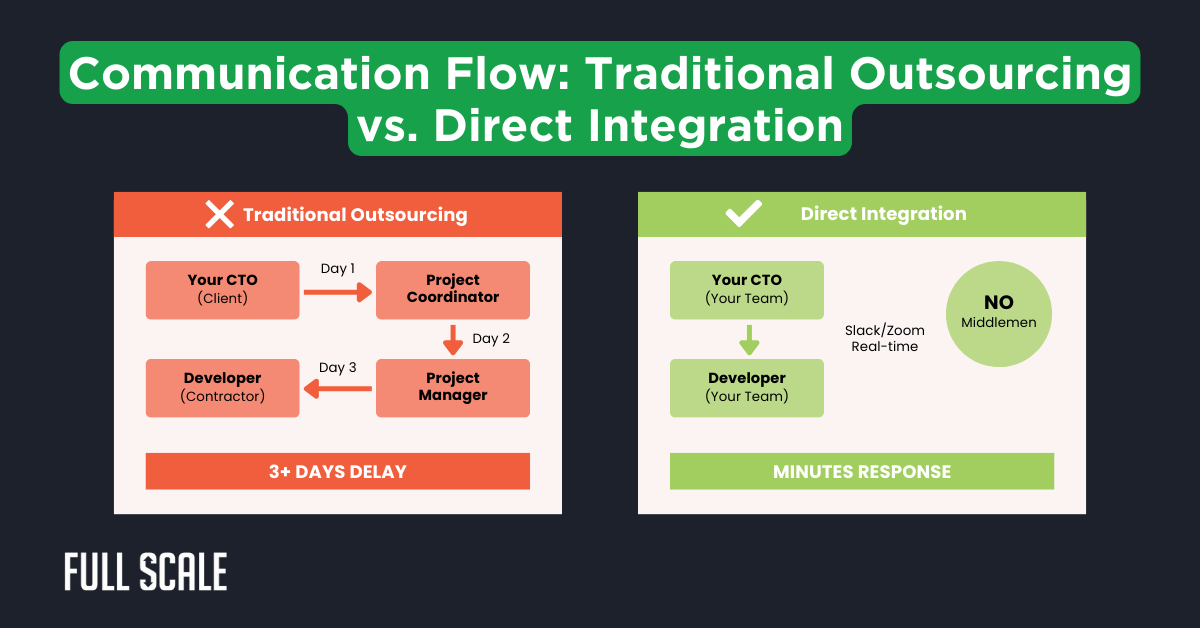
When I dig deeper, here’s what actually happened: They hired through an agency that stacked three project managers between them and developers. Communication took three days instead of three minutes. Developers rotated off projects without notice. Code quality varied wildly because nobody actually understood the product.
Yeah, that sounds awful. But that’s not offshore development failing.
That’s a broken outsourcing model destroying what could have been a great team.
What You'll Learn:
- Why every "offshore challenge" is actually a project outsourcing problem
- The model difference that determines offshore success or failure
- How Direct Integration eliminates communication, quality, and retention issues
- Real data from 500+ developer placements on what actually works
What Really Causes Offshore Software Development Challenges?
Offshore software development challenges occur when companies use traditional project outsourcing models with multiple layers of project managers separating them from developers. This creates communication delays, quality inconsistencies, and high turnover. Staff augmentation with direct integration eliminates these middlemen, giving you control and continuity that traditional outsourcing lacks.
The offshore software development industry has a dirty secret.
Most offshore software development challenges have nothing to do with developer skill. They have nothing to do with time zones or English proficiency. They’re not caused by cultural differences or geographic distance.
They’re caused by the model.
Project outsourcing creates an artificial barrier between you and your development team. You communicate through coordinators. Developers work on three other projects simultaneously. Nobody owns your codebase long-term. Quality control happens offshore, not in your CI/CD pipeline.
Staff augmentation with direct integration flips this entirely. Developers join your team directly. They attend your standups. They work in your Slack. They commit to your repositories. They become extensions of your engineering organization.
The difference isn’t subtle. It’s transformational.
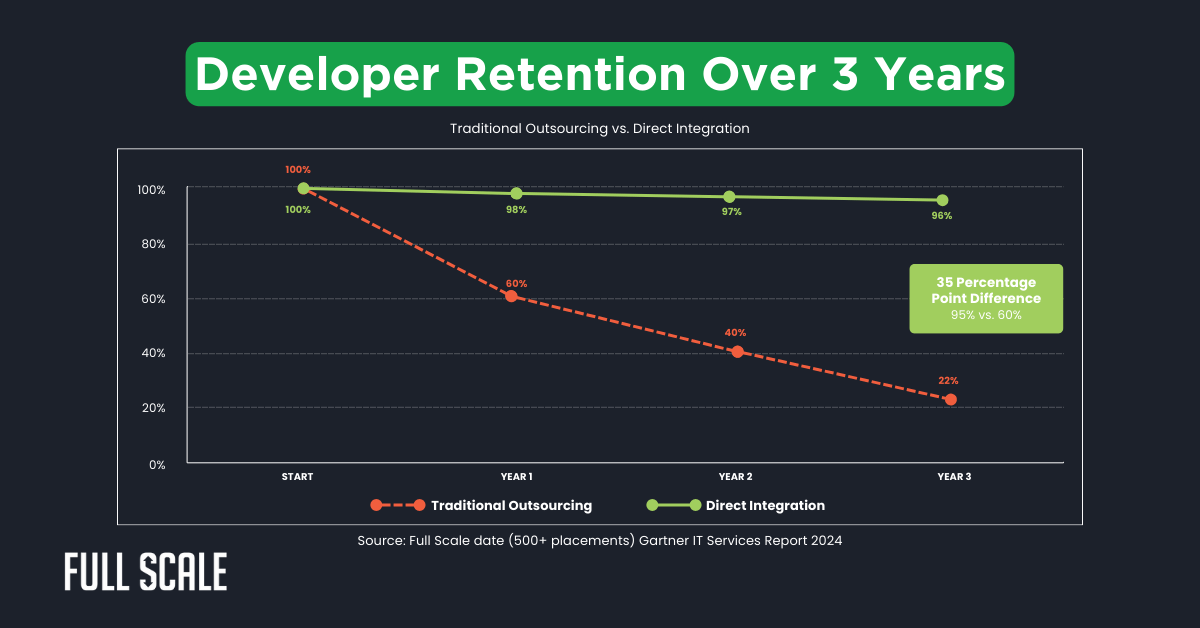
According to Full Scale’s analysis of 500+ developer placements, companies using Direct Integration maintain 95% developer retention over three years. Traditional project outsourcing? Industry average sits at 60% annual retention (Gartner IT Services Report, 2024).
That’s not a marginal improvement. That’s a completely different outcome from a completely different approach.
The 8 Offshore Software Development Challenges That Aren't Actually Offshore Problems
Challenge 1: Communication Barriers
What people believe: “Offshore teams can’t communicate effectively because of language barriers and distance.”
The real problem: Project outsourcing creates communication bottlenecks through PM middlemen, not developer capability issues.
Here’s what actually happens with traditional outsourcing.
You send a question on Monday morning. It goes to a project coordinator. They batch it with other questions. They discuss it in their Tuesday team meeting. They formulate a response on Wednesday. You get an answer on Thursday afternoon.
By then, you’ve already moved on. You solved it yourself. Or worse, you made a decision without critical information.
That’s not a communication problem. That’s one of the most common offshore software development challenges created by the model.
With Direct Integration, your offshore developers sit in your Slack channels. They respond in minutes, not days. They join your standup via Zoom at 9 AM your time. They ask clarifying questions in real-time.
One Full Scale client told me their Philippines team communicates faster than their remote U.S. developers. Why? Because the model demands immediate integration, not scheduled coordination.
Challenge 2: Quality Control Issues
What people believe: “Offshore code quality is inherently lower than onshore development.”
The real problem: Developers juggling multiple projects simultaneously can’t produce consistent quality for any client.
Traditional outsourcing treats developers as shared resources.
Your “dedicated team” spends mornings on your project. Afternoons on someone else’s. Fridays on maintenance work. When urgent requests come in, they context-switch between three codebases daily.
Nobody can write excellent code under those conditions. Not offshore developers. Not U.S. developers. Not anybody.
Direct Integration eliminates this offshore software development challenge entirely. Your developers work exclusively on your codebase. They understand your architecture deeply. They participate in your code reviews. They follow your style guides and testing standards.
Quality becomes a function of your processes, not their workload management.
Challenge 3: Time Zone Management
What people believe: “Time zone differences make offshore collaboration impossible for real-time work.”
The real problem: One of the common offshore software development challenges: outsourcing firms prioritize their local working hours over client overlap needs.
Project outsourcing typically runs on the vendor’s preferred schedule.
The Philippines team works 9 AM-6 PM Manila time. Your U.S. team needs them at 9 AM Pacific. Too bad. The vendor optimized for their convenience, not yours.
Staff augmentation flips this power dynamic completely.
Your developers adjust their schedules to overlap with your core hours. Four to six-hour windows become standard. Morning standups? Your offshore team is there. Afternoon sprint planning? They’re available.
One of our FinTech clients runs their daily standup at 8 AM Pacific. Their Full Scale developers in Manila join at 11 PM their local time. Why? Because they’re integrated team members, not outsourced contractors.
GitLab’s 2024 Remote Work Report found that distributed teams with 4+ hours of daily overlap achieve 89% of in-office productivity while maintaining better work-life balance.
Challenge 4: High Turnover Rates
What people believe: “Offshore developers leave frequently because they’re just looking for their next opportunity.”
The real problem: Project outsourcing treats developers as disposable contractors with no career growth path or stability.
The outsourcing model creates turnover by design.
Developers know they’re contractors. They know projects end. They know they’ll be reassigned to whoever needs bodies next. So they keep one eye on the job market, looking for their next W-2 position.
Can you blame them?
Direct Integration solves this through employment stability and career development.
Full Scale developers receive regular raises, clear promotion paths, and long-term project continuity. They’re not worried about their next assignment. They’re invested in their current codebase and team.
The data proves it. Full Scale maintains 95% three-year retention versus the industry average of 60% annually (Gartner, 2024). That’s 35 percentage points of stability.
Calculate what that means for institutional knowledge, onboarding costs, and project continuity. Learn more about our developer retention strategies.
According to the Society for Human Resource Management (SHRM), replacing a developer costs 50-200% of their annual salary when factoring in recruitment, onboarding, and productivity loss.
Challenge 5: Cultural Misalignment
What people believe: “Offshore teams don’t understand our company culture, making true collaboration impossible.”
The real problem: Cultural misalignment is an offshore software development challenge only when developers report to offshore companies and never integrate into your culture—because they’re not supposed to.
In project outsourcing, developers work for their employer, not you.
They follow their company’s culture. They participate in their organization’s rituals. Their loyalty flows to whoever pays their salary, which isn’t you.
You’re the client. They’re the vendor. That relationship dynamic prevents cultural integration regardless of geography.
Direct Integration embeds developers in your culture from day one.
They attend your all-hands meetings. They participate in your team celebrations. They contribute to your engineering values discussions. They’re not “the offshore team”—they’re the backend team, the mobile team, the platform team.
Geography stops mattering when organizational membership is real. Many CTOs still believe outdated myths about offshore team culture that prevent them from building great distributed teams.
Challenge 6: Intellectual Property Concerns
What people believe: “Offshore development creates IP risks because contracts and enforcement are unclear.”
The real problem: IP protection is a common offshore software development challenge because outsourcing firms retain code ownership until final payment, creating leverage and ambiguity.
Traditional outsourcing contracts protect the vendor, not you.
Work-for-hire clauses have exceptions. Payment schedules create transfer timelines. Modifications require amendments. The code you’re paying for exists in legal limbo until all contractual obligations are met.
Lawyers love this. CTOs hate it.
Staff augmentation through U.S. entities eliminates this entirely.
Full Scale operates under U.S.-based contracts with immediate IP transfer. Code belongs to you the moment it’s written. No payment schedule dependencies. No jurisdictional complexity. Clean ownership from commit zero.
Your developers are subject to your IP policies. Your code stays in your repositories. Your lawyer sleeps better.
Challenge 7: Hidden Costs
What people believe: “Offshore development saves money until hidden costs eat away at the savings.”
The real problem: Hidden costs represent one of the most damaging offshore software development challenges: project management overhead, scope creep, and rework from miscommunication destroy cost advantages.
Traditional outsourcing stacks invisible costs.
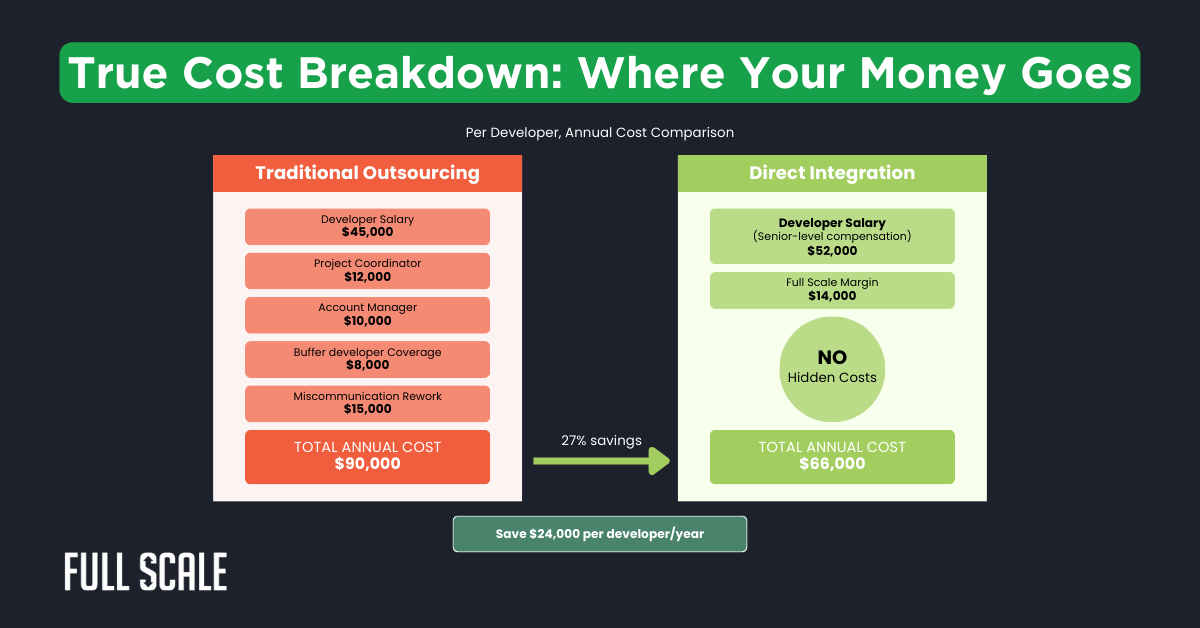
You pay for project coordinators you don’t need. You pay for weekly status meetings that produce slide decks. You pay for “buffer developers” who cover when your assigned team is busy. You pay premium rates for basic talent.
Then add the hidden costs. Rework from specification misunderstandings. Delays from communication gaps. Technical debt from developers who aren’t invested long-term.
Suddenly, that “60% cost savings” becomes 30%. Or breaks even. Or costs more when you factor in opportunity cost.
Direct Integration delivers transparent, predictable costs.
You pay developer salaries plus a reasonable margin. No PM markup. No surprise fees. No scope management overhead. Full Scale’s pricing shows exactly what you’re paying for: developer time.
One SaaS company calculated 60% savings versus their U.S. hiring plan. Three years later? Still 60%. No hidden cost creep, no surprise invoices, no budget adjustments.
Our detailed offshore vs. local developer cost breakdown shows the real total cost of ownership, including hidden expenses most companies overlook.
Challenge 8: Lack of Control
What people believe: “Outsourcing means losing control over development roadmap, priorities, and technical decisions.”
The real problem: Control issues are among the most frustrating offshore software development challenges because when the vendor manages developers, you’re a client making requests—not a manager directing your team.
Project outsourcing inverts the reporting structure.
Developers report to their project lead. The project lead reports to their delivery manager. The delivery manager reports to your account executive. You send priorities through this chain. They come back as estimates, schedules, and “recommendations.”
That’s not control. That’s negotiation.
Staff augmentation gives you actual management authority.
Your tech lead directs the developers. Your CTO sets technical standards. Your product team prioritizes the backlog. No intermediaries translating your vision through the organizational telephone.
One of our clients described it perfectly: “I forgot they weren’t local employees. They just… work like everyone else on the team. I assign tickets. They close them. That’s it.”
That’s control.
🎯 The 8 Offshore Software Development Challenges
Click each challenge to see why the model fails—not the developers
Ready to Solve These Challenges?
Build your offshore team with Full Scale's Direct Integration Model—no middlemen, no surprises, just great developers.
Get Started Today →How Direct Integration Solves Offshore Software Development Challenges
Here’s how each offshore software development challenge manifests differently across both models:
| Challenge | Project Outsourcing | Staff Augmentation (Direct Integration) |
|---|---|---|
| Communication | 2-3 day response times through PM middlemen | Real-time communication in your Slack/Teams |
| Quality Control | Developers split across 3-4 projects simultaneously | Dedicated full-time focus on your codebase |
| Time Zones | Vendor's preferred schedule (no overlap optimization) | Developers adjust to your core business hours |
| Retention | 60% annual turnover (industry average) | 95% retention over 3 years (Full Scale data) |
| Cultural Fit | Developers follow vendor's culture and values | Full integration into your company culture |
| IP Protection | Complex contracts with delayed IP transfer | U.S.-based contracts with immediate ownership |
| Costs | Hidden PM fees, scope creep, rework expenses | Transparent hourly rates, no hidden costs |
| Control | You make requests through account management | You directly manage your development team |
The pattern is clear.
Every challenge has the same root cause. The project outsourcing model creates artificial barriers, divided loyalties, and misaligned incentives. Remove the model, remove the problems.
Direct Integration isn’t a better version of outsourcing. It’s a fundamentally different approach to offshore development. Read our detailed comparison of staff augmentation vs. project outsourcing.
Real-World Example: How CloudMetrics Solved All 8 Offshore Software Development Challenges
CloudMetrics (name changed for confidentiality) is a B2B SaaS platform providing analytics for e-commerce companies. They needed to scale from five developers to fifteen within six months.
Their Previous Offshore Experience
CloudMetrics tried project outsourcing through a large offshore development firm in 2021.
They hit every challenge: Communication took days. Quality varied wildly. Turnover every four months. Hidden costs killed their budget. After eight months, they brought development back onshore.
Cost: $340,000 spent with minimal shipping code. Team morale crushed. CTO was nearly fired.
The Full Scale Approach
In early 2023, CloudMetrics tried again—this time using Direct Integration through Full Scale.
Communication: Daily standups with four-hour overlap. Developers in the company Slack. Real-time code reviews. Zero communication delays.
Quality: Same code review process as local hires. CI/CD integration from day one. Architecture discussions via Zoom. No quality complaints in 18 months.
Retention: All six original Full Scale developers are still on the team. Three promoted to senior positions. One now leads the mobile team.
Cost: $450,000 annual savings versus their original local hiring plan. Zero hidden fees. Budget is predictable month to month.
“This isn’t offshore development,” their CTO told me. “This is just our engineering team. Some happen to live in Manila instead of San Francisco.”
That’s the difference the model makes. Read more client success stories.
When Offshore Development Isn't the Right Choice
Direct Integration isn’t for everyone.
Some companies genuinely need local-only development. If you’re in these situations, offshore probably isn’t right yet:
- Pre-product-market-fit startups are still figuring out what to build. Rapid in-person iteration often works better until the product stabilizes.
- Companies without defined processes. If your U.S. team doesn’t have clear coding standards, testing protocols, or deployment procedures, offshore integration struggles.
- Industries requiring constant in-person client collaboration. If developers must be in client offices daily, geography matters more than model.
- Teams lacking remote work experience. If your company hasn’t figured out distributed collaboration for U.S. remote workers, adding offshore complexity multiplies problems.
But if you have clear requirements, established processes, and comfort with remote collaboration? The model matters infinitely more than the location.
Solving Offshore Software Development Challenges: Stop Blaming Geography
The offshore software development challenges conversation needs to change.
We keep having the wrong debate. “Is offshore risky?” is the wrong question. The right question: “Which offshore model creates the outcomes I need?”
Project outsourcing creates every offshore software development challenge you’ve heard about. Communication delays. Quality inconsistencies. High turnover. Hidden costs. Lack of control.
Direct Integration solves all of them. Not by changing developer capabilities. Not by overcoming geographic challenges. By removing the structural barriers that traditional outsourcing creates.
Full Scale’s 95% retention rate across 500+ developer placements proves this. Geography didn’t change. Developer capabilities didn’t change. The model changed.
And outcomes changed completely.
Your next developer hire doesn’t have to be local. It just has to use the right model.
Why Partner with Full Scale?
- Direct Integration Model: No project manager middlemen between you and developers
- 95% Retention Rate: Developers stay 35 percentage points longer than the industry average
- 7-Day Start Times: Begin working with vetted developers in one week, not three months
- U.S.-Based Contracts: Clear IP ownership and legal simplicity
- Transparent Pricing: No hidden fees, PM markups, or surprise costs
- 500+ Successful Placements: Proven track record across 60+ companies since 2017
Project outsourcing assigns developers to your project but they report to the vendor’s project manager. Staff augmentation embeds developers directly into your team where they report to your technical leadership. This eliminates middlemen, reduces communication delays, and gives you direct management control over development priorities and technical decisions.
With Full Scale’s Direct Integration approach, technical onboarding takes seven to fourteen days. This includes access setup, codebase familiarization, and team integration. Compare this to traditional hiring’s sixty to ninety days or project outsourcing’s four to twelve week kickoff processes.
Yes, when using Direct Integration. Developers participate in your all-hands meetings, team celebrations, and engineering rituals. They follow your values and communication norms. The key is treating them as full team members, not external contractors. Geography becomes irrelevant when organizational membership is genuine.
Full Scale operates under U.S.-based contracts with immediate IP transfer. All code belongs to you the moment it’s written, with no payment schedule dependencies or jurisdictional complexity. Developers are subject to your IP policies and NDAs like any employee.
The model determines success. Project outsourcing creates communication barriers, divided loyalties, and structural problems that lead to failure. Staff augmentation with Direct Integration eliminates these barriers by embedding developers directly into your team. Same geography, different model, completely different outcomes.