
India vs Philippines Outsourcing: What 4 Stackify Hires Taught Me (2026)

In this article
- Why India and the Philippines Both Show Up on Your Shortlist
- India vs Philippines Developer Costs (2026)
- What the Time-Zone Question Actually Misses
- Why Most Offshore Engagements Actually Fail
- Why I Picked the Philippines (After Trying Three Other Countries)
- Is offshore hiring in the Philippines exploitation?
- When India Actually Wins
- FAQ
- The Bottom Line
- Talk to Full Scale About Your Team
There are smart people all over the world. I’ve personally hired developers in Uruguay, Colombia, Russia, and the Philippines, and worked with engineers in Belarus, India, and Pakistan along the way. None of those teams failed because the developers weren’t smart. The ones that struggled struggled with one thing: communication. That fit is what separates offshore developers your team will actually want to work with from the ones they resent. The same trade-offs sharpen when you’re hiring .NET developers in India for a Microsoft-stack team in particular.
So when a CTO asks me whether they should hire offshore software developers in India or the Philippines, the country isn’t actually the question. Still, after hiring across four countries, my honest answer is that the best offshore developers are in the Philippines. The question is which team they can actually build a working relationship with. Which one can speak up when the spec is wrong. Which one will push back instead of nodding through a meeting. That’s the answer that decides whether the engagement works. For the hiring-side version of this, see how to hire developers in India without getting burned.
This post walks through India vs Philippines outsourcing the way I’d talk a founder through it over coffee. Real 2026 costs, real communication tradeoffs, and what actually goes wrong when offshore goes wrong. For 2026 rate ranges across every major offshore destination, my full breakdown is at comparing offshore software development rates by country. If you are weighing the whole field, our guide to the best countries for offshore software development ranks the major destinations.
Why India and the Philippines Both Show Up on Your Shortlist
India is the easy answer if you need volume. The country has the largest developer base in the world. GitHub already counts India as the largest open-source contributor base on earth and projects it passes the US entirely by 2030, at 57.5 million developers. Add the lowest rates of any major offshore destination, and the most mature staffing infrastructure on the planet. If you need to put 50 engineers on a project in 90 days on a specific tech stack, India can do it. The Philippines can’t match that scale. That’s an honest concession that almost no Philippines-vs-India post makes.
The Philippines plays a different role on the same shortlist. The country has spent the last 20 years building one of the deepest IT talent pools in Asia, and it consistently ranks as one of the most English-fluent non-native English countries in the world. That talent base is what’s behind so many Philippine outsourcing companies today. Manila and Cebu have mature tech infrastructure, decades of BPO experience, and a workforce that grew up consuming American culture. Most companies hiring offshore don’t need volume at all. They need a small team they can talk to, that sticks around, and that integrates with their existing engineers. That’s where the comparison gets interesting.
India vs Philippines Developer Costs (2026)
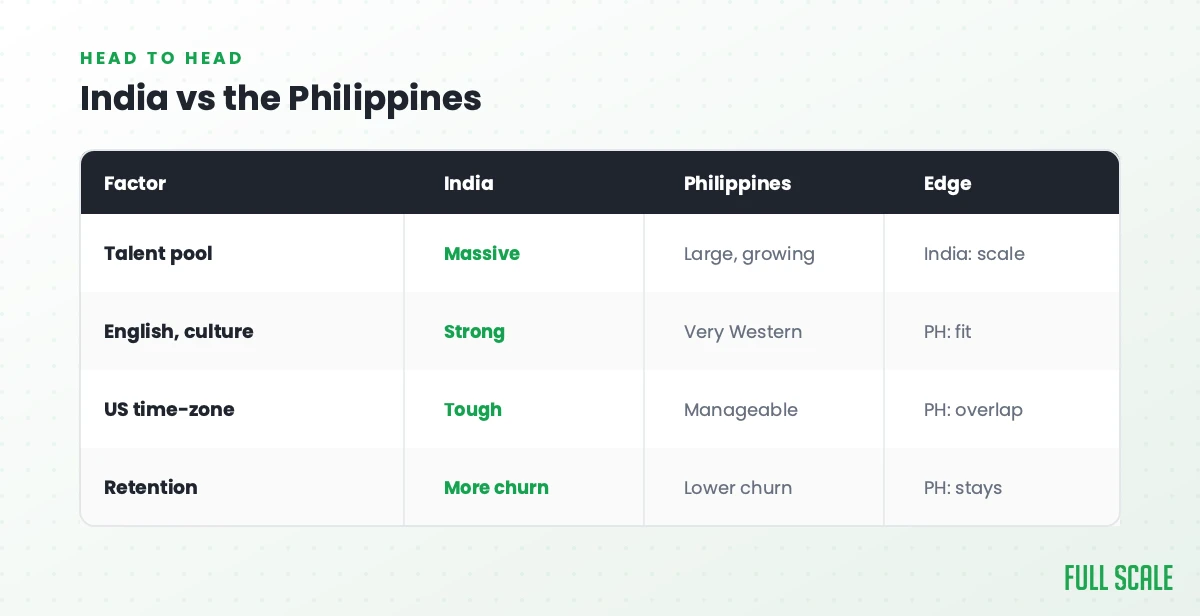
The honest version: developer rates in India are still the lowest of any major offshore destination, but the gap to the Philippines is smaller than it used to be. What used to be a clean 40 percent gap is now closer to 15 to 20 percent on senior roles, and once you include retention, the math reverses for most companies.
| Category | India | Philippines |
|---|---|---|
| Senior dev hourly rate (2026) | $30-$55/hour | $30-$40/hour (Full Scale senior PH rate) |
| Cost reduction vs US rates | 55-80% | 50-70% |
| English proficiency (EF EPI) | Ranked 74th, low-proficiency band (2025) | Ranked 28th globally, high-proficiency band, 2nd in Asia (2025) |
| Time zone | UTC+5:30; 9.5-12.5 hours from US | UTC+8; works half-day overlap, full US hours, or async |
| Talent pool depth | World’s largest developer base (57.5M projected by 2030); unmatched scale | Smaller pool; deep enough for most companies, narrow for 50+ engineer hires |
| Retention (industry average) | Top-firm attrition settled near 13% (FY26); the real friction is 60-90 day notice periods and offer reneging | 93%+ at Full Scale; cultural emphasis on long-term loyalty |
| IP protection | Improving; large enterprise-grade firms strong; smaller vendors variable | Strong legal framework, follows international data standards |
The honest version: developer rates in India vs the Philippines aren’t as far apart as the old narrative suggests, and on senior roles they overlap. What is different is what you’re paying for. In India, the bigger firms are optimized for scale and process. In the Philippines, the model is more often optimized for retention and direct communication. Neither is universally right. The right one depends on what your team actually needs. If you want the raw numbers behind that, here is what a senior developer in the Philippines earns at each level.
If you want the full math on what offshore developers actually cost when you include retention, ramp-up, and overhead, that’s all in the offshore cost analysis I walk founders through. If you’re comparing to what a US developer actually costs after benefits and overhead, the in-house alternative isn’t what most CTOs think.
What the Time-Zone Question Actually Misses
India and the Philippines both sit on the far side of the world from US business hours. India is 9.5 to 12.5 hours off, the Philippines is 12 to 15 hours off. People treat that as a meaningful difference. It usually isn’t.
Full Scale staffs three common patterns for clients who hire dedicated developers in the Philippines:
- Half-day overlap (most common). Filipino engineers work late afternoon to midnight Philippines time, which gives 3 to 4 hours of overlap with US working hours. Most clients find this is plenty for code review, standups, and product decisions.
- Full US hours (graveyard shift). Some engineers work 9 PM to 5 AM Philippines time and are on the same business day as a Kansas City team. We use this for roles that need real-time customer collaboration.
- Async-first. Daily standup overlap only, then independent ship-and-pick-up-the-next-task work the rest of the day. Works well for senior engineers and well-scoped tickets.
Most Full Scale customers find half-day overlap is plenty. India teams operate on similar patterns at the better firms. The country is incidental. What matters is the hours your team actually works.
This is the part most posts on India vs Philippines outsourcing skip. They treat the geographic time zone as fixed when it isn’t. An India team on a half-day overlap shift and a Philippines team on the same overlap shift operate the same way from your perspective. For more on when nearshore actually wins and when offshore wins, see the nearshore-vs-offshore question for English-speaking US clients.
Why Most Offshore Engagements Actually Fail
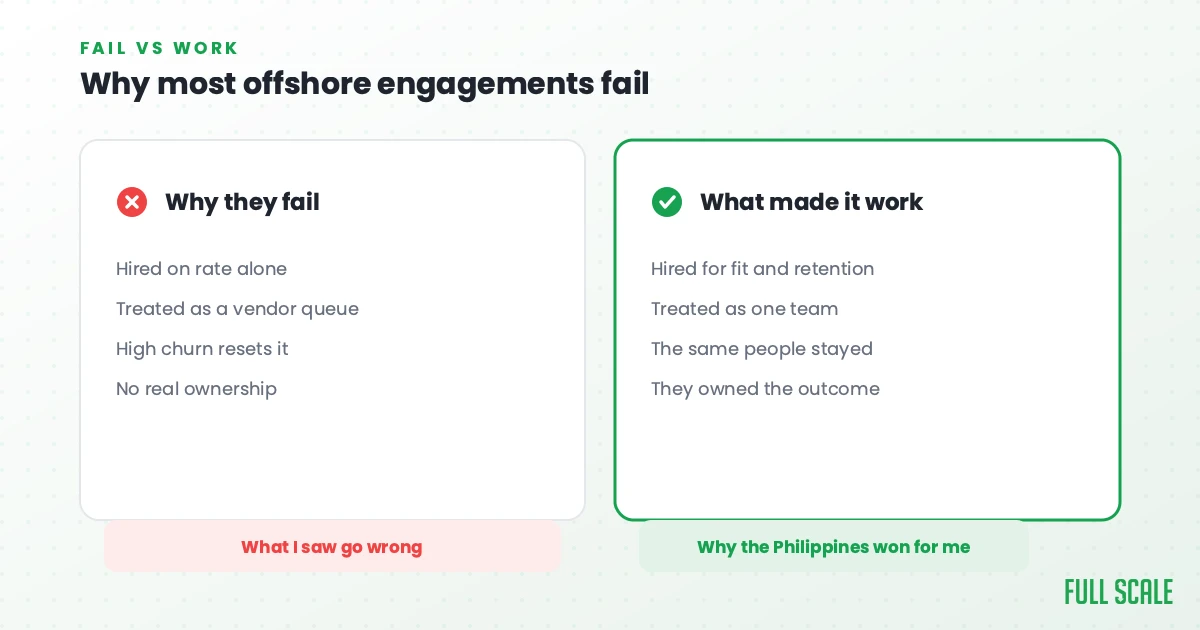
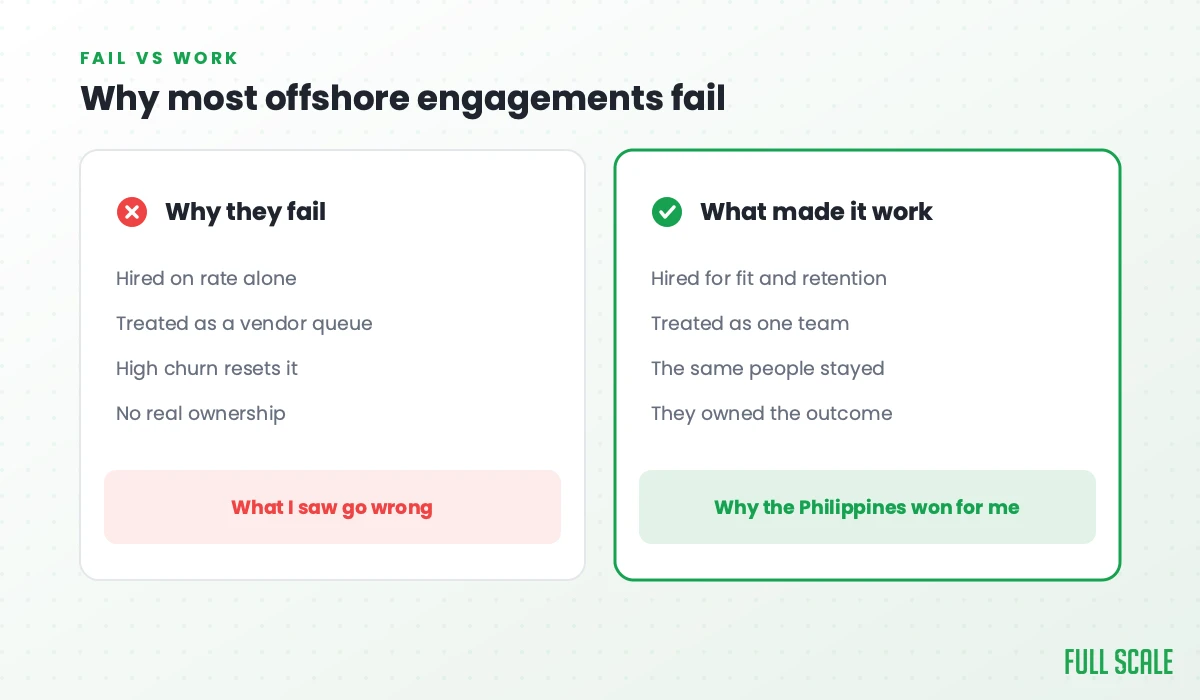
Software development is about communication more than anything else. That’s where most offshore engagements break. Talent is rarely the problem. I’ve talked to founders running teams in India where they’ve only ever spoken to one person, the technical project manager, while every other developer hides behind that person. Sometimes it’s a language gap. Sometimes it’s a cultural rule about who is allowed to talk to the client. Either way, the client ends up with a team they can’t actually communicate with, and a middleman in the way of every decision. I dug into the full evidence on why outsourcing software development to India fails so often in a separate post, most of it from India’s own institutions.
This pattern shows up everywhere, but it shows up more often with the larger India staffing firms because that model is how they scale. Their pitch is that you outsource the management problem, the PM handles it, you don’t need to talk to the engineers directly. The trade is that you lose every signal you’d get from a real engineering relationship. You can’t tell when a developer is struggling. You can’t tell when the architecture choice is wrong. You can’t tell when someone is two weeks from leaving. Everything goes through one person.
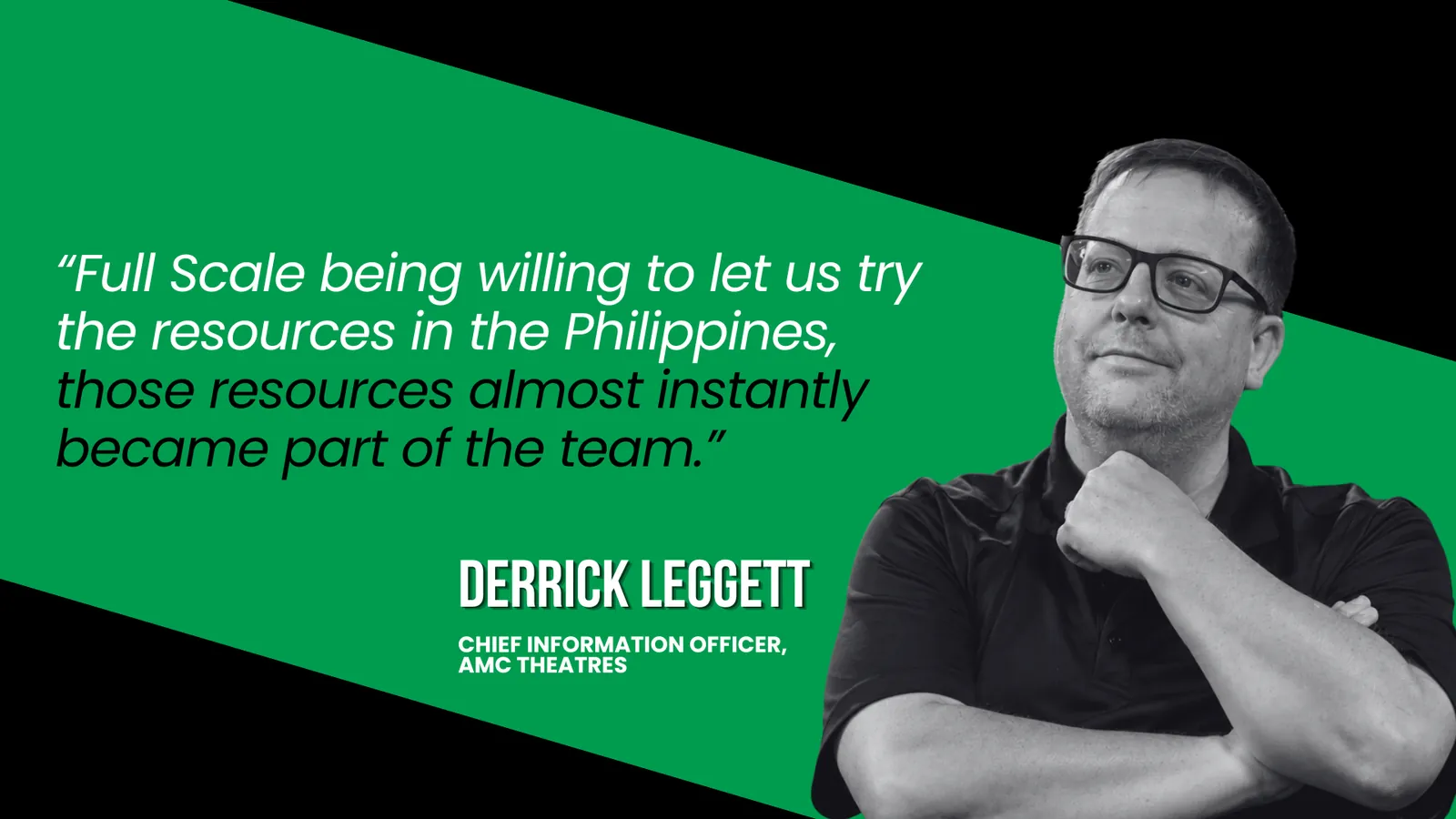
At Full Scale, the goal is the opposite. Our model for offshore software development in the Philippines means the developers we place are on the client’s Slack, in the client’s standups, and accountable to the client’s product manager, not to a Full Scale internal PM relaying decisions. There’s no middleman. AMC Theatres is the best example I can point to. The developers we placed in the Philippines are treated as full AMC engineers, not contractors. Same code review, same Slack, same standards as the Kansas City team. That is what makes offshore actually work.
Why I Picked the Philippines (After Trying Three Other Countries)
Before Full Scale, I ran engineering at Stackify and hired developers in four countries. Uruguay was a great team that gave us a proxy product owner who could carry the vision when I couldn’t. Colombia was a smaller engagement, strong technical talent, time-zone-aligned with Kansas City, easy to coordinate. Russia, starting in St. Petersburg in 2012, was my first offshore hire and the work was excellent. The Philippines, starting in 2018, grew to 20+ developers and was a meaningful part of Stackify’s 2021 exit.
I didn’t hire in India directly. I worked with developers from India through other engagements over the years, and the pattern was consistent: strong technical skills, less direct communication style, more friction on the spec-clarification step that determines whether features get built right the first time. None of that is a knock on Indian engineers as people. It’s a structural observation about how the work flows when the engineer doesn’t push back, doesn’t ask the dumb question, and doesn’t say “I don’t understand” when they don’t understand.
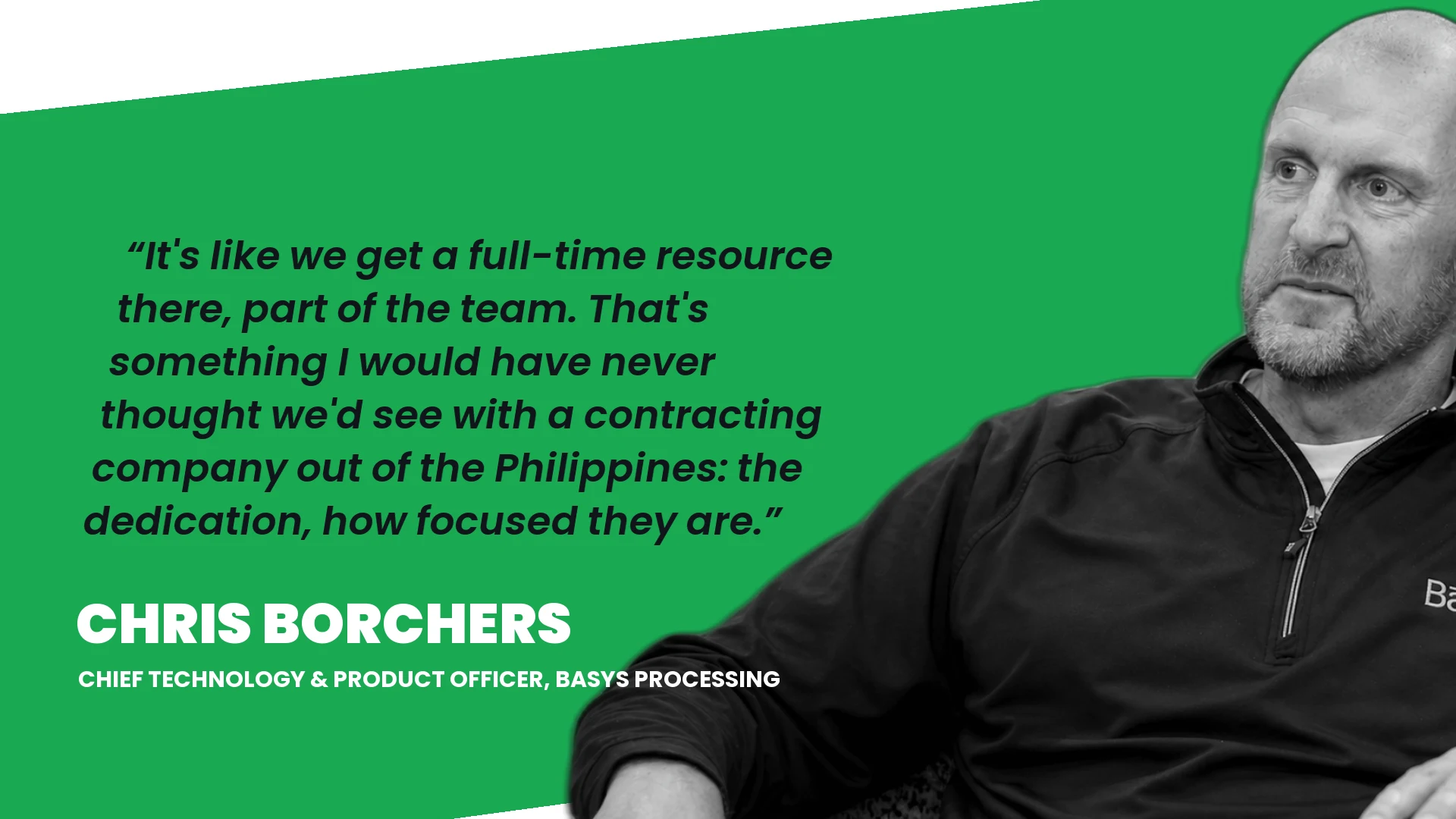
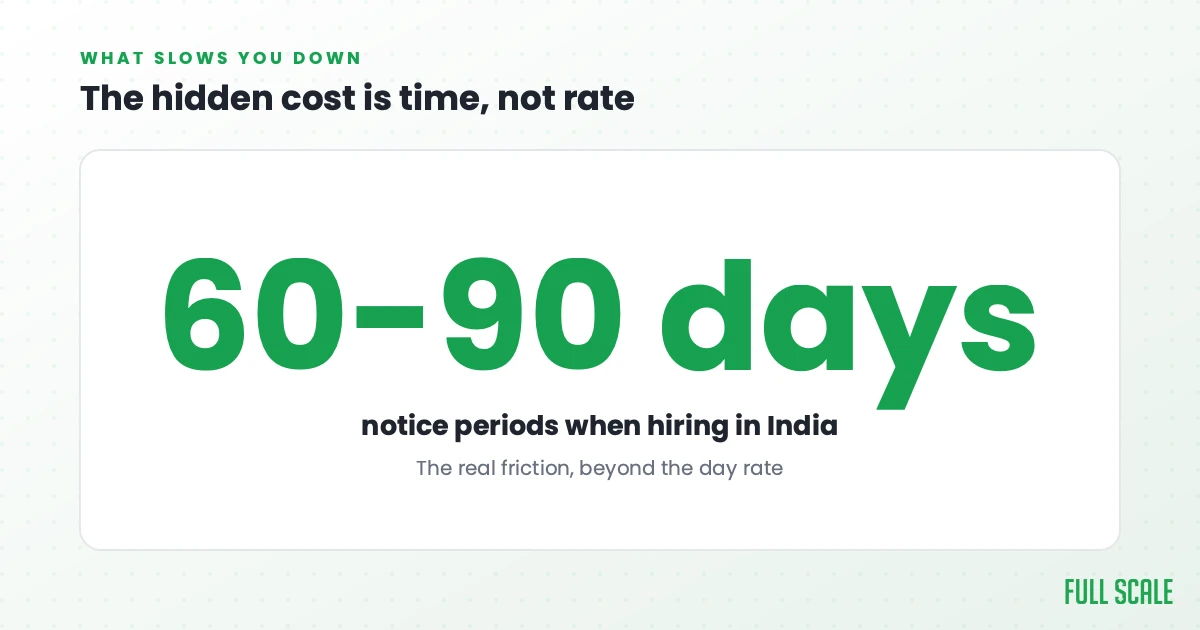
The hiring mechanics added their own friction. Indian IT runs on 60-to-90-day notice periods, and offers fall through there in a way US hiring never prepared me for: a candidate accepts, you wait out the notice period, and partway through they take a counter-offer and never start. We worked with some very talented people in India at Stackify, but after a couple of rounds of that you stop trusting the process, and we stopped trying to grow there. Headline attrition at the big Indian firms has actually settled back to around 13 percent, which is respectable. The mechanics are what wear you down.
Full Scale chose the Philippines for one reason, and it wasn’t price. English fluency, communication culture, and remote-work temperament line up there in a way they don’t anywhere else. There’s no language barrier. Filipino developers grow up consuming American culture, so they understand the references, the working style, the rhythm of a US team. Their communication is top notch. Filipinos dominate service jobs around the world for exactly that reason, and the same traits carry directly to software.
I give the Filipino developers on the Full Scale team most of the credit for why Full Scale has been as successful as it has. I mean that literally. After hiring developers in four countries at Stackify and many more at Full Scale, the Philippines is where the communication piece consistently shows up.
Jason Flowers, Head of Software Engineering and DevOps at AG Mednet, reached the same conclusion the hard way. He had offshored to India earlier in his career, where the hours rarely lined up, and came to the Philippines a skeptic. Now he tells other leaders:
It’s right for folks who’ve failed at offshoring before. They haven’t tried Full Scale in the Philippines. Give it a try again.
Jason Flowers, Head of Software Engineering and DevOps at AG Mednet, on working with Full Scale
Is offshore hiring in the Philippines exploitation?
It is a fair question. I answer it directly, including with my own family’s numbers, in the ethics of offshoring.
When India Actually Wins
I’m not going to pretend the Philippines is the right answer for every team. Here’s where India has a real case.
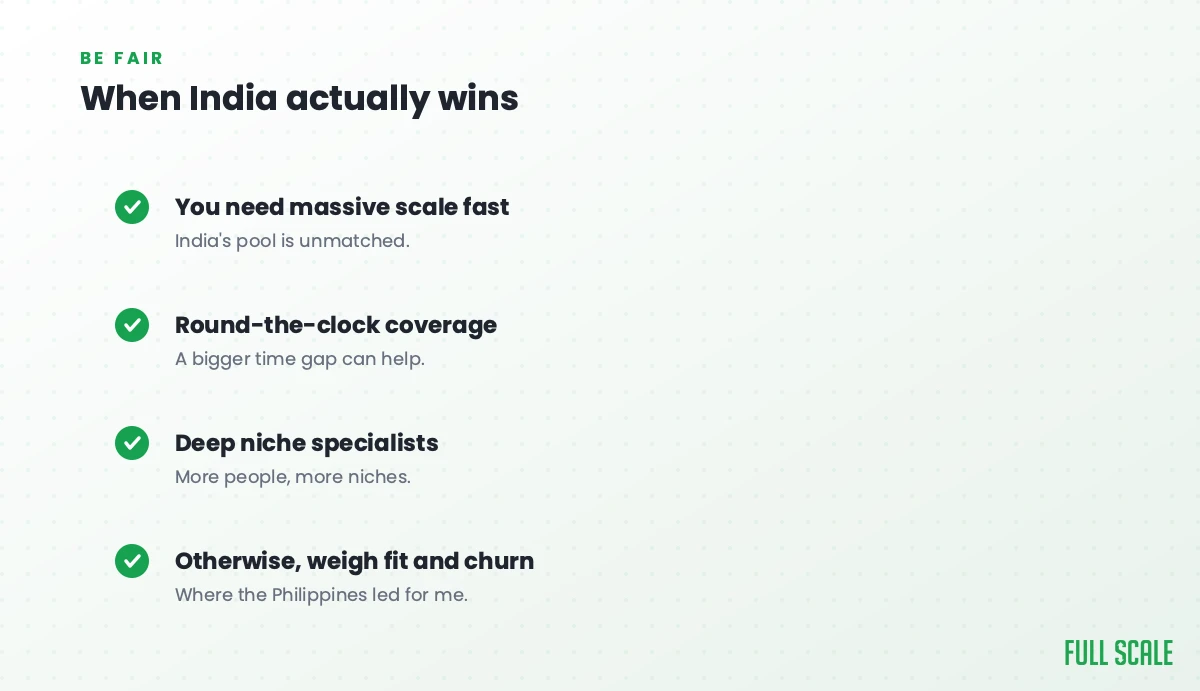
If you need to scale to 50, 100, or 500 engineers on a specific tech stack in a tight timeline, India is the only offshore market that can do it. The staffing depth is unmatched, and it is real at the top end too: 506 of the Forbes Global 2000 now run their own capability centers in India, employing 2.36 million professionals. If your company is enterprise-scale and needs SOC 2, ISO 27001, and the rest of the compliance stack from the offshore firm itself, the big India firms have spent 20 years building that infrastructure and run it at scale. If you have an existing India office, an India-resident leadership team, or a customer base that expects India coverage, the cultural and operational continuity matters more than country-comparison ranking pages can capture. And if you’re building something for India as a market, you want engineers who understand the user.
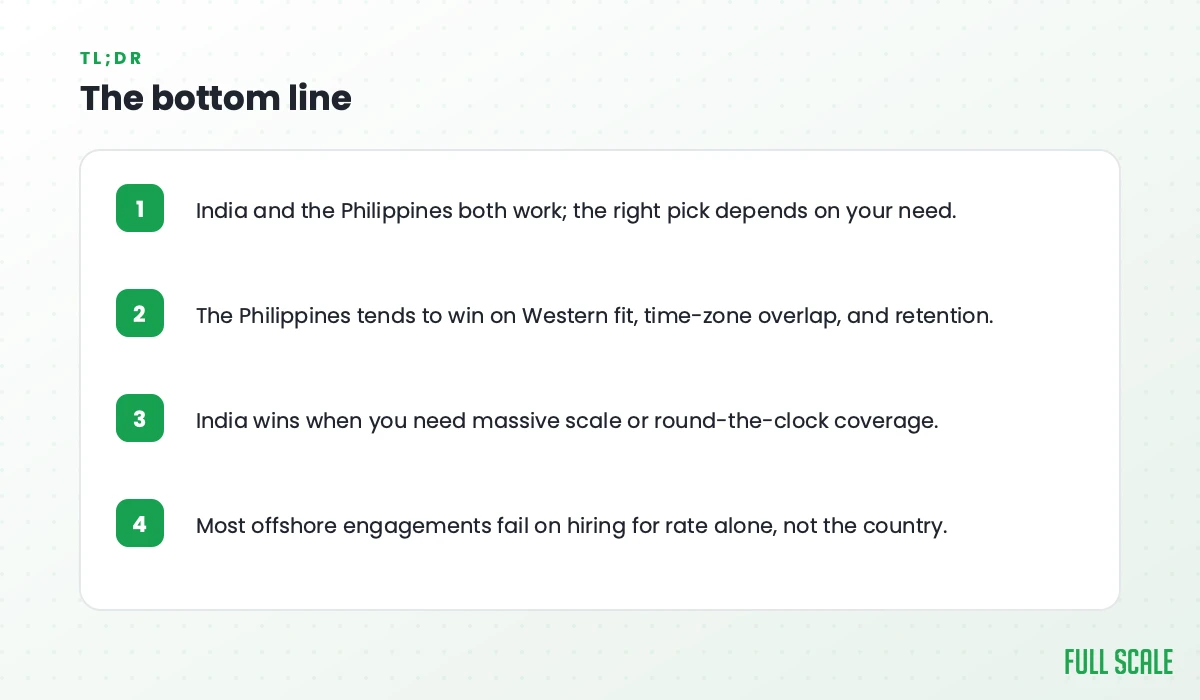
These are real cases. For most product engineering work, where the team is 5 to 30 engineers, retention matters, and the team needs to integrate cleanly with US engineers on Slack, the Philippines wins for me on communication and retention. For high-scale, enterprise-compliance, or India-market work, India is the right call.
FAQ
Is the Philippines really cheaper than India for software development?
Not by as much as it used to be. Senior Philippines developers at Full Scale run $30 to $40 an hour. Senior India developers at quality firms run $30 to $55, depending on the firm and the role. The honest comparison is no longer about which is cheaper on the hourly rate. It’s about which team retains longer, communicates more directly, and integrates more cleanly with your in-house engineers. When you include retention and ramp-up costs, the Philippines tends to come out ahead on total cost of ownership for smaller, long-term teams. For 50+ engineer scale, India’s volume advantage offsets the per-developer retention gap.
Will I have communication issues with Filipino developers vs Indian developers?
English proficiency in the Philippines ranks 28th globally on the 2025 EF English Proficiency Index, in the high-proficiency band. India ranks 74th, in the low band. But raw English scores are only half the story. Filipino developers grew up on American media, US tech blogs, and Silicon Valley work culture, so the shared context layer that most ranking pages can’t measure is what actually makes the communication land. Indian developers can communicate in English fluently, especially in top-tier firms, but the cultural-reference layer and the directness of asking “I don’t understand” varies more across the Indian engineering workforce.
How does outsourcing India vs Philippines work on time zones?
India is 9.5 to 12.5 hours from US business hours. The Philippines is 12 to 15 hours off. Both sit on the far side of the world. Full Scale staffs three patterns for the Philippines team: half-day overlap (the most common, 3 to 4 hours of overlap with US hours), full US hours (graveyard shift), and async-first. The better India firms run similar patterns. The geographic time zone is incidental. The schedule the team actually works on is what matters, and that’s a vendor decision, not a country one.
Is offshoring India vs Philippines a better fit for long-term teams or short projects?
Both regions can support either model, but they tend to specialize differently. India’s larger staffing firms are optimized for project-based delivery at scale. Philippines firms like Full Scale are typically built for long-term offshore staff augmentation with a dedicated team that becomes part of your engineering org. If you’re building a long-term engineering team, see staff augmentation pricing in 2026 for what dedicated developer engagement actually costs.
What’s the typical hire developers Philippines vs India timeline?
Full Scale’s typical timeline from initial call to integrated developer is 2 to 3 weeks, with vetted candidates on a video call with your team inside the first week. India staffing firms vary widely. Boutique firms can match this. Larger staff aug firms in either region often run 4 to 6 weeks for full integration. The bottleneck is almost always the client’s interview pipeline, not the offshore firm’s bench.
The Bottom Line
India vs Philippines software development isn’t really a country comparison. It’s a question about whether you can build a long-term team that actually communicates. The Philippines wins for me because the communication piece lines up, and after running engineering through four offshore countries at Stackify, I have the comparison to back that up. India is a real option for specific cases: high-scale staffing, enterprise compliance, or India-market work. For most product engineering at the 5 to 30 engineer level, the Philippines wins. And once you pick the country, the decision gets simpler: which city in the Philippines you hire in matters less than the lists claim, because a remote team draws on the whole country at once.
If you’re ready to talk through what offshoring in the Philippines would look like for your specific team, schedule a call and we can map out the right model. For .NET-based products, offshore .NET developers in the Philippines bring both technical depth and the English fluency that makes remote collaboration work at the speed a software product needs.