Funding Resources for Tech Startups: What Each One Lets You Build

In this article
Most articles about funding resources for tech startups give you a list of places to get money and rank them by how much you can raise. The size of the check is the least useful way to compare them. Taking that money also starts the clock on when and whether to sell the company down the road.
For a software company, money is not the goal. It is fuel for the build. The biggest thing you will spend it on is engineering, and the thing that decides whether you make it is how much product you can ship before the money runs out. So for every source on this page, ask one question: what does it let me build, and who does it let me hire? Spend it well by first learning how to start a SaaS company without raising venture capital. Knowing where to get the money is only half of it; sidestepping the startup mistakes to avoid after getting funded is what decides whether the round lasts.
I have lived both sides of that question. I co-founded VinSolutions and bootstrapped it to $35 million in annual recurring revenue with no outside funding, through the 2008 to 2009 recession, before it sold for $147 million in 2011. I was a 22-year-old college dropout when I started. I have also watched founders raise big rounds and burn through them in eighteen months because they spent the money on the wrong engineering team.
The funding decision and the build decision are the same decision. This guide treats them that way.
Start with the build, not the bank
Before you compare funding resources, get clear on one number: how long the money buys you to keep building. That window is your runway, and engineers are what eat it. A single senior software developer in the US costs around $133,000 a year in base salary, and senior engineers run higher once you add the full cost of employment.
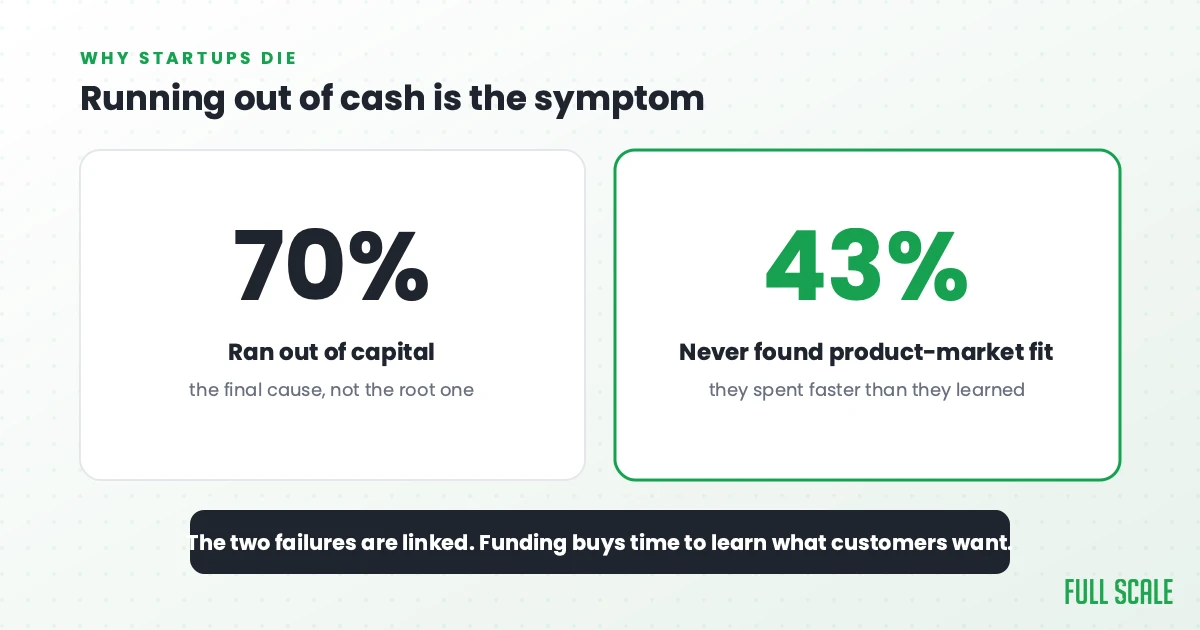
This matters because the most common way startups die is running out of cash before they find a market. When CB Insights studied more than 400 startups that shut down after 2023, 70 percent had run out of capital and 43 percent never found product-market fit. Those two failures are linked. You run out of cash when you spend it faster than you learn what customers want.
This is even more true in 2026. With AI startups pulling in record venture funding, investors now expect to see a working product and real users earlier than they used to. The money follows traction, and traction is something you build. That makes the question of what you can ship with your funding more important, not less.
So as you read each option below, hold two questions in your head. What does this source let me build right now? And how many months of engineering does it buy before I have to show results? Those answers matter far more than the size of the check.
The funding resources, judged by what they build
Here are the sources worth considering, each read through the same lens: what it lets you build, and who it lets you hire.
Your own revenue (bootstrapping)
Funding the company from sales is the most underrated option on this list, and it is the one I trust most. When the money comes from customers, every engineering decision gets sharper, because you are spending money you actually earned. Constraints force good calls. We scaled VinSolutions to $35 million in revenue on essentially one big database server plus read replicas, because adding capacity meant a purchase order and a drive to the data center. I built Full Scale the same way, with no outside money. That discipline is a gift, not a limit.
Bootstrapping will not work for every company. If you need a large team before you have a single dollar of revenue, it stalls. But for most software startups, it lets you build the core product, keep all the ownership, and answer to customers instead of investors. Start here and stay here as long as you can.
Personal savings and friends and family
Personal savings and money from friends and family is the first money most founders use, and it is fine for the earliest stage. It lets you build a prototype and prove to yourself that the idea has legs. The honest warning: this is money you cannot afford to lose, raised from people who cannot afford to lose it either. Spend it on the smallest thing that proves the concept, not on a full team.
Angel investors
Angels are individuals who write early checks, often before you have much traction. Good angels bring more than money. They bring introductions, hard questions, and a network. For the build, an angel round usually buys you enough to hire a small team and get to a real product. The trade is equity and a new set of expectations. Take angel money from people who understand software and will be patient while you build.
Venture capital
Venture capital is the option everyone writes about, and it is right for a narrow set of companies. VCs fund startups in exchange for equity, and they are betting on fast, large outcomes. If you have real traction and a market that rewards moving first, a venture round can be exactly the right call.
For most software founders, though, raising as much venture capital as you can is a trap. Big rounds create pressure to spend fast, and the fastest way to spend is to hire a large, expensive engineering team before you know what to build. I have watched that movie end badly more than once. A closed round is not a working business, and even an exit can disappoint. Be careful taking anything but cash when the time comes, because rolled equity and earnouts can come to nothing.
Grants and non-dilutive funding
Grants are the most overlooked funding resource for tech startups, and they cost you no ownership at all. America’s Seed Fund through the NSF invests up to $2 million in early-stage research and development and takes zero equity, so you keep full control of your company and your intellectual property. Federal and state programs listed on Grants.gov cover a wide range of technology work. The catch is time. Applications are slow and competitive. But for the right company, grant money buys real engineering runway without giving away a single share.
Crowdfunding
Crowdfunding, through platforms like Kickstarter and Indiegogo or equity portals like Wefunder, lets future customers fund the build before you ship. For the right product it does two jobs at once. It raises money without giving up equity, and it proves people will pay before you write much code. The cost is public pressure. You commit to a deadline and a feature set in front of an audience, and then you have to deliver. It works best when you have something visual to show and a clear audience to show it to.
Accelerators and incubators
A startup accelerator gives you a small amount of capital, mentorship, and a network, usually for a single-digit equity stake. Programs like Y Combinator and Techstars are the best known. For the build, the money itself is modest. The real value is the structure and the introductions, which can shorten the path to your next round. Treat the cash as a runway extension and the program as the actual product.
Loans, revenue-based financing, and equity-for-build deals
Bank loans and SBA-backed financing exist, though lenders are cautious with pre-revenue startups, and the debt has to be repaid on a schedule that competes with your runway. Revenue-based financing, where you repay from a share of sales, can work once you have real income. There is also the option of paying developers in equity instead of cash to stretch a thin budget, which trades ownership for headcount. Each of these funds the build without a traditional raise, and each has a real cost worth counting before you sign.
The mistake that kills the round
Once the money is in the bank, the danger shifts from raising it to spending it. The classic failure is simple. A founder raises a round, immediately hires a full in-house engineering team in an expensive US market, and watches the runway vanish before the product finds its footing.
The opposite mistake is just as costly. Hiring the cheapest developers you can find to save money usually means rework, missed deadlines, and a rebuild later. I call that cheapshoring, and it burns rounds just as fast, only slower to show up.
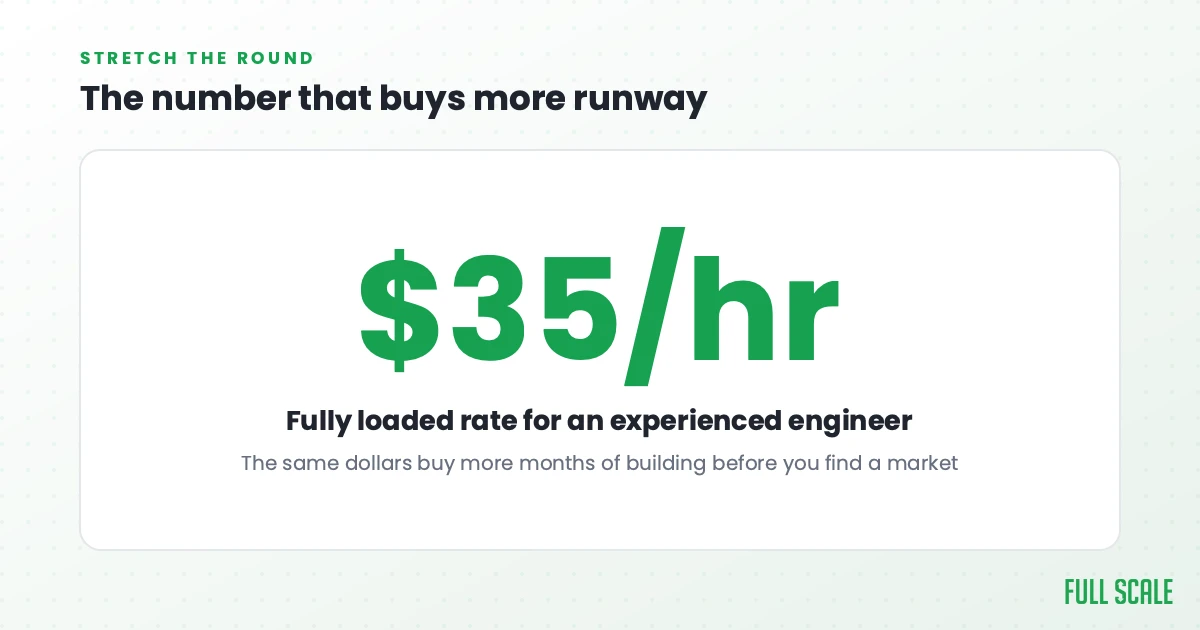
The move that actually stretches a round is to build a strong team without paying full US prices for every seat. That is what staff augmentation does. Instead of carrying the full cost of in-house hires, you add experienced engineers to your team at a fully loaded rate of around $35 an hour. Full disclosure: this is the business I run. At Full Scale, we have helped founders build software teams from the Philippines since 2018, paying engineers at the top of their local market while clients keep more runway for shipping.
The same dollars buy more months of building, and that is the only thing that matters before you find a market. For a startup specifically, outsourcing the right parts of development is one of the smartest moves a funded founder can make.
How to choose, by stage
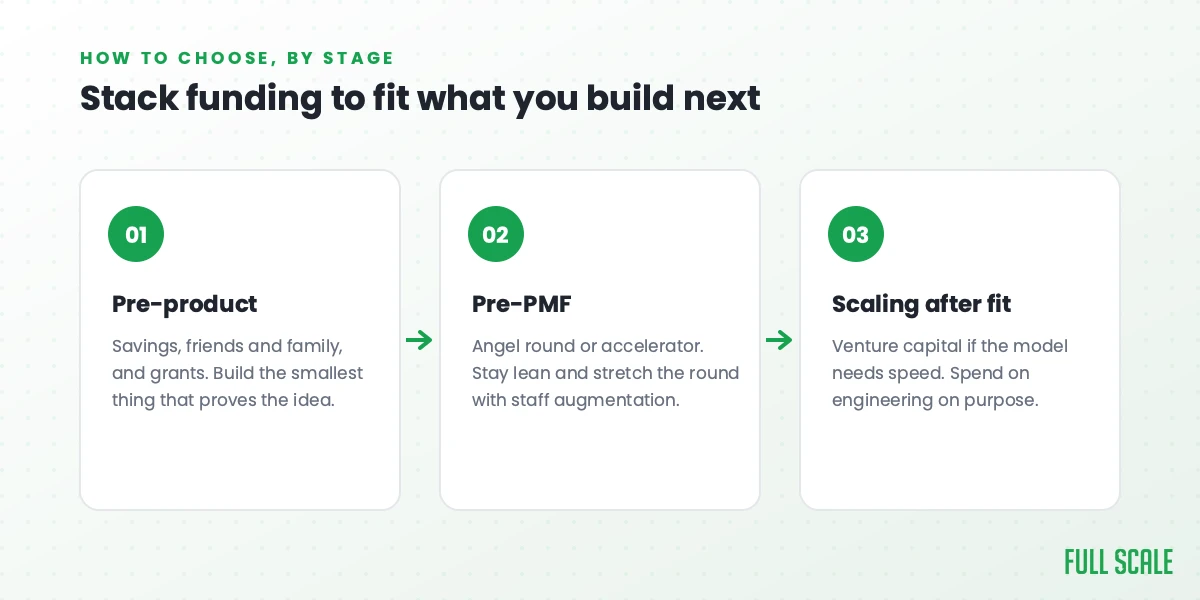
The usual labels, pre-seed, seed, and Series A, describe how much you raise. They say nothing about what to build. Here is the build-first version. You do not pick one funding resource. You stack them by stage, always asking what each one lets you build next.
- Pre-product. Use personal savings, friends and family, and grants. Build the smallest thing that proves the idea. Keep the team tiny.
- Pre-product-market-fit. Add an angel round or an accelerator. Hire a small, senior team and stay lean. Stretch the round with staff augmentation instead of a full in-house build.
- Scaling after fit. Now venture capital can make sense, if the model needs speed to win. Loans and revenue-based financing also open up once you have steady revenue. Spend on engineering on purpose, after you know what to build.
The pattern underneath all of it is the same. Funding is not the win. A shipped product that customers pay for is the win, and the right funding resource is just the one that buys you the most building toward it. If you want the deeper version of that argument, here is how software development actually works at a startup.
The funding decision is the build decision
If you take one thing from this, let it be this. Stop asking how much you can raise and start asking what each dollar lets you build. The founders who make it are the ones who turn the least money into the most working software.
That mindset, treating engineering as the thing the whole business is built around, is what I wrote Product Driven about. Get the build right and the funding question gets a lot simpler. If you are weighing how to build with the money you have, let’s talk about your team.