2026 Software Development Budget Template: What CTOs Actually Allocate (Real Data)
Most software development budget templates are garbage.
I’ve reviewed 60+ engineering budgets over the past six years. Here’s what I found. 80% were using the wrong software development budget template approach.
They’re built by finance people who’ve never managed a dev team. They assume project-based work when you’re doing continuous product development. They budget for local hiring only when offshore could double your team size for the same money.
The real problem isn’t the template itself. It’s the allocation philosophy behind it.
When I was CTO of my second startup, I budgeted $800K for five developers. By Q2, I’d blown the budget completely. I’d spent $1.1M and only hired three.
Here’s what I didn’t account for: recruiting agency fees at 25% of first-year salary, three months of reduced productivity during onboarding, and the cost of my senior engineer spending 20 hours per week training instead of shipping code.
Those hidden costs aren’t in traditional templates. The offshore allocation advantage isn’t mentioned. The retention tax that kills 20% of your budget annually? Ignored completely.
Here’s the software development budget template actual CTOs use. Plus the data to fill it in confidently.
What You'll Learn in This Guide
What Makes This Software Development Budget Template Different
Traditional software development budget templates assume you’re running a project shop. Bid on work. Deliver project. Move to next project.
That’s not how product companies operate.
You’re building continuous product development. Your team doesn’t finish and move on. They iterate, maintain, scale, and improve. Forever.
This software development budget template structure has to match that reality.
Here’s what makes this software development budget template different:
| Feature | Traditional Template | This Software Development Budget Template |
|---|---|---|
| Project Scope | ✗ Built for project budgeting | ✓ Built for continuous product development |
| Team Structure | ✗ Assumes 100% local team | ✓ Includes offshore allocation options |
| Budget Categories | ✗ Three generic categories | ✓ Six detailed categories with hidden costs |
| Foundation | ✗ Based on finance theory | ✓ Based on budgets from 60+ tech companies ($10M-$50M revenue) |
| Retention Planning | ✗ No retention planning | ✓ Accounts for turnover impact on budget |
| Review Cycle | ✗ Annual review only | ✓ Quarterly adjustment framework |
This software development budget template is based on real company data. Not finance theory.
Since founding Full Scale in 2017, we’ve analyzed engineering budgets from over 60 tech companies. Seed stage to $50M revenue. FinTech, SaaS, HealthTech, E-commerce. We’ve seen what works and what blows up by Q3.
"Most budget templates are built by finance people who've never managed a dev team. They don't account for the reality of continuous product development, offshore opportunities, or the hidden 20% that consistently blows annual plans." — Matt Watson, Full Scale CEO
The Full Scale 6-Category Budget Framework™
Since 2017, we’ve analyzed over 60 engineering budgets from seed to $50M revenue companies. The pattern was clear. Budgets using traditional 3-category models failed 80% of the time.
We developed the Full Scale 6-Category Budget Framework to solve this. Here’s what makes it different.
Every software development budget template should include these six categories. Not the generic three that most templates give you.
Quick Answer:
Every software development budget template needs six core categories: personnel costs (50-65%), infrastructure and cloud (20-30%), software and tools (10-20%), recruitment and onboarding, professional development (5-10%), and contingency buffer (15-20%). Traditional templates only include three generic categories, which is why budgets consistently fail by Q3.
The Core Budget Categories Every CTO Needs
Most templates give you three categories. Personnel, Tools, Infrastructure. Done.
That’s why budgets fail.
Here are the six categories this software development budget template includes:
Category 1: Personnel Costs (50-65% of total budget)
This isn’t just salaries. It’s the fully loaded cost per developer.
What’s included:
- Base salary
- Payroll taxes (7-10% of salary)
- Benefits (health insurance, 401k matching)
- Equity compensation
- Recruiting costs (15-25% of first-year salary)
- Onboarding overhead (3-6 months reduced productivity)
Local vs. Offshore breakdown:
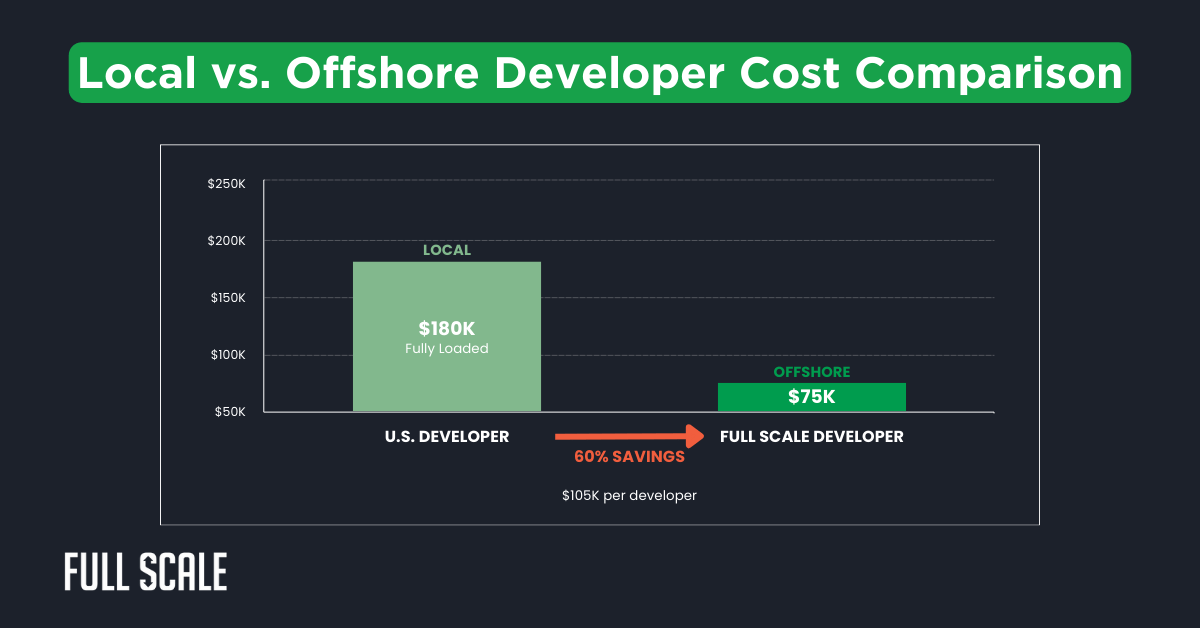
U.S. senior developer fully loaded: $180K-$250K annually
Offshore senior developer (Full Scale model): $60K-$90K annually
That’s 60% cost savings for equivalent quality. Not cheap developers. Strategic allocation.
Category 2: Infrastructure & Cloud (20-30%)
What’s included:
- AWS, Azure, GCP hosting
- CDN and bandwidth
- Database hosting
- Dev/staging/production environments
- Monitoring and logging tools
- Security and compliance tools
The percentage increases as you scale. Seed stage: 20-25%. Growth stage: 25-30%.
Category 3: Software & Tools (10-20%)
What’s included:
- IDE licenses
- GitHub/GitLab
- Jira, Asana, ClickUp
- Slack, communication tools
- Design tools (Figma, Sketch)
- Testing and QA tools
- CI/CD pipeline tools
Don’t over-invest here before you have the team to use them effectively.
Category 4: Recruitment & Onboarding (Often Missed)
This is where budgets blow up.
What’s included:
- Agency fees (15-25% of first-year salary)
- Job board postings
- Interview time (your senior engineers spending 10-20 hours per hire)
- Background checks
- Onboarding training time
- Reduced productivity during ramp-up (3-6 months at 50-70% capacity)
If you budget for salaries but not recruitment, you’re 15-20% short before you start.
Category 5: Professional Development (5-10%)
What’s included:
- Conference attendance
- Training courses
- Books and learning resources
- Certification programs
- Internal lunch-and-learns (time cost)
This pays for itself in retention. Developers who get professional development stay 2X longer.
Category 6: Contingency Buffer (15-20%)
The difference between CTOs who stay on budget and those who don’t. They budget for the unexpected.
What this covers:
- Emergency contractor rates (2-3X normal)
- Unexpected departures requiring backfill
- License creep (that SaaS tool you forgot about)
- Technical debt cleanup
- Scope changes mid-year
If you don’t budget a buffer, you’re budgeting to fail.
Budget Category Quick Reference
| Category | Typical % |
|---|---|
| 💼 Personnel Costs | 50-65% |
| ☁️ Infrastructure & Cloud | 20-30% |
| 🛠️ Software & Tools | 10-20% |
| 📋 Recruitment & Onboarding | Variable* |
| 📚 Professional Development | 5-10% |
| 💰 Contingency Buffer | 15-20% |
*Recruitment costs vary based on turnover rate and growth plans
Real Budget Allocations by Company Stage
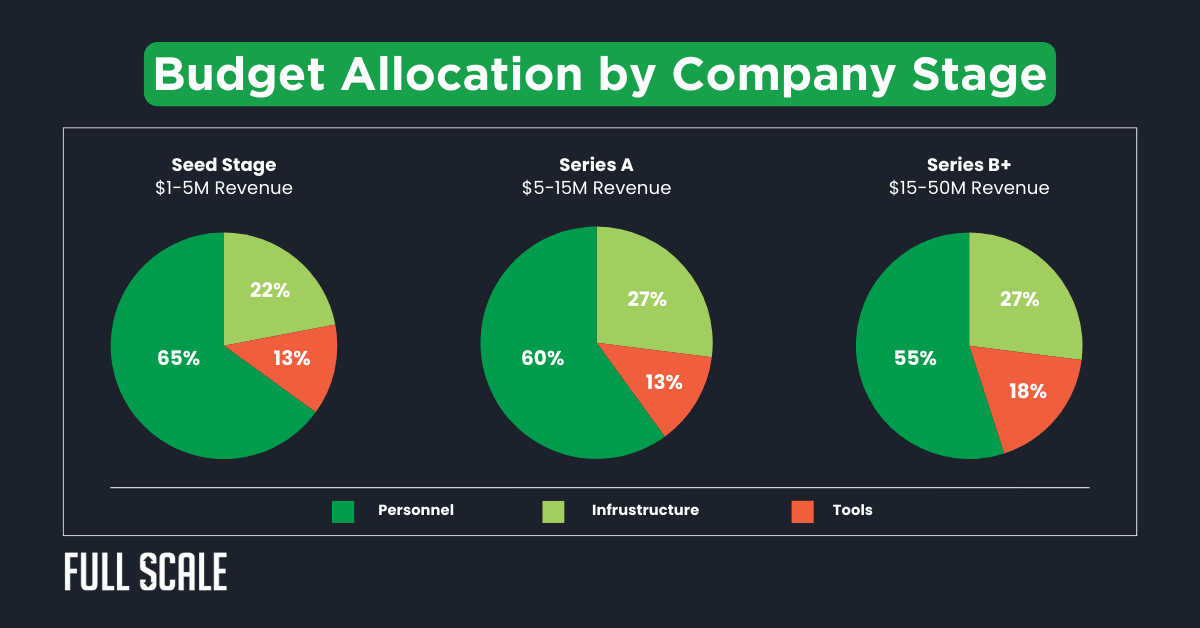
Here’s what actually works in a software development budget template. Based on our analysis of 60+ engineering budgets from 2017-2025.
Quick Answer:
Software development budget allocation varies by company stage. Seed-stage companies allocate 60-70% to personnel, 20-25% to infrastructure, 10-15% to tools. Series A companies shift to 55-65% personnel, 25-30% infrastructure, 10-15% tools. Series B+ companies allocate 50-60% personnel, 25-30% infrastructure, 15-20% tools. The percentage on people decreases as efficiency tools become force multipliers.
Seed Stage ($1-5M revenue)
Personnel: 60-70%
Infrastructure: 20-25%
Tools: 10-15%
Why: Speed matters more than efficiency. You’re building product-market fit.
Example software development budget template breakdown for $500K engineering budget:
- Personnel: $350K (5-6 developers, mix of local + offshore)
- Infrastructure: $100K (AWS, hosting, dev environments)
- Tools: $50K (core development tools)
At this stage, you over-invest in people. You under-invest in fancy tools.
Series A ($5-15M revenue)
Personnel: 55-65%
Infrastructure: 25-30%
Tools: 10-15%
Why: You’ve proven product-market fit. Now you’re scaling infrastructure to support growth.
Example software development budget template breakdown for $2M engineering budget:
- Personnel: $1.2M (12-15 developers)
- Infrastructure: $550K (scaling cloud services)
- Tools: $250K (adding collaboration and monitoring tools)
Infrastructure costs jump because you’re handling real load. Your AWS bill becomes meaningful.
Series B+ ($15-50M revenue)
Personnel: 50-60%
Infrastructure: 25-30%
Tools: 15-20%
Why: Efficiency becomes the multiplier. You invest in tools that make the team more productive.
Example software development budget template breakdown for $5M engineering budget:
- Personnel: $2.8M (30-40 developers)
- Infrastructure: $1.4M (multi-region, high availability)
- Tools: $800K (comprehensive tooling, security, monitoring)
At scale, the percentage on people drops slightly. The absolute dollars increase significantly.
Why Allocations Shift As You Scale
Seed-stage companies spend 70% on people. Speed matters more than efficiency. You need developers shipping code yesterday.
Growth-stage companies flip that. Infrastructure becomes critical. Tools become force multipliers. The percentage on people drops, but you're employing 3-5X more developers.
The mistake most CTOs make: keeping seed-stage allocation percentages when they hit Series A. Your infrastructure will collapse.
According to Gartner’s 2025 CFO survey, 77% of CFOs plan to boost technology spending in 2025. Almost half (47%) intend to increase spending by 10% or more. Understanding proper allocation in your software development budget template becomes critical when budgets grow.
The Offshore Budget Advantage: Real Cost Comparison
Most CTOs using a software development budget template assume 100% local team.
That’s like budgeting to drive across the country when flights exist.
Here’s the math most don’t see:
Quick Answer:
Strategic offshore allocation in your software development budget template can double team size without increasing spend. A $2M budget buys 11 local developers OR 18 developers with offshore-heavy allocation (64% larger team). The same budget, dramatically different capacity. Full Scale's offshore developers cost $60K-$90K fully loaded versus $180K-$250K for local senior developers—60% cost savings with equivalent quality and 95% retention rate.
Scenario A: Local-Only Budget ($2M total)
What you get:
- 8 senior developers at $180K fully loaded = $1.44M
- 3 mid-level developers at $120K fully loaded = $360K
- Infrastructure: $200K (constrained by personnel costs)
- Total team size: 11 developers
Scenario B: Hybrid Model ($2M total)
What you get:
- 4 senior local developers at $180K = $720K
- 10 senior offshore developers at $75K = $750K
- Infrastructure: $530K (freed-up budget)
- Total team size: 14 developers (27% larger)
Scenario C: Offshore-Heavy Model ($2M total)
What you get:
- 2 local tech leads at $200K = $400K
- 16 senior offshore developers at $75K = $1.2M
- Infrastructure: $400K
- Total team size: 18 developers (64% larger)
Same budget. Dramatically different outcomes in your software development budget template.
| Model | Total Budget | Team Size | Cost Per Dev | Infrastructure Budget |
|---|---|---|---|---|
| Local Only | $2M | 11 | $164K | $200K |
| Hybrid | $2M | 14 | $105K | $530K |
| Offshore-Heavy | $2M | 18 | $89K | $400K |
The question isn’t “Can I afford offshore in my software development budget template?”
The question is: “Can I afford NOT to?”
This isn’t about cheap developers. It’s about strategic budget allocation.
Full Scale’s offshore developers are senior engineers. They integrate directly into your team. They work your hours. They use your tools. They attend your standups.
The difference: they cost 60% less while delivering identical output.
According to Stack Overflow’s 2024 Developer Survey, the average developer turnover rate is 18-24% annually. This makes retention planning critical for budget accuracy. Full Scale’s 95% retention rate eliminates the 15-20% annual turnover tax.
What do you do with the freed-up budget in your software development budget template?
- Hire more developers (scale faster)
- Invest in better infrastructure (improve reliability)
- Increase your contingency buffer (reduce budget risk)
- All of the above
💰 Calculate Your Offshore Savings
See how offshore allocation could impact your 2026 software development budget template.
Your Potential Savings
Current Annual Cost:
$0
Cost with 50% Offshore:
$0
Annual Savings:
$0
Or Add Developers:
0 more developers for same budget
Hidden Costs That Blow Your Budget (And How to Plan for Them)
The CTOs who stay on budget don’t spend less. They just account for the 15-20% hidden costs that everyone pretends don’t exist.
Your software development budget template needs to include these.
Hidden Cost #1: Turnover Tax
What it costs: 6-9 months of salary per departure
If your annual turnover is 20% and you have 10 developers at $150K average:
- 2 departures per year
- Cost per departure: $75K-$112K (recruiting + onboarding + lost productivity)
- Annual turnover tax: $150K-$225K
That’s 10-15% of your personnel budget disappearing into turnover.
Full Scale operates development centers in Quezon City, Philippines, with U.S. headquarters in Kansas City. Our 95% retention rate means clients save this entirely. Compare that to the 60% industry average for offshore, or 68% for local teams.
Hidden Cost #2: Recruitment Agency Fees
What it costs: 15-25% of first-year salary
Planning to hire 5 developers this year at $150K each?
- Agency fees: $112K-$187K total
- Time your senior engineers spend interviewing: 50-100 hours
- Hidden recruitment cost: $150K+
Budget for salaries but forget recruitment? You’re 20% short before you start.
The January hiring rush amplifies these costs. Companies competing for talent in Q1 face 15-25% salary premiums. Extended timelines make it worse.
Hidden Cost #3: Onboarding Productivity Loss
What it costs: 3-6 months at 50-70% productivity
New senior developer at $150K:
- First month: 30% productive
- Month 2-3: 60% productive
- Month 4-6: 80% productive
- Lost productivity value: $30K-$45K per hire
Five hires this year? That’s $150K-$225K in lost productivity.
Hidden Cost #4: License Creep
What it costs: 20-30% more than planned
You budget for 10 developer seats. Actual annual costs:
- Jira, Confluence: $5K
- GitHub: $3K
- Slack: $4K
- Figma: $2K
- AWS tools: $8K
- Monitoring: $6K
- Security tools: $7K
- That random SaaS tool nobody remembers signing up for: $3K
- Total: $38K (not the $30K you budgeted)
Hidden Cost #5: Emergency Contractor Rates
What it costs: 2-3X normal rates
Senior developer quits mid-project. Need immediate backfill.
- Contractor rate: $150-$200/hour
- 6-month contract: $120K-$160K
- Premium over full-time hire: $40K-$60K
⚠️ The Hidden Cost Audit
If your turnover is 20%+, you're spending 15-30% of your budget on churn costs you're not accounting for in your software development budget template.
- Turnover tax: 10-15% of personnel budget
- Recruitment fees: 15-25% of first-year salary per hire
- Onboarding productivity loss: 3-6 months per hire
- License sprawl: 20-30% over planned tool costs
- Emergency contractors: 2-3X normal rates
Solution: Always budget 15-20% contingency buffer in your software development budget template.
Not “nice to have.” Required.
Read more about why offshore developers leave and how to prevent it.
How to Present This Budget to Your CFO
Engineering isn’t a cost center. It’s a revenue multiplier.
But your CFO doesn’t see it that way. They see a $2M line item. They wonder why sales “only” needs $800K.
Here’s how to translate your software development budget template to finance-speak:
Quick Answer:
Present your software development budget template as revenue investment, not cost center. Show each developer generates 3-5X their cost in product revenue. Offshore allocation reduces cost-per-developer 60% while maintaining output. At your stage, SaaS companies allocate 35-45% of revenue to engineering—industry standard backed by Gartner data. Frame budget as strategic capacity building, include quarterly review checkpoints, and emphasize 15% contingency buffer prevents emergency requests.
Translation Framework
Instead of: “We need 5 more developers”
Say: “Each developer generates 3-5X their cost in product revenue. This $750K investment returns $2.25M-$3.75M annually.”
Instead of: “Offshore developers cost less”
Say: “Offshore allocation reduces cost-per-developer 60% while maintaining identical output. This frees $600K to reinvest in infrastructure and team growth.”
Instead of: “Our budget is industry standard”
Say: “At our stage, SaaS companies allocate 35-45% of revenue to engineering. We’re targeting 38%. This positions us competitively while maintaining fiscal discipline.”
ROI Calculation for Engineering Spend
Show your CFO this math from your software development budget template:
Engineering Investment: $2M annually
Product Revenue: $8M annually (4X return)
Plus: Reduced customer acquisition cost (better product = lower CAC)
Plus: Increased customer lifetime value (better product = higher retention)
Actual Return: 5-7X investment
SaaS products should generate 3-5X their engineering spend in revenue. If you’re below that, you have a revenue problem. Not a budget problem.
Industry Benchmark Data
Your CFO trusts numbers. Give them numbers.
According to Gartner’s 2025 IT spending forecast, worldwide IT spending will reach $5.61 trillion in 2025. Software spending increases 14%. This validates technology investment as a strategic priority.
Script: Justifying Offshore Allocation
"Our software development budget template includes strategic offshore allocation. This reduces personnel costs 60% while maintaining quality. This isn't about cheap developers—it's about accessing senior talent at market-appropriate rates."
"Offshore rates: $50-70/hr. U.S. rates: $150-250/hr. The savings allow us to either hire 60% more developers for the same budget, increase our infrastructure investment by $600K, or reduce our total engineering spend by 40% while maintaining current team size."
"Our offshore partner maintains 95% developer retention versus 60% industry average. This eliminates the 15-20% annual turnover tax that most companies don't account for in their software development budget template."
Handling Common CFO Objections
Objection: “That seems high compared to other departments”
Response: “Engineering generates the product. Sales sells what engineering builds. Marketing promotes what engineering creates. Without engineering investment, sales and marketing have nothing to sell. That’s why product companies allocate 35-45% of revenue here.”
Objection: “Can’t we just hire fewer, better developers?”
Response: “We’re already hiring senior talent. The constraint is team size versus roadmap. Not quality versus quantity. Offshore allocation in our software development budget template solves this: same quality, larger team, same budget.”
Objection: “What if we go over budget?”
Response: “I’ve built in 15% contingency for unexpected costs. We’ll review quarterly to catch any variances early. Most overruns happen because teams don’t budget for recruitment costs or turnover. We’ve accounted for both in this software development budget template.”
Learn how to scale your engineering team without common hiring mistakes.
Quarterly Budget Review Process
Static annual budgets fail. Here’s why: everything changes by April.
The CTOs who stay on budget review quarterly. They adjust as needed.
Your software development budget template needs this built in.
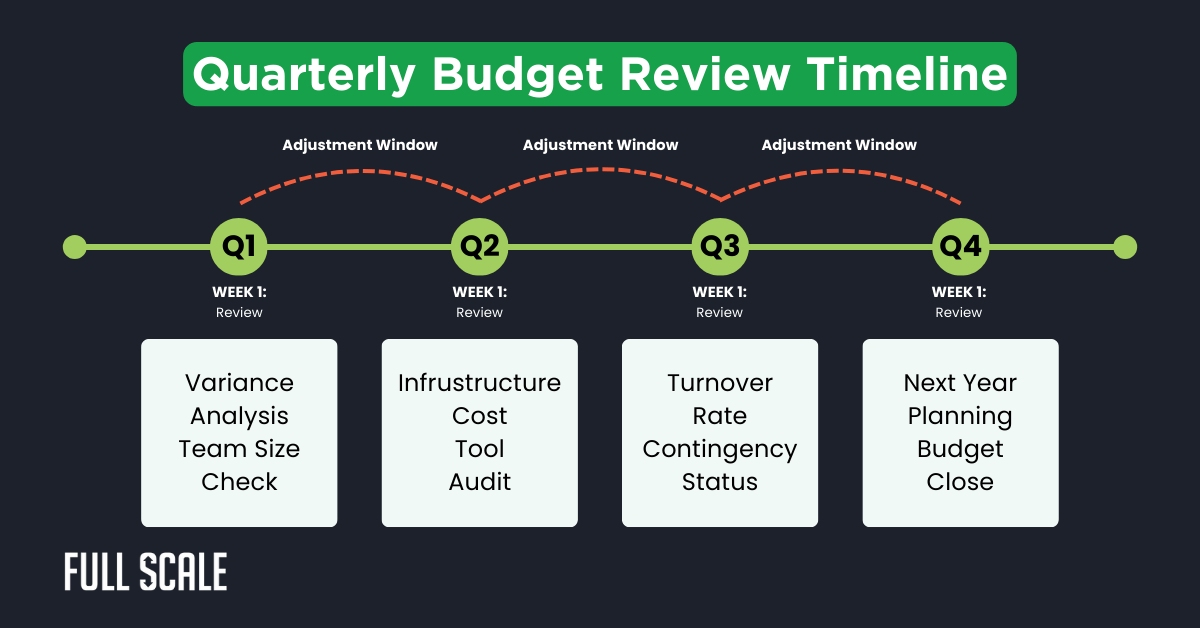
Week 1 of Each Quarter: Budget Health Check
What to review in your software development budget template:
- Actual spend vs. planned (by category)
- Team size vs. plan (hires made, departures)
- Infrastructure costs (AWS billing trends)
- Tool utilization (are you paying for unused licenses?)
- Upcoming needs next quarter
Red flags to watch:
- 15%+ variance in any category (investigate immediately)
- Multiple months of overspending in the same category (systemic issue)
- Underspending on professional development (leads to turnover)
- Contingency buffer already used by Q2 (insufficient planning)
When to Adjust vs. Hold Firm
Adjust when:
- Business priorities changed (new product line)
- Unexpected opportunity (major client requires feature)
- Team size is significantly different than planned
Hold firm when:
- Feature creep (nice-to-have, not must-have)
- Pressure to cut professional development (false economy)
- Request to eliminate contingency (increases risk)
Communication Template: Budget Adjustment Request
Q[X] Engineering Budget Adjustment Request
Quarterly Review Checklist
The best software development budget template isn’t rigid. It’s built with 15% flex capacity and quarterly checkpoints.
If you’re planning your year-end budget allocation, consider converting Q4 surplus into Q1 2026 team capacity through strategic planning.
Interactive 2026 Software Development Budget Template
Customize this software development budget template for your company’s stage. Get your personalized budget breakdown instantly.
2026 Software Development Budget Calculator
Enter your details below and click "Calculate Budget" to see your personalized allocation breakdown.
Your 2026 Software Development Budget Template
| Category | Amount | Percentage |
|---|---|---|
| Personnel Costs | $0 | 0% |
| Infrastructure & Cloud | $0 | 0% |
| Software & Tools | $0 | 0% |
| Recruitment & Onboarding | $0 | 0% |
| Professional Development | $0 | 0% |
| Contingency Buffer | $0 | 0% |
| TOTAL BUDGET | $0 | 100% |
Team Capacity Estimate
Total Team Size
0
Local Developers
0
Offshore Developers
0
Avg Cost Per Developer
$0
When Offshore Allocation Makes Sense (And When It Doesn't)
I’m going to be honest here. Offshore isn’t right for every software development budget template.
Offshore allocation works best when:
- You have a clear product roadmap
- You use collaborative tools (Slack, Jira, GitHub)
- You’re comfortable with remote work
- You have defined coding standards
- You need to scale faster than local hiring allows
Offshore allocation isn’t ideal when:
- You’re pre-product, figuring things out daily with whiteboard sessions
- Your team requires daily in-person collaboration
- You haven’t defined your development process yet
- You need someone physically in your office
The difference between offshore success and failure isn’t the developers. It’s your readiness.
If you don’t have defined process, start small. One or two developers. Test the model. Iterate.
Most companies start with 2-3 offshore developers. They prove it works. Then scale to 10-15 within 18 months.
Learn more about how to successfully integrate offshore developers into your team.
Start Planning Your 2026 Budget
You now have the software development budget template. The data. The offshore advantage framework.
The best budget isn’t the one you stick to rigidly. It’s the one that lets you build the team your company needs.
Here’s what to do next:
Use the interactive template above to model your specific budget scenario. Adjust for your company stage and offshore allocation preferences.
Calculate your offshore savings to see how strategic allocation could impact your 2026 software development budget template.
Review quarterly to catch variances early. Adjust as your business changes.
Most CTOs worry they’re allocating wrong. The real mistake isn’t the percentages. It’s not having a methodology.
Now you have one.
Understanding the 2026 developer hiring trends will help you time your budget allocation. Your recruitment strategy maximizes impact.
Why Partner with Full Scale
Here’s what makes Full Scale different from traditional outsourcing or freelancer platforms:
Early-stage SaaS companies typically allocate 50-70% of revenue to engineering. They’re building product-market fit. Growth-stage companies (Series A-B) allocate 35-45%. Mature companies with established products allocate 20-30%. Your stage, growth rate, and product complexity all influence the right percentage. Your software development budget template should reflect your growth stage.
U.S.-based senior developers cost $180K-$250K fully loaded. This includes salary, benefits, equity, and overhead. Mid-level developers cost $120K-$180K. Offshore senior developers through staff augmentation models like Full Scale cost $60K-$90K fully loaded. This enables 60% cost savings without quality reduction. Fully loaded means base salary plus payroll taxes, benefits, recruiting costs, and onboarding overhead.
The three biggest mistakes in any software development budget template: not budgeting for turnover costs (6-9 months’ salary per departure), under-allocating contingency buffer (need 15-20%), and budgeting for local-only teams without considering offshore strategic advantages. Most CTOs also underestimate tool licensing creep. Recruitment agency fees at 15-25% ofthe first-year salary. Onboarding productivity loss of 3-6 months per new hire.
Calculate engineering ROI by dividing annual product revenue by annual engineering costs. SaaS products should generate 3-5X engineering spend in revenue. Factor in customer acquisition cost reduction. Better product equals lower CAC. Customer lifetime value increase matters too. Better product equals higher retention. If engineering investment is $2M and the product generates $8M annually, that’s 4X ROI. This happens before considering CAC and LTV improvements.
Yes, but only with the right model in your software development budget template. Project outsourcing often sacrifices quality. Staff augmentation with direct integration maintains quality. Developers work as embedded team members, not distant contractors. Full Scale’s 95% retention rate proves stability. The key is treating offshore developers as full team members. Offshore senior developers at Full Scale cost $60K-$90K. Local equivalent costs $180K-$250K for equivalent experience and quality.