Year-End Budget Planning for Software Development: Fund Your January 2026 Team Capacity
It’s December 5. You have $80K left in your 2025 budget.
Option A: Let it disappear. Finance cuts your 2026 budget accordingly.
Option B: Panic-spend on tools you don’t need.
Option C: Use it to fund the team capacity you desperately need for Q1 2026.
Most CTOs choose A or B. Strategic CTOs choose C.
Most CTOs waste their December budget or lose it to Finance. Strategic CTOs convert it into January capacity—legally, quickly, without Finance pushback.
The difference? A framework for year-end budget planning for software development that turns surplus into a competitive advantage.
What You'll Learn
- Why "use it or lose it" creates Q1 disasters — and the strategic alternative most CTOs miss
- The 5-step framework to convert Q4 surplus into January team capacity legally and quickly
- Finance-approved contract language that satisfies procurement without the 45-day delay
- Real ROI calculations showing exactly how much capacity your remaining budget buys
- The December 20 deadline — and why waiting past this date costs you everything
The Year-End Budget Trap Most CTOs Fall Into
The “use it or lose it budget 2025” problem repeats every December. Finance demands spending justification. CTOs panic.
Here’s why traditional approaches fail and what strategic leaders do instead.
Why Traditional Approaches Destroy Q1 Momentum
According to Deloitte’s 2024 CFO Signals Survey, 71% of CFOs report increased scrutiny of Q4 spending. Most technology leaders forfeit allocated budget at year-end.
The real cost? You start January scrambling to recruit.
The Panic-Spend Trap:
- Buy 47 Jira licenses, your developers still hate
- Purchase AWS credits that expire unused
- Commit to tools solving yesterday’s problems
The Budget Loss Trap:
- Finance reclaims your $80K surplus
- Your 2026 budget gets cut by that same $80K
- You spend February begging for emergency hiring approval
The January Bottleneck:
- Start recruiting on January 2
- Lose 6-8 weeks to the hiring process
- Watch competitors ship while you’re interviewing
According to Stack Overflow’s 2024 Developer Survey, 64% of companies report difficulty hiring senior developers within 60 days. The Q1 correlation is direct and measurable.
What Strategic CTOs Do With Year-End Budget Planning for Software Development
They convert Q4 surplus into Q1 2026 team planning capacity. Not prepayment—strategic software development budget allocation that Finance approves.
This is the alternative nobody talks about.
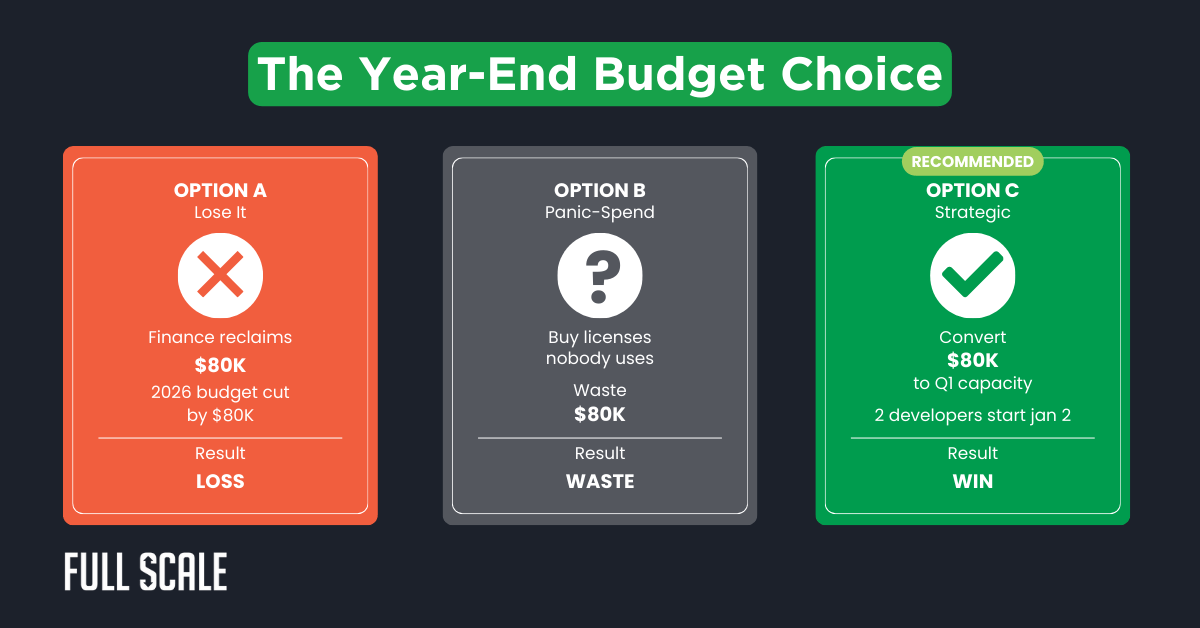
This diagram shows the three paths most CTOs face every December. Most choose red or grey—losing budget or wasting it. Strategic year-end budget planning for software development chooses the green path every time.
The Strategic Alternative: Pre-Fund Q1 2026 Team Planning
Here’s the framework that converts surplus into January capacity. This isn’t prepayment—it’s retainer-based software development budget allocation.
Finance approves one. Finance flags the other. Know the difference.
How Should CTOs Use Remaining Year-End Budget?
Convert Q4 surplus into Q1 2026 team planning capacity through retainer agreements. Structure as December 2025 commitment for January 2026 service delivery. This eliminates 6-8 week hiring lag, prevents budget loss, and provides Finance-compliant accrual accounting treatment. Execute by December 20 for 2025 budget year.
How Year-End Budget Planning for Software Development Actually Works
The Framework:
- Structure as Q4 retainer for committed capacity
- Lock in developers starting January 2
- Month-to-month agreements after the first month
- Finance-compliant accrual accounting treatment
The Capacity Conversion:
Based on Full Scale’s current 2024 pricing, here’s what Q4 surplus buys for Q1 2026 team planning:
| Q4 Budget Available | January Capacity | Skill Level | Time Advantage |
|---|---|---|---|
| $40,000 | 1 Senior Developer | Full-stack (React/Node) | 6-8 weeks |
| $80,000 | 2 Senior Developers | React + Backend | 6-8 weeks |
| $120,000 | 3 Senior Developers | Full team (iOS, Android, Backend) | 6-8 weeks |
This table shows the real software development budget allocation capacity conversion. Your surplus becomes productive team members on January 2. Not January 30 after recruiting delays.
Why This Beats Traditional January Hiring
❌ Traditional Hiring Timeline
Total: 7-10 weeks to productive developer
✅ Strategic Q4 Allocation
Total: Developer productive January 2
Seven weeks of delivery time gained. The math is simple for year-end budget planning for software development.
The 5-Step Budget Allocation Framework
This framework executes year-end budget planning for software development in five concrete steps. No theory—just execution mechanics that work.
Each step takes less than one day. Start today. By December 20, you’ll have January developers confirmed.
Calculate Budget
Determine available Q4 surplus
Forecast Needs
Define Q1 capacity requirements
Structure Deal
Get Finance approval
Get Buy-In
Secure leadership approval
Execute Fast
Contract by Dec 20
Step 1: Calculate Your Available Q4 Budget
Pull these numbers today. You need them for Q1 2026 team planning in Step 2.
Simple Formula:
Example Calculation:
- Annual budget: $2,500,000
- YTD committed through December 31: $2,350,000
- 15% buffer for unexpected costs: $22,500
- Available surplus: $127,500
That $127,500 converts to three senior developers for January. Or it disappears to Finance. Choose wisely.
Step 2: Forecast Your Q1 2026 Team Planning Needs
What team capacity do you need in January? Stop pretending you don’t already know.
Most CTOs fit into one of three common scenarios. Click each to see detailed requirements and costs.
Common Q1 Scenarios
Need: 2 senior full-stack developers
Skills: React, Node.js, AWS
Timeline: January 2 start for February launch
Cost: ~$80,000/month
Need: 3 mid-to-senior developers
Skills: iOS, Android, Backend
Timeline: Staggered start dates
Cost: ~$100,000/month
Need: 1 senior DevOps specialist
Skills: Kubernetes, Terraform
Timeline: January 2 for infrastructure migration
Cost: ~$45,000/month
You already know which scenario fits. You’ll hire these people in January anyway.
Step 3: Structure the Allocation for Finance Approval
This is where most CTOs screw up year-end budget planning for software development. They say “prepayment,” and Finance kills it instantly.
Finance-Compliant Language:
✓ Say This (Finance Approves):
"Retainer for committed development capacity effective January 2026. Services commence Q1 2026 under month-to-month agreement."
✗ Don't Say This (Finance Flags):
"Prepayment for future services to be delivered in 2026."
Key Contract Elements:
- Service agreement dated December 2025
- Retainer equals commitment fee, not advance payment
- Developer allocation confirmed by December 31
- Month-to-month terms after January
- Clear service commencement date: January 2, 2026
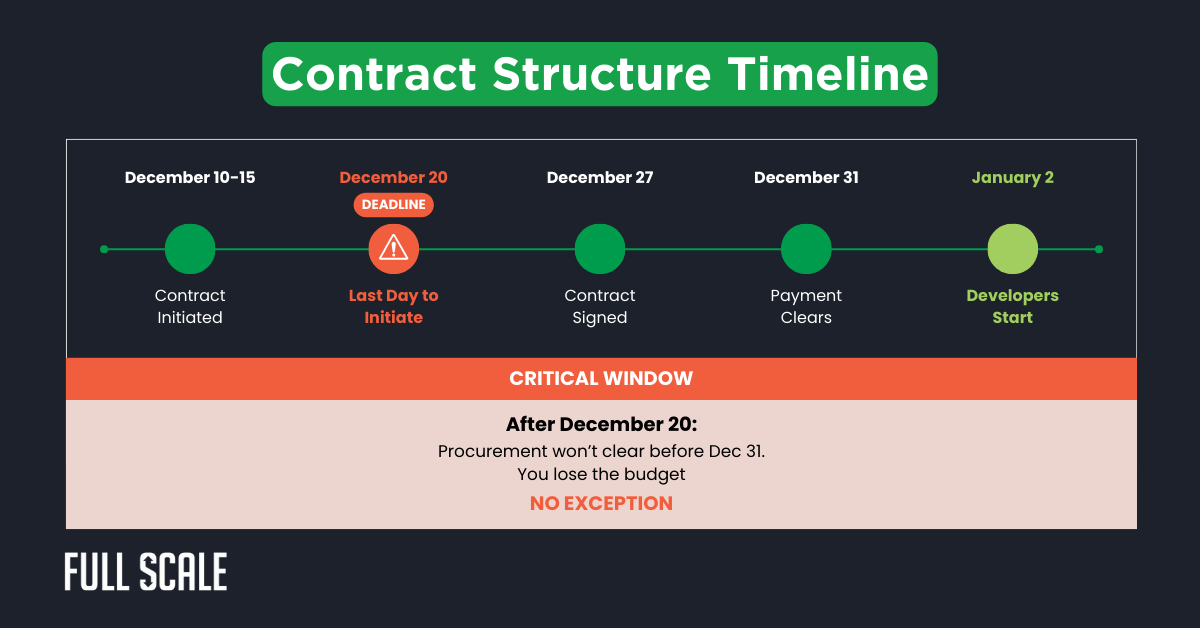
This timeline shows your execution window for year-end budget planning for software development. December 20 is the hard stop. Procurement and payment processing need a minimum of 7-11 days.
Step 4: Get Leadership Buy-In Fast
Your CEO and CFO need different talking points. Here’s what closes the deal.
💰 CFO Conversation
"We're converting at-risk budget into competitive advantage. Lose $80K and wait 6 weeks, or spend $80K today and gain 6 weeks. Six weeks of two-developer output = $40K delivered value. That's 50% ROI on budget we'd otherwise lose."
🚀 CEO Conversation
"Competitors face the same use it or lose it situation. Most will waste or lose budget. We get 6-8 week head start. They're recruiting in January while we're shipping features."
Step 5: Execute Before December 20
Speed matters for year-end budget planning for software development. After December 20, procurement won’t clear in time.
This Week’s Action Plan:
Monday: Calculate available Q4 budget using Step 1 formula
Tuesday: Identify Q1 2026 team planning needs from Step 2 scenarios
Wednesday: Initial consultation with Full Scale
Thursday-Friday: Review developer candidates for software development budget allocation
Next Week: Contract signed, retainer processed for committed capacity
By December 31: Developers confirmed, January onboarding scheduled
Budget-to-Capacity Calculator
Use this calculator to see what your remaining budget buys. Enter your available Q4 surplus. See immediate capacity conversion for Q1 2026 team planning.
This tool converts your specific surplus into software development budget allocation capacity. Based on Full Scale’s current pricing, you see exactly what January brings.
Q4 Budget → Q1 Capacity Calculator
Convert surplus budget into immediate team capacity
Your Q1 Capacity Projection
⏰ Time-Sensitive: Lock in capacity before December 20 deadline
How a FinTech Company Used $95K to Dominate Q1
This framework works for year-end budget planning software development. Here’s real proof from December 2024.
The company executed this exact strategy. Same five steps. Same timeline. Real results.
The Company:
Series B FinTech startup, 45 employees. Major product launch scheduled for February 2025.
The December 2024 Situation:
CTO had $95K remaining in the 2024 budget. Three open senior developer reqs planned for January hires.
Typical path: Lose budget to Finance, start recruiting January 2, hire by late February, miss February launch.
What They Did With Year-End Budget Planning for Software Development:
The Results:
✓ Started Q1 with full capacity—6-week competitive advantage over traditional hiring
✓ Hit February launch deadline while competitors scrambled to recruit
✓ $95K investment generated an estimated $180K in Q1 delivered value
✓ Zero recruiting delays, zero missed deadlines, zero budget loss
CTO’s Take:
“I almost let Finance reclaim that $95K through poor year-end budget planning for software development. Instead, we started the year ahead of everyone.
Our competitors spent January recruiting. We spent January shipping code and features.”
This is a real staff augmentation strategy that converts surplus into momentum.
Why Partner With Full Scale for Year-End Budget Planning for Software Development
We built our entire contracting process around December year-end budget planning for software development scenarios. Here’s what makes our software development budget allocation different.
Most vendors can’t execute by December 31. We specialise in exactly this window for Q1 2026 team planning.
Fast Contracting: 5-7 Days
Most vendors take 45 days. We take 7. Pre-approved MSAs eliminate weeks of legal negotiation.
95% Retention Rate
Your competitors post jobs January 2. You ship code January 2. That's the difference.
Finance-Friendly Terms
Month-to-month after first month. No multi-year traps. Simple contracts Finance loves.
Direct Integration Model
Full Slack and standup access. No middlemen. Your culture, our payroll infrastructure.
December Specialization:
We’ve executed this exact year-end budget planning for software development strategy with 60+ tech companies. December is our busiest contracting month.
Not because companies are desperate. Because strategic CTOs realize this window converts at-risk software development budget allocation into real Q1 2026 team planning capacity.
Ready to Convert Your Q4 Surplus Into Q1 Capacity?
The December 20 deadline is real for year-end budget planning for software development. After that date, procurement won’t clear before December 31.
Lock in your January capacity now!
Full Scale completes contracts in 5-7 business days for software development budget allocation. Standard procurement takes 30-45 days because of custom MSA negotiations.
We use pre-approved MSA templates and completed security assessments. Most CTOs sign contracts within one week of initial consultation for Q1 2026 team planning. December 20 is the hard deadline for 2025 budget year execution.
Yes, this year-end budget planning software development structure follows GAAP standards. The retainer secures committed capacity in Q4 2025. Service delivery occurs in Q1 2026.
Your Finance team approves similar retainers for legal services, consulting, and advisory work. Software development capacity retainers follow identical treatment. Provide Finance with the service agreement dated December 2025, retainer language, developer allocation confirmation, and month-to-month post-January terms.
Month-to-month agreements provide full flexibility for year-end budget planning software development. Scale down with 30 days’ notice without penalties.
Options for software development budget allocation include: reduce to part-time at 50% cost, pause for one month, or reallocate to different Q1 2026 team planning projects. Full Scale data shows 95% of clients who pre-fund January capacity expand teams in Q1. Scaling down is rare because capacity proves valuable.
Absolutely for year-end budget planning for software development specializations. Full Scale maintains pre-vetted specialists across all major tech stacks for Q1 2026 team planning.
Available specializations in software development budget allocation: DevOps with Kubernetes and Terraform, Mobile for iOS and Android, Frontend with React and Vue, Backend with Node and Python. Senior specialists cost $4,500-$5,000 monthly based on current pricing.
Three factors drive Full Scale’s retention rates for year-end budget planning for software development. First, developers are treated as long-term employees, not disposable contractors. Second, a competitive Philippine market salary with a full benefits package. Third, career growth opportunities and ongoing technical training programs.
Industry average offshore retention: 60% annually. Full Scale retention: 95%+ annually over the past three years of software development budget allocation. This matters for Q1 2026 team planning because your January developers stay long-term.