
This Is How CTOs Cut Development Costs 50% with Efficient Quality Assurance in Software Development
Quality assurance in software development drives modern business success. According to the World Quality Report 2024, companies investing in comprehensive QA frameworks see 40% faster time-to-market. GitLab’s 2024 DevSecOps survey reveals that 87% of high-performing teams prioritize automated testing strategies.
Quality assurance in software development encompasses five core components. These include strategic planning, test automation, CI/CD integration, quality metrics, and continuous improvement. Companies achieve 60% defect reduction through proper implementation. Investment yields 50% cost savings within 90 days.
Modern software testing strategy requires balancing speed with quality. Automated testing strategy implementation reduces manual effort by 70%. Enterprise software testing strategy adoption improves deployment confidence. Quality assurance framework investment protects long-term business value.
Why Does Software Testing Strategy Matter?
Understanding the impact of quality drives strategic investment decisions. Organizations must quantify both costs and benefits systematically.
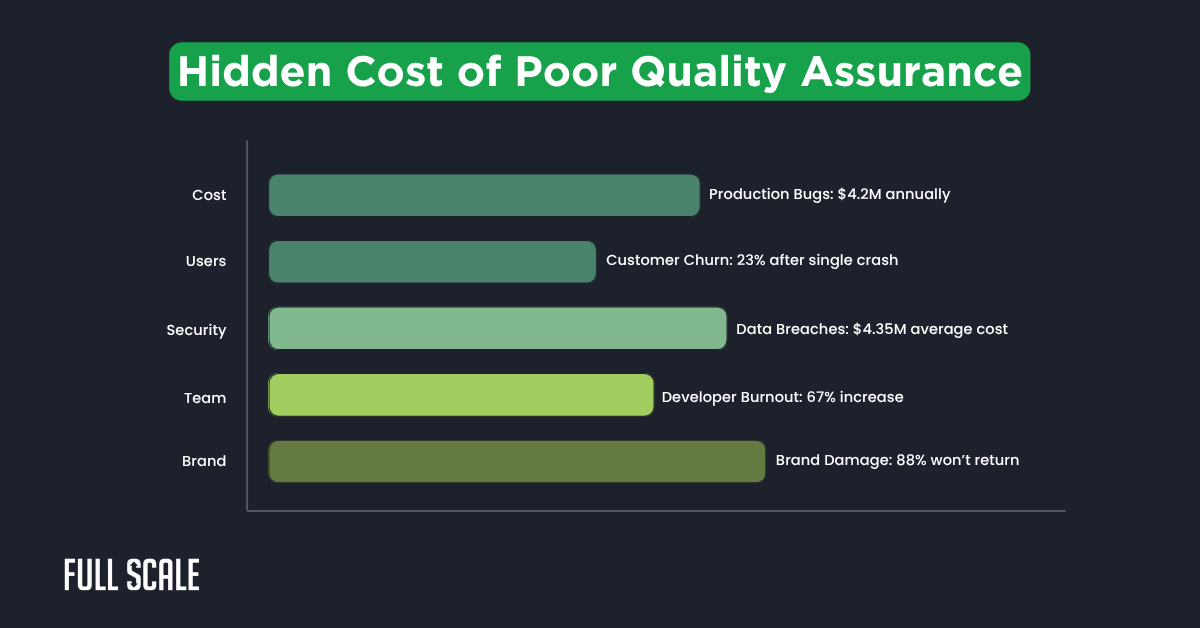
Quality assurance in software development prevents catastrophic business failures. Poor testing creates cascading problems across organizations. Strategic investment in quality assurance framework development protects revenue streams. The data below reveals the true cost impact.
The Hidden Costs of Poor Quality
ROI Metrics by Stakeholder Role
Quality assurance in software development delivers unique value to each stakeholder. Software testing ROI varies by role and priorities. The metrics below show role-specific benefits:
| Stakeholder | Key Metric | Improvement | Impact |
| CTO | Technical debt | 45% reduction | Better maintainability |
| Product | Time-to-market | 35% faster | Competitive advantage |
| CFO | Development costs | 40% savings | Budget efficiency |
| HR | Team productivity | 30% increase | Higher satisfaction |
Investment Prioritization for QA Testing Budget Optimization
Strategic QA testing budget optimization requires careful planning. Organizations must balance immediate needs with long-term goals. Quality assurance in software development investments guides resource allocation effectively.
Quick wins include unit testing coverage and basic automation setup yielding 300% ROI within 6 months. Strategic investments encompass complete test automation architecture and performance testing infrastructure delivering 250% ROI within 12 months. This QA testing time to market improvement accelerates competitive advantage significantly.
Three (3) Complete Software Testing Strategy Framework
A robust framework provides the foundation for testing excellence. Successful implementations align technical approaches with business objectives.
1. Strategic Foundation for Quality Assurance in Software Development
Risk-based testing prioritization maximizes resource efficiency. Teams identify critical business functions first. Quality gates prevent defective code progression. This quality assurance framework ensures consistent standards.
Risk assessment matrices evaluate features by business impact and failure probability. High-risk, high-impact areas receive maximum testing coverage through quality assurance in software development. Medium-priority features get balanced testing approaches systematically. Low-risk areas utilize efficient automated checks exclusively.
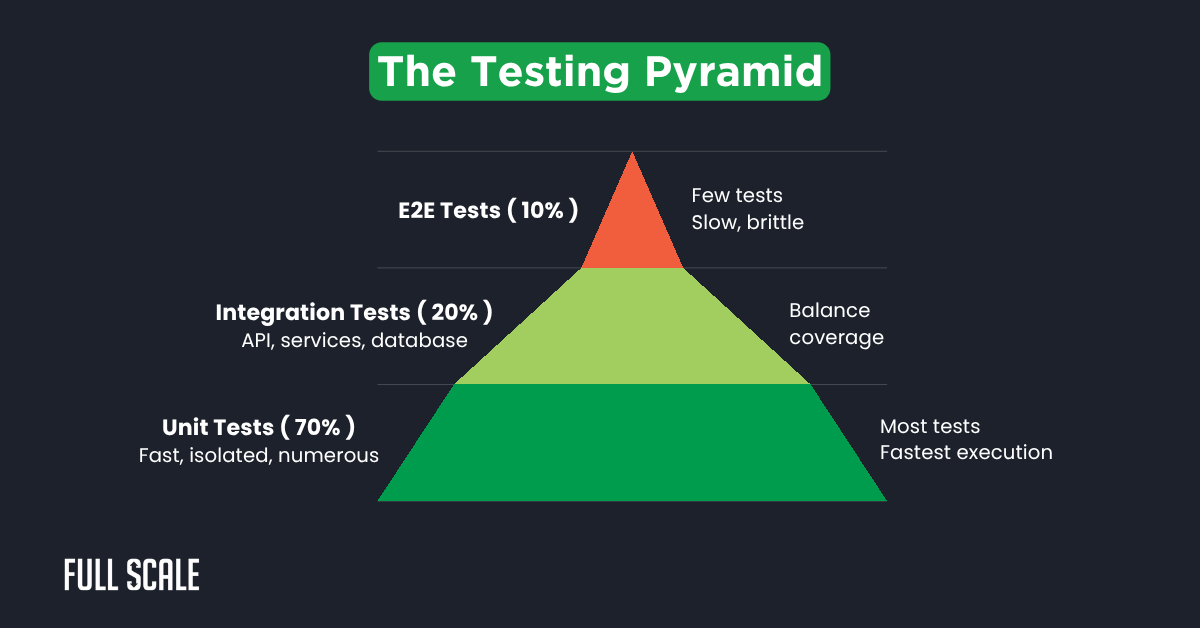
2. The Testing Pyramid: Optimizing Test Automation Architecture
Unit Testing (70% Coverage)
Unit testing forms the foundation of quality assurance in software development. Tests validate individual functions and methods independently. Test-driven development ensures code quality from inception. Coverage focuses on business logic complexity validation.
Integration Testing (20% Coverage)
API testing validates service contracts between components. Database testing ensures data integrity across transactions. Message queue testing verifies asynchronous processing reliability. Service virtualization enables isolated component validation strategies.
End-to-End Testing (10% Coverage)
System testing confirms complete user journey functionality. Cross-browser testing prevents platform-specific issues from production. Mobile testing validates responsive design across devices. Performance testing establishes acceptable response time benchmarks.
3. Production Readiness and CI/CD Testing Pipeline
Quality assurance in software development extends to production environments. Pre-production validation prevents customer-facing failures systematically. Modern CI/CD testing pipeline approaches ensure continuous quality through comprehensive validation.
Security vulnerability scanning, performance benchmarking, and load testing validation form the foundation. Rollback procedures, canary releases, and feature flags provide deployment safety. Continuous testing strategy implementation reduces production incidents by 75%.
Continuous deployment relies on automated smoke tests and progressive rollouts. Real-time monitoring alerts detect issues immediately. Automatic rollback triggers prevent widespread impact while A/B testing validates assumptions.
QA Testing Methodology Comparison
Choosing the right QA testing methodology determines project success rates. Each approach offers unique advantages for specific contexts. A complete guide to software quality assurance requires understanding methodology differences.
Choosing the Right Approach
Enterprise software testing strategy depends on project characteristics. Each methodology suits specific scenarios:
| Methodology | Best For | Timeline | Key Benefits |
| Waterfall | Regulated industries | 6-12 months | Comprehensive documentation |
| Agile Testing | Fast products | 2-4 weeks | Flexibility, early feedback |
| DevOps Testing | Continuous delivery | Daily | Speed, automation |
| DevSecOps | Security-critical | Continuous | Built-in security |
Manual vs. Automated Testing Strategy
Automated testing strategy implementation requires strategic decisions. Quality assurance in software development succeeds through proper test selection. Automate tests executed three or more times, including regression testing suites and performance testing scenarios. API testing workflows and security testing scans benefit from automation.
Manual testing excels at exploratory validation and usability assessment. One-time scenarios don’t justify automation investment. Ad-hoc edge cases require human creativity and intuition.
Agile Testing Methodology Integration
Modern agile testing methodology transforms quality assurance in software development. Sprint-based testing ensures continuous quality validation throughout software testing and product development. Sprint planning includes test case design, while daily standups track defect updates.
Development phases employ test-driven development with mid-sprint integration testing. Sprint ends with complete regression testing followed by a quality metrics review. QA testing time to market improvements reach 40% through agile practices.
Agile quality metrics track defect escape rates per sprint. Test automation coverage growth indicates maturity progression. Story point testing velocity measures team efficiency, while defect resolution time impacts customer satisfaction.
Implementing Automated Testing Strategy
Automation transforms testing efficiency and accuracy dramatically. Strategic implementation ensures maximum return on investment.
Automation ROI Framework
A cost-effective testing strategy balances investment with returns. Automated testing cost savings compound over time. Quality assurance in software development automation typically requires a $100,000 initial investment. Annual savings reach $250,000 through efficiency gains. Break-even occurs after three test executions with 250% Year 1 ROI.
Technology Stack for Scalable Testing Framework
| Category | Open Source | Commercial | Use Case |
| Web Testing | Selenium, Playwright | TestComplete | UI automation |
| API Testing | REST Assured | ReadyAPI | Microservices |
| Mobile | Appium | Perfecto | Device testing |
| Performance Testing | JMeter, K6 | LoadRunner | Load testing |
Test Case Management and Defect Tracking
Effective test case management ensures comprehensive coverage. Quality assurance in software development requires systematic organization. Modern tools streamline testing workflows through requirements traceability matrices and test case versioning. Execution history tracking links defects, while reporting dashboards provide visibility. Team collaboration features enhance productivity significantly.
Popular Test Management Tools
| Tool | Best For | Key Features | Pricing Model |
| TestRail | Enterprise teams | Comprehensive reporting | Per user |
| Zephyr | JIRA integration | Agile workflows | Subscription |
| qTest | End-to-end management | AI-powered insights | Enterprise |
| PractiTest | Customization | Flexible workflows | Team-based |
QA Testing Team Structure and Management
Effective teams form the backbone of quality initiatives. A proper QA testing team structure and management enable consistent excellence. Software testing strategy for growing companies depends on a scalable team organization.
Optimal Team Composition
Software testing team management varies by organization size. Quality assurance in software development requires proper staffing ratios.
Small teams with 5-15 developers need one QA engineer per three developers. Medium teams of 15-50 developers benefit from dedicated QA teams. Large organizations exceeding 50 developers require Testing Centers of Excellence.
Remote Testing Team Training Strategy
Distributed QA testing framework implementation needs a structure. Successful teams follow proven practices, including daily standups across time zones and asynchronous Slack updates.
Video calls resolve complex issues while shared wikis maintain documentation. Performance tracking focuses on outcome-based metrics with clear deliverables. Regular one-on-ones maintain engagement while recognition programs celebrate achievements.
Building QA Testing Framework for Distributed Teams
Remote software testing team management requires specialized approaches. Quality assurance in software development succeeds through structured processes and clear communication. QA testing framework distributed teams implementation ensures global team effectiveness.
JIRA handles defect tracking while Confluence manages documentation comprehensively. Slack enables real-time communication, and Zoom facilitates pair testing sessions. GitHub stores test code while Jenkins automates the CI/CD testing pipeline execution.
Time Zone Management Strategy
| Region | Coverage Hours | Primary Focus | Handoff Protocol |
| Americas | 8 AM – 6 PM EST | New feature testing | End-of-day report |
| Europe | 8 AM – 6 PM CET | Regression testing | Morning sync |
| Asia | 8 AM – 6 PM IST | Automation development | Status dashboard |
Cultural integration best practices include regular virtual team building and cultural awareness training. Flexible holiday scheduling accommodates global teams while multilingual documentation ensures clarity. Cross-team mentoring programs share knowledge effectively.
Quality Metrics and Software Testing ROI
Metrics drive continuous improvement and justify investments. Data-driven decisions ensure sustainable quality advancement through measurable software testing ROI. Comprehensive metrics tracking validates investment returns consistently.
Key Performance Indicators
Software quality metrics drive improvement decisions. Quality assurance in software development tracks essential KPIs systematically.
Leading indicators include test coverage targeting 80% minimum and defect injection rate monitoring. Automation coverage goals reach 70% while mean time to detect measures response speed.
Lagging indicators validate quality outcomes through production defect rates and customer satisfaction scores. System availability reflects reliability, while cost per defect justifies investments.
Executive Dashboard Metrics
| Role | Focus Area | Key Metrics |
| CTO | Technical debt | Code quality, complexity |
| Product | Feature quality | Defect rates, velocity |
| CFO | ROI tracking | Cost savings, efficiency |
| HR | Team health | Productivity, satisfaction |
Top 3 Advanced Enterprise Software Testing Strategies
Modern enterprises require sophisticated testing approaches. Advanced strategies address complex architectural challenges effectively.
1. AI-Driven Testing Strategy (2025 Trends)
Artificial intelligence transforms quality assurance in software development fundamentally. AI-powered test generation creates comprehensive scenarios automatically. Machine learning predicts high-risk code areas systematically. These shift-left testing methodology improvements prevent defects early.
2. DevSecOps Testing Approach
Security integration throughout development prevents vulnerabilities. Continuous testing CI/CD pipelines automate security scans. Shift-right testing methodology validates production behavior. Quality assurance in software development ensures comprehensive protection.
Code-level security employs static application security testing and software composition analysis. Secret scanning automation prevents credential exposure while code review security checks maintain standards. Build pipeline security scans, container images, and validate dependencies. Configuration validation ensures compliance while policy enforcement maintains standards.
Runtime security testing combines dynamic and interactive application security testing. Runtime application self-protection monitors production behavior while penetration testing automation validates defenses continuously.
3. Test-Driven Development and Behavior-Driven Development
Quality assurance in software development benefits from development methodologies. Test-driven development ensures code quality through failing test creation, minimal implementation, quality refactoring, and continuous cycles. Behavior-driven development aligns technical implementation with business requirements using Given-When-Then-And structures.
Industry-Specific Testing Requirements
Different industries demand specialized testing approaches. Compliance and domain expertise shape testing strategies.
A. Compliance Testing by Sector
Different industries require specialized quality assurance in software development frameworks. FinTech demands SOX compliance testing, PCI-DSS validation, transaction integrity verification, and security audits. HealthTech requires HIPAA compliance, FDA validation, patient safety protocols, and interoperability testing. E-commerce focuses on performance testing, payment gateway validation, cross-browser compatibility, and mobile optimization.
B. Software Development Lifecycle Integration
Quality assurance in software development integrates throughout SDLC phases. Each phase requires specific testing approaches and validation methods. Complete software testing strategy guide implementation follows structured processes.
Requirements phase testing includes review sessions and acceptance criteria validation. Testability assessment, risk analysis, and traceability matrix creation ensure comprehensive coverage. This complete guide to software quality assurance maximizes early defect prevention.
Design phase incorporates architecture reviews and interface validation systematically. Performance requirement verification and security design evaluation prevent downstream issues. Test planning initiation aligns QA testing methodology with project objectives effectively.
Development phase testing implements unit tests and participates in code reviews. Continuous integration setup and static analysis execution ensure code quality. Component validation prevents integration issues through a systematic QA testing methodology application.
The deployment phase executes smoke tests and verifies deployment success. Configuration validation and performance baseline establishment ensure production readiness. User acceptance coordination validates business requirements through structured testing approaches.
C. Risk-Based Testing Prioritization
Enterprise software testing strategy requires intelligent prioritization. Risk-based testing effectively focuses resources. Quality assurance in software development maximizes value through systematic assessment.
Risk Assessment Factors
| Factor | Weight | Scoring Criteria | Impact |
| Business criticality | 40% | Revenue impact | High/Medium/Low |
| Technical complexity | 25% | Code complexity | Complex/Moderate/Simple |
| Change frequency | 20% | Update rate | Daily/Weekly/Monthly |
| User impact | 15% | Affected users | All/Many/Few |
Your Guide on How to Implement a Comprehensive QA Testing Strategy
Successful implementation requires structured planning and execution. The 90-day roadmap ensures systematic transformation of quality processes. This section explains how to implement a comprehensive QA testing strategy effectively.
90-Day Implementation Roadmap
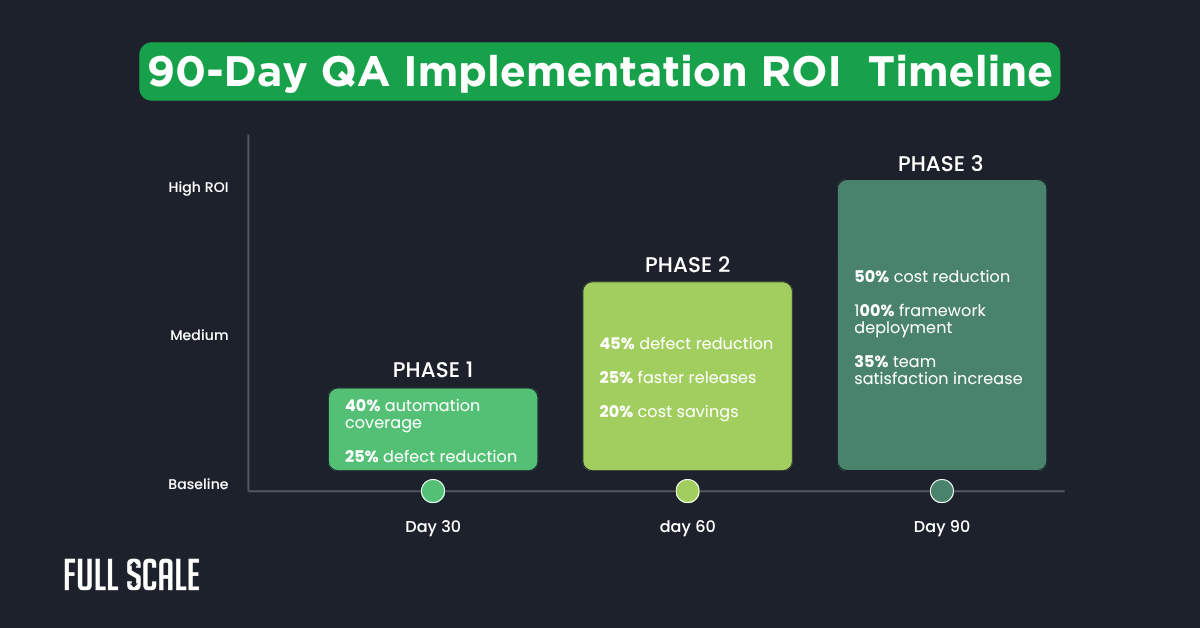
Quality assurance in software development implementation follows structured phases.
- Phase 1 Foundation (Days 1-30) establishes a baseline through current state assessment, tool selection, team training, and strategy documentation delivery.
- Phase 2 Integration (Days 31-60) implements processes, sets up CI/CD testing pipelines, deploys automated regression testing, and delivers automated test suites.
- Phase 3 Optimization (Days 61-90) implements performance testing, creates advanced scenarios, establishes quality metrics dashboards, and delivers complete testing ecosystems.
Overcoming Implementation Challenges
Every transformation faces obstacles requiring proactive management. Strategic solutions address common challenges effectively.
Common Obstacles and Solutions
Quality assurance in software development faces predictable challenges. Resistance to change requires executive sponsorship, training programs, success story sharing, and gradual rollout. Resource constraints demand risk-based prioritization, phased implementation, offshore partnerships, and an automation focus. Technical debt needs wrapper testing, incremental refactoring, legacy system integration, and documentation creation.
Managing Testing in Complex Environments
Enterprise software testing strategy addresses complexity systematically. Large-scale implementations require specialized approaches. Quality assurance in software development scales through structured solutions.
Microservices testing challenges include service dependencies requiring contract testing, service virtualization, mock services, and dependency mapping. Data consistency demands transaction testing, event-driven patterns, eventual consistency validation, and saga pattern testing. Deployment complexity needs multi-service testing, version compatibility checks, rollback validation, and configuration management.
Legacy System Integration
| Challenge | Solution | Implementation | Timeline |
| No test automation | Wrapper approach | API layer testing | 30 days |
| Poor documentation | Reverse engineering | Behavior capture | 60 days |
| Fragile architecture | Isolated testing | Component mocking | 45 days |
| Technical skills gap | Training program | Skill transfer | 90 days |
Scaling Quality Across Organizations
Software quality assurance best practices 2025 require organizational alignment. Scaling quality initiatives demands structured approaches.
Quality assurance in software development succeeds through governance structures including quality steering committees, testing centers of excellence, standards documentation, metrics dashboards, and regular audits.
Knowledge management encompasses best practices repositories, lesson learned databases, training materials libraries, expert network directories, and innovation lab setups. These elements ensure sustainable quality improvements.
Future-Proofing Your Testing Strategy
Technology evolution demands adaptive testing approaches. Forward-thinking strategies ensure long-term relevance and effectiveness.
Software Testing Trends 2025
Quality assurance in software development evolves rapidly. Emerging technologies reshape testing approaches continuously.
AI and machine learning enable AI-powered test generation, predictive defect analysis, self-healing tests, and visual AI validation.
Continuous testing evolution includes shift-everywhere testing, production testing expansion, chaos engineering adoption, and observability integration.
Hyperautomation Testing and Agentic AI Testing
Next-generation quality assurance in software development leverages hyperautomation. Agentic AI testing creates autonomous testing systems. Process mining integration enables automatic test path discovery, usage pattern analysis, bottleneck identification, and optimization recommendations. RPA testing validates end-to-end workflows, cross-system automation, business processes, and exception handling.
AI orchestration layers provide intelligent test selection, dynamic priority adjustment, resource optimization, and predictive failure analysis. Agentic AI capabilities include autonomous test creation, self-optimizing suites, intelligent bug reproduction, automated root cause analysis, and proactive issue prevention.
Ethical AI Testing Strategy
Quality assurance in software development must address AI ethics. Testing AI systems requires specialized approaches, ensuring responsible deployment. Bias testing frameworks validate dataset diversity, algorithm fairness, output bias detection, demographic parity, and explainability.
AI Safety Testing
| Test Type | Focus Area | Validation Method | Frequency |
| Robustness | Edge cases | Adversarial testing | Continuous |
| Reliability | Consistency | Statistical analysis | Daily |
| Transparency | Explainability | Interpretation tests | Per release |
| Accountability | Audit trails | Logging validation | Real-time |
Conclusion and Next Steps
Quality transformation requires commitment and strategic action. Success comes from systematic implementation and continuous improvement.
Key Takeaways
Quality assurance in software development transforms organizational capabilities. Strategic implementation delivers 250% ROI through systematic approaches.
All stakeholders benefit from improved software quality assurance processes. Success requires commitment to continuous improvement.
Action Items for Software Testing Strategy Implementation
Quality assurance in software development implementation starts immediately.
- This week, assess current testing maturity, identify critical business paths, evaluate existing tools, and define success metrics.
- Next month, select automation tools, design test automation frameworks, train teams on best practices, and implement critical tests.
- Next quarter, deploy complete testing ecosystems, establish quality metrics tracking, create an improvement culture, and scale successful practices.
Building Your Quality Culture
Quality assurance in software development requires cultural transformation. Organizations must embed quality thinking throughout teams systematically. Success depends on sustained commitment and continuous testing strategy adoption.
Leadership commitment drives quality through executive champions and regular reviews. Team empowerment distributes quality ownership while supporting continuous learning. Process integration enforces quality gates and builds peer review culture.
Measuring Cultural Success
| Indicator | Baseline | 6 Months | 12 Months | Target |
| Quality mindset | 40% | 60% | 80% | 95% |
| Proactive testing | 30% | 55% | 75% | 90% |
| Automation adoption | 25% | 50% | 70% | 85% |
| Defect prevention | 35% | 60% | 80% | 95% |
Partner with Full Scale for Quality Excellence
Complex QA testing framework implementation benefits from expertise. Full Scale accelerates your quality transformation journey. Our teams bring proven automated testing implementation frameworks. We deliver cost-effective testing strategy solutions.
Ready to transform your software quality? Full Scale’s QA experts can help you implement a comprehensive testing strategy that delivers results.
Start Your Quality Transformation Today
Frequently Asked Questions
Common questions deserve clear, comprehensive answers. This section addresses key concerns for quick reference.
What is quality assurance in software development?
Quality assurance in software development is a systematic process that ensures software meets requirements. It includes planning, testing, metrics, and continuous improvement. QA prevents defects through proactive quality measures. The goal is to deliver reliable, high-quality software products.
What are software testing best practices?
Software testing best practices include risk-based testing prioritization and test automation for repetitive tasks. Continuous integration testing ensures quality throughout development. Comprehensive test documentation maintains knowledge while regular team training builds skills. Metrics-driven improvements guide decisions, and early testing integration prevents costly defects.
How to implement an automated testing strategy?
Implementing automated testing strategy requires systematic planning. Start with critical path identification. Select appropriate automation tools. Build reusable test frameworks. Integrate with CI/CD pipelines for continuous testing.
What is the ROI of automated testing?
Automated testing ROI typically reaches 250% within one year. Initial investments return through reduced manual effort. Faster releases and early defect detection multiply savings. Long-term benefits compound through maintenance efficiency.
When to use microservices vs monolithic in testing?
Quality assurance in software development differs between architectures. Microservices require extensive integration testing strategies. Monolithic applications benefit from end-to-end testing approaches. Choose based on system complexity and team structure.
How to create a QA testing framework?
Creating a QA testing framework involves multiple steps. Define testing objectives and scope first. Select appropriate tools and technologies carefully. Implement reusable components and libraries systematically. Document standards and best practices thoroughly.
What is software testing strategy definition?
Software testing strategy defines systematic validation approaches for quality assurance. It encompasses test planning and execution methods throughout development. Strategy includes automation frameworks and quality metrics tracking systems.
How to measure testing effectiveness?
Testing effectiveness measurement requires comprehensive metrics. Track defect detection rates before production. Monitor test coverage across the code base. Measure the mean time to detect issues. Calculate cost savings from early detection.
What are the types of software testing?
Software testing includes multiple specialized approaches. Functional testing validates feature requirements. Non-functional testing checks performance and security. Structural testing examines code coverage. Each type serves specific quality goals.
How does AI impact software testing?
AI transforms quality assurance in software development significantly. Machine learning optimizes test case selection. Natural language processing generates test scenarios. Predictive analytics forecasts potential defects. AI accelerates testing efficiency dramatically.