Outsourcing Developers or Hiring In-House? It Depends

In this article
- You’re not choosing between two options, you’re choosing between four
- When hiring in-house is the right call
- When outsourcing developers wins
- Why outsourcing developers actually fails (two mistakes, not geography)
- The model most people miss: outsource like it’s in-house
- How to outsource developers without getting burned
- So which should you choose?
- FAQ
A friend of mine called me a few weeks ago, frustrated. He runs a software company and has sixteen developers in Pakistan. He told me the team was great. Whenever something big broke, he could call and they’d fix it almost immediately. The same calculus applies for frontend-specific work: a company that needs Vue.js developers rarely justifies a full-time in-house hire for the role when offshore options land faster and at a fraction of the cost. For a React or Next.js team, that offshore option usually means you hire Next.js developers who slot straight into the existing codebase. Part of the in-house premium is simply geography, since the cost to hire a developer depends on their location.
Then he told me the part that gave the whole thing away.
Something broke every single week.
His developers weren’t the problem. The way he had set up the work was. And that gap is exactly why how to hire the right tech talent, whether you outsource developers or hire in-house, is so easy to get wrong. Most people treat it as a money question. It isn’t. Cost is the easiest thing to compare and the worst thing to decide on. Knowing where IT outsourcing is heading helps here, because AI has changed what an outsourced developer is actually worth.
The real question is whether you’re buying a project or building a team. That decision is one of the four ways to hire software engineers, and each one fits a different kind of work.
So when a founder asks me whether to outsource developers or hire in-house, I don’t reach for a pros and cons list. I ask them three questions, because the right answer changes depending on what they’re actually trying to build:
- How long will you need the work?
- How much control do you need over the people doing it?
- Do you have someone technical who can actually manage them?
Quick Answer: Hire developers in-house when the work is core to your product, you’ll need it for years, and you have a technical leader who can manage a team. Outsource developers when you need speed, flexibility, or a skill you can’t hire locally; Full Scale’s fully loaded rate starts at $35/hr, roughly 50-70% less than a comparable US hire. The version that holds up isn’t a project shop, it’s a dedicated team you manage like your own.
You’re not choosing between two options, you’re choosing between four
The moment you frame this as “hire or outsource,” you’ve already narrowed it too far. There are really four ways to get software built, and most founders bounce between them without ever naming them. That’s where the trouble starts.
- Hire developers full-time and build in-house.
- Contract a freelancer or a local agency.
- Outsource to a team offshore, usually at a much lower cost.
- Build it yourself.
Each one trades off the same four things: money, speed, quality, and ownership. By ownership I mean how invested the people are in your product, how close they sit to your customers, and whether they care when something breaks at 2am. An in-house engineer who owns a feature behaves differently than a contractor billing by the hour. That difference is the whole game.
Here’s how the four stack up.
| Way to build | Cost | Speed to start | Quality control | Ownership |
|---|---|---|---|---|
| Hire in-house | Highest | Slowest (2 to 3 months) | High | High |
| Freelancer or local agency | Medium | Fast | Mixed | Low |
| Offshore project shop | Lowest | Fast | Variable | Lowest |
| Dedicated offshore team, managed like in-house | Low | Fast (weeks) | High | High |
If you want the longer version of this, I’ve written about the outsourcing vs. in-house tradeoff and the different models for outsourcing software development in more depth. For now, the table is enough to make the point: the bottom row is the one most people never seriously consider, and it’s usually the right answer.
When hiring in-house is the right call
If the software you’re building is the core of your business, and you’ll be working on it for years, hire in-house. There’s no real substitute for an engineer who lives inside your company, knows your customers, and has skin in the game. That person makes a hundred small decisions a week you never see, and they make them with your business in mind.
The catch is what it costs you, and I don’t just mean salary.
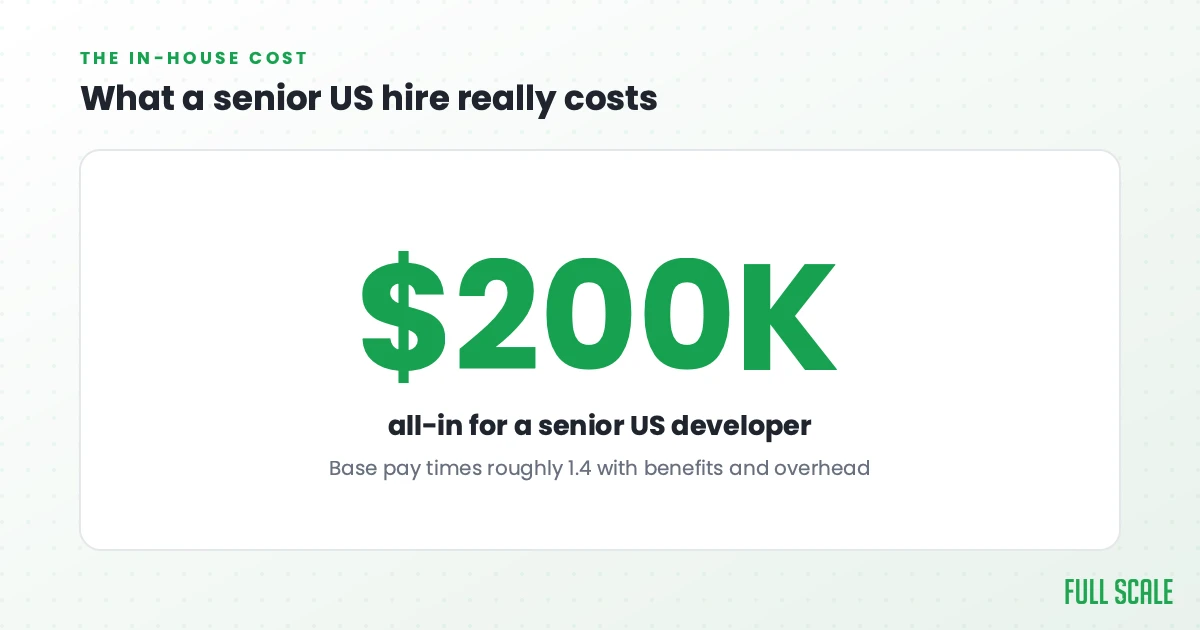
The Bureau of Labor Statistics puts the median US software developer around $133,000 a year. A senior engineer runs higher, often $150,000 to $185,000 in base pay. Then you load in benefits, payroll taxes, equipment, and recruiting. The long-standing rule of thumb from MIT is that an employee actually costs 1.25 to 1.4 times their base salary, which pushes a senior hire toward $200,000 a year, all in.
And money is the smaller problem. The bigger one is time. Hiring a good engineer takes me about two to three months from posting the job to their first day. Once, when I couldn’t find anyone myself, I paid a recruiter a 25% fee just to fill one seat. If you’re trying to ship something this quarter, that timeline alone can sink you.
In-house also assumes you can keep the person. Hiring is only half the job, and retention is the half people forget. If your culture is weak or your product is boring, you’ll hire someone in three months and lose them in nine.
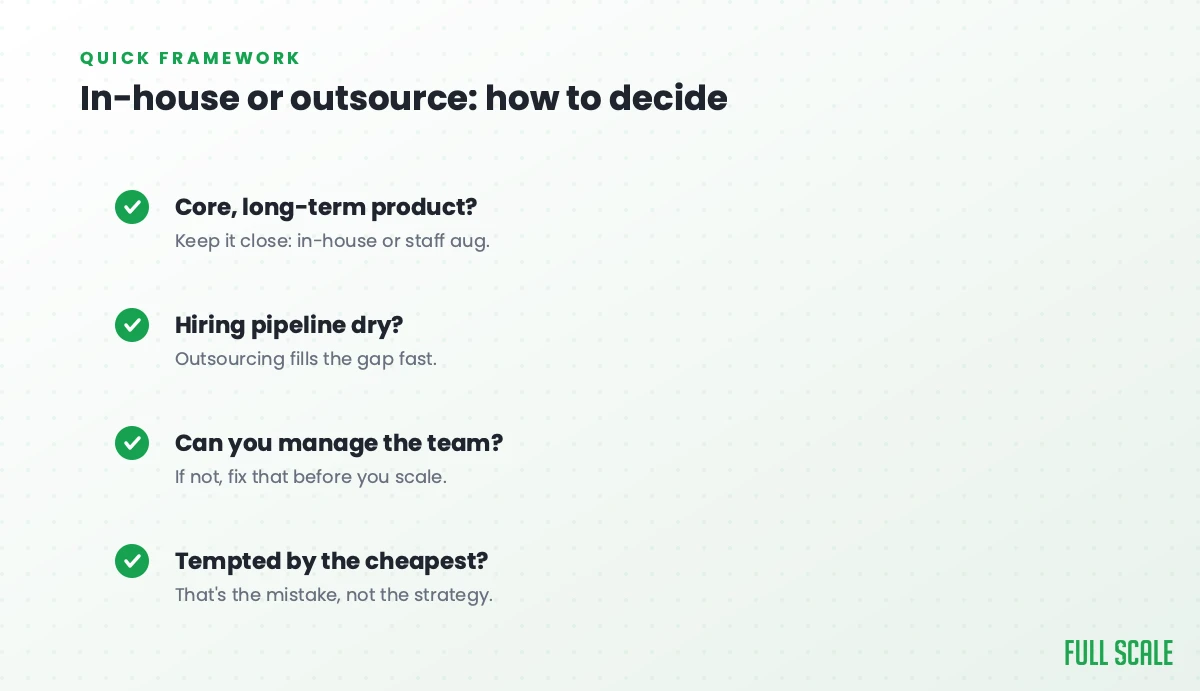
Hire in-house when the work is permanent, central to your product, and you have someone who can lead engineers. If you can’t say yes to all three, look harder at the other options, including staff augmentation and the dedicated-team model further down.
When outsourcing developers wins
Now flip it. There are plenty of situations where it makes no sense to spend six months and a quarter million dollars on a permanent hire.
You outsource developers when speed matters more than permanence. Maybe you’re proving out an idea, maybe you have a fixed budget, maybe you need a skill for one project you’ll never need again. I’ve done this myself. I’ve outsourced one-off builds for WordPress and Elasticsearch, things I had no interest in hiring a full-time developer for. Those were small, bounded jobs with a clear finish line, and handing them to a contractor on a per-project basis was exactly the right call.
That’s the honest case for arm’s-length software development outsourcing: a defined deliverable, a fixed scope, and no need for anyone to stick around once it ships. When the work really is a project, treat it like one. Companies outsource software development for exactly these reasons. They get access to talent they can’t find locally, they scale a team up or down without the drama of hiring and firing, and they get moving in weeks instead of months.
The cost gap is real, too. For what one senior US engineer costs me, I can put a small team of strong developers to work offshore. The Philippines, where I built my own team, is the third-largest English-speaking country in the world, and the talent there is excellent. When budget is the constraint, the math is hard to argue with.
But cheap is exactly where people get burned, and it usually comes down to two mistakes.
Why outsourcing developers actually fails (two mistakes, not geography)
As the founder and CEO of Full Scale, and the host of the Startup Hustle podcast, I’ve talked to hundreds of founders over the years. The horror stories almost always come down to one of two mistakes, out of the ten outsourcing mistakes I see most often, and neither has anything to do with where the developers live.
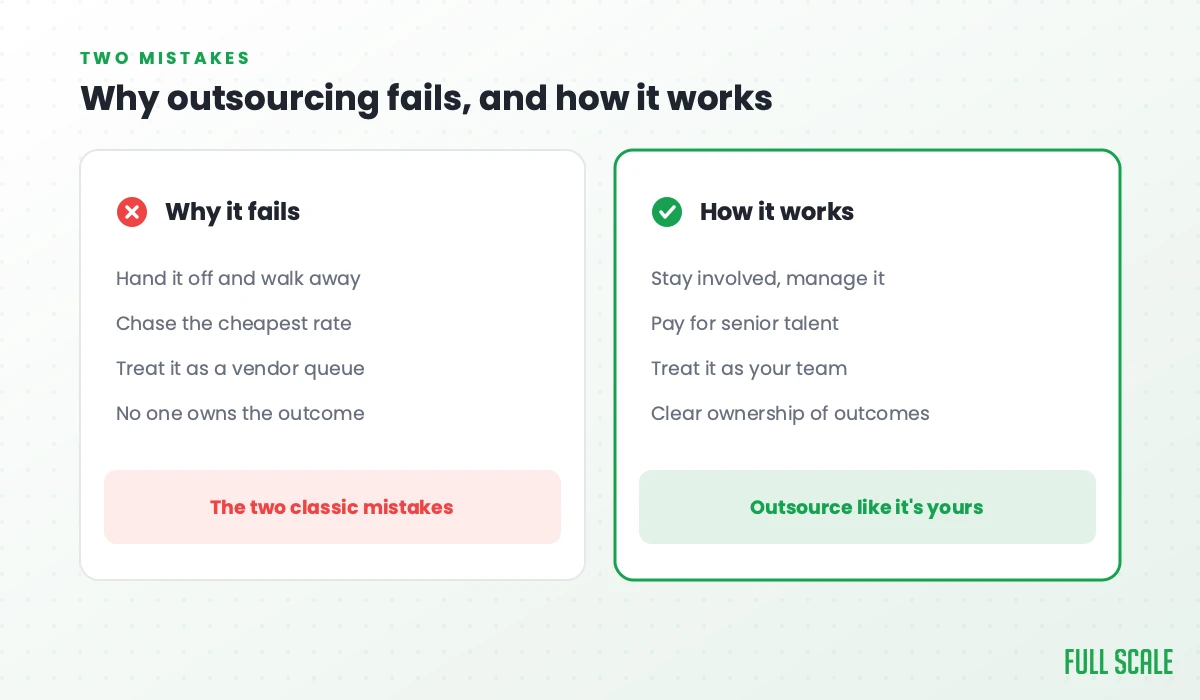
The first is that you never actually talk to the developers. A founder hires a firm, works through a single project manager, and never deals with anyone else. The people writing the code are walled off behind that proxy. They can’t ask questions, so they never really understand the why, and the work drifts. As I’ve said before, most offshore collaboration fails because people simply hand a bunch of requirements over to an outsourcing firm and then expect to get back a successful project. You’re right back to throwing work over a wall and hoping the right thing comes out the other side.
The second mistake is the one that quietly sinks people. You don’t have the engineering leadership in-house to manage the team.
Go back to my friend with the sixteen developers in Pakistan. His team was stuck in never-ending firefighting and he couldn’t see why. I told him what I tell everyone in that spot: the developers aren’t the problem, the missing leadership is. Nobody on his side knew how to manage an offshore team, so no one was making sure quality assurance actually happened, or that there were real processes around testing and releases. Sixteen good developers with no one steering quality will firefight forever, no matter how fast they patch each fire.
You always need technical leadership in-house. That’s the rule, and almost every risk of outsourcing I’ve seen traces back to ignoring it.
This is the core idea in my book Product Driven. As the mechanical part of writing code gets easier, the human skills decide whether a team succeeds, and the first of those is communication. A team that understands the why builds the right thing. A team that only gets tickets builds what the ticket said, which is rarely what you actually needed. Geography doesn’t create that gap. The way you set up the work does.
So here’s my honest advice. If you’re hiring more than one developer, staff augmentation beats traditional outsourcing almost every time. You keep your own engineering leadership, and you bring on dedicated developers who become part of your team, even when they sit in another country. That single change fixes both failure modes at once.
The model most people miss: outsource like it’s in-house
Here’s what took me too long to figure out. The choice was never really “hire in-house” versus “outsource.” The best model sits in the middle, and it’s the one I ended up building my whole company around.
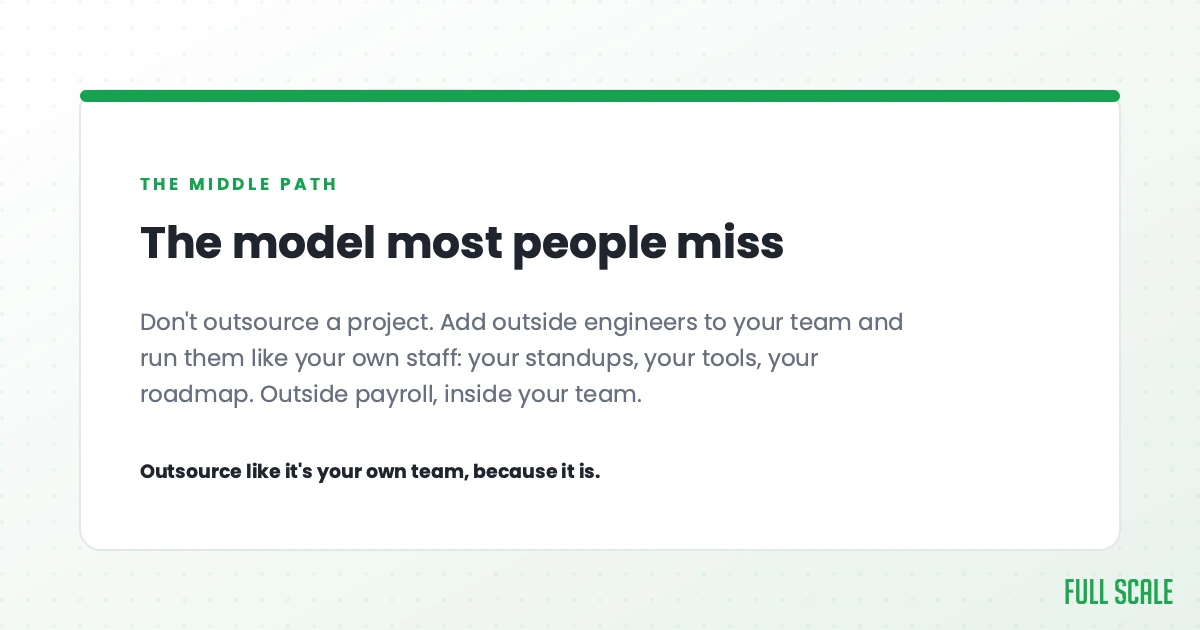
You hire a dedicated team offshore, and then you manage them exactly like your own employees. They work full-time on your product and only your product. You talk to them every day. They join your standups, sit in your Slack, and learn your customers. The vendor handles payroll, benefits, HR, and equipment, so you get the cost advantage of offshore staff augmentation without the headache of running a company overseas. The relationship looks nothing like a project shop. It looks like your team, because it is.
This is what staff augmentation actually means when it’s done right, and it’s the real staff augmentation vs. outsourcing distinction: a team you keep, not a project you buy.
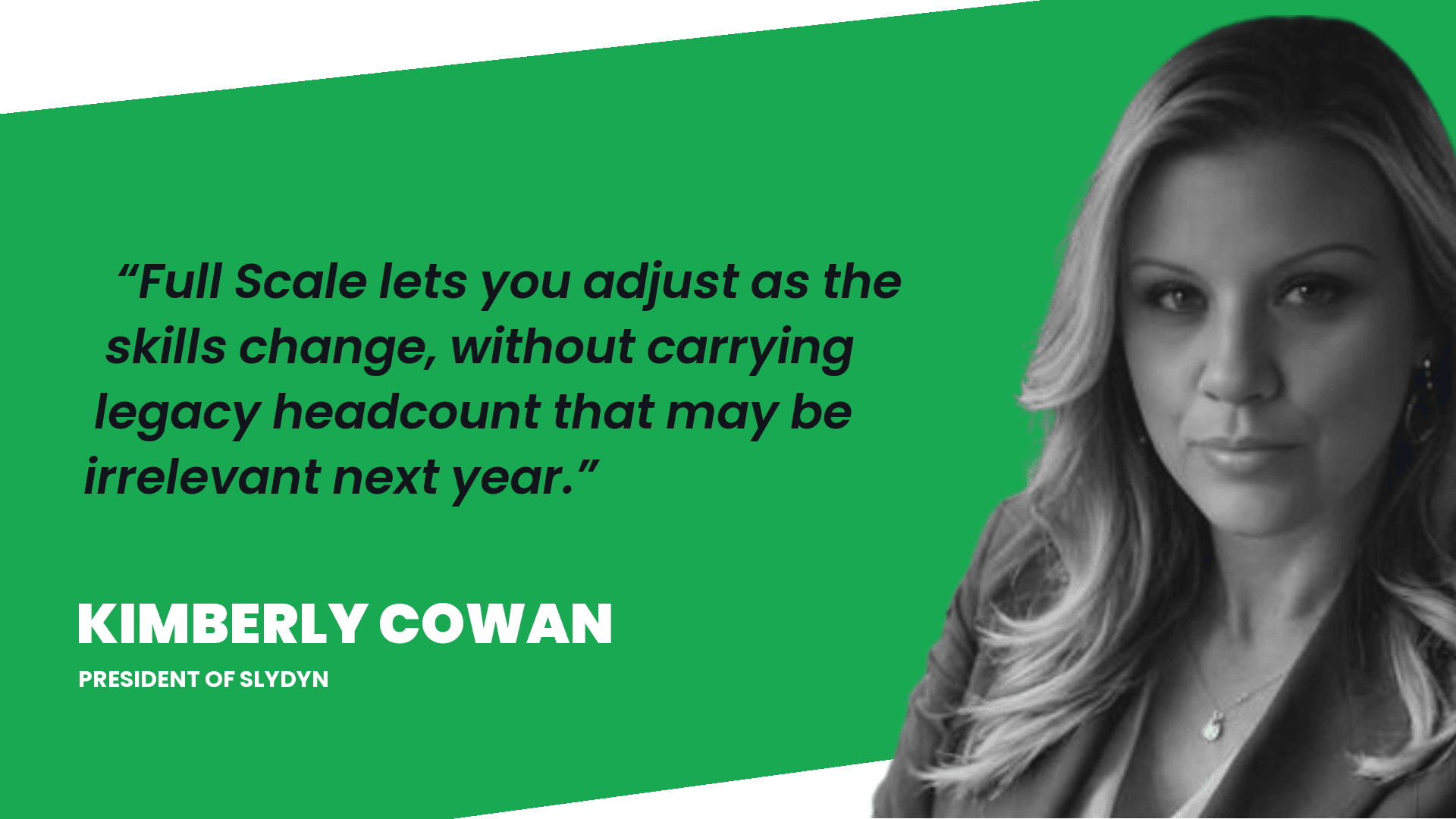
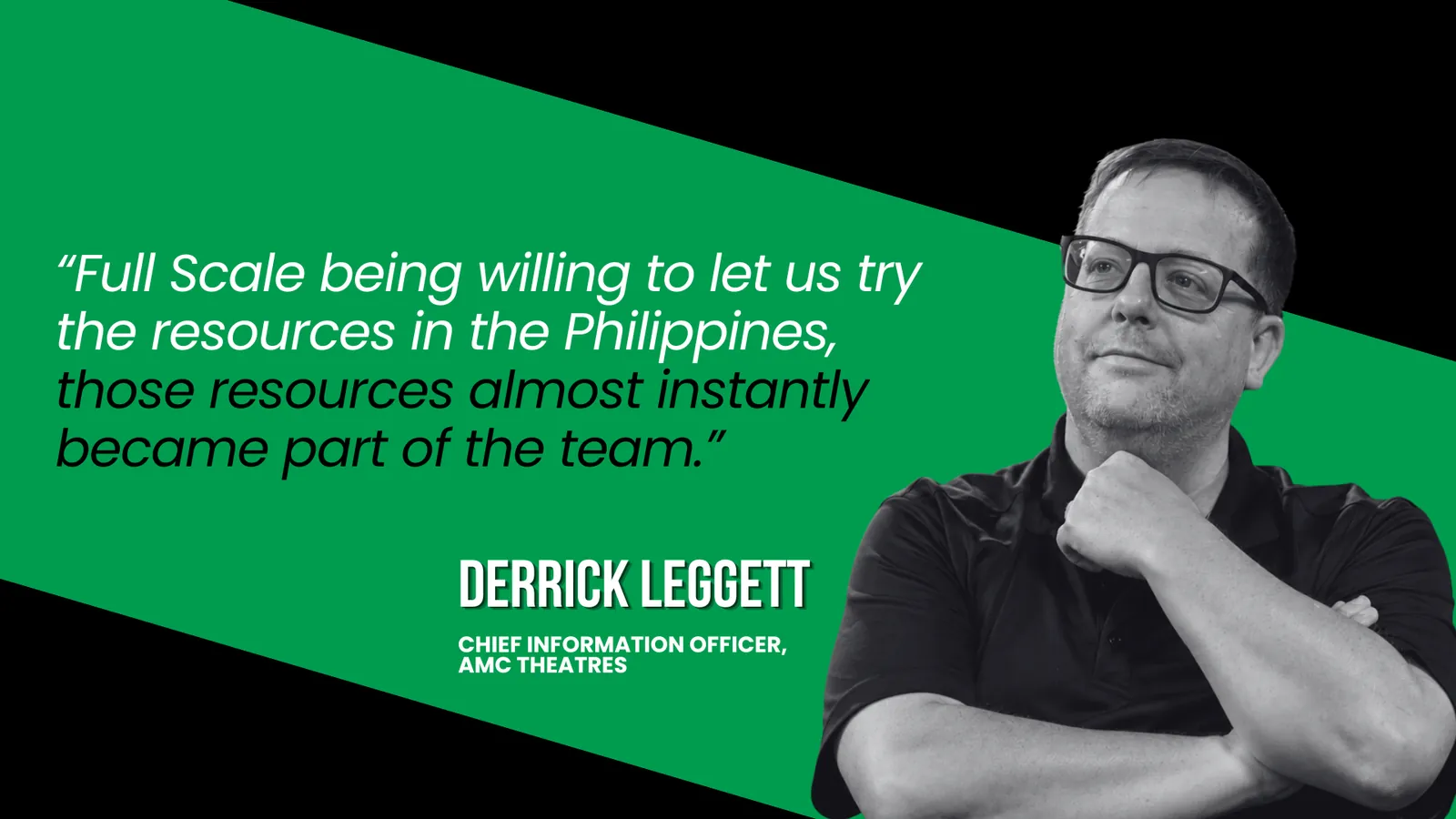
One of my clients, AMC Theatres, runs their Full Scale developers as one integrated team alongside their US staff. As their CIO Derrick Leggett puts it, “It’s a fully integrated team. It’s just some of the people happen to be living in the Philippines.” There’s no us-and-them, and that’s exactly why it works. Their engagement has lasted for years instead of ending in a rebuild.
I stumbled into this model almost by accident, and I’ve written the full story of how that happened. The short version is that the version of offshore that works is the one that feels the least like offshore.
How to outsource developers without getting burned
If you’re going to be outsourcing developers, a few things separate a partnership that lasts from one you’ll regret. None of them are complicated, and all of them are easy to skip when a quote looks cheap.
First, insist on direct communication with the actual developers, not just an account manager who relays messages. If a vendor won’t let you talk to the people writing your code, walk away.
Second, get a real overlap in working hours. I tell people they need at least three to four hours of overlap with their team every day. Without it, every question costs you a full day and momentum dies.
Third, watch how they handle the things that aren’t in the spec. The best developers ask why. They push back when a request doesn’t make sense, and that kind of curiosity only shows up when people feel safe enough to speak. If your team just nods and builds whatever you say, you don’t have engineers, you have typists.
Fourth, check that they use standard, open technology. If a shop builds your product on a proprietary framework only they understand, you’re locked in, and the next team you bring on has to learn something nobody else uses. Standard tools mean you can hire your own developers later and they’ll know exactly what they’re looking at.
Finally, look at whether the vendor can keep its own people. Turnover is the silent killer of outsourced work, because every engineer who leaves takes context with them. Make sure you work with a dev agency that cares about your product, not just your project. I care about this enough that retention is one of the numbers I watch most closely. Full Scale is Great Place to Work Certified, with 95% of our team saying it’s a great place to work versus 65% at a typical company. That isn’t a vanity badge. It’s why the same developers are still on your project two years in.
So which should you choose?
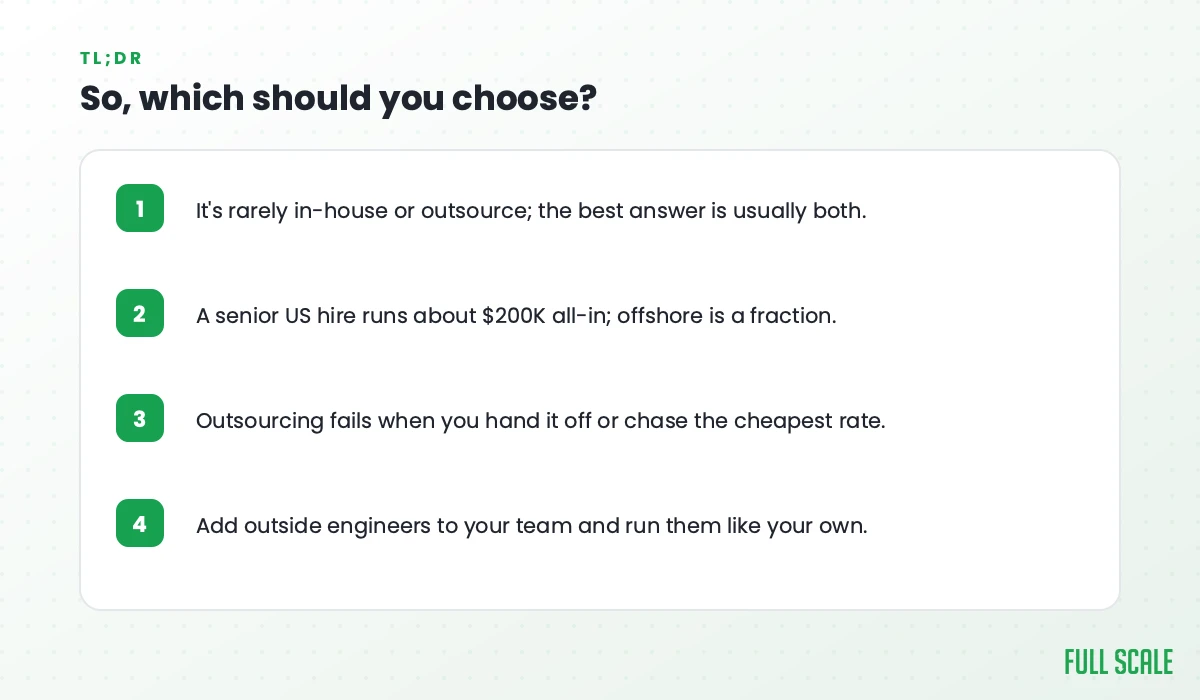
Like I said at the top, it depends. That’s not a cop-out, it’s the real answer, and now you know what it hinges on.
If the work is core to your product and you’ll need it for years, hire in-house, and budget for the time and the retention it takes to make that work. If you need speed, flexibility, or a skill you can’t find locally, outsource developers, but do it the right way: a dedicated team you manage closely. For most founders I talk to, the honest answer is a mix. They keep a small core in-house and extend it with an offshore team that operates like part of the company.
What you should never do is decide on price alone.
The cheapest option that produces software you have to rebuild is the most expensive choice you can make. I’ve watched founders learn that the hard way, and the lesson always costs more than doing it right would have.
If you want to talk through which model fits your situation, that’s what Full Scale does. We help companies build and scale engineering teams in the Philippines without the throw-it-over-the-wall problem, and we’ve made the Inc. 5000 five years running doing it. Book a call and we’ll talk through what you’re actually trying to build.
FAQ
Is it cheaper to outsource developers or hire in-house?
Outsourcing developers offshore costs far less than a full-time US hire. A senior US engineer’s base runs about $150,000 to $185,000, and the real all-in cost lands closer to $200,000 once you add benefits, payroll taxes, and equipment. Full Scale’s fully loaded rate for a strong offshore developer starts at $35/hr, roughly 50-70% less than that all-in US cost. But price shouldn’t decide it, because cheap work you have to rebuild ends up costing the most.
When should I hire in-house developers instead of outsourcing?
Hire in-house when the software is core to your business, you’ll be working on it for years, and you have a technical leader who can manage and keep the team. An in-house engineer who knows your customers and owns the product makes better day-to-day decisions than a contractor billing by the hour.
Why do outsourced development projects fail?
Most failures come from treating outsourced developers like a vending machine: write the requirements, throw them over the wall, wait for finished software. Without daily communication, the team builds the literal request instead of the right thing, and small misunderstandings compound into a codebase you have to rebuild. The fix is to manage outsourced developers like your own team.
How do I hire developers for outsourcing the right way?
Insist on talking to the developers directly, not just an account manager. Require three to four hours of daily time-zone overlap, confirm they use standard open technology, and check the vendor’s retention rate so your team doesn’t churn out from under you. The strongest setup is a dedicated team that works only on your product and is managed like in-house staff. It is also worth confirming how a vendor handles intellectual property when you outsource, since the contract structure protects your code more than the vendor’s location does.
What is the best way to outsource software development?
The most reliable model is a dedicated offshore team that works full-time on your product and is managed like your own staff. You talk to the developers every day, they learn your customers, and the vendor handles payroll and HR. It combines the cost advantage of offshore with the close collaboration of an in-house team.
How long does it take to hire a software developer?
Hiring a good in-house engineer typically takes about two to three months from posting the job to their first day, and the offer often comes in higher than budgeted. Outsourcing through a staffing partner can put vetted developers on your project in a matter of weeks, which is one of the main reasons companies choose it when speed matters.
What factors affect offshore developer productivity compared to an in-house team?
The gap comes down to five things: time-zone overlap, documentation quality, attrition, domain knowledge, and how fast someone actually ramps up. A dedicated offshore developer who overlaps three to four hours with your team, works from clear docs, and stays on the project for years closes the gap almost entirely, exactly the pattern the research on offshore developer productivity points to. What actually drags productivity down isn’t the time zone. It’s high turnover forcing you to retrain someone every few months, and thin documentation that leaves every new hire, offshore or in-house, guessing at the same problems.
Should a 50-person engineering org hire in-house or outsource?
At that size, the honest answer is usually both. Keep core product work, the parts that need deep customer context and roadmap ownership, on your permanent in-house team. Layer a dedicated offshore team on top for overflow capacity, specialized skills, or extra velocity, managed inside the same standups and code review as everyone else. The mistake at 50 people is treating outsourcing as a separate project team instead of an extension of the team you already have.