
Offshoring vs. Outsourcing: Most CTOs Get This Wrong (And How It’s Costing Them)

In this article
- Everyone Confuses These Terms (Even the “Experts”)
- What Offshoring vs. Outsourcing Actually Means
- Your Offshore Project Didn’t Fail Because of Offshore
- The Three Models: A Real Comparison
- The Direct Integration Model: Best of Both Worlds
- Should You Offshore, Outsource, or Keep In-House?
- Common Objections Answered
- 2025-2026 Industry Statistics That Matter
- Why Partner With Full Scale
- FAQs on Offshoring
“I’ll never do offshore again.”
Once you’ve picked offshore over generic outsourcing, the next set of choices are covered in our guide to offshore development best practices, including which sourcing model to use and how to protect your IP across borders.
That’s what a CTO told me last month. Smart guy. Built a successful SaaS company. Raised $15M.
His offshore project was a disaster. Communication sucked. Developers quit after four months. The code was a mess.
He’s not wrong to be frustrated. But he’s wrong about what failed.
Offshore didn’t fail him. The project outsourcing model he chose did.
Here’s the thing: most CTOs use “offshoring” vs.”outsourcing” interchangeably. Industry articles do it. Vendors do it. Hell, even I catch myself doing it.
But these aren’t the same thing. And confusing offshoring vs. outsourcing is exactly why so many offshore projects fall apart inside the first year.
The location was fine. The model was the mistake.
The offshoring vs. outsourcing distinction is more than semantics. It often decides whether the whole project succeeds or fails.
Let me show you the difference between offshoring vs. outsourcing that actually matters.
Everyone Confuses These Terms (Even the “Experts”)
Google “offshoring vs. outsourcing” and you’ll find articles from Forbes, Deloitte, and Harvard Business Review using the terms interchangeably.
This isn’t your fault. It’s an industry-wide problem.
Here’s why understanding offshoring vs. outsourcing matters:
When you confuse geography with model, you make decisions based on WHERE developers are instead of HOW they’re integrated into your team. Getting that right starts with understanding the difference between onshore, nearshore, and offshore teams.
It’s like confusing “remote work” with “freelancing.” Both involve working from home. But the employment model is completely different. One is an employee on your team. The other is a contractor you hire for a project.
The difference determines everything: retention, control, communication, quality, outcomes.
Most failed offshore projects weren’t killed by geography. They were killed by the wrong integration model, the same trap I unpack in my guide to offshore outsourcing.
That CTO I mentioned? His developers weren’t bad because they were in the Philippines. They churned because they were project contractors with zero connection to his company’s mission.
Now that you understand why the offshoring vs. outsourcing distinction matters, let’s define exactly what each term means.
What Offshoring vs. Outsourcing Actually Means
Quick Answer: Offshoring is relocating operations to another country.
Let’s break this down:
Offshoring: It’s About Location
Offshoring = Moving operations to a different country.
When comparing offshoring vs. outsourcing, this is the geography dimension.
Examples:
- Opening your own development office in the Philippines
- Hiring Filipino developers who work as your direct employees
- Relocating your customer service to India
- Establishing an offshore development center abroad
Key point: You’re choosing a geographic location. But you still control HOW these people work.
Outsourcing: It’s About Employment Model
Outsourcing = Delegating work to an external third party.
In the offshoring vs. outsourcing comparison, this is the employment dimension.
Examples:
- Hiring a local agency to build your website
- Contracting a U.S. company to handle payroll
- Bringing in consultants for a specific project
Key point: You’re choosing WHO employs the workers. They might be next door or across the world.
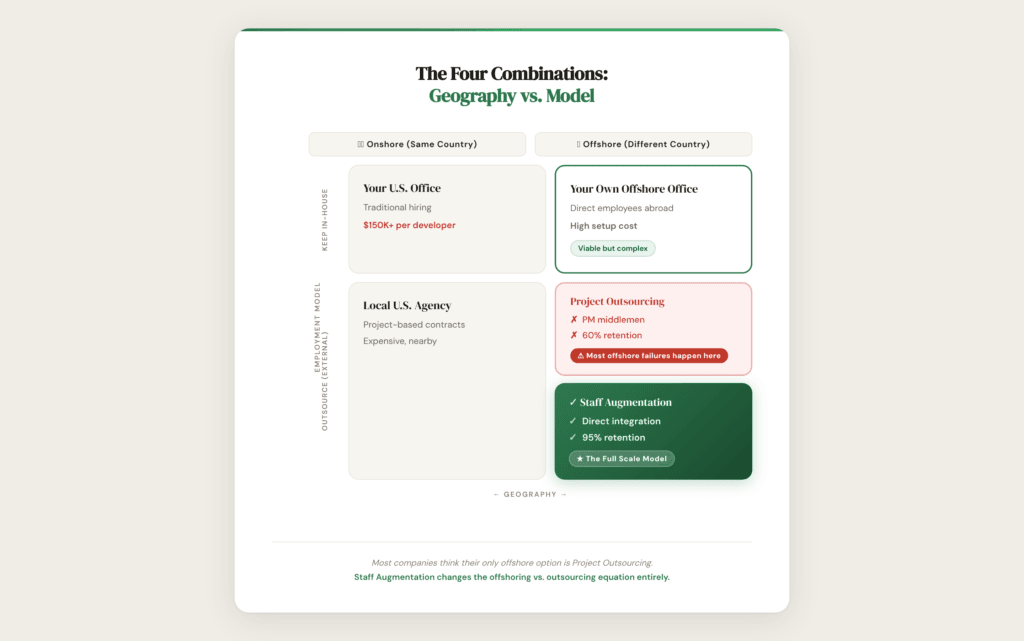
Understanding this matrix is crucial. Most failed offshore projects happen in that bottom-right quadrant, not because of geography, but because of the project outsourcing model. If you’re in that quadrant on purpose, it pays to know when project outsourcing actually works and how to set it up so it does.
Your Offshore Project Didn’t Fail Because of Offshore
Here’s what actually happened:
You hired a company that uses project outsourcing. They gave you developers. But those developers:
- Reported to a project manager (not you)
- Worked on multiple client projects simultaneously
- Had no connection to your company’s mission
- Saw this as a gig, not a career
When did they find a better gig? They left.
That’s not an offshore problem. That’s a project outsourcing problem. Understanding offshoring vs. outsourcing helps you avoid this trap.
We’ve placed 700+ developers since 2018. Here’s what the data shows about offshoring vs. outsourcing outcomes:
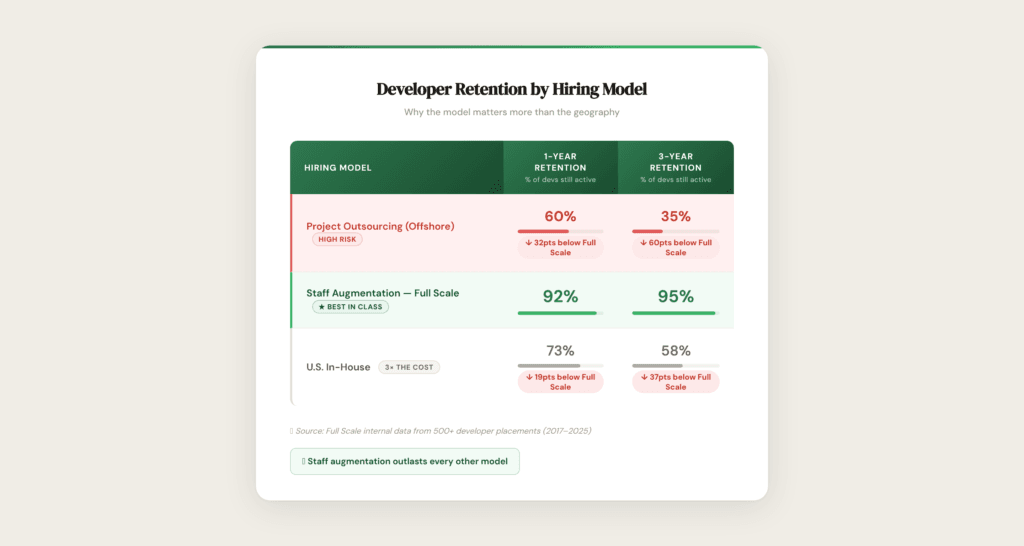
Notice something? Our offshore retention beats local U.S. hiring.
That’s not supposed to happen. Every article about offshore development problems warns you about high turnover. But when you understand offshoring vs. outsourcing properly, the data makes sense.
What Project Outsourcing Gets Wrong
Problem 1: Middlemen You don’t work directly with developers. Everything goes through a project manager. This creates communication delays, translation errors (not language, context), and misaligned incentives.
Problem 2: Contractor Mentality Developers know they’re project contractors. When the project ends, they’re reassigned or laid off. So they keep one foot out the door, don’t invest in learning your systems deeply, and optimize for their next gig instead of your long-term success.
Problem 3: Profit-Driven Staffing Outsourcing companies maximize profit by charging you for senior developers while staffing with juniors, rotating developers to balance workloads, and minimizing developer pay to increase margin. This isn’t evil. It’s just a fundamentally different model.
For a closer look at vetting offshore vendors, see our offshore development due diligence checklist. It walks through exactly what to ask before signing.
What Staff Augmentation Does Differently
Staff augmentation = Developers work as full-time extensions of your team.
- They join your daily standups
- They use your Slack, Jira, GitHub
- They report to you, not a project manager
- They have stability, benefits, and career growth
Outcome: They act like employees because they’re treated like employees. That’s why retention goes from 60% to 93%+.
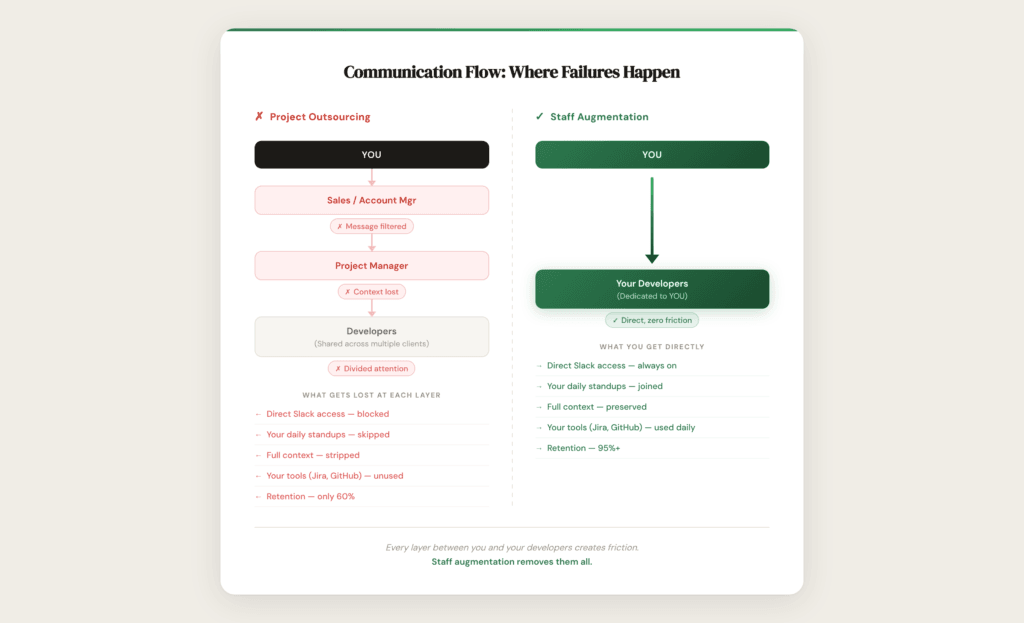
Now that you understand why integration models matter more than geography in the offshoring vs. outsourcing debate, let’s compare your actual options side by side. It also helps to know the main types of software outsourcing before you pick one.
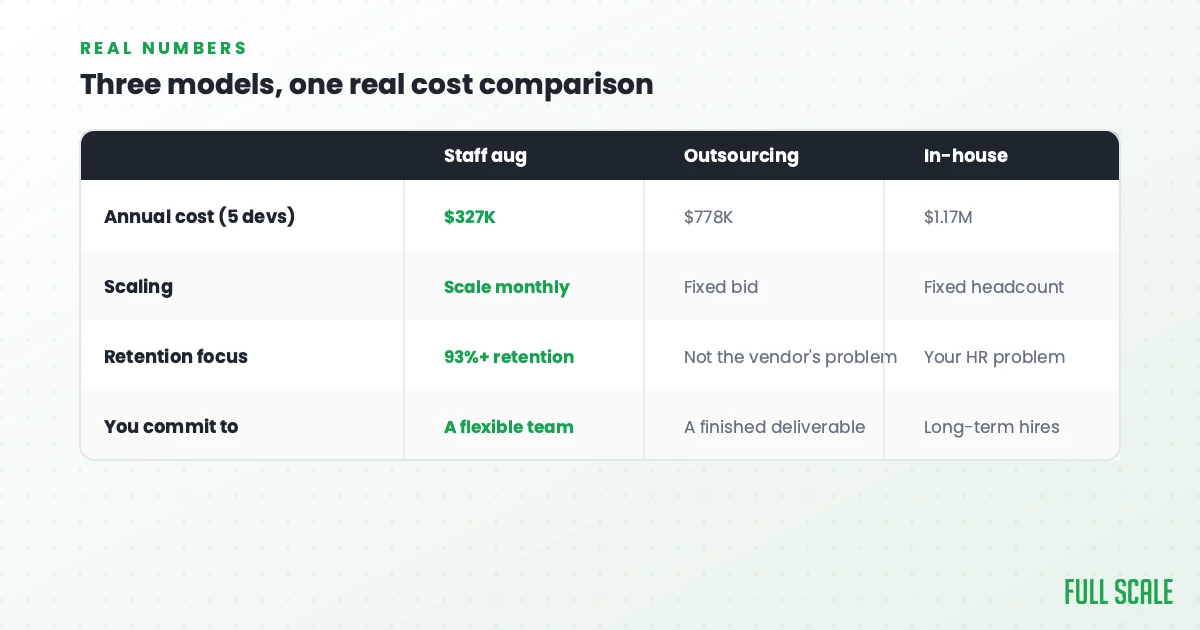
The Three Models: A Real Comparison
Let’s compare your actual options. Not just “offshore vs. onshore,” which is the wrong comparison when evaluating offshoring vs. outsourcing models.
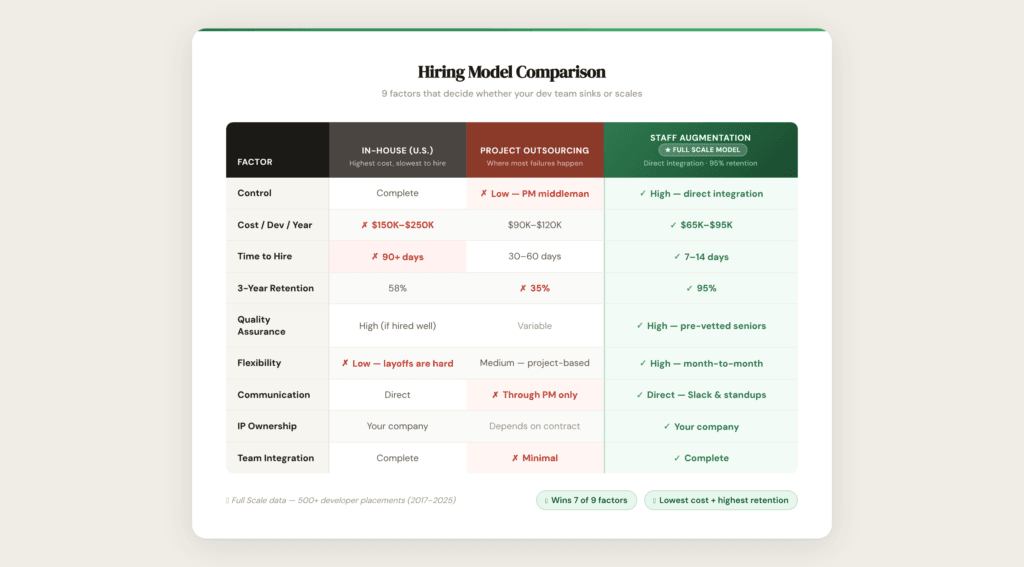
The Real Cost Breakdown
Let’s talk actual numbers. Because “offshore is cheaper” oversimplifies the offshoring vs. outsourcing cost comparison.
The true offshoring vs. outsourcing cost analysis must include hidden expenses.
Scenario: You need 5 senior developers for 1 year.
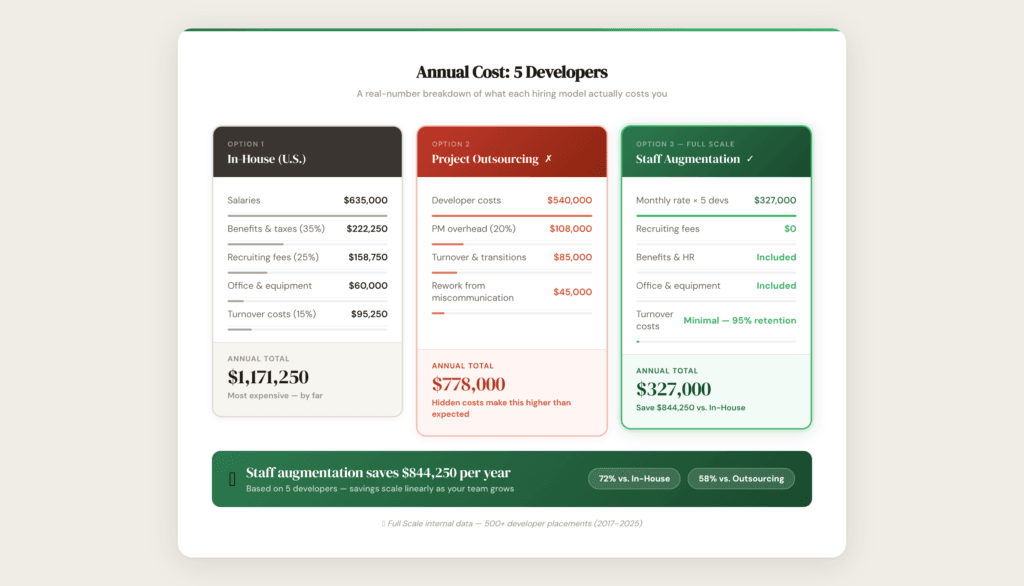
Plus: You scale up/down monthly. No layoff costs. No long-term contracts.
For a complete breakdown of offshore development costs with real data, see our 2025 cost analysis guide with ROI calculator.
The Direct Integration Model: Best of Both Worlds
Here’s how staff augmentation with Full Scale actually works, and why it resolves the traditional offshoring vs. outsourcing tradeoffs:
What “Direct Integration” Means
Your offshore developers are:
- On your Slack (not a separate communication platform)
- In your daily standups (not weekly client check-ins)
- Using your tools (GitHub, Jira, Figma, whatever you use)
- In your sprints (part of the team, not a separate workstream)
- Accountable to you (not to our project managers)
They’re indistinguishable from your U.S. remote employees. This is what makes offshoring vs. outsourcing outcomes so dramatically different.
For companies building custom apps, see our guide on offshore app development for how to set up a team that actually ships.
Here’s What Day 1 Looks Like
Week Before Start:
- We introduce you to vetted candidates
- You interview (yes, YOU interview, we don’t assign)
- You select team members
Day 1:
- Developers join your Slack
- Added to your GitHub/systems
- First standup with your team
- Begin working on actual tasks
Week 1:
- Participating in sprint planning
- Reviewing PRs with the team
- Asking questions in Slack
- Contributing to the actual product
No ramp-up project. No “shadow” period. They’re on your team from day one.
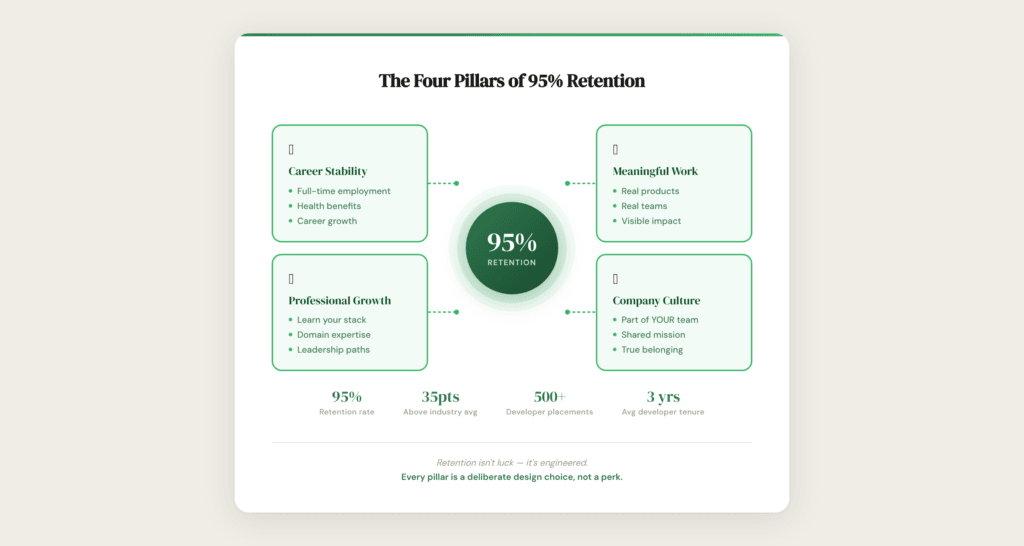
Why Retention is 93%+
Understanding offshoring vs. outsourcing at the retention level is critical.
Our developers stay because:
- Career Stability: They’re not project contractors wondering when the gig ends. They have full-time employment, health benefits, career development plans, and growth opportunities.
- Meaningful Work: They work on real products with real teams, not isolated “offshore projects.”
- Professional Growth: They learn your tech stack, domain, and processes. That knowledge compounds over the years.
- Company Culture: They’re part of your team culture, not outsiders looking in.
When developers feel like employees, they act like employees. That’s the difference between 60% retention and 93%+ retention.
We break down exactly how to build an offshore team that works and why staff augmentation succeeds where traditional offshoring vs. outsourcing models fail.
Now that you understand the Direct Integration Model, how do you decide which approach is right for YOUR company’s offshoring vs. outsourcing needs?
Should You Offshore, Outsource, or Keep In-House?
Start with these questions to navigate the offshoring vs. outsourcing decision:
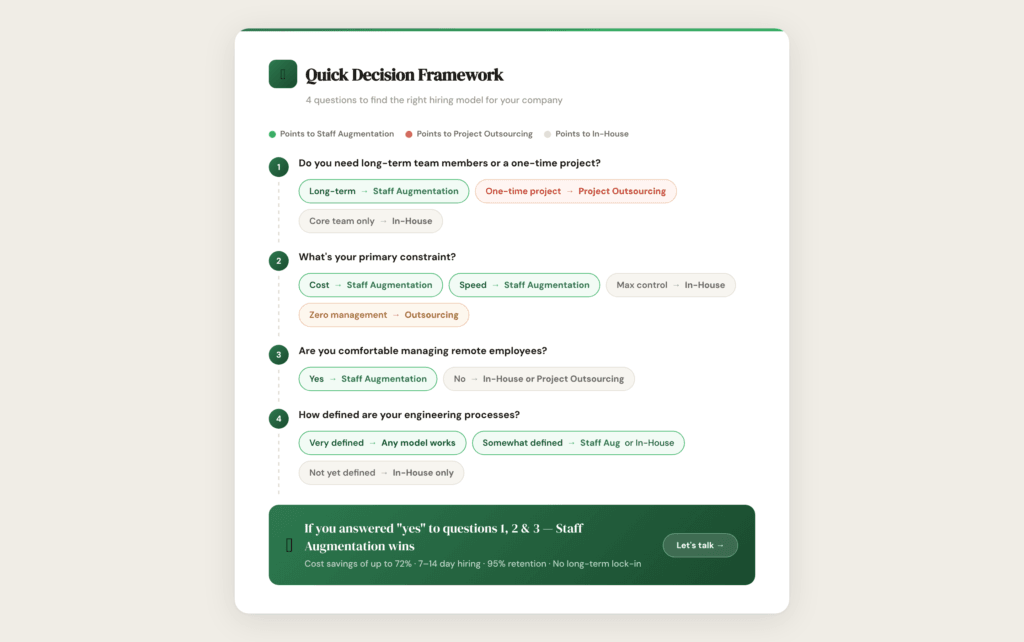
You’re Ready for Staff Augmentation If:
You successfully manage remote U.S. employees
You use Slack, Zoom, and collaboration tools
You have defined sprints, standups, or processes
You need to scale faster than local hiring allows
You want month-to-month flexibility
Don’t Offshore If:
You need daily in-person collaboration
Your work requires physical presence
You have zero remote work experience
You can’t articulate what you need built
You’re looking for “cheap” instead of “value”
We turn down companies that aren’t ready. Because forcing offshore when you’re not ready guarantees failure, and we don’t want that any more than you do.
For a deeper look at different engagement options, see our guide to offshore software development models that explains when each approach makes sense.
Common Objections Answered
Before you make your final offshoring vs. outsourcing decision, let’s address the concerns we hear most often:
“What about communication and time zones?”
Real concern: 12-hour time difference with the Philippines.
Reality: We solve this with overlap hours. Developers work during overlap with your timezone (typically 3-5 hours). They attend your daily standups live, are available on Slack during your working hours, and async work happens overnight.
Reality: When developers sit in your standups and answer in your Slack all day, communication stops being the problem people warn you about. The horror stories come from project outsourcing, where everything routes through a project manager, not from developers integrated directly into your team.
“How do I ensure code quality?”
Real concern: Can’t look over their shoulder.
Reality: Same quality processes as remote U.S. developers. Code reviews (every PR reviewed), automated testing (CI/CD pipeline), pair programming sessions, and regular architecture reviews.
Plus: Our 5-stage vetting process means you’re starting with senior developers, not hoping juniors level up. Quality comes from process and vetting, not from sitting in the same room.
“What about IP and legal issues?”
Real concern: Worried about IP protection offshore.
Reality: All contracts are U.S.-based (enforceable in U.S. courts). Your company owns all IP, code, and documentation. NDAs and IP assignment agreements are standard.
We’ve done 700+ placements. Zero IP issues.
“What if the developer isn’t a good fit?”
Real concern: Worried about being stuck with the wrong hire.
Reality: Month-to-month engagement (no long-term contract required). You can scale down anytime. We replace team members if needed. Trial period to ensure fit.
Risk is lower than in-house hiring, where you’re committed to salary + benefits for extended periods.
For more on avoiding common pitfalls, read our comprehensive guide on offshore development success with the 8 keys that determine whether your offshoring vs. outsourcing project thrives or fails.
2025-2026 Industry Statistics That Matter
The offshoring vs. outsourcing landscape is shifting rapidly. Here are the numbers driving offshoring vs. outsourcing decisions in 2026:
1. Market Growth: The global offshore software development market was valued at $120 billion in 2023 and is projected to grow to $389.7 billion by 2033 at a 12.5% CAGR. (Source: Market.us)
2. Skills Shortage Crisis: By 2026, IDC estimates 90% of businesses will be significantly impacted by the IT skills shortage, potentially losing $5.5 trillion globally. This makes offshore talent access a competitive necessity, not a cost-cutting tactic. (Source: IDC, 2025)
3. Hiring Speed Advantage: Staff augmentation models onboard offshore developers within 7-14 days, compared to traditional in-house recruitment, which takes 8-12 weeks. (Source: Grand View Research, 2025)
For a comprehensive primer on everything you need to know about offshore development, our complete guide covers the fundamentals of how offshoring vs. outsourcing decisions shape outcomes.
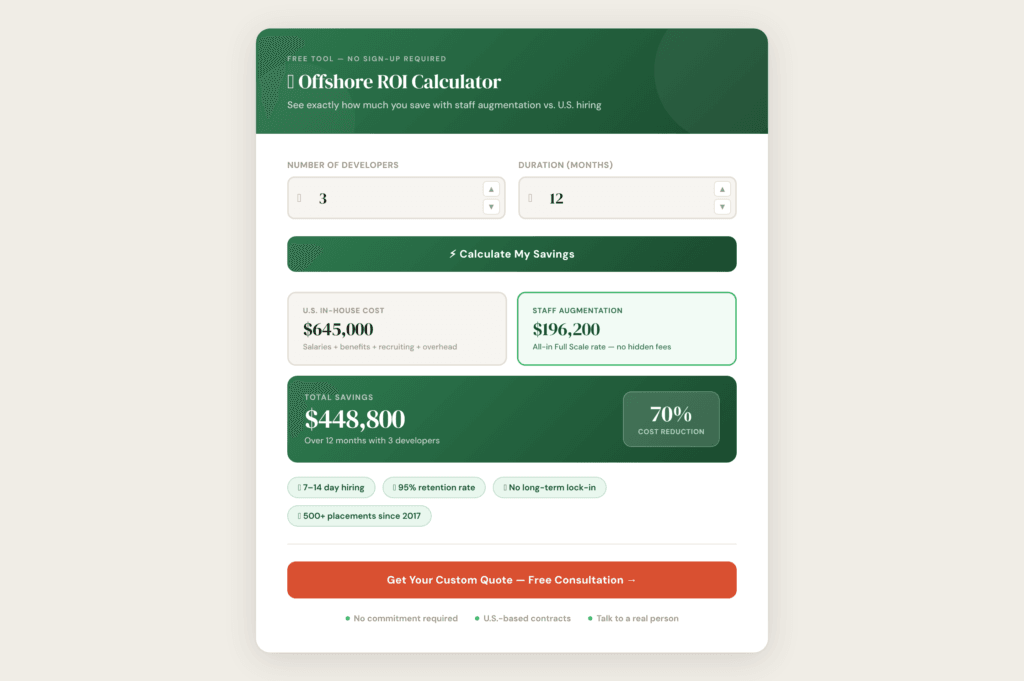
Why Partner With Full Scale
When comparing offshoring vs. outsourcing options, here’s what sets Full Scale apart:
- 93%+ annual retention (industry average: 60%)
- 700+ successful placements since 2018
- 7-14 day start time (vs. 90+ days for local hiring)
- Direct integration model: no middlemen, no project managers translating requirements
- Month-to-month flexibility: scale up or down without penalty
- U.S.-based contracts: full IP protection and legal enforceability
- Transparent pricing: flat monthly rate, no hidden fees, no hourly billing (See our pricing)
- Senior-only talent: less than 3% acceptance rate, rigorous 5-stage vetting
- Zero recruiting fees, ever
Ready to Build Your Offshore Team?
Scale your team without the hiring headaches.
Get a free assessment. No sales pitch. Just honest answers about offshoring vs. outsourcing for your situation.
FAQs on Offshoring
Is offshoring the same as outsourcing?
No. Offshoring is moving operations to another country (geography). Outsourcing is hiring an external company to do work (employment model). You can offshore without outsourcing by opening your own office abroad, or outsource without offshoring by hiring a local agency. The terms are often used interchangeably but represent different dimensions that dramatically affect outcomes. Understanding the distinction between offshoring vs. outsourcing is critical for making the right decision.
Why do offshore projects fail?
Most offshore failures stem from the project outsourcing model, not geography. Project outsourcing creates middlemen (project managers), a contractor mentality, and misaligned incentives. This leads to 40% annual turnover and communication breakdowns. Staff augmentation, where developers integrate directly with your team, achieves 93%+ retention because developers are treated as employees, not contractors. The key to success in offshoring vs. outsourcing is choosing the right integration model.
How much does offshore development cost compared to U.S. hiring?
Staff augmentation typically costs $5,450/month per developer, all-inclusive, versus $150-250/hour for equivalent U.S. hires. Total cost including benefits and overhead: approximately $327K annually for 5 developers offshore versus $1.17M in-house, roughly 70% savings. Project outsourcing can actually cost MORE than U.S. in-house once you account for turnover and transition costs. (See Full Scale pricing)
What’s the difference between staff augmentation and outsourcing?
Staff augmentation means developers work as direct extensions of your team. They join your Slack, attend your standups, use your tools, and report to you. Project outsourcing means you hire a company to deliver a project. You communicate through a PM, developers work on multiple clients, and they’re not integrated into your team. When evaluating offshoring vs. outsourcing options, this distinction determines outcomes. Retention reflects the difference: 93%+ vs. 60%. For proof, these famous outsourcing success stories show companies that got the model right.
How do you handle time zone differences?
Offshore developers work during overlap hours with your timezone (typically 3-5 hours daily). They attend your live standups, respond to Slack during your working hours, and complete focused work during non-overlap hours. This provides an advantage: your overnight becomes their productive coding time. The communication problems you hear about come from project outsourcing with a project manager in the middle, not from developers working directly on your team.
Is my company ready for offshore development?
You’re ready if: (1) you successfully manage remote U.S. employees, (2) you use collaboration tools (Slack, Zoom, Jira), (3) you have defined processes or sprints, and (4) you need to scale faster than local hiring allows. Don’t offshore if: you require daily in-person collaboration, have zero remote work experience, or can’t clearly define what you need built. A proper offshoring vs. outsourcing assessment starts with honest self-evaluation. If you check those boxes, the next step is finding offshore developers who ship instead of ones who just interview well.