
The Onsite and Offshore Model: 3 Ways to Staff It (and Which One to Pick)

In this article
- What the onsite and offshore model actually is
- The 3 ways to staff an onsite and offshore model
- Which of the three to pick comes down to one question
- How I learned this at Stackify
- What integration actually takes
- Handling the timezone without 8 hours of overlap
- Your first 30 days, week by week
- How teams run the hybrid with Full Scale
- Frequently asked questions
- Ready to build your onsite and offshore team?
Almost every article about the onsite and offshore model does the same thing. It tells you what the words mean, lists a few pros and cons, and stops.
That was never the hard part.
The hard part is deciding which version of it to run, because there are three of them, and they are not interchangeable. Pick the wrong one and you get the nightmare stories: walled-off vendors, a project manager playing telephone, code you can’t trust. Pick the right one and you get a team that ships.
I’ve run this model myself. Before I started Full Scale, I built a hybrid team at my last company, Stackify, with my leads in Kansas City and my developers spread across four countries. So this isn’t theory for me. It’s how I’ve operated for over a decade.
Here’s the whole decision in one question, and I’ll come back to it: do you already have engineering leadership in-house? Your answer picks the model for you.
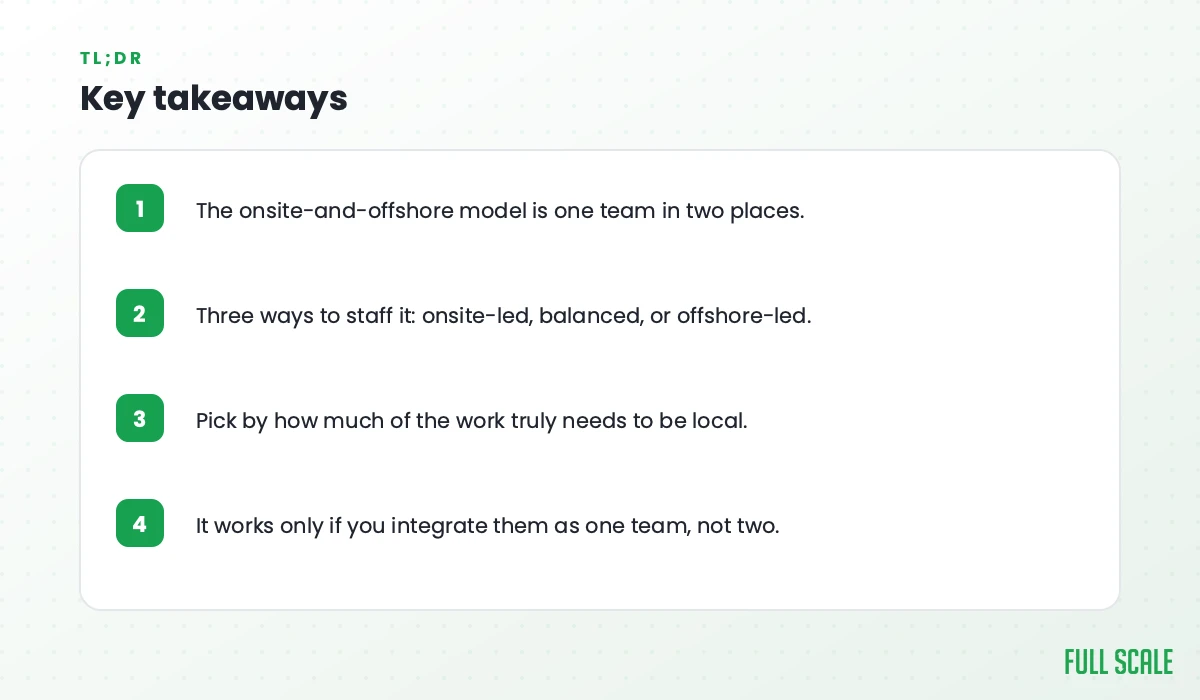
Quick Answer: The onsite and offshore model combines onsite leadership with an offshore development team, and it comes in three staffing versions: a fully vendor-managed team, a staff-augmentation hybrid where your own in-house leaders direct dedicated offshore developers, and a pure offshore team run under a US-based technical lead or fractional CTO. Which one to pick comes down to one question: do you already have engineering leadership in-house? If yes, the staff-augmentation hybrid is usually the best fit. If not, a fractional CTO over the remote team keeps you in control without a full-time executive salary. Full Scale runs the hybrid model, with dedicated developers running $4,000 to $10,000 a month, about 60% below a comparable US hire.
What the onsite and offshore model actually is
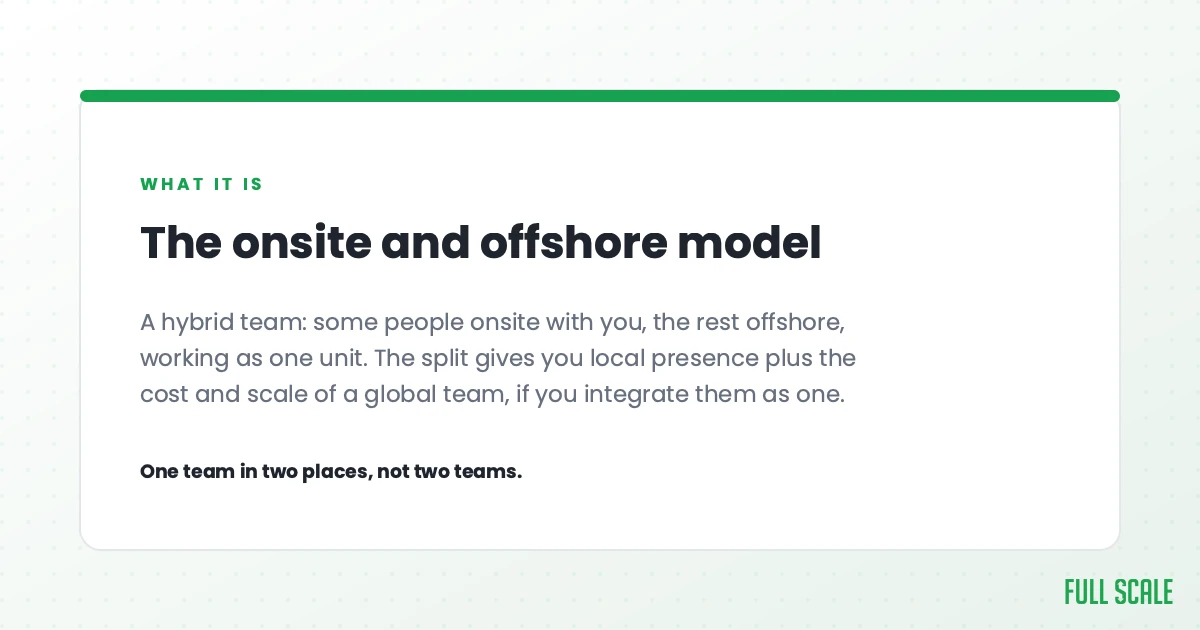
The onsite and offshore model is a way of building software where leadership stays close to the business and execution happens somewhere more affordable. The onsite side handles direction, requirements, and decisions. The offshore side handles the building: writing code, testing, and shipping.
The whole point is to keep strategic control near you while you extend your delivery capacity through a dedicated remote team. Done right, the two sides work as one group rather than as a client and a vendor staring at each other across a wall.
That last part is where most companies get it wrong. They treat the offshore team like a black box they throw tickets into, which is where most offshore arrangements run into trouble. The companies that succeed treat them like teammates who happen to live somewhere else.
The 3 ways to staff an onsite and offshore model
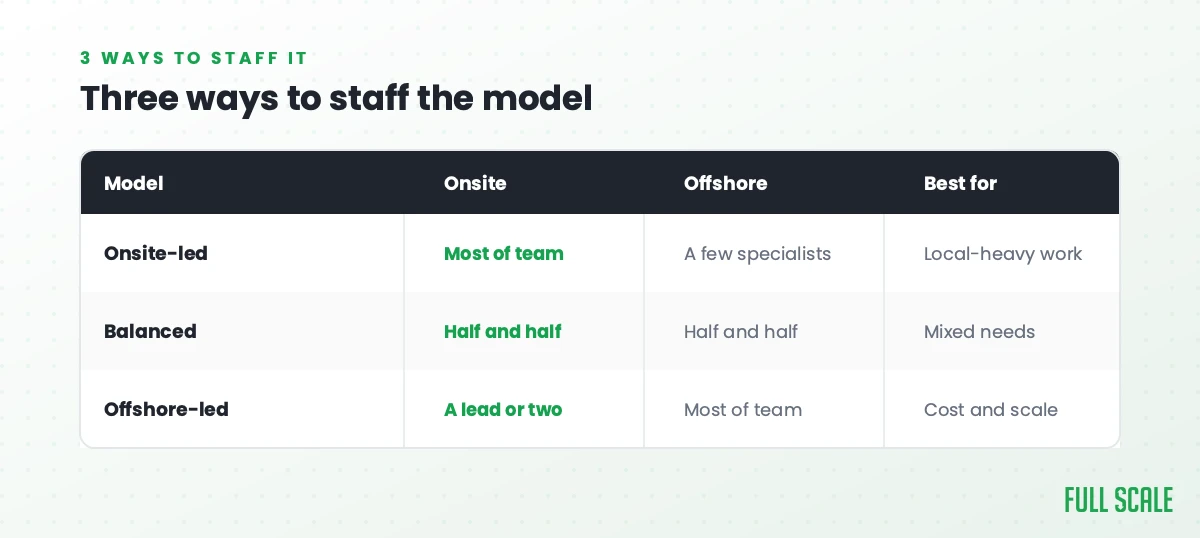
The reason the model confuses people is that “onsite and offshore” describes a shape rather than a staffing plan. There are three common ways to fill that shape, and the difference between them is who provides the people on each side.
Vendor-managed: you hand off everything
In the classic version, a single vendor staffs both sides. They put a project manager or business analyst in your office, and that person pushes work to the vendor’s own offshore developers. You hand over the management entirely and get finished work back.
This is fine for a scoped project you want off your plate. The catch is what you pay for it.
You’re paying US market rates plus a markup for that local vendor body, and that person sits between you and the people writing your code. Every question, every clarification, every bug report runs through them. You’ve added a game of telephone to your development process and paid extra for the privilege.
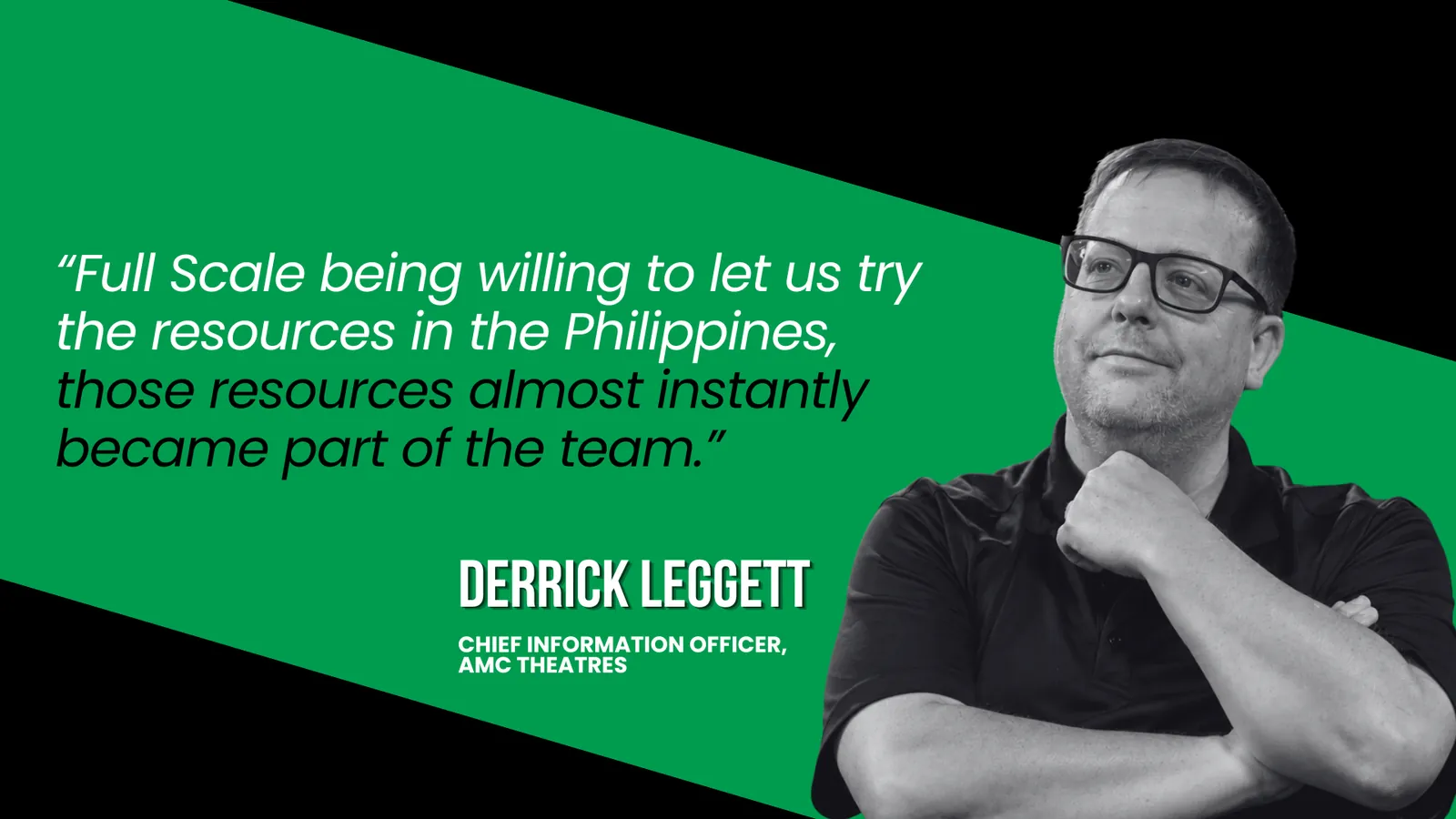
When AMC Theatres looked at traditional outsourcing, this is exactly what they rejected: engineers walled off behind an account manager, with roughly 30 to 40 percent overhead going to layers that never wrote a line of code.
Staff-augmentation hybrid: your leadership, their offshore team
In the second version, you keep your own leadership and bring in a dedicated offshore team that plugs into it. Your tech leads, architects, and product people stay in charge. The partner provides senior engineers who join your sprints, use your tools, and report to your managers. Some providers call this team augmentation, which is the same arrangement scaled past a single hire.
This is the version I’m a fan of, and it’s the model we run at Full Scale.
You keep direct control over architecture and code quality, because the people making those calls already work for you. You skip the premium you’d pay a vendor for a local lead you don’t need. And the offshore engineers aren’t rotating between three other clients, they’re dedicated to you and they stick around. That’s the heart of staff augmentation, and it’s why it beats project-based outsourcing for ongoing product work.
Pure offshore: you manage the remote team directly
The third version has no local footprint at all. The whole team is overseas and you manage them yourself through Slack, video calls, and your normal sprint process.
This is the cheapest of the three. It also asks the most of you. It only works if your internal team already has the bandwidth and the process to run a remote team well, with no one local helping carry the load. If that’s you, great. If it isn’t, this is the version that quietly falls apart around month three.
Here’s how the three compare on the things that actually matter when you’re choosing.
| What matters | Vendor-managed | Staff-aug hybrid | Pure offshore |
|---|---|---|---|
| Who leads | The vendor’s PM | Your own leaders | You, directly |
| Control over code and architecture | Low (through a middleman) | High (your leads decide) | High, if you have capacity |
| Cost | Highest (local rates + markup) | Moderate ($4K–$10K per developer) | Lowest |
| Who the developers report to | The vendor | Your managers | You |
| Best fit | A scoped, hand-it-off project | Ongoing product work with leadership in place | A team with spare leadership bandwidth |
| Developer retention | Varies by vendor | 93%+ at Full Scale | Depends entirely on you |
Which of the three to pick comes down to one question
Forget the feature charts for a second. The choice almost always comes down to a single thing.
Do you have engineering leadership in-house?
If you do, run the staff-augmentation hybrid. You have the people who can set direction, review code, and own the architecture, so you don’t need to rent a vendor’s project manager to do it badly. Bring in a dedicated offshore team and point your existing leaders at it.
If you don’t, you have two honest options. You can go vendor-managed and accept the markup and the middleman in exchange for not having to manage anyone. Or, and this is the move I’d actually recommend, you can put a US-based technical lead or a fractional CTO over the remote team.
I think the fractional-CTO route is underrated. Some of our clients at Full Scale do exactly this: they hire an experienced part-time leader to manage their remote engineers, and it gives them the control of the hybrid model without a full-time executive salary. It’s a genuinely good answer to “I want offshore but I don’t have anyone to lead it yet.”
The thing to avoid is choosing pure offshore when you have nobody to lead it. That’s wishful thinking, and it’s the most common way these setups fall apart.
How I learned this at Stackify
I didn’t read about the hybrid model. I built it, badly at first.
At Stackify, my last company, I had my team leads in Kansas City and my developers spread across Russia, Uruguay, Colombia, and eventually the Philippines. The key detail: those leads were my employees, sitting in my office. I wasn’t renting an onsite body from a vendor. It was local people managing remote people, all on the same team. That’s the staff-aug hybrid before I had a name for it.
Not every version worked. In Uruguay, I tried running things through a proxy product owner who sat between me and the developers. It was the vendor-managed problem in miniature: the person in the middle slowed everything down and softened every message. I learned fast that the middleman was the whole problem.
The Philippines team is the one that clicked. It grew past 20 developers and was a real part of why we exited Stackify in 2021. That experience is the whole reason Full Scale exists. The model that worked wasn’t the cheapest or the most hands-off. It was local leadership over a dedicated remote team.
What integration actually takes
Choosing the model is the easy half. Making the two sides feel like one team is where the work is, and it’s the part most companies skip.
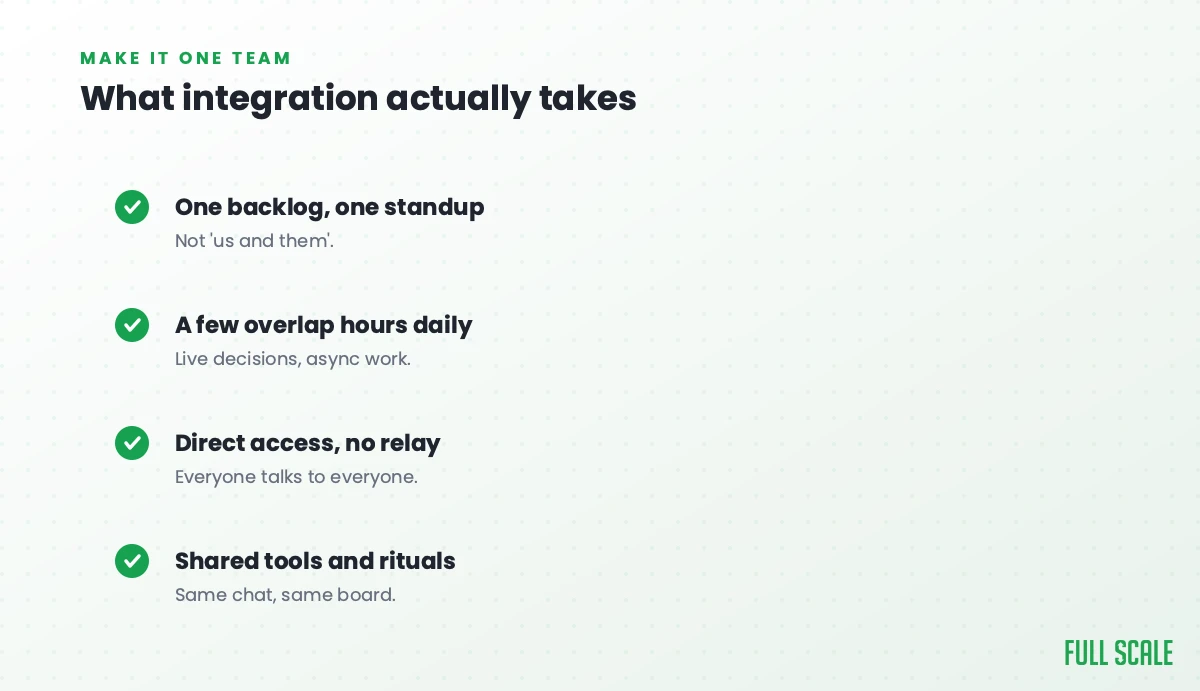
The non-negotiable is direct, daily contact. Your offshore developers should be in your Slack workspace, in your standups, and reviewing pull requests in your GitHub. They use your Jira, your coding standards, your deployment process. If everything still routes through a project manager, you don’t have an integrated team, you have outsourcing with extra steps.
Then comes the human side, which matters more than people expect. Give every new offshore developer a buddy on your local team for the first month. Put them in the team photo. Invite them to the casual channels too, the ones that have nothing to do with work. Developers who feel like teammates stay, and the ones who feel like contractors leave. That gap shows up in your retention within a year. Closing that gap is what most of the challenges of remote work culture really come down to.
AMC Theatres is the clearest example I can point to. Their CIO, Derrick Leggett, built a global engineering org where the Philippines-based engineers are treated as full AMC engineers, with no parallel vendor layer. As he puts it:
“It’s a fully integrated team. It’s just some of the people happen to be living in the Philippines.”
That’s the bar, and it sits higher than a vendor who simply delivers on time. It means one team where some of the people happen to live somewhere else.
One warning while you’re choosing. If the only reason you’re going offshore is to spend as little as possible, you’ll buy the cheapest thing you can find and it will fail. I call this cheapshoring, and it’s the single most common way these arrangements go wrong. Cost is a fair reason to hire offshore. It just can’t be the only reason.
Handling the timezone without 8 hours of overlap
The most common excuse I hear for not doing this is the timezone. People assume you need the whole workday to overlap. You don’t.
Communication itself is rarely the blocker, since the Philippines is the third-largest English-speaking country in the world. For a US team working with developers there, you need two to four hours of overlap, not eight. Use that window for the things that actually need to happen live: a daily standup and one planning or design sync. Everything else runs async.
Async work is a skill worth building on purpose, and the teams that treat it as a fallback never get good at it. Record your standups and planning calls so anyone can catch up. Use Loom for code walkthroughs and bug reproductions instead of forcing a live call. Write things down. A team that documents well barely feels the time gap. A team that relies on hallway conversations feels it constantly, and that’s a communication problem dressed up as a timezone one.
Your first 30 days, week by week
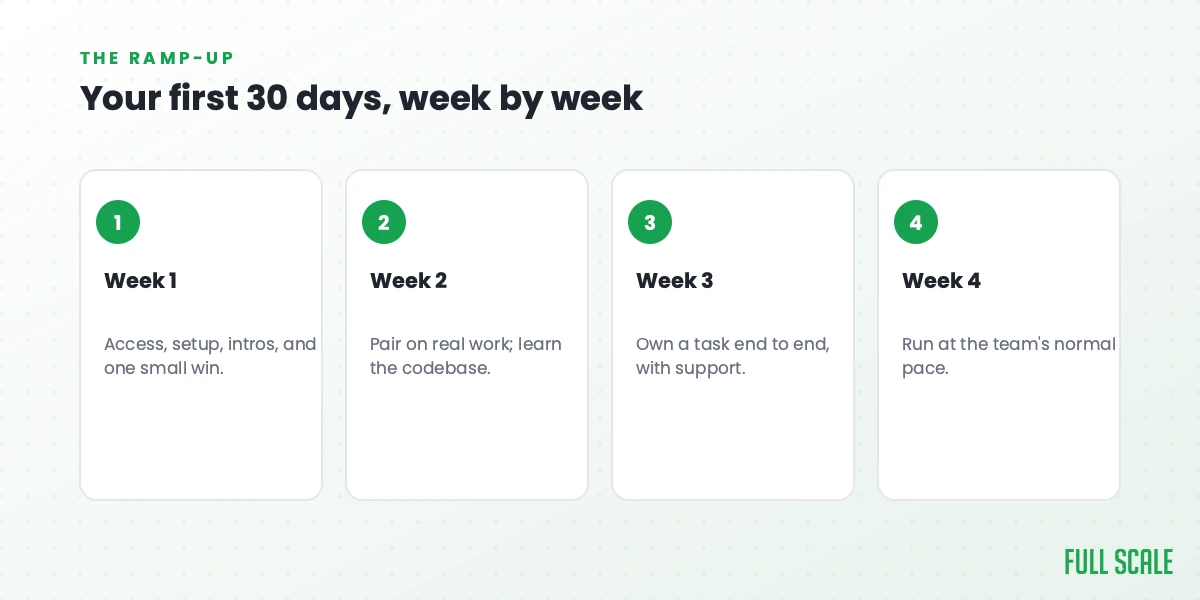
When you bring on an offshore team, the first month sets the tone. This is the rough framework we use, and it works whether you’re adding one developer or four.
| Week | Focus | What good looks like |
|---|---|---|
| Week 1 | Setup and first commits | Tools and access configured, buddy assigned, one or two small PRs merged, joining standups |
| Week 2 | Growing responsibility | Owning real sprint tickets, starting to review others’ PRs, estimating their own work |
| Week 3 | Full velocity | Same complexity as the rest of the team, unblocking themselves, visibly part of the group |
| Week 4 | Full integration | Indistinguishable from your local engineers, owning features end to end |
Spend the couple of weeks before day one on prep: access, documentation, a recorded codebase tour, and a clear plan for who the new developers talk to. The teams that prep are the teams whose developers are committing code in week one instead of week four, which is the fastest way to protect your development velocity.
How teams run the hybrid with Full Scale
If the staff-augmentation hybrid is the model you want, you can build it yourself or you can skip the setup. Building it from scratch means establishing a legal entity overseas, recruiting, vetting, payroll, benefits, and equipment, which is six months of work before anyone writes code.
Here’s what we handle so you don’t have to. We provide pre-vetted senior developers, typically five-plus years of experience, who passed technical assessments in your stack. You interview them and choose who joins your team. They integrate directly into your tools and process, with no project manager in the middle. We take care of payroll, benefits, HR, and equipment on the back end.
Every client also gets a customer success manager (CSM) whose job is to keep the relationship healthy. That layer is a big reason our developer retention sits above 93 percent, well clear of what you’d get rotating contractors. Developers who stay become experts in your codebase, and that compounds.
Pricing runs $4,000 to $10,000 per developer per month depending on experience, which usually works out to around 60 percent less than a comparable senior hire in the US. And if you don’t have leadership to run the team yet, we can help you sort that out too, including the fractional-CTO route.
Frequently asked questions
What is the onsite and offshore model?
The onsite and offshore model is a software delivery approach that combines onsite leadership with an offshore development team. The onsite side handles direction, requirements, and decisions, while the offshore side handles the building, testing, and shipping. The goal is to keep strategic control close to the business while extending capacity through a more affordable remote team.
How is the onsite and offshore model different from traditional outsourcing?
Traditional outsourcing usually puts a vendor’s project manager between you and the developers, separates the workflows, and treats the engineers as contractors who rotate between clients. A well-run onsite and offshore model gives you direct access to dedicated developers who use your tools and processes and report to your leaders. The difference is integration: one team instead of a client and a vendor. We break down the broader offshore vs outsource distinction separately.
Which onsite and offshore model should I choose?
It depends on whether you have engineering leadership in-house. If you do, the staff-augmentation hybrid is usually the best fit, because your own leaders direct a dedicated offshore team. If you don’t, you can either hand everything to a vendor or put a US-based technical lead or fractional CTO over the remote team, which keeps you in control without a full-time executive salary.
How do you handle timezone differences with an offshore team?
You need two to four hours of overlap for live work rather than a full shared workday. Use that window for a daily standup and one planning or design sync, and run everything else asynchronously with recorded meetings, written documentation, and tools like Loom. For US teams working with the Philippines, an early-morning US window lines up well with the Manila afternoon.
What does the onsite and offshore model cost?
With Full Scale, dedicated developers run $4,000 to $10,000 per month depending on experience level. That typically comes in around 60 percent below the fully loaded cost of a comparable senior developer in the US. There’s no vendor markup for a local project manager you don’t need, since your own leaders run the team.
Ready to build your onsite and offshore team?
The model isn’t complicated once you know which version fits you. If you have leadership in place, run the staff-augmentation hybrid and bring in a dedicated team. If you don’t, get a leader over the remote team first, then build. Once leadership is in place, most of the value comes down to finding dedicated offshore developers through a partner who already vets for it.
If you want help figuring out which version fits your situation, book a 15-minute call and we’ll talk through it.