The Offshoring Manual: The Guide Every CTO Needs to Read (Because We Have the Model That Actually Works)
Most CTOs think offshoring failed them. Wrong.
The factory model they used failed them. According to Deloitte’s 2024 Global Outsourcing Survey, 59% of companies report dissatisfaction with offshore outcomes. Gartner found that 67% require significant rework.
The problem? They blamed geography when they should have blamed the model.
Here’s what changed: Companies achieving 95% retention aren’t doing traditional offshoring. They’re using staff augmentation. I learned this the hard way after building VinSolutions.
The difference between these models isn’t subtle. It determines everything.
What You'll Learn in This Guide
Let’s start with the fundamental definition most companies get wrong:
What Is Offshoring? (The Answer You Haven't Heard)
Offshoring is hiring developers in another country to work for your company. But here’s what matters: the MODEL determines success, not geography. Staff augmentation (developers as full-time team members) achieves 95% retention. Traditional outsourcing (project-based with middlemen) fails 67% of the time, according to Gartner research.
Most articles define offshoring as “delegating work to another country.” True. But incomplete.
The critical distinction they miss: Offshoring describes WHERE developers work. The model describes HOW they work with you.
Three offshore models exist: project outsourcing, contractor platforms, and staff augmentation. Geography isn’t your problem.
The factory model is.
I’ve watched hundreds of CTOs blame “offshore development” after failed projects. They used project outsourcing with three layers of middlemen.
That’s not an offshoring failure. That’s a model failure wearing an offshore label.
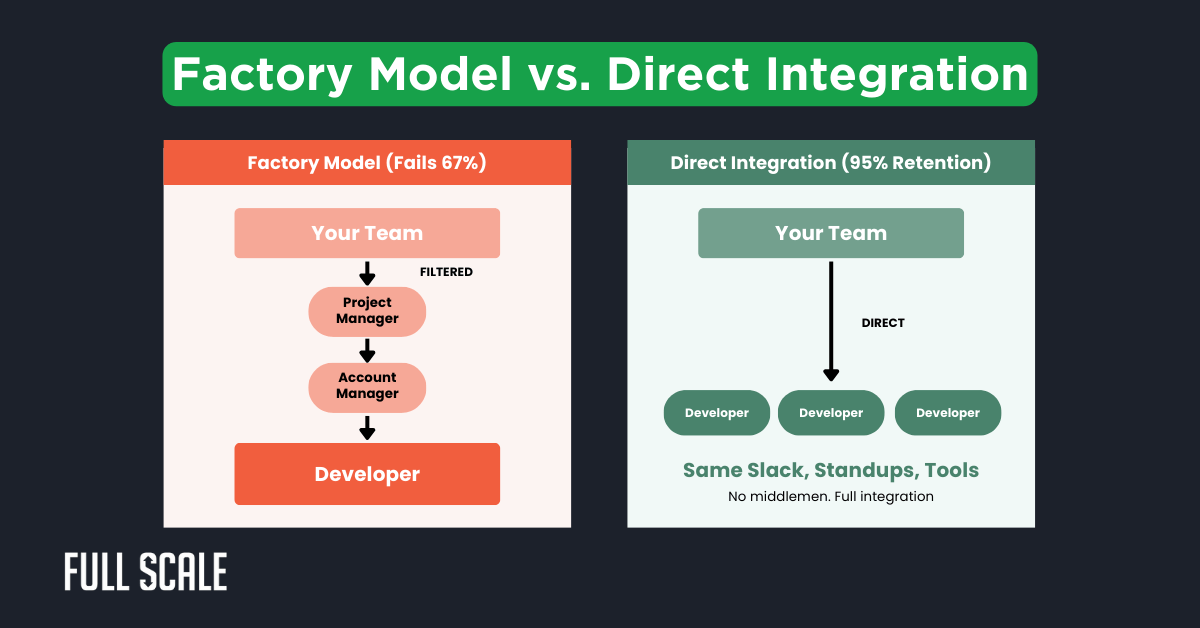
This graph comparison illustrates the fundamental difference between models. Factory models insert multiple management layers that filter communication and create distance. Direct integration eliminates these barriers entirely, connecting your team directly to developers.
The image tells the story. Factory models insert barriers between you and developers. Direct integration eliminates them.
Simple. Effective.
Now that you understand the critical distinction, here’s where confusion starts—most people conflate offshoring with outsourcing:
Offshoring vs. Outsourcing vs. Staff Augmentation
Let’s clear up the confusion killing offshore projects.
Offshoring vs. Outsourcing: Not the Same Thing
Offshoring = WHERE work happens (geography). Outsourcing = WHAT you delegate (function).
You can outsource locally OR offshore. The question “offshoring vs. outsourcing” misses the point.
Ask instead: “What MODEL am I using?” That determines success.
The Three Offshore Models (And Why Two Fail)
1. Project Outsourcing (67% failure rate)
You hand off a project to a vendor. They assign it to developers juggling 3+ clients simultaneously.
Project managers become translators. Communication breaks down. Quality suffers.
According to Grand View Research, the global IT outsourcing market will reach $731 billion by 2025. Yet satisfaction remains below 50%. The model itself creates failure.
Hidden costs: rework (40-50% of project cost), turnover (40% annually), management overhead, and communication delays.
2. Contractor Platforms (60% annual turnover)
You hire freelancers through marketplaces. They disappear mid-project. No loyalty.
No continuity. Constant recruiting cycle.
Average contractor stays 8-12 months. You lose knowledge with every departure. The race to find “cheap” talent creates expensive instability.
3. Staff Augmentation (95% retention)
Developers become full-time extensions of your team. Employment model. Single focus.
Direct integration. This is what Full Scale does with staff augmentation.
Why it works: Career development opportunities. Competitive local compensation. One company means deep domain knowledge.
Developers treated like teammates, not vendors.
Three Offshore Models Comparison
| Factor | Project Outsourcing | Contractor Platforms | Staff Augmentation |
|---|---|---|---|
| Control Level | Low (PM middleman) | Medium (direct but transient) | High (your team) |
| Retention | 40% after 1 year | 60% annual turnover | 95% over 3 years |
| Start Time | 4-12 weeks | 1-4 weeks | 7-14 days |
| Cost Transparency | Hidden fees common | Hourly rates vary | Fixed monthly |
| Developer Focus | Multiple clients | Project-hopping | Single company |
This comparison table clearly shows why staff augmentation outperforms other models. High control, exceptional retention, and rapid start times create a foundation for long-term success.
Key Insights from Table:
- Control: Staff augmentation provides "High" control vs. "Low" for project outsourcing
- Retention: 95% over 3 years vs. 40-60% for other models
- Speed: 7-14 days to start vs. 4-12 weeks for project outsourcing
- Transparency: Fixed monthly pricing vs. hidden fees or variable hourly rates
- Focus: Single company dedication vs. divided attention across multiple clients
I’ve tried all three models. Two burned me badly. One built successful companies.
The difference shows immediately. Project outsourcing creates distance. Staff augmentation creates teammates.
Simple as that.
Now that the models are clear, let’s examine what benefits make this approach worthwhile:
Offshoring Pros and Cons (The Honest Breakdown)
Every offshore article lists generic benefits. No one mentions this: benefits only apply when you use the right model.
Most “cons” are actually cons of project outsourcing. Not offshoring itself.
The Real Offshoring Benefits (When Done Right)
Benefit 1: 60-70% Cost Savings (Without Sacrificing Quality)
Senior developer in the Philippines: $75,000/year (Full Scale pricing). Same skill level in the US: $153,000/year.
That’s 51% savings on direct costs.
But here’s the critical distinction: cheap offshore fails. Market-rate offshore wins. Companies paying below-market rates get 60% annual turnover.
Full Scale’s 95% retention over 3 years proves employment model matters more than geography. We pay competitive rates for senior talent in the Philippines.
Benefit 2: 14-Day Start Time vs. 90-Day Local Hiring
Pre-vetted talent pools eliminate recruitment bottlenecks. One client needed 3 developers by Q1.
Started December 15. Fully productive January 1.
Local hiring timeline: 90 days average. Offshore staff augmentation: 7-14 days. The difference captures Q1 revenue instead of missing deadlines.
Benefit 3: Access to 84% of Global Developer Talent
The US has 4.4M developers. The world has 26.9M developers.
Hiring locally means competing for 16% of available talent. Specific skills (React, Python, DevOps) become easier to find.
The Philippines specifically produced 90,000 new engineers in 2024, according to market research. Eastern Europe adds 250,000 annually.
Benefit 4: 95% Retention = Knowledge Stays With Your Team
Industry average retention: 60% stay 1+ years. Full Scale: 95% stay 3+ years.
Why? Employment model creates career paths. Competitive local compensation matters.
Single company focus builds loyalty. Every developer who leaves costs $40,000-$60,000 in replacement expenses (2024 SHRM research).
High retention isn’t just convenience. It’s a massive cost avoidance.
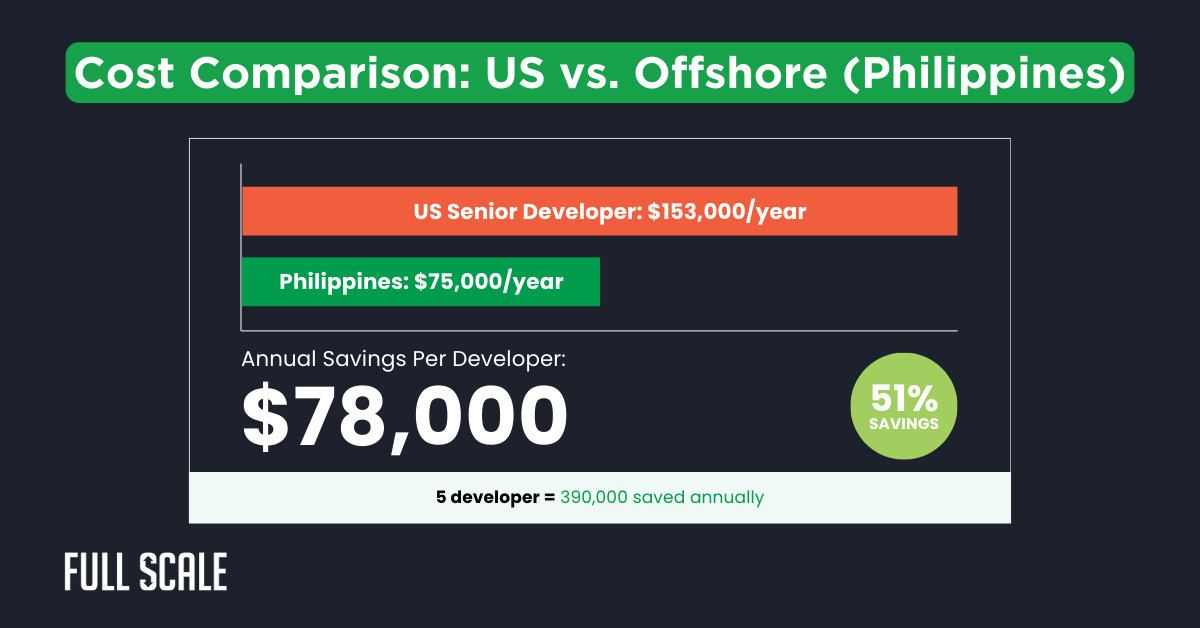
This cost breakdown visualization demonstrates real savings at scale. Five offshore developers at market rates save $390K annually versus US hiring. That’s a full-time tech lead’s salary available for reinvestment.
The numbers don’t lie. Five offshore developers at market rates save $390K annually vs. US hiring.
That’s a full-time tech lead’s salary.
The Real Offshoring Problems (And How to Avoid Them)
Problem 1: “Communication will be terrible”
What’s actually true: Project outsourcing creates communication barriers. Middlemen filter everything.
What’s false: Geography creates barriers.
The fix: Direct integration eliminates this completely. Developers, join your Slack. Attend your standups. Use your tools.
The Philippines specifically offers a 4-6 hour overlap with US time zones. Developers adjust schedules for critical meetings. English proficiency ranks top 20 globally (EF EPI Index).
Problem 2: “Developers leave constantly”
What’s actually true: Contractor models create 60% annual turnover.
What’s false: Offshore inherently means high turnover.
The fix: Employment model with career paths. Full Scale’s 95% retention over 3 years beats US local hiring retention.
How? Full-time W2-equivalent employment. Comprehensive benefits. Clear advancement opportunities.
Data point: Developers promoted to lead roles stay 8+ years on average.
Problem 3: “I’ll lose control”
What’s actually true: Outsourcing models remove control by design. Project managers gatekeep developers.
What’s false: Offshoring equals loss of control.
The fix: Staff augmentation = your team, your control. You manage directly.
No intermediaries. No “we’ll get back to you.”
One client runs their entire backend infrastructure offshore. Kubernetes, microservices, 99.99% uptime. The offshore team handles on-call rotation for production systems.
If they trust offshore developers with production at 3 AM, maybe your “too complex for offshore” theory needs updating.
Problem 4: “Time zones kill productivity”
What’s actually true: Zero overlap kills productivity.
What’s false: All offshore locations have zero overlap.
The fix: The Philippines provides 4-6 hours daily overlap with the US. Developers adjust schedules for standups.
Async communication tools (Slack, Jira) handle non-urgent items. Smart CTOs exploit time zones for follow-the-sun development.
The San Francisco team deploys on Friday at 5 PM. The Manila team monitors real weekend traffic. SF wakes Monday to production-ready improvements.
Problem 5: “IP security risks”
What’s actually true: Contractor relationships have legal gaps.
What’s false: Geography creates IP risk.
The fix: US-based contracts where American IP law applies. Employment models provide stronger legal protection than contractor relationships.
Full Scale specifics: SOC2 compliance. US entity holds all contracts. Developers sign comprehensive NDAs. IP ownership transfers completely to clients.
According to 2024 compliance audits, a proper contract structure eliminates geographic IP risk entirely. The risk comes from the relationship type, not the location.
These challenges are manageable with proper planning. Successful companies view them as setup requirements, not barriers. Full Scale’s processes address each challenge systematically.
Now that you understand both benefits and challenges, let’s explore location selection:
Offshore vs. Nearshore vs. Onshore (Which Model Fits Your Needs)
The location question deserves honest analysis. Not every company needs the same solution.
Offshore vs. Nearshore vs. Onshore Comparison
| Factor | Onshore | Nearshore | Offshore |
|---|---|---|---|
| Cost Savings | 0-20% | 30-50% | 60-70% |
| Time Zone Overlap | 8 hours | 6-8 hours | 4-6 hours |
| Start Time | 60-90 days | 30-45 days | 7-14 days |
| Talent Pool Size | Small (4.4M US) | Medium | Largest (26.9M global) |
| Best For | Compliance-heavy industries | Real-time collaboration priority | Maximum scale + savings |
This location comparison helps determine the best fit for your specific needs. Each option offers distinct advantages depending on your priorities around cost, collaboration, and speed.
Key Insights from Table:
- Cost Savings: Offshore delivers 60-70% savings vs. 0-20% onshore (3-6x better ROI)
- Speed to Start: Offshore at 7-14 days vs. 60-90 days onshore (6x faster)
- Talent Access: Offshore provides access to 26.9M global developers vs. 4.4M US-only
- Trade-offs: Onshore has 8-hour overlap vs. offshore's 4-6 hours (but still sufficient)
- Use Case: Each model serves different needs—offshore optimizes for scale and savings
When to Choose Each Model:
🏢 Choose Onshore if:
- Regulatory requirements absolutely demand it (government contracts, specific healthcare)
- Budget isn't the primary concern
- You need 8-hour daily overlap for real-time pairing
🌎 Choose Nearshore if:
- You want cost savings but need maximum timezone overlap
- Latin America proximity matters for occasional travel
- Cultural similarity is priority #1 over cost
🌏 Choose Offshore if: ⭐ RECOMMENDED
- Cost savings 60%+ are critical to your business model
- You need access to largest global talent pools
- 4-6 hour overlap provides sufficient collaboration window
- You're comfortable with proven remote practices
💡 Comparison Details:
| Model | Primary Advantage | Primary Trade-off |
| Onshore | Maximum timezone overlap (8 hours) | Highest cost, smallest talent pool |
| Nearshore | Good overlap (6-8 hours), moderate savings | Higher cost than offshore, smaller talent pool |
| Offshore | Maximum savings (60-70%), largest talent pool | Less timezone overlap (but still workable at 4-6 hours) |
🎯 Strategic Messaging Impact:
This table provides balanced comparison while strategically highlighting offshore advantages. It doesn't dismiss onshore or nearshore—instead, it positions them as valid choices for specific use cases (compliance, real-time collaboration) while making offshore the obvious choice for companies prioritizing scale, speed, and savings. The green highlighting on Cost Savings (60-70%), Start Time (7-14 days), Talent Pool (26.9M), and Best For (Maximum scale + savings) creates visual anchors that reinforce the offshore value proposition without being heavy-handed. Readers see all options fairly presented, but offshore advantages are impossible to miss.
Ready to Explore Offshore Development?
Schedule a free consultation to discuss your team needs and discover how offshore developers can accelerate your projects while reducing costs by 60-70%.
Schedule Your Free ConsultationI chose the Philippines offshore for Full Scale because 4-6 hour overlap works perfectly when processes are right. The 60%+ savings and talent access matter more than perfect timezone alignment.
Companies successfully running 24/7 operations with offshore teams prove that timezone differences become advantages, not obstacles.
With location factors clear, let’s move to the practical implementation steps:
Offshoring Best Practices (The 5 Non-Negotiables for Success)
After 500+ developer placements, we’ve identified 5 factors separating 95% retention from 40% failure rates.
Miss even one and success odds drop to coin-flip territory.
Best Practice 1: Choose the Right Model (Staff Augmentation, Not Outsourcing)
Model choice is the number one predictor of success. Everything else becomes easier or impossible based on this decision.
Red flags indicating wrong model:
- “Project managers will handle communication”
- “Account managers coordinate between teams”
- “Developers come from our bench”
Green flags indicating the right model:
- “Developers work directly with your team”
- “You manage them day-to-day”
- “They’re dedicated to you only”
Staff augmentation means developers become full-time employees (or local equivalent). Not contractors juggling multiple clients.
Best Practice 2: Direct Integration From Day One
Communication barriers kill 67% of offshore projects, according to Gartner. Eliminate barriers by making offshore developers part of your team immediately.
Specific implementation:
- Add to Slack on day 1
- Include in daily standups
- Grant the same tool access as the local team
- No separate “offshore team” channels
- Same code review processes
One client integrates developers into daily standups within 48 hours. Treats them identically to the San Francisco team.
Result: developers can’t tell who’s offshore without asking.
Best Practice 3: Hire at Market-Appropriate Rates (Not “Cheap”)
Cheap offshore creates 60% turnover. Market-rate offshore creates 95% retention. The math is simple.
The Philippines’ senior developer market rate: $50-70/hour, fully loaded. Still 60-70% cheaper than US $150-250/hour.
But attracts and retains senior talent. According to the 2025 market analysis from Near and DistantJob, companies paying below-market offshore rates spend more on turnover than they save on salaries.
Best Practice 4: Employment Model With Career Growth
Contractors leave. Employees stay. The distinction determines retention.
Full Scale specifics:
- Full-time W2-equivalent employment
- Comprehensive benefits package
- Clear advancement paths to lead roles
- Technical specialist tracks
- Annual performance reviews with raises
Data point: Developers promoted to lead roles have 8+ years of average tenure. Career growth opportunity matters as much as compensation.
Best Practice 5: Treat Them Like Your Team (Because They Are)
“Vendor mindset” creates outsider syndrome and drives turnover. “Teammate mindset” creates 95% retention.
Specific actions:
- Include in the company all-hands meetings
- Celebrate wins together
- Same performance review process
- Send company swag
- Invite to team events (virtual or in-person)
What NOT to do: use “offshore team” vs. “our team” language. That linguistic separation creates psychological separation.
One client includes offshore developers in company offsites. Flies them to the US annually.
Treats them as core team members. Result: zero voluntary departures in 4 years.
The companies that fail to treat offshore developers like vendors. The companies with 95% retention treat them like teammates.
Simple as that.
Now let’s walk through the practical implementation process:
How to Start Offshoring (Without the Usual Disasters)
De-risking offshore starts with proper planning. Here’s the 4-step framework for preventing disasters.
How to Start Offshoring
Your 4-Step Framework to Prevent Disasters
Test the model before scaling. Identify non-critical but real project work.
Client started with 2 React developers on feature work. Proved integration model in Q1. Scaled to 12 developers by Q2 based on success.
Why Start Small?
- Test integration processes with minimal risk
- Validate communication workflows
- Build confidence before major investment
- Identify potential issues early
✗ If <90%, walk away
✓ Full Scale: 95%
✓ Answer should be NO
Single focus ensures deep domain knowledge
✓ You should
Partner handles HR/admin, you manage work
✓ Month-to-month shows confidence
Long-term commitments hide poor retention
✓ Answer should be YES
You choose who joins your team
- Lines of code
- Hours worked
- PRs merged
- Features shipped
- Code quality metrics
- Team feedback
- Retention rates
- Velocity improvement
Honest assessment prevents wasted time and money.
- Your team is 100% co-located by choice and works perfectly
- You have unlimited budget and zero hiring pressure
- Regulatory requirements truly prevent it (rare)
- You're not willing to implement proper remote practices
If you're not ready to treat offshore developers like real team members, don't offshore. You'll waste money and blame geography when the problem was your approach.
Ready to Start Your Offshore Team?
Book a free consultation to discuss your specific needs
Schedule Free ConsultationIf you’re not ready to treat offshore developers like real team members, don’t offshore. You’ll waste money and blame geography when the problem was your approach.
That’s my honest take after 20 years of building offshore teams.
Offshoring Works When You Fix the Model
Offshoring doesn’t fail. The factory model fails.
Geography isn’t the problem. Middlemen, contractors, and project-based thinking are the problem.
95% retention becomes possible when developers are full-time team members, not vendors.
Three things determine success:
- Model choice: Staff augmentation beats project outsourcing
- Direct integration: Your team, your tools, your culture
- Employment structure: Employees stay, contractors leave
The data proves it: 60-70% cost savings, 7-14 day start times, 95% retention over 3 years across 500+ placements.
I avoided offshoring for years because of horror stories. Then I learned those were outsourcing horror stories.
Once I understood the difference between models, offshoring became my competitive advantage. It’s how I built VinSolutions’ engineering team.
It’s why Full Scale exists today.
If you’re ready to build a real team that happens to work from another country, offshoring might be the best scaling decision you make this year.
But here’s my honest final caveat: If you’re not ready to treat offshore developers like team members, don’t offshore. Save yourself the money and frustration.
With implementation clear, here’s why partnering with Full Scale makes this easier:
Why Partner With Full Scale?
Full Scale fixes what traditional offshoring breaks. Here’s how we’re different:
95% Retention Over 3 Years
- Industry average: 60% stay 1+ years
- Employment model, not contractor relationships
- Career development and advancement opportunities
7-14 Day Start Times
- Pre-vetted senior talent pool ready to interview
- No recruitment delays
- Faster than local hiring’s 60-90 days
Direct Integration, No Middlemen
- Developers join your Slack, standups, and tools immediately
- You manage them directly
- No project managers are filtering communication
Transparent Pricing
- Fixed monthly rates starting at $75,000/year per senior developer
- No recruiting fees, no hidden costs
- 51% savings vs. US hiring ($153,000/year average)
Philippines-Based Advantage
- 4-6 hour overlap with US time zones
- 97% English proficiency, minimal accent
- Western business culture alignment
Full Employment Benefits
- Comprehensive healthcare and benefits
- Career growth tracks and mentorship
- Competitive local market compensation
SOC2 Compliance & US Contracts
- All contracts under US jurisdiction
- Complete IP protection
- Enterprise-grade security standards
500+ Successful Placements
- Proven integration framework
- Customer Success Managers for ongoing support
- Development Managers for technical mentoring
Ready to Build Your Offshore Team?
See how we achieve 95% retention with direct integration.
Nearshore means neighboring countries with similar time zones (US→Mexico, US→Colombia). Offshore involves greater geographic distances (US→Philippines, US→India). Nearshore offers 6-8 hours of overlap for easier real-time collaboration. Offshore maximizes cost savings at 60-70% versus nearshore’s 30-40%. Choose nearshore if constant real-time collaboration is critical. Choose offshore for maximum savings and the largest talent pools.
Offshoring typically saves 60-70% compared to US hiring when done correctly. A senior developer in the Philippines costs $75,000/year fully loaded vs. $153,000 in the US (Full Scale pricing). However, “cheap” offshore (under market rate) creates high turnover and fails. The savings come from geographic cost-of-living differences, not cutting corners. Five developers save $390,000-$450,000 annually with proper implementation.
The biggest risk is using the wrong model. Project outsourcing with middlemen fails 67% of the time, according to Gartner. Staff augmentation (developers as full-time team members) achieves 95% retention. Most “offshoring failures” are actually outsourcing model failures. Choose the model carefully, and the geography becomes low risk. The model determines outcomes more than location.
Philippines-based offshore teams provide 4-6 hours of overlap with the US time zones. Developers adjust schedules for important meetings and attend daily standups. Key: Use async communication tools (Slack, Jira) for non-urgent items and reserve overlap hours for real-time collaboration. Proper time zone management enables 24/7 productivity through follow-the-sun development. Smart companies exploit time zones as advantages.
Communication problems stem from project outsourcing models with middlemen, not from offshoring itself. Direct integration eliminates this: developers join your Slack, attend your standups, use your tools. The Philippines specifically offers high English proficiency (ranked top 20 globally by EF EPI). Model choice determines communication quality, not geography. With proper integration, communication works identically to remote US teams.
With staff augmentation and pre-vetted talent pools, offshore hiring takes 7-14 days from decision to developer start date. This beats local hiring’s 60-90 day average. Process: define requirements, interview pre-screened candidates, and onboard selected developers. Pre-vetting eliminates the recruitment bottleneck while maintaining quality standards. Full Scale’s hiring process moves 6x faster than traditional recruitment.
Yes. Many companies run entire backend infrastructures, microservices, and AI systems offshore. The “offshore is only for simple work” belief is outdated. Senior offshore developers handle production systems, architecture decisions, and complex features daily. Quality depends on hiring senior talent at market rates, not on geography. One Full Scale client runs 99.99% uptime Kubernetes infrastructure entirely offshore with on-call rotation at 3 AM.
IP protection comes from contract structure, not geography. Use US-based contracts where American IP law applies. Employment models (staff augmentation) provide stronger legal protection than contractor relationships. Additional safeguards: comprehensive NDAs, code ownership clauses, SOC2 compliance. Full Scale uses US entity contracts for all clients under American jurisdiction. Proper legal structure eliminates geographic IP risk completely.