IT Work from Home Jobs in the Philippines


In this article
- Is Work-From-Home IT Work Actually Legit?
- How to Spot a Legitimate Remote IT Job
- Where to Find Real Remote IT Jobs in the Philippines
- IT Roles That Work Well Remotely, and What They Pay
- A Call Center Seat and a Software Job Are Not the Same Thing
- What You Need Before You Apply
- Frequently asked questions
- Work From Home, Permanently, With Full Scale
“Work from home” is also the exact pitch used by every scam job posting on Facebook Marketplace, so the phrase has a trust problem it didn’t create for itself. Here’s what a legitimate work-from-home IT job in the Philippines actually looks like, what it pays, and how to tell it apart from the ones that ask for your bank details before your first day.
Quick Answer: Legitimate work-from-home IT jobs in the Philippines are real and pay the same as office roles, roughly ₱40,000 to ₱60,000 a month at entry level up to ₱250,000 for very senior or specialized engineers, with no "remote penalty." The scams share the same "work from home" pitch, so check for a real employer with real clients and a LinkedIn presence, a salary rather than per-task gig pay, a real interview process, and never a fee to get hired. Nearly any development, QA, DevOps, or project management role translates cleanly to remote work. Full Scale hires developers as permanent, fully remote employees anywhere in the Philippines, not gig contractors.
Is Work-From-Home IT Work Actually Legit?
Yes, and it’s bigger than most job seekers realize. Software development doesn’t require anyone to be in a specific building; it requires a laptop, an internet connection, and a team that knows how to communicate without being in the same room. A meaningful share of the Philippines’ roughly 1.97 million IT-BPM jobs projected for 2026 are now delivered remotely, not from a seat in a Manila office tower. Full Scale itself has been remote-first since before that was a trendy thing to say on a careers page. We equipped every employee with a personal laptop and a home setup years before “remote-first” became a slide in someone’s pitch deck.
The catch: because “work from home” is also the pitch used by a lot of scams and low-quality gig platforms, it’s worth knowing what a real remote IT job looks like before you hand over any information.
How to Spot a Legitimate Remote IT Job
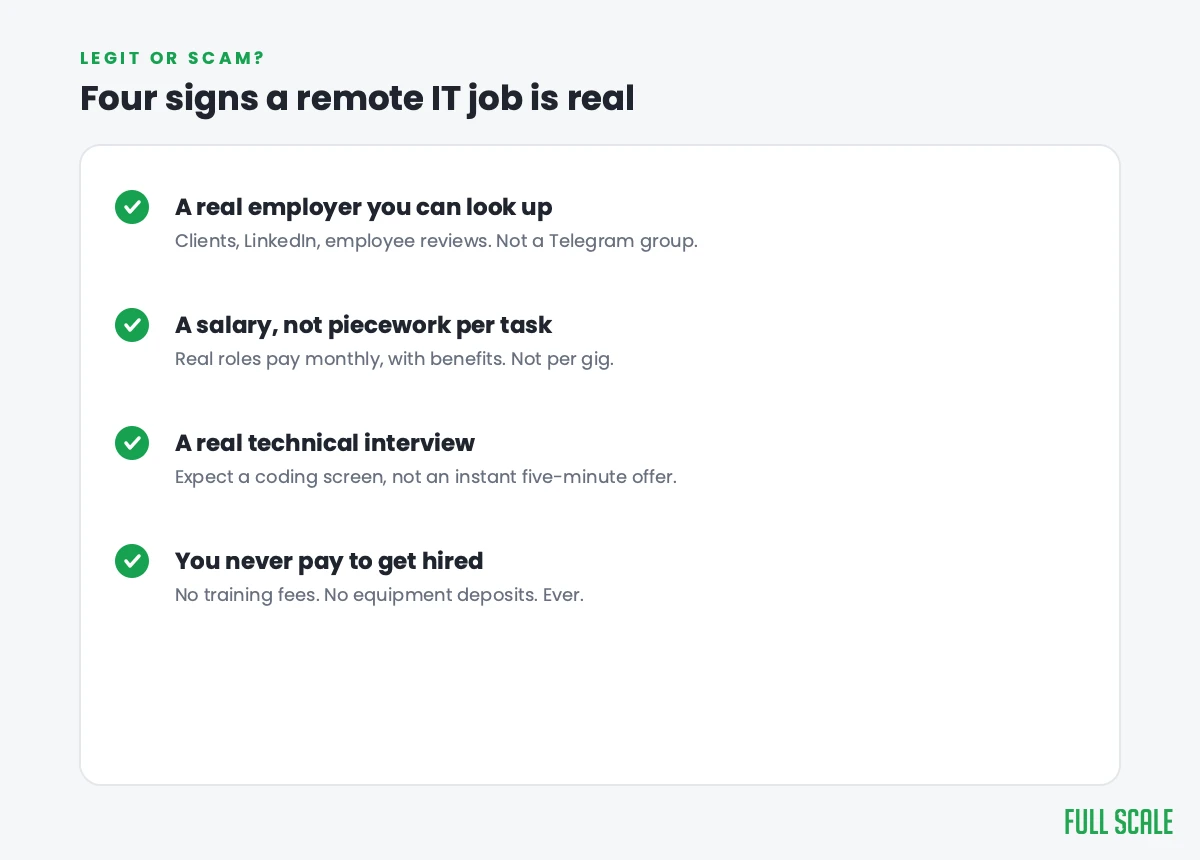
Run every posting through these four checks before you give anyone your details.
- It’s a real employer, not a “task” platform. You should be able to find the company’s actual clients, LinkedIn presence, and employee reviews. A landing page and a Telegram group are not a company.
- It pays a salary, not per “gig.” Legitimate remote developer roles are salaried or hourly employment, with benefits. Not piecework paid per completed task, like you’re a vending machine that occasionally ships code.
- There’s a real interview process. Expect a technical screen or coding assessment, not an instant “you’re hired” after a five-minute chat.
- You never pay to get hired. No legitimate employer charges you a “training fee” or “equipment deposit” before you start. If a job offer starts costing you money, it isn’t a job offer.
Where to Find Real Remote IT Jobs in the Philippines
Skip the Facebook groups and the comment-section recruiters. The legitimate remote IT jobs in the Philippines show up in four places:
- The big job boards. JobStreet, Kalibrr, and LinkedIn Jobs all carry remote developer roles from real companies, and all let you filter for remote. OnlineJobs.ph is the biggest home-based board, but bring the four checks above, because the quality runs from real employers to someone’s “business opportunity.”
- Employers directly. Most of the top IT companies in the Philippines hire remote developers through their own careers pages. If a company looks interesting, apply at the source instead of through a middleman.
- Staffing firms with permanent roles. Companies like Full Scale hire you as a permanent Philippine employee and place you on a US client’s engineering team. You get a local employer, local benefits, and a US-grade project, all remote.
- City hubs, if you want options beyond remote. Manila and Cebu have the deepest benches of tech employers. We broke down what’s hiring and what it pays in Manila, IT job opportunities in Cebu, and the IT companies based in Cebu separately.
IT Roles That Work Well Remotely, and What They Pay
Almost any software role can be done remotely, but some are especially well-suited to it because the work itself is heads-down and asynchronous-friendly. Here’s how the main remote roles stack up:
| Role | Why it works from home |
|---|---|
| Frontend, backend, and full stack developers | The core heads-down work: tickets in, code out, reviews over pull requests |
| Mobile developers (Android and iOS) | Same shape as web development, with a cloud device lab when you need one |
| QA and test engineers | Test plans and automation suites are asynchronous by nature |
| DevOps and cloud engineers | The infrastructure was never in your office anyway |
| Project managers | Runs the distributed rituals: standups, boards, docs, demos |
For a live read on which of these is actually hiring, we track the in-demand IT jobs in the Philippines separately, with current pay bands per role. The short version: developers and QA stay at the top of the list, and AI-literate developers are pulling ahead of everyone.
Public salary aggregators lowball remote developer pay just as much as they lowball office roles. Here’s what Full Scale actually pays by seniority, based on our own pay data across 350+ Philippine employees, all of it remote:
- Entry-level: ₱40,000–₱60,000/month (about $670–$1,000)
- Junior to mid-level: ₱60,000–₱100,000/month (about $1,000–$1,670)
- Senior: ₱100,000–₱150,000/month (about $1,670–$2,500)
- Very senior or specialized: ₱150,000–₱250,000/month (about $2,500–$4,170)
There’s no “remote penalty” baked into these numbers. A senior developer working from a spare bedroom in Davao earns the same band as one who’d be commuting into a Manila office, because the work is identical. The only pay difference that’s real is the Manila cost-of-living premium (about 20 to 30 percent), which has nothing to do with where your desk is and everything to do with rent.
From a Full Scale developer
“I was worried about working remotely, but the team structure here is solid. Daily standups, clear documentation, and my tech lead is always available when I’m stuck. It’s the most supported I’ve felt in 6 years as a developer.” — Michael Robin D., Full Stack Developer (C#, .NET, Angular)
A Call Center Seat and a Software Job Are Not the Same Thing
Search for work-from-home jobs in the Philippines and most of what comes back is BPO: call center seats, back-office processing, content moderation. Real jobs, real paychecks, and a real industry that employs over a million Filipinos. But the work is a headset and a script, the shift is whatever the client’s time zone demands, and the ceiling shows up fast.
Software roles are a different animal wearing the same “work from home” costume. The pay ceiling runs three to five times higher (see the bands above), the work compounds into a career instead of a shift log, and the skill you build this year raises what you earn next year. The BPO industry itself grew from call centers into code for a reason: that’s where the value went. If you can code, test, or run cloud infrastructure, don’t let the search results talk you into a headset.
What You Need Before You Apply
The barrier to a remote IT job is lower than people think, but it isn’t zero. What Philippine employers actually expect from a home-based developer:
- Internet that survives the weather. At least 25 Mbps down and 10 up, plus a backup like a pocket WiFi or a second provider. Typhoons and brownouts are part of the deal, and “my internet died” only works as an excuse once.
- A real workspace. A quiet room, a door that closes, a decent chair, and a headset. Your team doesn’t care what your house looks like. They care whether they can hear you.
- Equipment, usually provided. Real employers ship you a company laptop (Full Scale does) or pay an equipment allowance. Gig platforms expect you to bring your own, which is one more way to spot the difference.
- Hours that overlap with the US. Most remote roles with American clients expect three to four hours of shared workday. That usually means early mornings or evenings in Philippine time, not the whole night shift.
- Written English you can think in. Standups, tickets, and pull-request reviews all happen in writing. This matters more than a perfect accent ever will.
Frequently asked questions
Are work-from-home IT jobs in the Philippines legitimate?
Many are, and many are not. Legitimate remote IT work is salaried employment with a real company, a real interview process, and real benefits. Anything that asks you to pay a training fee, buy a starter kit, or hand over bank details before your first day is a scam, no matter how professional the Facebook page looks.
How much do work-from-home IT jobs pay in the Philippines?
At Full Scale, entry-level remote developers earn ₱40,000 to ₱60,000 a month, senior developers earn ₱100,000 to ₱150,000, and very senior or specialized engineers reach ₱250,000. There’s no pay cut for working from home; the bands are the same as office roles. The salary section above breaks the full data down by seniority.
What IT jobs can you do from home in the Philippines?
Frontend, backend, and full stack development, mobile development, QA and test engineering, DevOps and cloud work, and project management all translate cleanly to remote. The roles that struggle are the ones tied to physical hardware or a physical office, which is almost none of modern software.
What internet speed do I need for a remote IT job?
Plan for at least 25 Mbps down and 10 Mbps up, plus a backup connection for typhoon season. Employers care less about raw speed than reliability: a pocket WiFi or second provider that keeps you online through a brownout beats a fast plan that drops twice a week.
Do I need a degree to get a remote IT job in the Philippines?
No. Most serious employers test what you can build, not what you studied. Expect a technical screen or a coding assessment, and expect your portfolio and your written English to carry more weight than a diploma. A degree helps on paper; skill wins the interview.
How do I avoid work-from-home job scams?
Never pay anything to get hired, ever. Check that the company has real clients, real employees on LinkedIn, and real reviews, and be suspicious of instant offers after a five-minute chat. If the entire interview happens over Telegram or Messenger, you already have your answer.
Work From Home, Permanently, With Full Scale
Full Scale is built around remote work, not tolerating it. Our developers work from home anywhere in the Philippines, on real client engineering teams. Not as anonymous contractors, but as permanent employees with the same benefits you’d expect from an office job, minus the office, minus the commute, and minus the fluorescent lighting.
Full Scale is hiring, remote
Every role at Full Scale is permanent and fully remote. No commute, real benefits, real career growth.
What that actually looks like:
- Permanent employment, not project-based contracts or gig work
- Health insurance from day one, with all dependents covered free, plus group term life insurance
- Company laptop, equipment, and a dedicated work-from-home allowance
- Flexible hours and a results-focused culture, not micromanagement
- Structured mentorship and clear promotion paths from junior to senior to lead
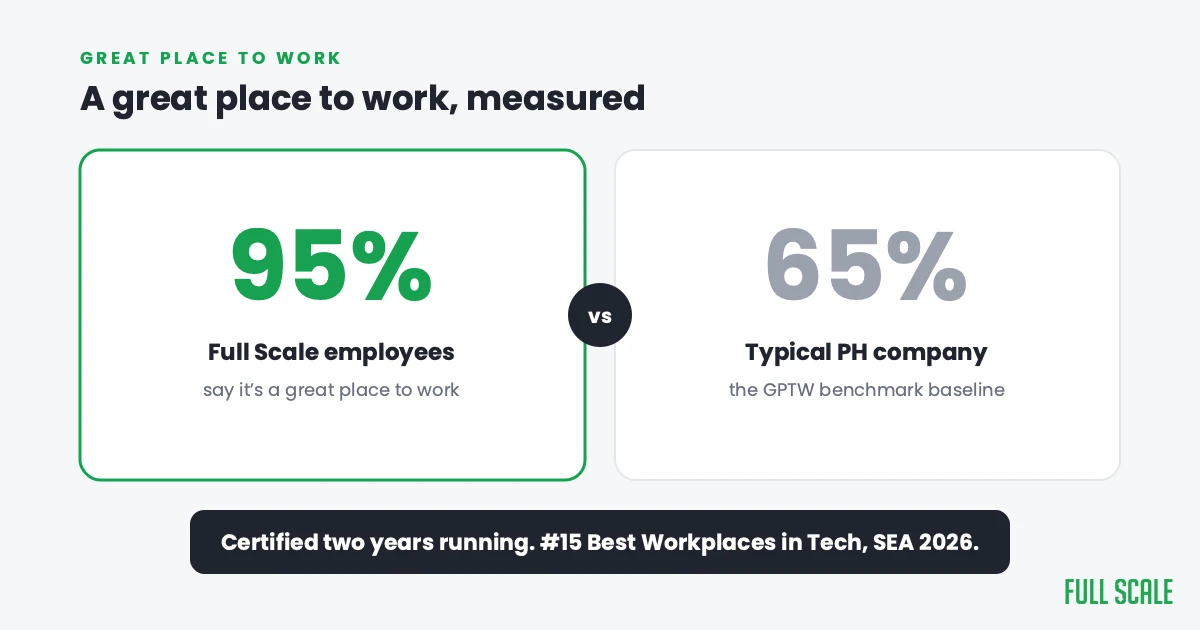
Full Scale developer retention runs 93%+ and average tenure is 5+ years. That’s a strong sign the remote setup actually works, not just a line on a careers page, and it’s the subject of a separate post on how we keep developers for the long haul. We’re also Great Place to Work® Certified in the Philippines, two years running: 95% of our employees say it’s a great place to work, versus 65% at a typical Philippine company. And we’re #15 on Great Place To Work’s Southeast Asia Best Workplaces in Technology 2026 list (our announcement). Employees run their own clubs, and once a year the company shuts down, paid, for CSR Day, where employees propose and lead volunteer projects across the Philippines themselves.
See open remote developer roles at Full Scale and apply directly. Every position is remote, permanent, and open to candidates anywhere in the Philippines.