Do You Know How to Vet Senior PHP Developers Correctly? Here Are 5 Questions Most CTOs Get Wrong
The hardest senior PHP interview questions aren’t hard—they’re just memorizable. Real vetting happens differently.
You’ve been there. The candidate walks in with 10 years of PHP experience. Perfect answers about design patterns. Laravel expert. You hire them. Three months later, they still can’t design a database schema. Every solution is “add another Laravel package.” Your team is rewriting its code.
A resume doesn’t equal reality. Interview skills don’t equal engineering skills.
At Full Scale, 60% of candidates claiming “senior” fail basic architecture discussions. We’ve used our methodology on how to vet senior PHP developers—over 5,000 since 2017. If your interview can be passed with one weekend of LeetCode and memorizing design pattern definitions, you’re testing the wrong way to vet senior PHP developers.
How to vet senior PHP developers: Focus on three dimensions:
- Architectural thinking—ask them to design scalable systems, not recite patterns,
- Production wisdom—have them explain past mistakes and lessons learned,
- Teaching ability—request that they explain complex concepts simply.
Use scenario-based questions, not memorizable theory, and verify through multi-stage assessment, including live coding and system design discussions.
The stakes are high. A bad senior hire costs $150K+ in salary, lost productivity, and team morale damage. According to Harvard Business Review research, senior-level bad hires cost 5-27 times their annual salary.
📋 What You'll Learn in This Guide
- Why traditional PHP interview questions fail to identify real seniors
- 5 specific questions that reveal architectural thinking and production experience
- How to interpret answers with senior vs junior examples
- Red flags that disqualify candidates immediately
- Full Scale's 5-stage remote vetting process that achieves 95% retention
Why Most PHP Interview Questions Test the Wrong Things When You Vet Senior PHP Developers
Traditional interview questions are a trap. What most CTOs ask doesn’t predict performance when they try to vet senior PHP developers.
The usual suspects: “What design patterns do you know?” or “Explain dependency injection” or “What’s the difference between abstract class and interface?” These questions sound technical. They feel rigorous.
They’re memorable. Available in every “PHP Interview Questions” blog post. It can be studied in 48 hours. Test recall, not application.
According to Stack Overflow’s 2025 Developer Survey, 73% of developers admit to using interview prep resources to memorize answers they’ve never implemented in production.
The Three Fatal Flaws
Flaw 1: They test knowledge, not judgment. Knowing design patterns doesn’t mean knowing when to use them.
Flaw 2: They miss what makes seniors different. When you properly vet senior PHP developers, you need to test for battle scars. Seniors have made mistakes and learned from them. Seniors know when NOT to apply patterns. Seniors think in systems, not syntax.
Flaw 3: They reward the wrong behavior. The worst hires aren’t nervous juniors who admit what they don’t know. They’re confident, articulate mid-level developers who’ve memorized senior-sounding answers.
I’ve made four types of bad senior hires using conventional interviews:
- The Resume Inflator with 8 years of repetitive work.
- The Framework Tourist, who jumps platforms every 18 months.
- The Tutorial Developer who freezes on novel problems.
- The Confident Junior with polished answers but a shallow understanding.
Traditional interview approaches fail because they test the wrong dimensions. Here's how conventional questions compare to the methods that actually reveal senior competence:
| Evaluation Dimension | Traditional Interview Questions | Effective Senior Developer Questions | What It Reveals |
|---|---|---|---|
| Architectural Thinking | "Explain MVC architecture" or "What are design patterns?" | "Design a system for processing 1M row CSV files" | Can they design scalable systems vs recite memorized definitions |
| Production Wisdom | "What's your biggest accomplishment?" | "Tell me about an architectural decision you'd do differently now" | Have they learned from mistakes vs rehearsed success stories |
| Debugging Process | "How do you optimize PHP performance?" | "Walk me through debugging an API timing out under load" | Systematic methodology vs generic optimization tips |
| Teaching Ability | "What is dependency injection?" | "Explain database indexing to a bootcamp graduate" | Deep understanding vs surface memorization |
| Engineering Judgment | "Why would you use Laravel?" | "When would you NOT use Laravel?" | Trade-off analysis vs framework advocacy |
The 5 Interview Questions That Actually Reveal Senior PHP Developers
These questions can’t be memorized. They require real experience.
Question 1: “Walk me through how you would debug an API endpoint that’s timing out under production load.”
This is one of the most revealing questions when you vet senior PHP developers. It separates systematically trained engineers from those who guess randomly.
What it tests: Debugging process, production experience, performance optimization, and problem decomposition.
What Senior Answers Look Like
A senior developer’s response starts with systematic elimination:
“First, I’d reproduce the issue in non-production if possible. If it’s load-specific, I analyze production metrics.
My process:
- Check application monitoring (New Relic, Datadog)—response time breakdown showing if it’s app code, database, or external APIs
- Review recent deployments—did this start after a deploy?
- Check database performance—slow query logs, missing indexes, table scans
- Profile the endpoint—use Xdebug or Blackfire to identify bottlenecks
- Common culprits: N+1 queries, missing indexes, expensive computations that should be cached, external API calls that should be queued
- Implement fix—eager loading for N+1, add indexes, implement caching, move slow operations to background jobs
- Test under load before deploying
- Monitor post-deployment to verify fix”
Why this is senior: Systematic process, specific tools mentioned, considers multiple causes, includes verification.
What Junior/Mid Answers Sound Like
“I’d add more caching. Maybe use Redis. Check if database queries are slow and optimize them.”
Why this fails: Jumps to solutions without diagnosis. Vague. No process.

Question 2: “Tell me about an architectural decision you made that you’d do differently now.”
When you vet senior PHP developers, this question reveals self-awareness and learning capacity. Only experienced developers have architectural hindsight.
What it tests: Self-awareness, learning from mistakes, and architectural experience.
What Senior Answers Look Like
“On a SaaS project two years ago, I designed a multi-tenant architecture where all clients shared the same database with a tenant_id column.
At the time, it seemed efficient: simpler deployment, easier cross-tenant reporting, lower infrastructure costs.
What I didn’t anticipate:
- Query performance degraded at 500+ tenants, even with proper indexes
- Security risks: one missing WHERE clause equals a data leak
- Customization limits: couldn’t accommodate large clients wanting custom fields
- Backup complexity: couldn’t restore one tenant cleanly
What I’d do differently: Schema-per-tenant for mid-to-large clients, shared schema only for small clients, clear cutoff point like 100 users to move to dedicated schema.
This would cost more upfront but prevent the painful migration we did—$150K project, 6 months.
Lesson: Optimize for future flexibility, not just initial simplicity.”
Why this is senior: Specific project, explains initial reasoning, details what went wrong with examples, includes numbers, and provides a clear lesson learned.
Question 3: “You’re designing a feature where users upload and process CSV files with up to 1 million rows. How would you architect this?”
This question is critical in how to vet senior PHP developers because it tests end-to-end system design thinking. It’s not about parsing CSV files—it’s about building production-ready systems.
What it tests: System design, scalability, async processing, error handling.
What Senior Answers Look Like
“This is a classic async processing problem.
Upload (Synchronous):
- Accept file upload with validation
- Quick validation: format, header check
- Store in S3 or Google Cloud Storage
- Generate a unique job ID, return immediately
- DON’T process synchronously—would timeout
Processing (Asynchronous):
- Queue job to a worker using Laravel Queue or RabbitMQ
- Process in chunks of 1,000 rows
- Store job status: pending, processing, complete, failed
- Track rows processed for progress
Error Handling:
- Row-level validation: invalid data shouldn’t stop the entire import
- Store errors: row number, column, message
- Allow partial success
Scalability:
- Multiple workers can process different jobs in parallel
- Database batch inserts—1,000 records at a time
- Monitor queue depth
What I’d Avoid:
- Processing in HTTP request—guaranteed timeout
- Loading entire file into memory—crashes on large files
- All-or-nothing processing—one bad row shouldn’t fail 999,999 good ones”
Why this is senior: End-to-end design, async awareness, scalability considered, mentions what NOT to do.
Question 4: “Explain database indexing to someone who just finished a coding bootcamp.”
When you vet senior PHP developers, this question tests deep understanding. If you can’t explain something simply, you don’t understand it well enough.
What it tests: Deep understanding, teaching ability, and avoiding jargon.
What Senior Answers Look Like
“Think of a database index like the index at the back of a textbook.
Without an index: To find every page mentioning ‘PHP’ in a 500-page book, you’d read every page. Slow.
With an index: You flip to the back, look up ‘PHP,’ see ‘pages 47, 103, 201.’ Jump straight there.
Without an index on the email column: Database reads every row to find email = ‘john@example.com’—slow on 1 million users.
With index: Database jumps straight to the row—fast.
Key points:
- Speeds up searches: WHERE, JOIN, ORDER BY
- Slows down writes: every INSERT/UPDATE must update the index
- Takes up space: trade disk space for speed
- Only index columns you search on
When to add:
- Columns in WHERE clauses
- JOIN conditions
- Foreign keys
When NOT to:
- Small tables
- Columns rarely searched
- Heavy write tables
Real example: Users table with 2 million rows. Login query without index: 800ms. After adding an index on email: 3ms.”
Why this is senior: Clear analogy, benefits AND trade-offs, real-world example with timing.
Question 5: “When would you NOT use a framework like Laravel for a PHP project?”
This reveals engineering judgment when you vet senior PHP developers. Knowing when NOT to use your preferred tool shows maturity.
What it tests: Engineering judgment, trade-off analysis.
What Senior Answers Look Like
“Laravel is my default, but there are scenarios where it’s wrong:
- Extremely High-Performance APIs:
- Framework overhead adds 2-5ms
- For financial trading or real-time gaming, that matters
- Example: Bidding system needing under 10ms. Laravel was 7-12ms, Swoole was 2-4ms
- Long-Running CLI Daemons:
- Laravel bootstraps for every request—web-focused
- Memory leaks in long-running processes
- Single-Purpose Microservices:
- Service doing one thing, like image processing
- Laravel brings full ORM, routing you won’t use
- 30MB memory footprint
- Serverless with Resource Constraints:
- Lambda needs under 1 second cold start
- Laravel can have a 200-500ms+ cold start
Laravel excels at:
✅ Rapid application development
✅ CRUD web applications
✅ Team collaboration
Wrong for:
❌ Extreme performance requirements
❌ Non-web use cases
❌ Minimal resource environments
That said: 95% of web applications I’ve built benefit more from Laravel’s productivity than from micro-optimizing away its 2ms overhead.”
Why this is senior: Nuanced understanding, specific scenarios with data, knows alternatives, pragmatic conclusion.
Senior Developer Red Flags: When to Walk Away
Some signals disqualify candidates immediately. Don’t waste time hoping they’ll improve. Knowing what questions to ask when you vet senior PHP developers is only half the battle—you also need to recognize disqualifying warning signs that reveal fake seniors.
Not all red flags are created equal. Some are absolute disqualifiers, while others warrant deeper investigation. Here's how to prioritize what you discover:
| Red Flag | Severity | Action Required | Why It Matters |
|---|---|---|---|
| Can't explain their own code | Critical | Immediate disqualification | Indicates plagiarized portfolio or memorized answers |
| Blames others for all failures | Critical | Immediate disqualification | Will never take ownership, toxic to team culture |
| Can't discuss mistakes or failures | High | Probe deeper, likely disqualify | Lack of self-awareness, hasn't made real decisions |
| Every problem = same solution | High | Test with follow-up scenarios | No trade-off analysis, buzzword-driven development |
| Dismisses "simple" questions | Medium | Assess cultural fit carefully | Won't mentor juniors, potential "brilliant jerk" |
| Obsessed with latest tech trends | Medium | Probe business pragmatism | May prioritize resume-building over business needs |
| Nervous during live coding | Low | Provide comfortable environment | Interview anxiety doesn't predict job performance |
| Limited framework knowledge | Low | Assess fundamentals instead | Frameworks can be learned, fundamentals can't |
⚠️ The Gut Check
After the interview, ask yourself: Would I trust them to architect our next major feature? Would juniors learn from them? Would I want to review their code at 2am during an outage? If any answer is "no," keep looking.
How to Vet Senior PHP Developers Remotely: The Full Scale Method
Remote vetting requires different techniques, but the principles remain the same when you vet senior PHP developers. You can’t pair program in person or observe work habits directly, yet you still need to accurately assess competence.
At Full Scale, we’ve perfected how to vet senior PHP developers remotely through 5,000+ assessments since 2017. Five stages. Seven days total. 95% retention proves it works. Learn more about building effective software teams.
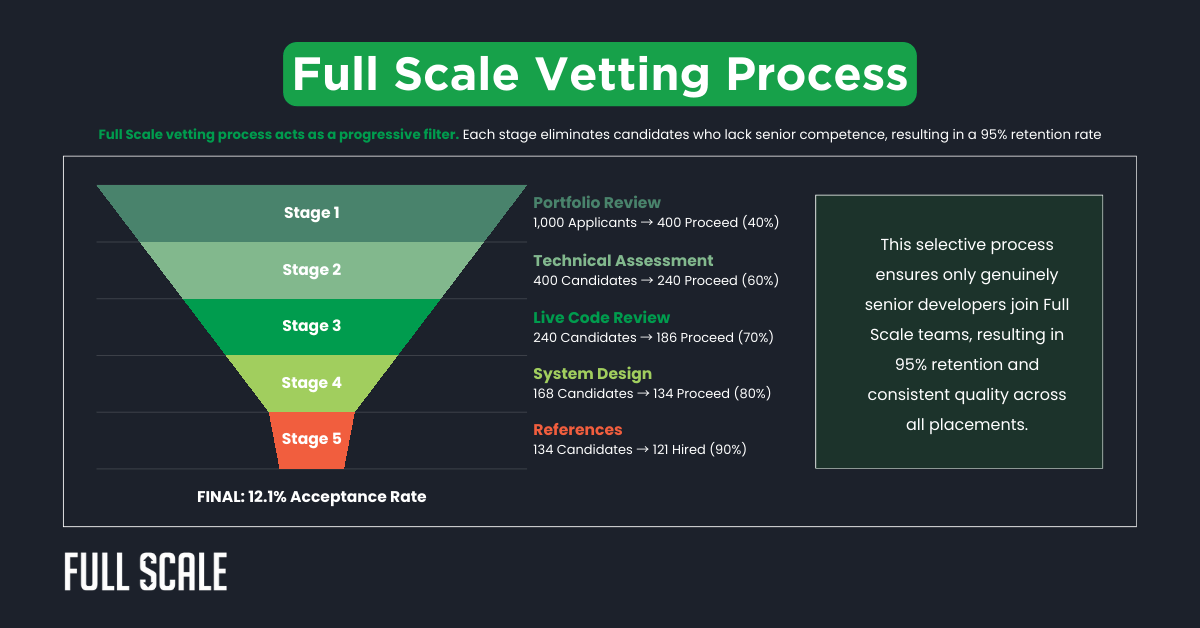
Full Scale’s 5-Stage Process
Stage 1: Portfolio Review
15-20 minGitHub activity: real projects or tutorials?
Code quality in public repos
Stage 2: Technical Assessment
2-3 hoursBuild REST API for specific business problem
Assess: database design, API structure, error handling, security
Stage 3: Live Code Review
45-60 minWalk through their take-home
"Explain your database schema choices"
Live extension exercise
Stage 4: System Design Discussion
30-45 minOne of the five questions from earlier
Test architectural thinking, scalability, production experience
Stage 5: Reference Checks
1-2 days"Describe a complex problem they solved"
"Would you hire them again?"
Total pass rate: 15-20% of applicants become hires
Why this works when you vet senior PHP developers remotely: Multiple validation points. Mix of async and sync. Code review catches plagiarism. References validate claims.
Geography doesn’t determine competence. The process is when you vet senior PHP developers. Discover how our staff augmentation model delivers 95% retention.
Calculate the True Cost of a Bad Hire
Bad Hire Cost Calculator
Hiring the wrong senior developer costs far more than just salary. Calculate your actual financial impact including lost productivity, team disruption, and opportunity cost.
Your Total Bad Hire Cost:
Compare to Full Scale: Our 5-stage vetting process delivers 95% retention. With our process, you'd avoid this $0 loss entirely.
Skip the Vetting Headache—Work with Pre-Vetted Senior Developers
Learning how to vet senior PHP developers is a skill. Most CTOs learned it through expensive mistakes.
Each bad hire costs $150K+ in salary, lost productivity, and team damage. This guide on how to vet senior PHP developers exists so you don’t have to make those mistakes.
The Core Message
When you vet senior PHP developers, traditional interview questions reward memorization. They hire confident talkers over competent engineers.
The five questions in this guide test what actually matters when you vet senior PHP developers: debugging process, architectural hindsight, system design, teaching ability, and engineering judgment.
These can’t be faked with weekend prep. They require real experience.
The Full Scale Advantage
When you work with Full Scale:
- 5,000+ developers assessed since 2017—refined process through volume
- 5-stage validation catches what single interviews miss
- 15-20% acceptance rate means only genuinely senior developers make it
- 95% retention rate proves our vetting works long-term
- 7-day hiring timeline provides speed without sacrificing quality
- Pre-vetted talent pool means you only see top candidates
- Direct integration model ensures offshore teams work like in-house extensions
- Month-to-month contracts provide flexibility
You can build this vetting process yourself. Many CTOs do. Or leverage a process refined through 5,000 assessments.
Either way: stop asking predictable questions. Start testing for actual seniority.
Minimum 3 touchpoints over 5-7 days: portfolio review, technical assessment with code review, system design interview, and reference checks. Rushing under 3 days increases bad hire risk. Taking over 2 weeks loses good candidates. Full Scale completes thorough vetting in 5-7 business days.
Ask: “Tell me about an architectural decision you’d do differently now.” Inflated resumes can’t provide specific examples with consequences and lessons learned. Follow with: “Walk me through your code” from their portfolio. If they can’t explain decisions, they didn’t write it.
No. When you vet senior PHP developers, test software engineering fundamentals: system design, architectural thinking, debugging process, trade-off analysis. Ask language-agnostic questions like “Design a file processing system.” Senior engineers can discuss these regardless of the interviewer’s expertise.
Use a multi-stage remote process: review portfolio, assign take-home, conduct live video code review to catch plagiarism, hold system design discussion, and complete reference checks. Multiple validation points prevent gaming any single stage. Full Scale’s 5-stage process achieves 95% retention offshore.
Seniors demonstrate: (1) Architectural thinking—design systems considering scalability upfront, (2) Production wisdom—debugged issues at scale, learned from mistakes, (3) Teaching ability—mentor effectively and explain concepts clearly. Years alone don’t create seniority. Ten years of repetitive work equals one year repeated ten times. Progressive challenges create genuine seniority.