
How AI Changed the Front-End Developer Job Description

In this article
- Stop hiring front-end engineers. Start hiring front-end developers.
- What a front-end developer actually does now
- The skills and requirements that still matter
- Senior versus junior: the gap is wider now
- How we screen for this at Full Scale
- A front-end developer job description template you can use
- Frequently asked questions
- Write the description for the job you actually have
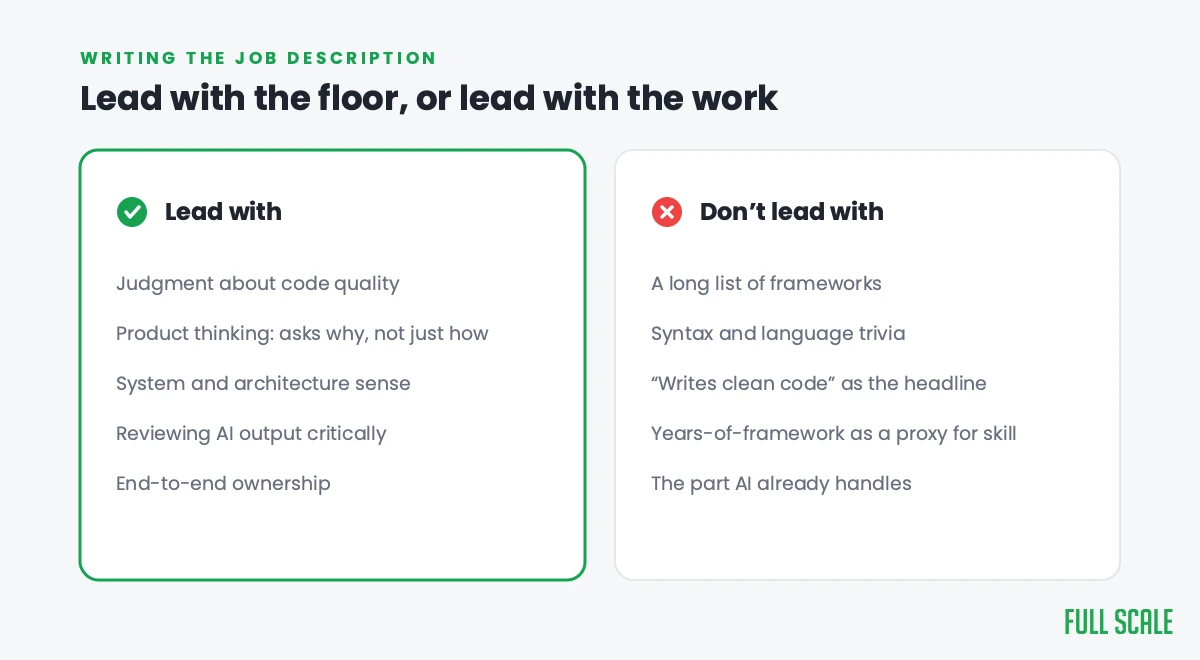
A front-end developer job description used to be a list of technologies. Strong HTML, CSS, and JavaScript, knows React or another framework, responsive design, writes clean, accessible markup. That list describes someone who can build a screen. Building a screen is the part AI now does fastest, so the list screens for the wrong thing.
Front-end is the discipline AI hit hardest. Describe an interface and a model produces something that looks polished and usually runs. Anyone can prompt an on-trend layout now, which means a job description built around “can you build the UI” no longer separates a strong candidate from a weak one. The interface is a commodity. What’s scarce is the judgment about what to build, who it’s for, and whether the result is actually good.
I run Full Scale, where we staff front-end and UI teams for US companies. Here’s what changed about the role, what to require instead, and a template you can copy.
Quick Answer: A front-end developer job description should lead with judgment, product and user thinking, and architecture, not a list of frameworks. AI is especially good at generating interfaces, so producing a polished-looking UI no longer identifies a strong hire. What still separates candidates is judgment about quality including AI-generated code, product and user thinking about who the interface is actually for, front-end architecture sense as the app scales, and clear communication, with the technical checklist (HTML, CSS, JavaScript or TypeScript, a major framework) as the floor, not the pitch. Full Scale screens every front-end hire on exactly that judgment before they ever join a client team.
Stop hiring front-end engineers. Start hiring front-end developers.
This reads like a word game, but I mean it literally, and I’m using the words backward from how most people do.
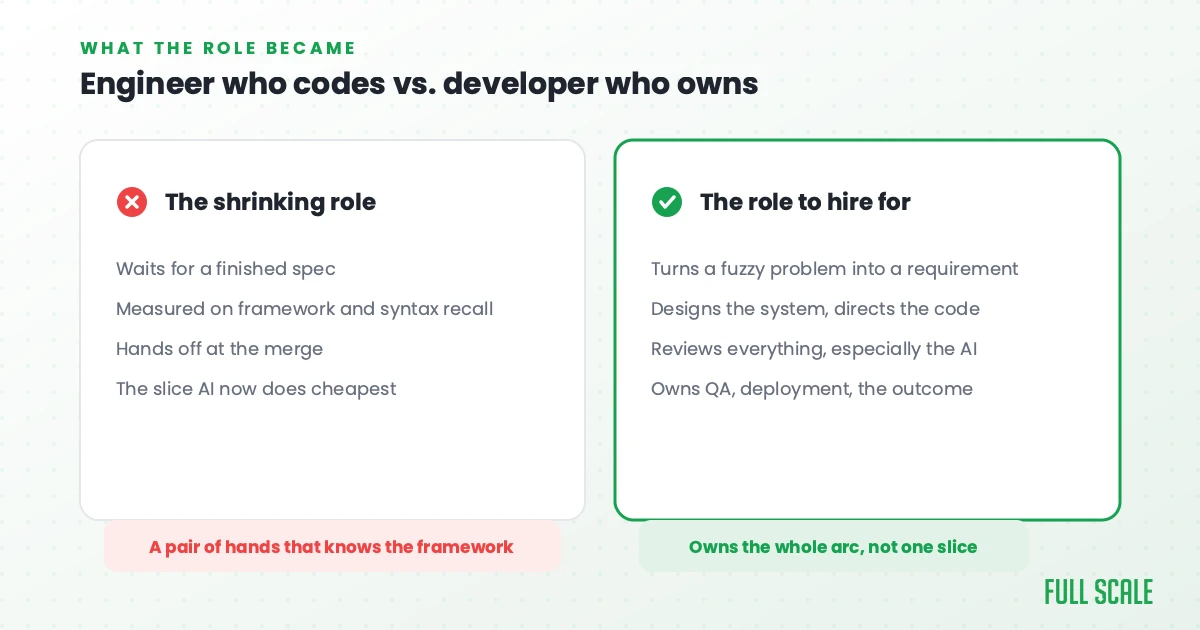
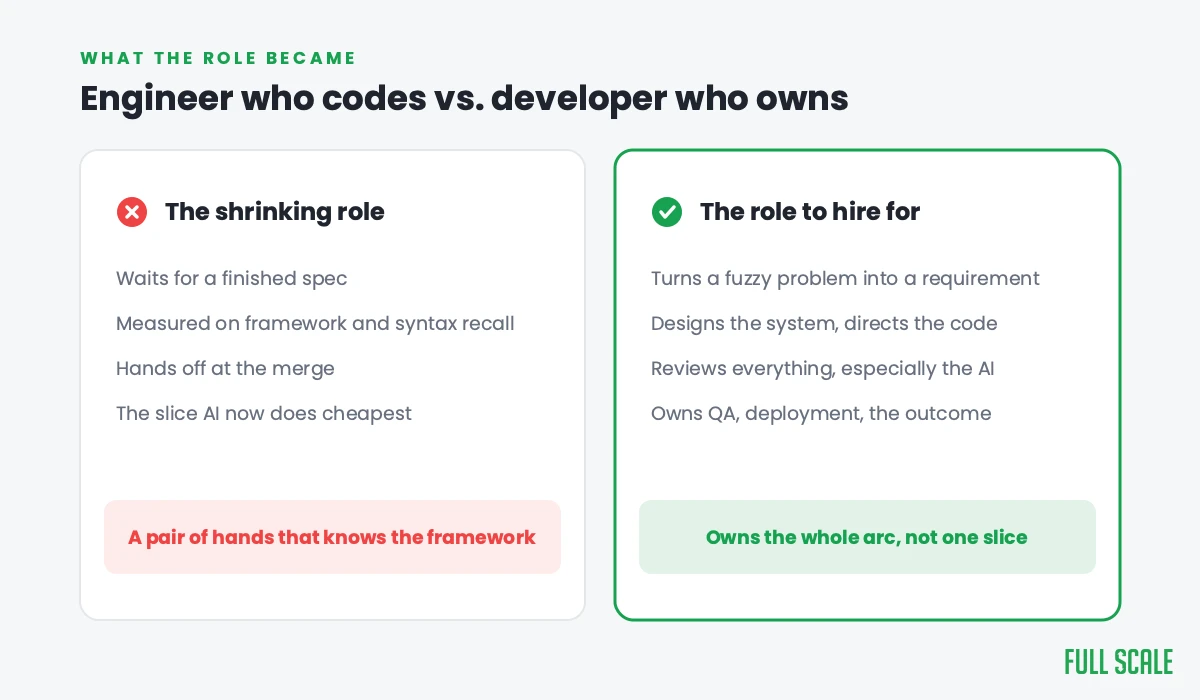
For most of my career, a “front-end engineer” was the person who builds the interface. You handed them a design, they implemented it, you shipped it. That’s the role most front-end job descriptions still hire for: a pair of hands that knows the framework.
That job is shrinking. When AI writes a large share of the UI code, paying someone mainly to turn a mockup into markup is a poor use of the budget. Microsoft says AI already writes as much as 30% of its new code, and Google’s CEO put their number at 75%. The mechanical front-end got cheap.
So the role I hire for now is broader. A developer, in the sense that matters, owns the whole arc: spotting the problem, working out what the user needs, building it, testing it, shipping it, and confirming the customer got value. The interface is one slice of that, and it’s the slice AI helps with most. The rest of the arc still sits squarely on the developer.
The job description has to hire for the expanded role, not the shrinking one.
That’s the shift, and it’s why a list of frameworks tells you almost nothing about whether someone can do the work.
What a front-end developer actually does now
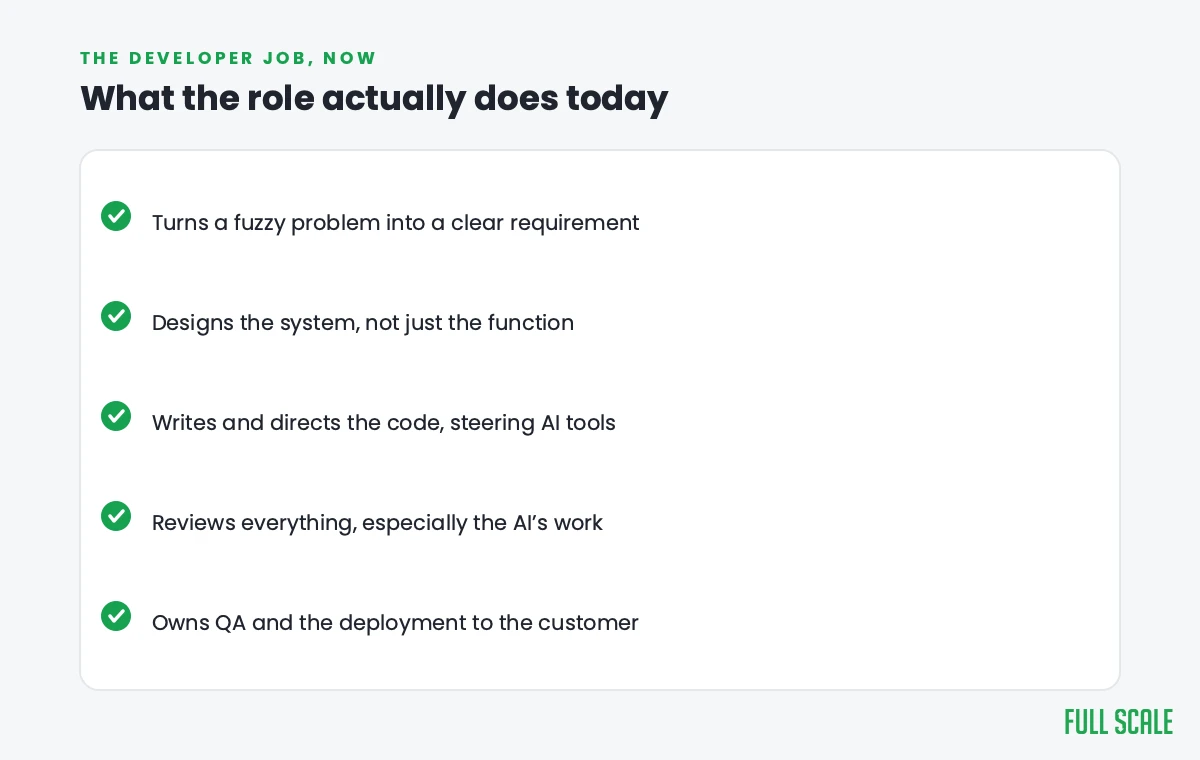
A current front-end developer job description should describe an owner, not a framework specialist. Here’s the real shape of the role.
- Turns a fuzzy problem into a clear requirement. Most of the cost of bad software is building the wrong thing well. A front-end developer who can work out what the user actually needs, and what to build first, is worth far more than one who waits for a finished design.
- Owns the front-end architecture, not just the screen. State management, data fetching, performance, accessibility, and how the whole interface holds together across a real product. AI is good at one component. It is far weaker at the system.
- Builds and directs the code. They still write the framework code. But increasingly they’re steering an AI tool through it, which takes a different skill: knowing what to ask for, and knowing when the generated UI is subtly broken or just generic.
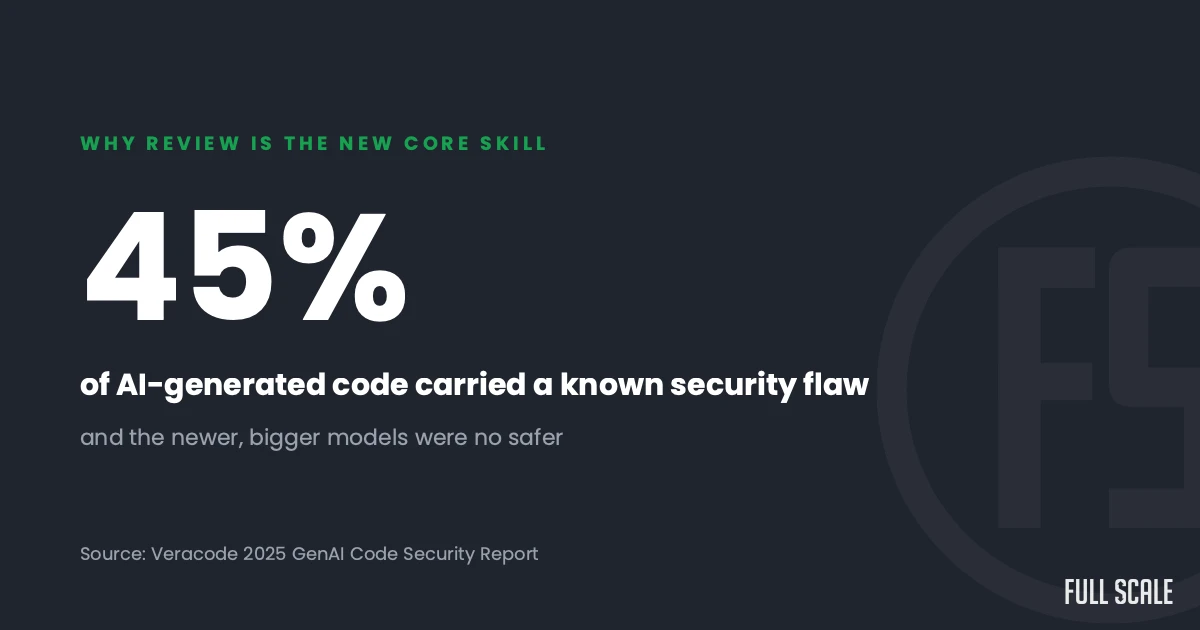
- Reviews everything, especially the AI’s work. This is the new core skill. AI-generated interfaces look the same because they lean on the same defaults, and Veracode found that 45% of AI-generated code carried a known security flaw. On the front end the misses are subtler: in the 2025 Stack Overflow developer survey, 66% of developers said their top frustration with AI is code that’s “almost right, but not quite.”
- Owns the user experience and the ship. The job isn’t finished at the merge. It’s finished when the interface works for a real person on a real device.
Notice what’s missing: memorizing CSS and framework trivia. A developer who can recite flexbox rules from memory but can’t tell when an AI-generated layout will break accessibility or tank performance is the wrong hire now. What you want instead is someone who reasons well and reviews carefully, even if they look up the syntax along the way.
The skills and requirements that still matter
You still need a requirements section. Just aim it at the right things.
Technical foundation (table stakes, not the whole story):
- Strong HTML, CSS, and modern JavaScript or TypeScript, plus a major framework (React, Vue, or Angular)
- Real performance, responsive, and accessibility fundamentals, and a grasp of front-end architecture
- Testing, the build toolchain, and working with APIs
- Comfortable using AI coding tools, and clear-eyed about where they produce generic or broken UI
The skills that actually separate candidates:
- Judgment about quality. Can they look at an AI-generated interface and tell you what’s wrong with it, from accessibility to performance to the fact that it looks like every other AI screen?
- Product and user thinking. Do they ask who the user is and what they’re trying to do, or just build the mockup? When AI does the mechanical work, this becomes the durable skill, and the person who is only a coder is the most exposed.
- Communication. They have to write a clear requirement, explain a tradeoff, and push back when the design is wrong.
- Front-end architecture sense. The bigger the product, the more this matters and the less AI helps.
The technical list gets you a candidate who can function. The second list is what tells you whether they’re worth keeping.
Senior versus junior: the gap is wider now
A senior front-end developer job description and a junior one should look more different than they used to, because AI widened the distance between them.
A junior used to be slow because they were still learning CSS and a framework. AI mostly erased that penalty. What it didn’t erase is judgment, and judgment is the entire senior job. A senior front-end developer knows when an AI-generated layout will fail on a real screen, when the design is solving the wrong problem, and when to tell a stakeholder no. I have watched the failure mode up close: a junior ships the AI’s polished-looking interface because it looked right in the browser, and the senior is the one who catches the accessibility gap and the performance cost.
So weight a senior description toward architecture, performance, accessibility, mentoring, and owning ambiguous problems end to end. For a junior role, screen for reasoning and user empathy over how many frameworks they can name. The junior who asks good questions and checks the AI’s output is the one worth betting on.
How we screen for this at Full Scale
Writing the job description is the easy half. The hard half is telling, from a stack of candidates, who can actually do the expanded job, because anyone can put “product thinking” on a résumé, and anyone can prompt a nice-looking screen.
We screen for it directly. Less than 3% of applicants make it through our process, and the bar isn’t trivia. We look at how someone reasons through an open problem, how they review code they didn’t write, and how they work with AI without leaning on it for the parts where judgment matters. If you want the actual questions, I wrote them up in our guide to front-end developer interview questions, and for the most common front-end stack specifically, the React developer job description goes deeper.
A trained team also beats a fresh job posting on speed. Our engineers go through an internal AI upskilling program, the Spartan Training Academy, so they aren’t guessing at how to use these tools. AI raised the floor on what a front-end developer can produce. It didn’t raise the ceiling, and the ceiling is where the good hires live.
A front-end developer job description template you can use
Here’s a copy-paste template built for the role as it exists now. It leads with ownership and judgment on purpose, and keeps the technical stack at the bottom where it belongs. Edit the bracketed parts and cut what doesn’t apply.
Job title: Front-End Developer (or Senior Front-End Developer)
About the role:
We’re looking for a front-end developer who owns problems end to end. You’ll work with [team/product] to figure out what to build, design how the front end holds together, build it with [React/Vue/Angular], review your own and others’ code (including what AI tools generate), and make sure it actually works for real users.
What you’ll do:
- Turn user problems into clear requirements
- Own the front-end architecture: state, data, performance, accessibility
- Use AI coding tools effectively, and review their output critically
- Build and maintain interfaces with a modern framework and TypeScript
- Own quality through reviews and testing, and see your work through to a real user
What we’re looking for:
- Good judgment about quality, including AI-generated UI
- Product and user thinking: you ask who it’s for, not just how to build it
- Clear communication and the confidence to push back
- Front-end architecture sense on real, growing products
- A solid technical floor: strong HTML, CSS, and JavaScript or TypeScript ([N]+ years), a major framework, and performance and accessibility fundamentals
Nice to have:
- [Domain experience, e.g. SaaS, e-commerce]
- Design-system experience
- A second framework or full-stack exposure
Use it as a starting point. The bullets that decide your hire are the judgment and product-thinking ones at the top, so keep them there.
Frequently asked questions
What does a front-end developer do?
A front-end developer builds the user-facing part of web applications using HTML, CSS, and JavaScript, usually with a framework like React, Vue, or Angular. The role has expanded: beyond writing the interface, a strong front-end developer now turns user problems into requirements, owns the front-end architecture, reviews code (including AI-generated code), and sees the work through to a real user.
What should a front-end developer job description include?
It should include the core technical requirements (HTML, CSS, JavaScript or TypeScript, a major framework, and performance and accessibility fundamentals), plus the skills that actually separate good hires now: judgment about quality, product and user thinking, front-end architecture, and the ability to use and review AI coding tools. Lead with the second set, not the framework list.
How has AI changed what to look for in a front-end developer?
AI is especially good at generating interfaces, so producing UI is no longer the scarce skill. The value moved to what AI can’t do well: deciding what to build, owning the architecture, and catching the performance, accessibility, and “it looks generic” problems AI introduces. Screen for judgment and user thinking over framework recall.
What’s the difference between a senior and a junior front-end developer job description?
A senior description should emphasize architecture, performance, accessibility, owning ambiguous problems, and mentoring. A junior one should screen for reasoning and user empathy rather than how many frameworks the candidate can name. AI widened the gap by erasing the speed penalty of not knowing a framework while leaving judgment, the senior skill, untouched.
Should the job description name a specific framework like React?
If your stack is fixed, name it, and a React-specific role can go deeper on that framework. But the hiring shift is the same across frameworks: lead with judgment, user thinking, and architecture, not with how many libraries the candidate can list.
Write the description for the job you actually have
The job changed, so the job description has to change with it.
If yours still leads with a list of frameworks and finishes with “writes clean, accessible markup,” it measures the commodity part of the role while the part that actually decides whether the hire works out goes unmentioned. Lead with ownership, judgment, and user thinking. Treat the front-end stack as the floor, not the ceiling.
And if you’d rather skip the part where you screen a hundred candidates to find the one who can actually do the expanded job, that’s what we do. Talk to us about building your front-end team, and we’ll put pre-vetted developers in front of you who already work this way.