CIO vs CTO: Which One Your Company Actually Needs

In this article
- CIO vs CTO: the textbook split, and where it’s actually true
- Why that clean line is blurring
- The honest answer most companies don’t want to hear
- Which one to add first, and when
- Hire the job, not the title
- Who gets paid more, a CIO or a CTO?
- What actually makes either seat work
- The bottleneck usually isn’t a C-title
- Frequently asked questions
- The bottom line
Most people typing “CIO vs CTO” into Google think they’re asking what the two titles mean. They’re not. They’re asking a more practical question they haven’t put into words yet: which one do I actually need, and when? For an early-stage company, the more pressing question is usually bringing on a technical co-founder rather than a CIO or CTO hire.
I’ve been the chief technology officer (CTO) four times over. I started as a software engineer, became a CTO, and I’m a chief executive officer (CEO) now. I was the founder and CTO of VinSolutions, which we bootstrapped to $35 million in annual recurring revenue and sold for around $150 million, and I did it again as founder and CTO of Stackify. I also work with a real chief information officer (CIO) just about every week: Derrick Leggett runs the engineering organization at AMC Theatres, and we’ve known each other for 25 years. I moved into the CEO role at Full Scale after buying out my co-founder.
So I’m not going to hand you the org-chart diagram that every other article on this page is built from. I’m going to tell you what these two seats actually do, where the textbook line between them falls apart, and how to decide which one your company should hire.
Here’s the short version.
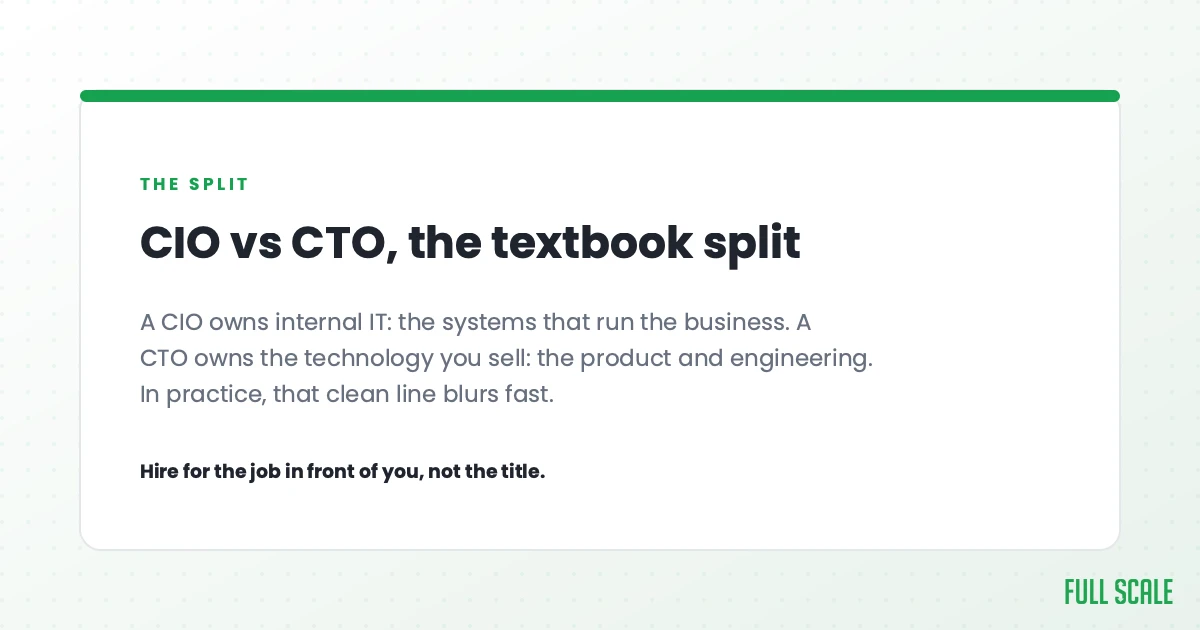
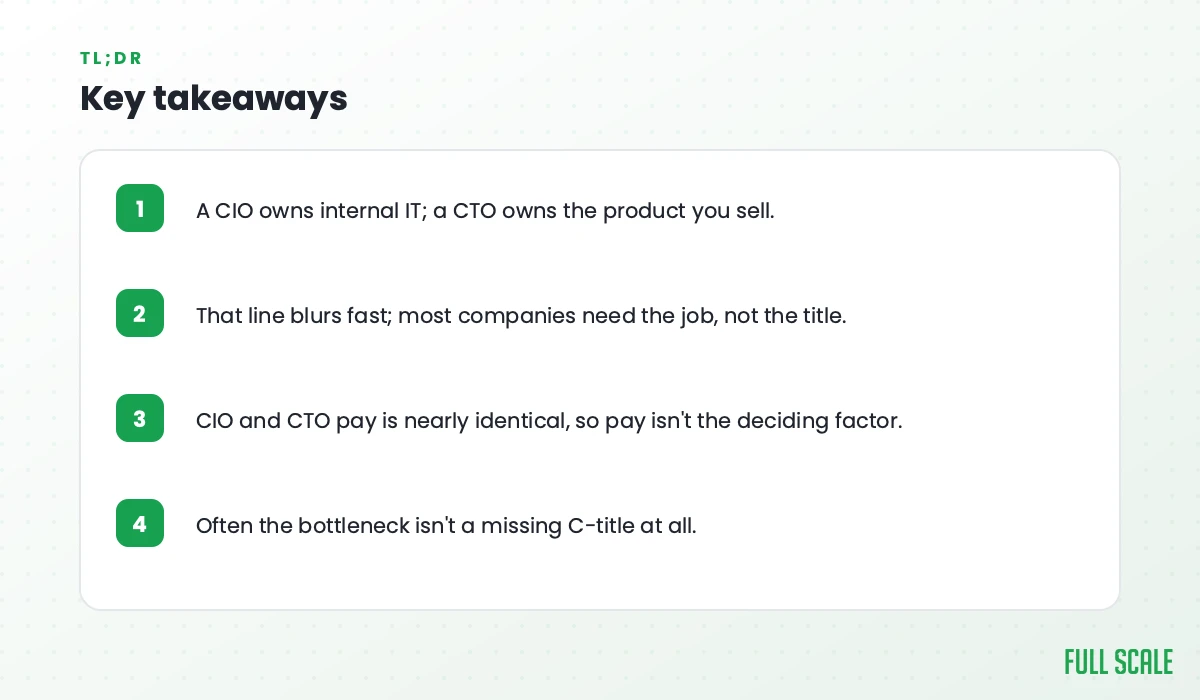
A CTO owns the technology your customers pay for. A CIO owns the technology your company runs on. Most companies asking the question need neither title yet.
CIO vs CTO: the textbook split, and where it’s actually true
The standard answer goes like this. The CTO looks outward, at the product and the market. The CIO looks inward, at the systems and infrastructure that keep the business running. One builds the thing you sell, the other runs the thing you sell it with.
That’s not wrong. It’s just incomplete, and it only holds at companies big enough for each job to be a full-time job.
The chief technology officer is the outward-facing technical leader. The job is to set the technical direction for the product, decide what to build in-house versus buy, and make the architecture bets the company will live with for years. When a customer-facing feature needs six months of plumbing, the CTO is the one who finds the two-week version that gets most of the value. The role sits close to the product, the roadmap, and the revenue.
The chief information officer is the inward-facing technical leader. The job is to make sure the company itself runs on technology that works: the internal systems, the security posture, the data, the tools every other department depends on, and the compliance that keeps regulators off your back. When the whole company can’t log in on a Monday morning, that’s the CIO’s problem. When an auditor wants proof of how customer data is handled, that’s the CIO’s problem too.
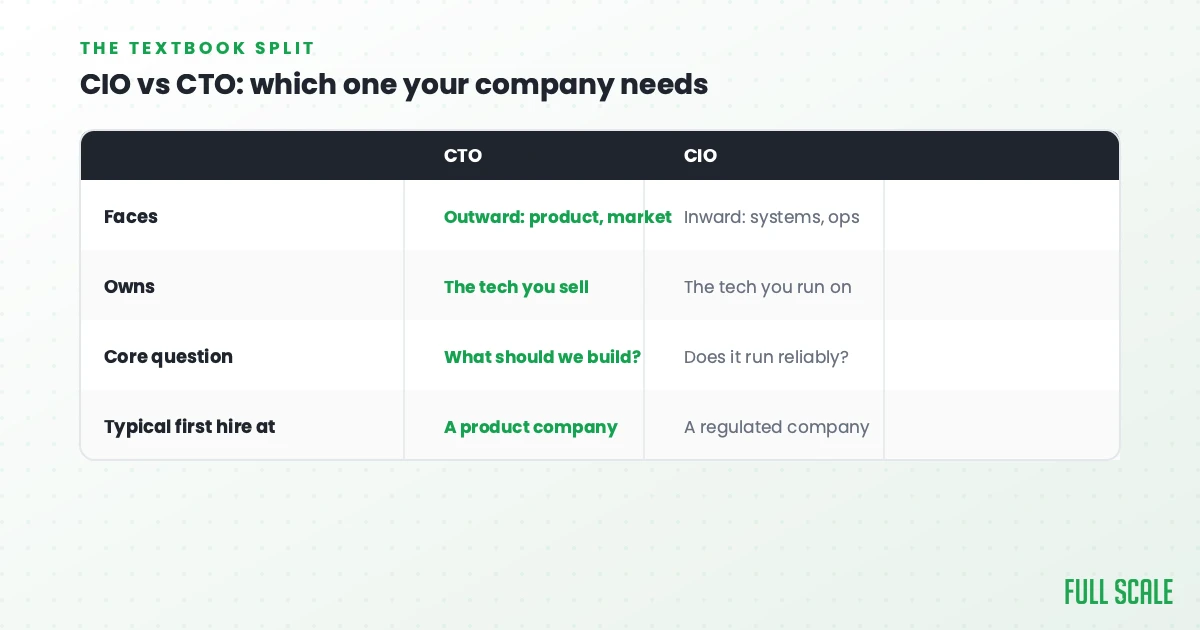
The two roles line up like this on the dimensions that matter when you’re deciding which one to hire.
| Dimension | CTO | CIO |
|---|---|---|
| Faces | Outward: product, customers, market | Inward: systems, employees, operations |
| Owns | The technology you sell | The technology you run on |
| Core question | What should we build, and why? | How does the company run reliably and securely? |
| Measured by | Product and technical advantage | Uptime, security, efficiency, risk |
| Typical first hire at | A software or product company | A larger or regulated company with heavy internal IT |
| Reports to | CEO (or board) | CEO, sometimes CFO |
Read it top to bottom and the split looks clean. The trouble is that the clean version describes a world that’s disappearing.
Why that clean line is blurring
The inward-versus-outward split was written for a time when “technology the company runs on” and “technology the company sells” were two different things. For a software company in 2026, they’re the same thing.
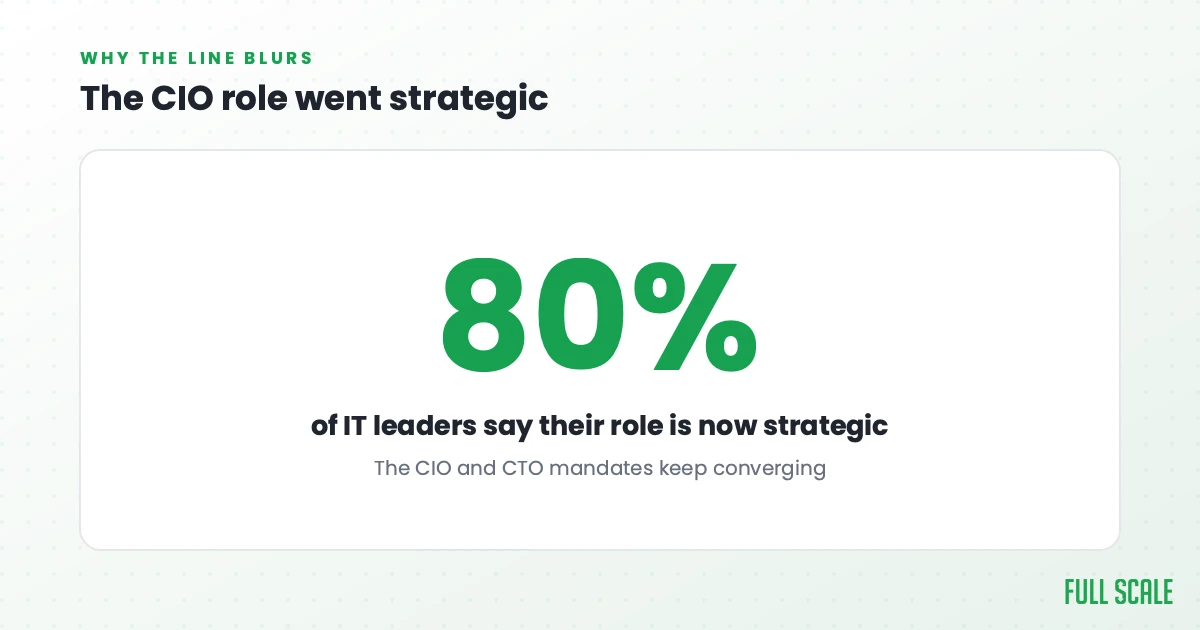
Look at what’s actually happening to the CIO role. Sixty-five percent of CIOs now report directly to the CEO, up from about 41% a decade ago. In Foundry’s 2025 State of the CIO survey, 41% of IT leaders called their role “strategic,” up from 35% the year before, and 80% said they’re now tasked with evaluating artificial intelligence (AI) for the business. The CIO is no longer the person who keeps the email server running. They’re increasingly the person deciding where technology takes the company next, which used to be the CTO’s whole job. That overlap is one of the challenges reshaping the CTO role right now.
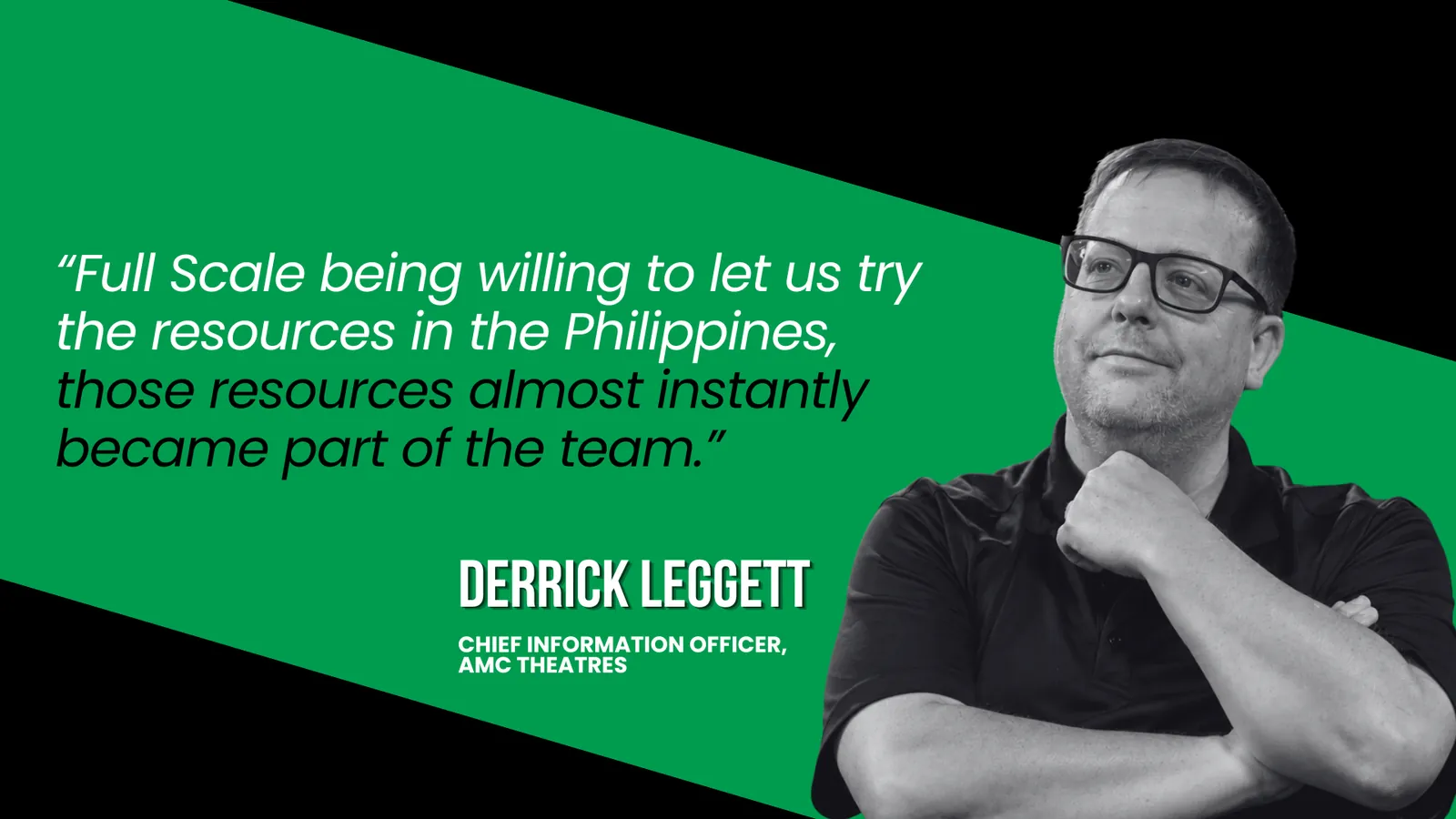
I see this up close at AMC. Derrick is their CIO, and the way he describes it cuts right through the textbook framing:
“Technology’s gone from being a sideshow to being the center of almost everything we do at AMC.”
When technology is the center of the business, the wall between “internal IT” and “the product” stops making sense. Derrick runs a global engineering organization. He treats developers in the Philippines as full AMC engineers rather than contractors held at arm’s length. That looks a lot more like a builder than the back-office CIO the org chart promised.
AI is accelerating the blur. Both roles are now judged partly on whether they can turn AI into shipped outcomes, and that’s a question about execution rather than org-chart design. The label on the office door matters a lot less than whether the person behind it can make technology move the business.
The honest answer most companies don’t want to hear
If you’re a founder or a CEO weighing CIO vs CTO, here’s the part the recruiting-firm blogs won’t tell you, because they’re in the business of placing executives.
You probably need neither title yet.
I started building software for car dealerships as a 22-year-old college dropout. There was no CIO. There was barely a CTO. I was the founder who could code, and the company grew up around me until I looked up one day and I was the chief technology officer without ever having decided to be one. That’s how almost every early-stage technical leader backs into the title.
At that stage, debating which C-suite seat to fill is the wrong conversation. What an early company needs is people who ship: a small team of strong engineers and one hands-on technical leader who can both make architecture calls and write code. Splitting that into an outward “CTO” and an inward “CIO” creates two part-time executives where you needed one full-time builder. The titles are a cost you take on only once the work exists to justify them.
The need comes first. The title comes second. Get that order backwards and you end up paying a six-figure executive to manage a job that doesn’t exist yet.
Which one to add first, and when
Once you’re past the founder-does-everything stage, the order is usually clear, and it depends on what kind of company you are.
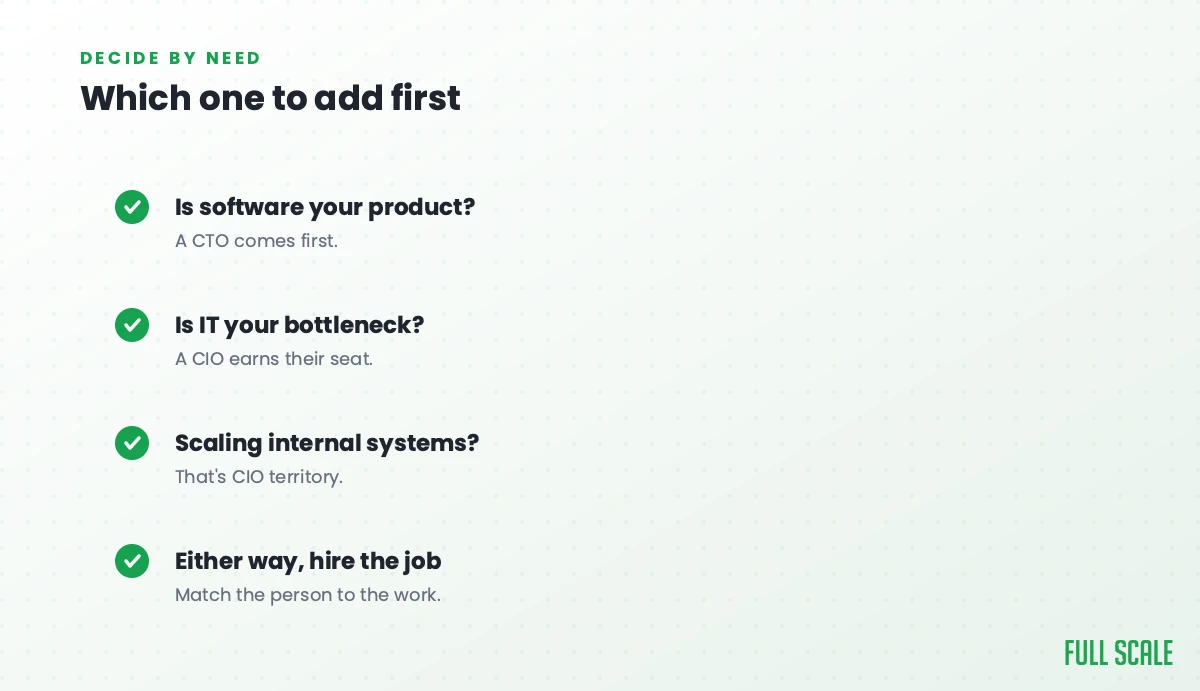
If you’re a software or product company, the CTO-shaped role comes first, every time. Your product is your technology. The first technical executive you need is the one who owns what you build and how it’s built. Internal IT, at that size, is a laptop, a few SaaS subscriptions, and someone competent handling them part-time. It does not need a C-suite owner.
You add a CIO when internal technology becomes a job big enough to break things if nobody owns it. That trigger usually shows up as one of three things: you’ve grown to hundreds of employees who all depend on internal systems, you’ve entered a regulated space where security and compliance carry real legal weight, or you’ve started acquiring companies and have to stitch their systems into yours. Until one of those is true, the CTO (or whoever holds the technical leadership) absorbs the internal-technology work, and that’s fine.
For a traditional, non-software enterprise, the order often flips. The CIO comes first, because the immediate need is running a large organization on reliable internal systems, and the CTO gets added later when the company decides technology should also be a product or a competitive edge instead of just plumbing.
If you’re still sorting out the seats one level down from here, the difference between a director and a VP of engineering and the CEO and CTO split are the next two questions worth getting right. And if the debate is really about product ownership, you’re having a CTO vs CPO conversation instead. When that conversation turns into a hiring decision, start with what the CPO seat actually owns.
Hire the job, not the title
The most expensive mistake I see founders make here has nothing to do with the acronym. They hire a title when what they needed was a job done.
I lived a version of this at VinSolutions. I was the CTO, and I had the vision, but I forced myself into the operations role of running the team day to day, and it drained me. The company didn’t need more of me being a reluctant operator. It needed a different leader in a different seat. I had the title that felt right and the wrong job description under it.
That’s the trap. Founders hand someone the “CTO” title for credibility when the actual need is a leader who runs people and process. Or they bring in a “CIO” when what they really needed was a strong systems administrator who didn’t require a C-suite seat. The title is the last decision you make, after you’ve named the job. Figure out the work that’s actually undone, then give it the title that matches. Screen for the job instead of the title and you get someone who fixes what’s broken, rather than someone who just looks right on the cap table.
Who gets paid more, a CIO or a CTO?
People expect the outward-facing, product-building CTO to out-earn the inward-facing CIO. The numbers say otherwise, and it’s a useful gut-check on how much the old hierarchy has shifted.
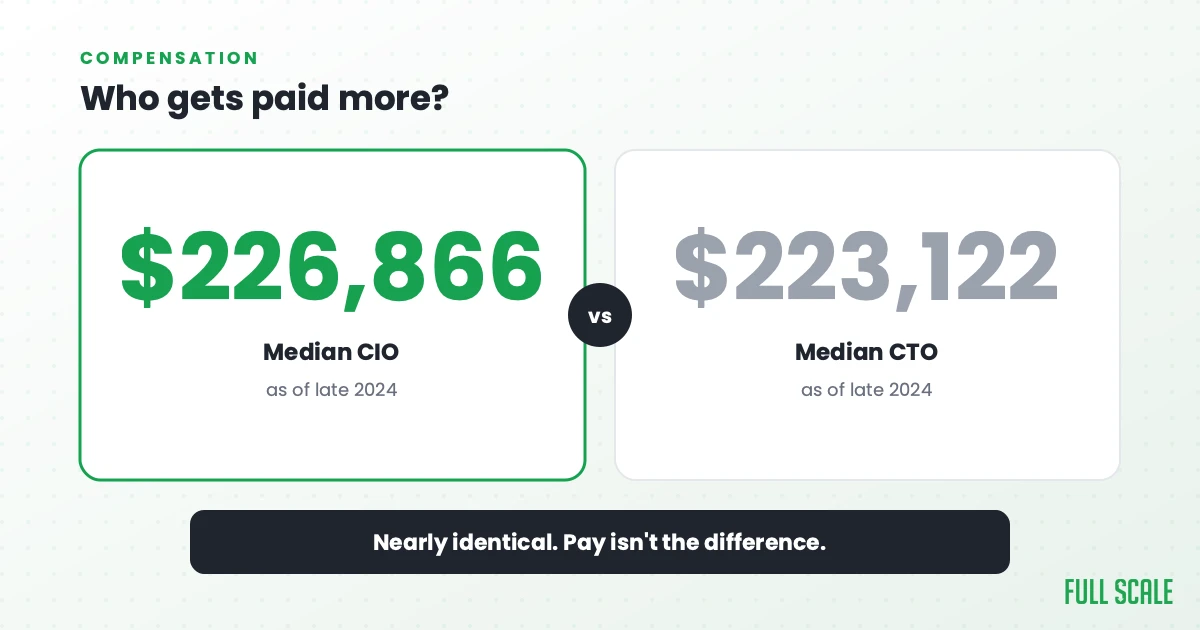
McKinsey’s own explainer puts average US base pay at $226,866 for a CIO and $223,122 for a CTO, as of late 2024. They’re effectively tied, with the inward role edging ahead. The US Bureau of Labor Statistics groups both titles into “computer and information systems managers” and reports a median wage of $171,200, with the top 10% earning more than $239,200 and the field projected to grow 15% through 2034. That’s a blended category, not a CIO-only or CTO-only number, so treat it as the floor for serious technical leadership rather than a precise read on either seat.
The exact figure matters less than the shape of it: both roles command real executive money, the gap between them is small, and which one pays more depends far more on your company and industry than on the title itself.
What actually makes either seat work
Strip away the inward-outward debate and the same thing decides whether a CIO or a CTO succeeds, and the title has nothing to do with it.
For most of the last 20 years, the value of a technical leader was tied to how well they understood the technology. The deepest architect won. AI is pulling that apart, because the mechanical part of the work is the part AI does best. What’s left is the part it can’t do: deciding what’s worth building, catching the design that’s about to back you into a corner, and getting a group of people aligned and moving. That makes judgment the scarce resource, because the volume of plausible-looking output has exploded. One recent study found that 45% of AI-generated code carried a known security flaw, and the bigger models were no safer. Developers already feel the gap: in Stack Overflow’s 2025 survey, 84% use or plan to use AI tools, while about 46% say they don’t trust the accuracy of what it produces. Somebody with taste still has to be in charge.
That’s the whole argument of my book, Product Driven. The skills that decide whether a technology leader succeeds now are communication, curiosity, and courage. Those are human skills, and they’re what’s left over once AI handles the throughput. Both seats need all three. When you’re choosing between a CIO and a CTO, or hiring for either, those three are what you’re really screening for. The org-chart box matters far less than whether the person in it can set a direction, stay curious as the ground shifts, and make hard calls in front of the rest of the executive team.
The bottleneck usually isn’t a C-title
After building engineering organizations for 20 years, I’d bet on this: for most growing software companies, the real constraint isn’t which executive title you’re missing, it’s plain execution capacity. The fix is rarely another six-figure leader on the org chart. It’s usually more strong engineers under the leader you already have.
You always need technical leadership in-house. The vision, the architecture calls, the accountability for what ships have to live with someone on your own team. That’s the part you can’t outsource. What you don’t have to do is build the entire senior engineering org around that leader at US prices.
This is the work I do now at Full Scale. We help companies keep their CTO or CIO in-house and build the team underneath them with senior developers in the Philippines, as a long-term part of their own team rather than a project shop on the other side of a wall. Recruiting senior people who already have jobs and aren’t looking is one of the hardest parts of any technical leader’s role, and it’s one of the things we’re actually built to do, which is part of why we keep 93% of our engineers year over year.
AMC is the clearest example I can point to. Derrick described his team to me in one line that sticks with me:
“It’s a fully integrated team. It’s just some of the people happen to be living in the Philippines.”
The leadership and the standards are AMC’s. The team is built across borders. That’s the model that works: strong leadership in-house, a strong team wherever the talent is. The version that fails is the opposite move, hiring on price alone and treating people as disposable headcount. I call that cheapshoring, and you can read why chasing the cheapest developer backfires if that’s the road you’re tempted by.
If you’ve already got the leader and you need to build the team affordably, that’s a staff augmentation conversation, and it’s the cheaper half of this whole problem to solve.
Frequently asked questions
Is a CTO higher than a CIO?
Neither outranks the other by default. They’re peers, and both typically report to the CEO. Which one carries more weight depends on the company. At a software or product company, the CTO is usually the more central role because the product is the business. At a large traditional enterprise, the CIO often holds more organizational power because internal systems run everything. In some companies one reports to the other, but there’s no universal rule that one title sits above the other.
Does a CTO report to a CIO?
Traditionally, in large non-tech enterprises, yes, the CTO sometimes reported to the CIO, who owned the overall technology function. That’s become less common. Today both roles usually report to the CEO as peers, especially at software companies, where the CTO owns the product technology and the CIO owns internal systems. The reporting line depends on what kind of company it is and where technology sits in the business.
Can one person be both the CIO and the CTO?
Yes, and below a few hundred employees they usually are, whether or not the title says so. At a startup or mid-size software company, a single technical leader (most often titled CTO) handles both the product technology and the internal systems. The roles split into two seats when internal IT, security, and compliance grow into a full-time job, which typically happens at larger scale or in regulated industries.
Who gets paid more, a CIO or a CTO?
It’s close. McKinsey’s explainer puts average US base pay at roughly $227,000 for a CIO and $223,000 for a CTO, effectively a tie. Which one earns more in a given company depends far more on industry, company size, and equity than on the title. Both are senior executive roles that command real compensation.
Does a startup need a CIO or a CTO?
Most early-stage startups need neither title formally. What they need is a hands-on technical leader who can set direction and help build the product, plus engineers who ship. If you’re a software company and you’re going to use a title, make it CTO, because your product is your technology. A CIO becomes worth hiring once you have hundreds of employees on internal systems, real compliance requirements, or an acquisition strategy that forces you to integrate other companies’ technology.
The bottom line
Stop agonizing over the acronym. The CTO owns the technology your customers pay for; the CIO owns the technology your company runs on; and the line between them is blurring fast because for modern companies, those are increasingly the same technology. Figure out which job your company actually needs done right now. Early on, that’s one person doing both. As you scale, the inward work grows into its own seat, and you add the second title when, and only when, the work exists to justify it.
Keep the technical leadership in-house. Build the team wherever the best people are.
If you’ve got the leader and need to build a senior engineering team without paying US prices for every seat, book a quick call and we’ll talk through what your team should actually look like.