The Top Startups in St. Louis: A Founder’s Field Guide

In this article
I have started four companies and sold two of them. I co-founded VinSolutions and grew it into a company that sold for around $150 million, and I later built and sold Stackify, a developer-tools company I raised venture money for. I have hired engineers by the dozen and sat on both sides of an acquisition table. I will say up front that I am not from St. Louis. I built my companies on the other side of Missouri, in Kansas City. But I have spent twenty years close enough to the St. Louis scene to know it is badly underrated, and most of the lists that try to capture it miss what actually makes it interesting.
Most “top startups in St. Louis” articles read like a spreadsheet someone exported and lightly cleaned up. They list a company, paste a one-line description, and move on. What they never tell you is that St. Louis has been quietly producing real companies for more than a century, that some of the biggest names in tech started here, and that the city’s startup scene today is concentrated in a few areas where it is genuinely world-class.
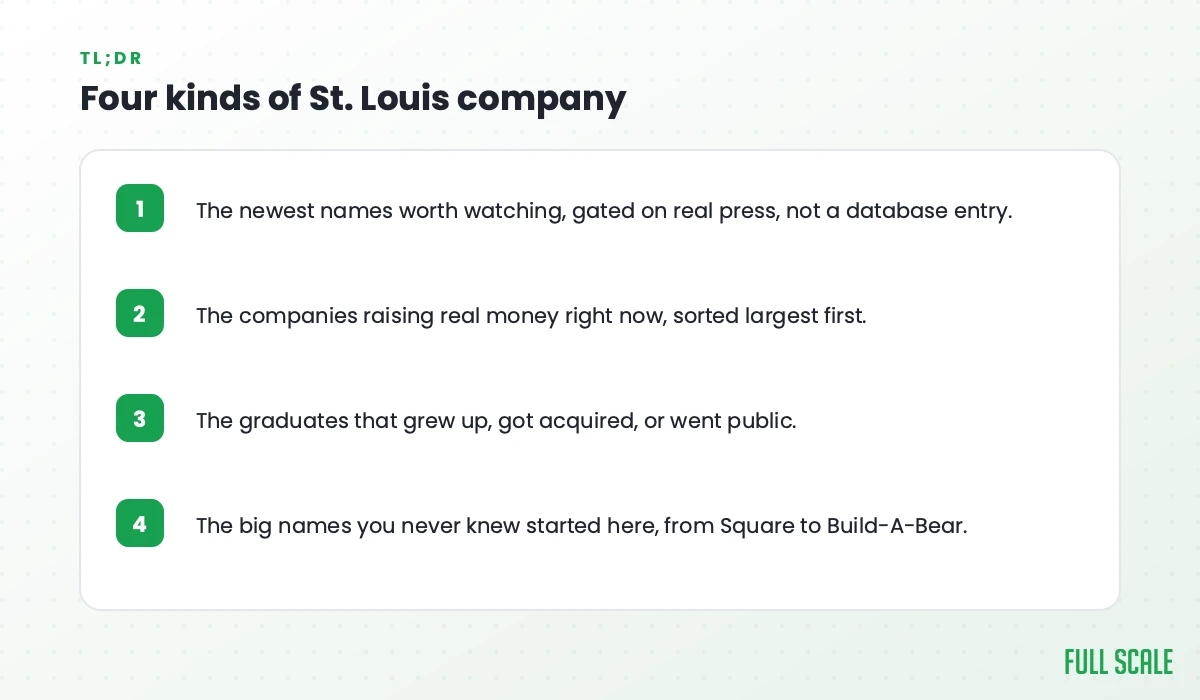
So I put together the version I wish existed. It covers four kinds of company. I start with the newest names worth watching, then the ones raising real money right now, then the companies that grew up and got acquired or went public. My favorite section is last: the big names you would never guess started in St. Louis. Every company links out to its own site, and every funding number is one I verified against a primary source like a funding announcement or an SEC filing.
The newest names first.
The newest names worth watching
These are the youngest companies on the list, founded in the last few years. I only included a company if there was real press behind it, not just a database entry, because at this stage traction is the only honest reason to put a young company on a list like this.
A few of them have already raised a priced round:
SweetSpot pairs software with a virtual clinical team to manage data from diabetes devices like continuous glucose monitors and insulin pumps. It spun out of BioGenerator and raised a seed round led by Cultivation Capital in 2025.
Hire Henry builds autonomous industrial mowers that use GPS and computer vision to cut large commercial properties without a driver. It has pulled in federal SBIR grants and a Google Black Founders Fund award.
Unlocked Labs is a social-enterprise software company building education-access tools for incarcerated people. It has backing from Andreessen Horowitz and John Legend’s FreeAmerica, which is rare company for a startup this young.
The rest are earning their first real attention through grants and accelerators rather than venture rounds, which is exactly where you would expect to find them:
ASL Aspire gamifies STEM education in American Sign Language for deaf and hard-of-hearing students, and relocated to St. Louis on an Arch Grants award.
MatchNP runs a marketplace that matches nurse-practitioner students with the clinical preceptors they need to graduate, solving a real bottleneck in healthcare training.
oneKIN combines AI-driven livestream shopping with revenue-based financing for small and BIPOC-owned brands, and came up through Capital Innovators and Mastercard’s Start Path program.
OrgAcuity is a B2B people-analytics platform that helps companies read their own org and make better decisions about it.
Prezerv Technologies builds AI 3D maps and digital twins of underground utilities so construction crews stop hitting things they cannot see, and it relocated to St. Louis on an Arch Grant.
If there is a pattern here, it is that the youngest St. Louis startups cluster around healthcare, education, and applied AI. That is not an accident, and it connects directly to the next two sections.
Who’s getting funded right now
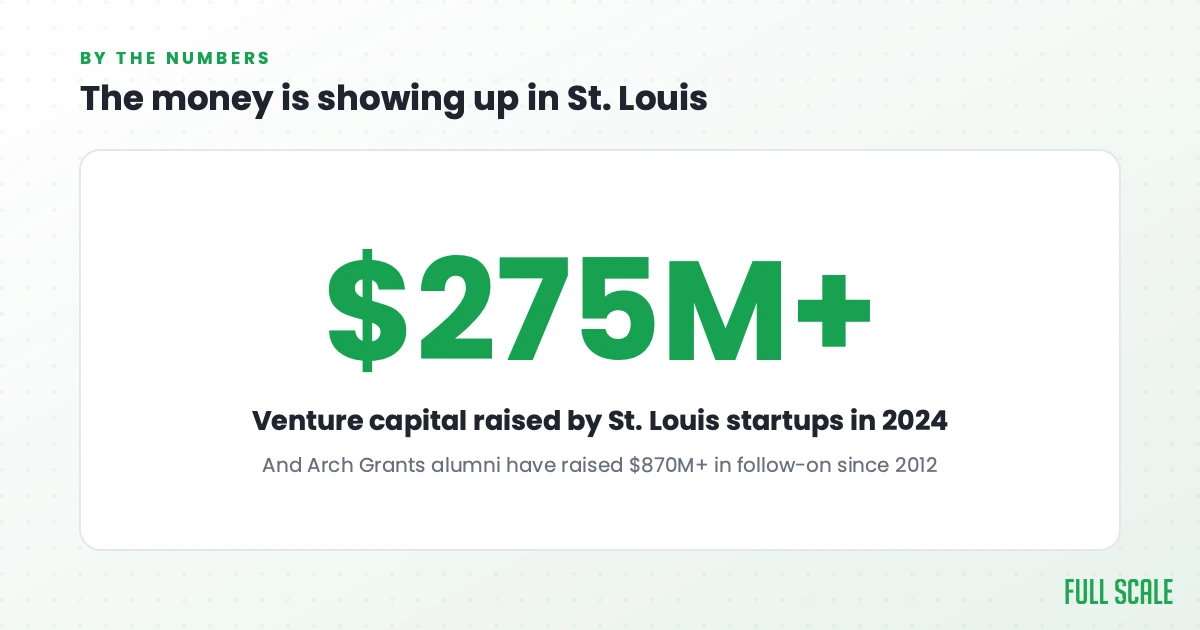
This is the backbone of the list. Every company below raised a disclosed round recently. I have sorted the tech-leaning companies largest first; the life-sciences raises are bigger still, and they get their own group at the end of this section. St. Louis startups raised more than $275 million in venture capital in 2024, and these are the companies doing the raising. If you want to understand the city’s startup economy, this is the section to read.
Lumeris is the heavyweight. The Maryland Heights company builds value-based-care technology and managed services for health systems, and it closed a $100 million equity growth round in 2024 led by Deerfield Management and Endeavor Health.
Capacity raised $92 million in 2025 for its AI support-automation platform, though it is worth being precise about that number: it was $42.6 million in Series D equity plus $50 million in debt. The University City company automates customer support for contact centers and has grown by acquisition.
SimpleRose raised around $23 million in 2023 for software that solves large mathematical-optimization problems, the kind that sit behind scheduling, production planning, and logistics.
FinLocker raised a $17 million Series B in 2024. The Clayton company builds white-label financial-readiness software that mortgage lenders hand to consumers to get them ready to buy a home.
IntraMotev raised a $14.4 million Series A in 2024, led by Flybridge and Alpaca VC, to build battery-electric railcars that move themselves instead of waiting on a locomotive.
Rezilient Health raised a $10 million Series A in 2024 led by Govo Venture Partners. Its CloudClinic model streams remote physicians into physical clinics so a patient gets a real exam without a doctor in the room.
SentiAR, a Washington University spinout, raised an $8.5 million Series B in 2023 for real-time 3D holographic visualization that guides cardiac-ablation procedures.
Sailes raised a $5.1 million Series A in 2023, led by Lewis & Clark Ventures, for autonomous AI agents that handle the grind of enterprise sales prospecting.
Balto has raised more than $50 million across its life to date for real-time AI coaching that prompts contact-center agents mid-call. It is one of the more established names on this list and one I have watched for years.
PayRecs raised $3.8 million in 2025 to give regional banks an international-payments and treasury platform that handles dozens of currencies.
Clockwork raised around $3 million in 2023 for AI financial-planning software that forecasts cash flow and plugs into tools like QuickBooks and Xero.
There is also a tight cluster of agtech companies raising serious money around the Donald Danforth Plant Science Center, including Plastomics and Solis Agrosciences, both backed by Cultivation Capital. St. Louis is one of the few places in the country where plant science is a venture category, not a curiosity.
The science side
I kept the list above tech-leaning on purpose, but it would be dishonest to write about St. Louis funding and skip the life sciences, because that is where the biggest checks are going. Wugen raised $115 million in 2025 for off-the-shelf cell therapy. Geneoscopy raised a $105 million Series C in 2025 for its FDA-approved at-home colorectal cancer screening test. C2N Diagnostics has Samsung among its backers for a blood-based Alzheimer’s test, and MediBeacon got FDA approval and fresh funding in 2025 for a transdermal kidney-monitoring system. These are not software companies, but they are some of the most important things being built in the city.
The graduates: St. Louis startups that made it big
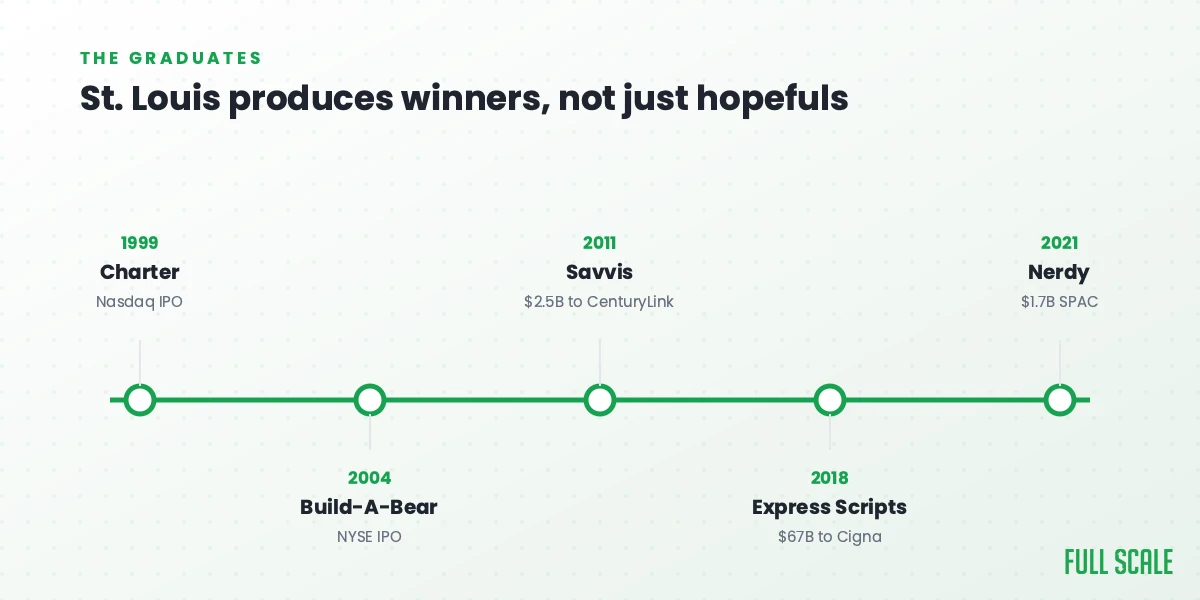
A startup scene is only as credible as its exits. These are the St. Louis companies that grew up and proved the city produces winners, not just hopefuls.
Nerdy, the parent of Varsity Tutors, is the one most people miss. Chuck Cohn started it in St. Louis in 2007, and it went public through a SPAC in 2021 at a valuation around $1.7 billion, which made it the city’s first billion-dollar tech company.
Express Scripts is the giant. Founded in St. Louis in 1986, the pharmacy-benefit manager was acquired by Cigna in 2018 in a deal worth about $67 billion.
World Wide Technology never left and never went public, and it is still the most impressive company on this list. David Steward and Jim Kavanaugh founded it in 1990, and it has grown into roughly $20 billion in revenue and more than 14,000 employees, which has made it the company regularly ranked the largest Black-owned business in the United States.
Savvis built data-center and managed-hosting infrastructure out of the St. Louis area and sold to CenturyLink for about $2.5 billion in 2011.
Answers.com ran one of the early knowledge sites on the web from offices on Delmar Boulevard, and sold to Apax Partners in 2014 in a deal reported at around $900 million.
Stereotaxis has been quietly building surgical robotics for cardiac procedures since 1990, went public in 2004, and still trades on the NYSE today.
Asynchrony is the homegrown software-services exit. The downtown agile-development shop grew to around 250 people before World Wide Technology acquired it in 2015, which is a nice loop: one St. Louis company buying another.
Charter Communications belongs here with one honest caveat. It was founded and incorporated in St. Louis in 1993 by former Cencom executives and went public in 1999, but it moved its headquarters to Connecticut in 2012. The roots are St. Louis even if the address no longer is.
Big names you didn’t know are from St. Louis
This is the section I have the most fun with. Some genuinely large companies started in St. Louis, and almost nobody knows it.
Square, now Block, was founded in St. Louis in 2009. Jack Dorsey grew up here, and the company started after his co-founder Jim McKelvey lost a glass-art sale because he could not take a credit card. They built the company up in San Francisco after that, so it is not a St. Louis company today, but it started in one. Dorsey is also, of course, the same St. Louisan who co-founded Twitter.
Build-A-Bear Workshop was founded in St. Louis in 1997 by Maxine Clark, went public in 2004, and is still headquartered here.
Panera Bread began life as the St. Louis Bread Company in Kirkwood in 1987. It became Panera in 1997 and eventually sold to JAB Holding for about $7.5 billion in 2017, and locals still call it Bread Co.
Enterprise Rent-A-Car was founded in St. Louis in 1957 and is still run from Clayton. It grew into the largest car-rental company in the country and never moved.
Centene is headquartered in Clayton and grew into a Fortune 500 health insurer ranked in the top 25 of the entire list. It was actually founded in Milwaukee, so the honest version is that it became a giant in St. Louis rather than starting here.
Energizer and Purina both trace back to St. Louis’s Ralston Purina, founded in 1894. Energizer spun off in 2000 and is run from Clayton; Nestlé Purina still operates out of St. Louis.
I left a few giants off this section on purpose. Anheuser-Busch and Monsanto both started in St. Louis, but everyone already knows the first one, and the second one’s story is not really a startup story. I wanted the names that actually surprise you.
Why St. Louis keeps producing companies
After spending the time to build this list, the thing that stands out to me is how concentrated the St. Louis scene is. The plant-science companies cluster around the Danforth Center and the 39 North district. The health and bio companies cluster around Cortex and BioGenerator in the Central West End. Arch Grants has been writing $75,000 checks to founders for more than a decade, and its alumni have raised over $870 million in follow-on capital since 2012. When a city builds that kind of infrastructure, companies keep coming out of it.
I have always believed that great companies get built in places people overlook. I built mine in Kansas City, and from across the state I can tell you St. Louis is one of those places. The talent is there and the money is finally showing up, and the exits prove the model works.
If you are a founder on this list, congratulations. You earned the spot. And if I missed your company, that is on me and I would genuinely like to hear about it, because a list like this is never finished.
I run Full Scale, a company that helps growing software teams hire and scale their engineering talent, so I spend my days around companies exactly like the ones above as they figure out how to build. Watching what comes out of St. Louis next is going to be worth the attention.