The Top Indianapolis Startups: A Founder’s Field Guide

In this article
I have started four companies and sold two, all from the Midwest. I co-founded VinSolutions, an auto-dealer software company, in 2006 and sold it to Cox Automotive in 2011; I started the developer tools company Stackify in 2012 and it was acquired in 2021. I run Full Scale now. So when I look at a startup scene, I am not reading a database. I am looking for the things I know take years to build: real exits, repeat founders, and money that stays in town and goes back to work.
Indianapolis has all three, and it’s the Midwest tech scene I think outsiders underrate the most.
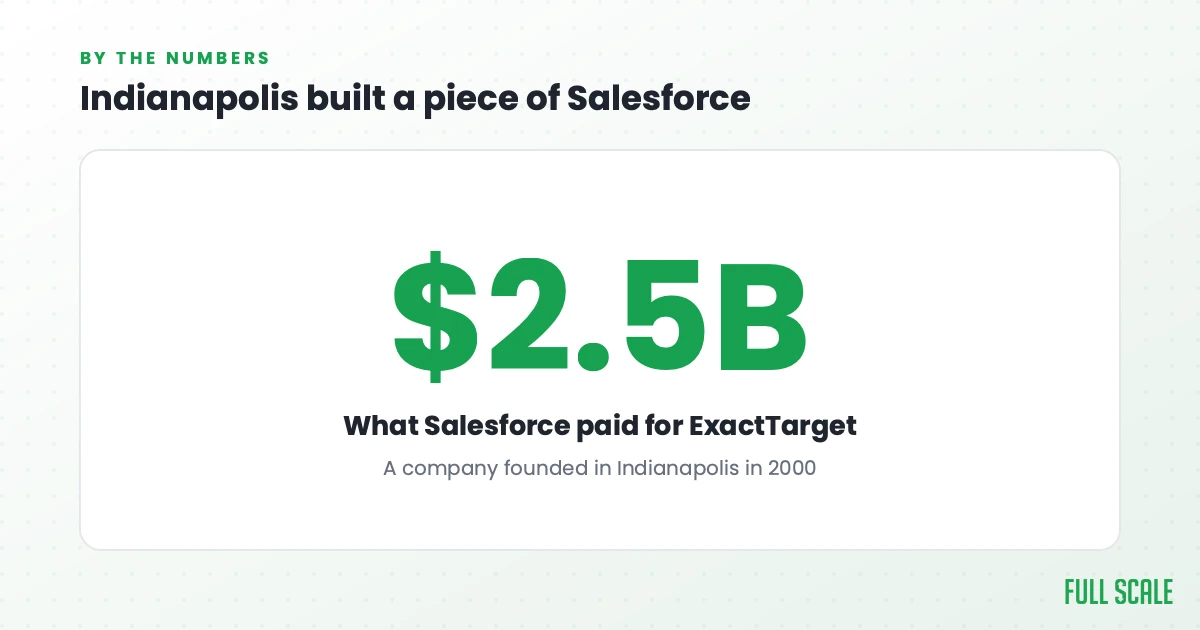
Here is the fact that makes my point. A piece of Salesforce, the biggest CRM company in the world, started in Indianapolis. It was called ExactTarget, it sold for about $2.5 billion, and the tallest building in the state is now named Salesforce Tower. The founder of that company turned around and built a venture studio that has since funded a whole new generation of Indy software companies. Most people outside Indiana have no idea any of that happened.
That is also why most “top startups in Indianapolis” lists bug me. They are a list scraped from a database, and they miss the lineage that makes this city interesting. So I put together the version I wish existed. It runs in four parts: the young companies I am watching, the ones closing real rounds this year, the alumni that exited or went public, and the part I like best, the household names nobody realizes are from here. Where a company still has its own site, I link to it, and the dollar figures all come from filings and press, not a directory’s guess.
The watch list comes first.
Startups to watch
The companies in this bucket are young enough that I am betting on signal, not track record. The bar to make it here was simple: somebody other than the founder has put money or press behind them. I have sorted them by how much of that proof exists right now. A few of these will not be around in 2028, and that is the whole reason it is a watch list and not a winners list.
Funded, with early traction
Spektrum Labs builds a platform that lets companies prove their cyber-resilience to insurers and their own boards, instead of just claiming it. The Carmel company came out of stealth in 2025 with a $10 million seed round.
Tenon builds marketing work-management software natively on the ServiceNow platform. It came out of the High Alpha studio and raised an $8 million Series A in 2024, co-led by High Alpha and ServiceNow’s venture arm.
Bearing brings physical-security operations onto ServiceNow with an AI layer on top. It was launched out of High Alpha and raised an oversubscribed $4.5 million seed round in early 2026, led by AZ-VC.
Entegrata builds an Azure data-lakehouse and analytics layer aimed at law firms. It raised a $4.5 million seed round in 2025 led by Chicago Ventures.
Athian runs a carbon-inset marketplace for the livestock industry, so food companies can fund and count emissions cuts in their own supply chains. It raised a $4 million Series A in late 2025 with strategic backing from names like Chipotle and Mondelez.
Champion turns happy B2B customers into a pipeline engine, using AI to find and activate the people already willing to vouch for you. It raised a $3.3 million seed round in 2024 led by Flyover Capital.
Luster uses AI to spot the skill gaps in customer-facing teams before those gaps cost a deal. It raised a $3 million seed round in 2025, co-led by High Alpha and Ivy Ventures.
Stellar helps mid-market companies actually put generative AI and large language models into their day-to-day operations. It raised an oversubscribed $2.7 million seed round in early 2025.
Backstroke is a generative-AI email marketing platform for ecommerce brands. The founder, R.J. Talyor, came out of ExactTarget, which is a thread you will see over and over in this city. It has raised about $4.8 million.
Reportwell simplifies the regulatory compliance reporting that K-12 schools have to file, built by former educators who got buried in state and city paperwork. It raised a $1.1 million pre-seed round in 2024, backed by Detroit Venture Partners, Techstars, and Duo Security founder Dug Song.
Earning their first attention
Windrow matches farmers to USDA grants they qualify for and would otherwise never find. It came out of a local venture studio and raised a $975,000 seed round in 2025.
Valio automates the rebate-contract compliance that hospitals and their suppliers fight over, turning paperwork back into cash. It was selected for a Techstars AI Health accelerator in 2025.
Bereave is a “digital death concierge” that helps employers support employees through a death in the family, coordinating the services and grief logistics nobody is ready for. It raised a $750,000 pre-seed round.
Who’s getting funded right now
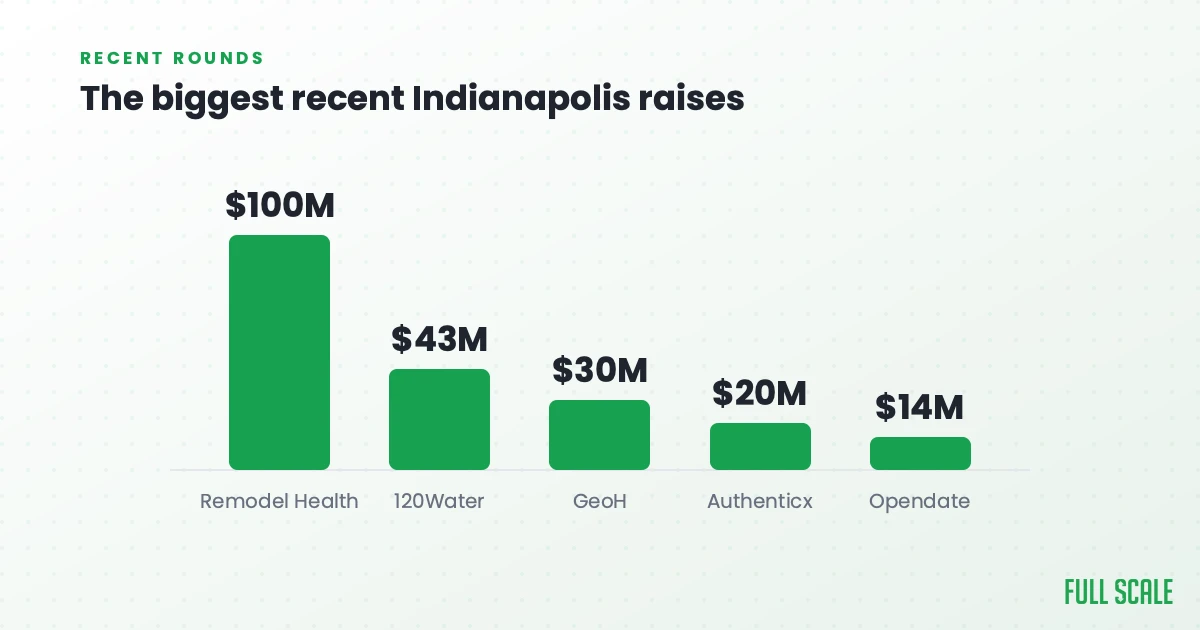
Recent money is the cleanest signal of momentum, so this is the live deal flow. One name does most of the work here: High Alpha. The studio I flagged up top sits behind a striking share of these rounds, which makes sense once you know it was co-founded by Scott Dorsey, the same person who built ExactTarget. I have stacked them biggest raise first, starting with a nine-figure one.
Remodel Health builds software that lets employers offer individual-market health coverage to their teams through an ICHRA model instead of a traditional group plan. In December 2024 it raised more than $100 million in growth equity, the biggest recent raise on this list, led by Oak HC/FT with Hercules Capital.
120Water out of Zionsville builds the software utilities use to manage water quality and stay on top of lead-pipe compliance, which became a national problem in a hurry. It raised a $43 million growth round in 2024 led by Edison Partners.
GeoH builds the back-office software, billing, and visit verification that home-care and home-health agencies run on. It raised more than $30 million in growth equity in 2025, led by Council Capital.
Authenticx listens to the millions of conversations between healthcare companies and their patients and pulls real signal out of them. It raised a $20 million Series B in early 2023 led by Blue Heron Capital.
Opendate is an operating system for independent live-music venues, handling booking, ticketing, and marketing in one place as an alternative to the big incumbents. It raised a $14 million Series A in January 2026 led by High Alpha.
Olio builds care-coordination software that connects payers and health systems with the providers a patient needs after they leave the hospital. It raised an $11 million Series B in 2025 led by Fulcrum Equity Partners.
PAXAFE uses AI to predict and prevent the things that go wrong in cold-chain shipping, the kind of failure that ruins a pallet of vaccines in transit. It raised a $9 million Series A in 2024 led by Framework Venture Partners.
hc1 turns lab and diagnostics data into something hospitals and labs can actually act on. It raised a $6.25 million round in early 2025 led by Health Cloud Capital.
MetaImpact, formerly MetaCX, builds collaboration software for groups of organizations trying to move on a shared goal together. It raised a $5 million round in 2025 led by BIP Ventures.
Upper Hand builds scheduling and payments software for sports and fitness businesses, from single coaches to multi-location academies. It closed an oversubscribed growth round of around $5 million in early 2023.
Zylo helps big companies see and control everything they spend on SaaS subscriptions, which is a bigger and messier number than most finance teams expect. It added $5 million from MassMutual Ventures in early 2023 on top of an earlier Series C.
Elate is cloud software for strategic planning, the work of setting a company’s goals and actually tracking them, which most teams still do in spreadsheets. It raised a $4.9 million Series A in 2023 led by WestWave Capital.
Your Money Line is a financial-wellness benefit that pairs software with real human coaches to help employees get out of debt and handle money stress. It raised a $4.5 million Series A in 2024 led by Allos Ventures.
Qualifi speeds up high-volume hiring with asynchronous phone screening, so recruiters filling dozens of roles at once are not stuck playing phone tag. It raised an oversubscribed $4.5 million round in 2023.
AfterSchool HQ out of Fishers builds program-management software for the organizations that run youth and after-school programs. It raised a seed round of around $3.1 million in 2023 led by Reach Capital.
The graduates: Indianapolis startups that made it big
These are the ones that made it out of the build phase. They started small in Indianapolis and turned into real exits or standalone businesses with real revenue, which is the line between a city that produces companies and one that just produces pitch decks. The most famous graduate, ExactTarget, gets its own entry in the surprises section below. It is far from alone.
Interactive Intelligence was founded in Indianapolis in 1994 and built pioneering all-in-one contact-center software. It went public in 1999 and was acquired by Genesys for about $1.4 billion in 2016. Genesys still runs a major office in Indianapolis today.
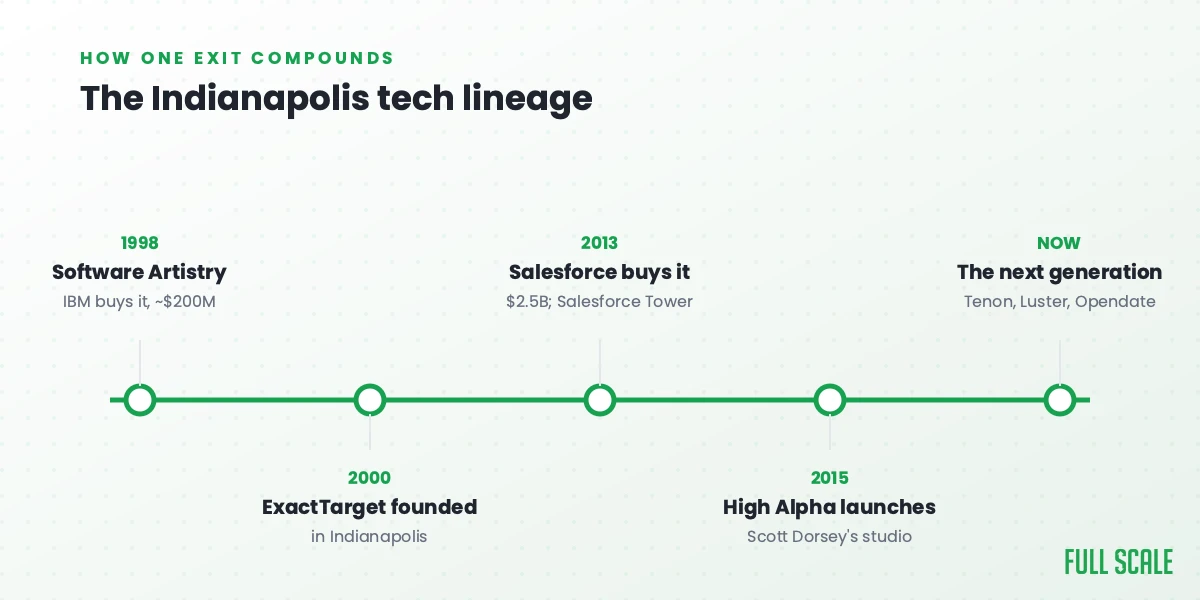
Software Artistry was founded in Indianapolis in the late 1980s and became Indiana’s first publicly traded software company. IBM bought it for about $200 million in 1998. That exit matters more than the number, because the people and money it produced seeded much of what came next in this city.
Aprimo was founded in Indianapolis in 1998 and built enterprise marketing-operations software. Teradata acquired it for about $525 million in 2011. The company still runs major operations out of Indianapolis, though its headquarters later moved to Chicago.
Greenlight Guru builds quality-management software for medical-device companies, the system of record for staying compliant while you ship. Founded in Indianapolis in 2013, it took a $120 million investment from JMI Equity in 2021 and is still independent and still here.
Formstack builds online forms and workflow automation and grew up in the Indianapolis area, now headquartered in Fishers. It landed a $425 million growth investment in 2021 from Silversmith Capital and PSG.
Pondurance runs risk-based managed detection and response, a 24/7 security team that hunts threats inside client networks. Founded in Indianapolis in 2008 and still headquartered downtown, it took a major growth investment from Newlight Partners and scaled into a national cybersecurity name from its Indianapolis base.
Lessonly built sales-training and enablement software in Indianapolis starting in 2012, and was acquired by Seismic in 2021. Seismic kept the Indianapolis office and team.
Compendium was a content-marketing platform co-founded in Indianapolis in 2007 by Chris Baggott, who had earlier co-founded ExactTarget. Oracle acquired it in 2013 and folded it into its marketing cloud.
Octiv, which started life as TinderBox, built sales-document automation software in Indianapolis from 2010. Conga acquired it in 2018 and kept Indianapolis as a core hub.
Sigstr built an email-signature marketing platform in Indianapolis and was acquired by Atlanta’s Terminus in 2019.
MOBI built managed-mobility software in Indianapolis to help big companies handle their fleets of devices. Tangoe acquired it in 2018, and Indianapolis became the headquarters of the combined business.
Big tech names you didn’t know are from Indianapolis
Now the part I actually enjoy. None of these are startups anymore. They are names you would recognize from a TV ad, and almost nobody connects them to Indiana. Ask a room full of tech people where they came from and you will hear California or New York long before you hear Indianapolis.
Salesforce Marketing Cloud. Here is the big one. It was founded in Indianapolis in 2000 as ExactTarget, went public in 2012, and was acquired by Salesforce in 2013 for about $2.5 billion, becoming the marketing engine inside the world’s largest CRM. Salesforce still runs one of its largest US operations in Indianapolis, in a building literally renamed Salesforce Tower, the tallest in the state. A piece of one of the most important software companies on earth started here, and the founders went on to seed half this list.
Angi, the home-services brand most people still call Angie’s List. It was grown and headquartered in Indianapolis, where it ran for more than two decades, went public in 2011, and merged with HomeAdvisor in 2017 in a deal worth around $780 million. The corporate headquarters later moved to Denver, but the household name was built in Indianapolis.
Klipsch, one of the most respected American speaker and audio brands. The company was founded in Arkansas, but its worldwide headquarters has been in Indianapolis since the early 1990s, and that is where a lot of its engineering happens. If you own a set of Klipsch speakers, they were designed out of Indiana.
BrightPoint was once one of the largest wireless-device distributors in the world, moving phones for carriers everywhere and doing billions in revenue. It was founded and headquartered in the Indianapolis area, and Ingram Micro acquired it in 2012 for more than $650 million.
ChaCha was the viral “human-powered” answers service from the mid-2000s, the one where you texted a question to 242-242 and a real person texted back. It was founded in Carmel by Scott Jones and Brad Bostic and raised around $82 million before the smartphone made the whole idea obsolete.
Roche Diagnostics runs its entire North American operation out of Indianapolis, including the diabetes-care technology a lot of people rely on every day. It’s medtech more than software, but it’s one of the largest tech-driven employers in the city and most people have no idea its North American home is here.
One last entry, and it is not a tech company at all, but it is a big reason the rest of this list exists. Eli Lilly, the pharmaceutical giant, was founded in Indianapolis in 1876 and is still headquartered here. The fortune it created funds the Lilly Endowment, one of the largest private foundations in the country, which has poured money into Indiana education, civic life, and entrepreneurship for generations. Strip out the talent, the philanthropy, and the civic muscle that one company has funded since 1876, and most of the names above it have a much harder time getting built. Every real startup city has an engine like this underneath it, and in Indianapolis it has been running for almost 150 years.
Why Indianapolis keeps doing this
Here is what I see looking at Indianapolis from one Midwest city over. The cost math works and the engineering talent is deep, but plenty of cities can say that. What Indianapolis has that most cannot is a tight loop where one big exit funds the next generation directly. ExactTarget sold, its founder built High Alpha, and High Alpha has now seeded a long list of the companies on this page. That loop is the whole ballgame, and Indianapolis has it running better than most cities its size.
There is no coastal hype machine here, and I think that is a feature. When nobody is chasing a quick flip, you get founders building companies meant to still be standing in ten years.
Full Scale, my current company, is a Kansas City outfit, not an Indianapolis one, so I am writing this as an outsider with a horse in the same race. The bet is identical on both sides of the Mississippi: the next company that matters does not have to come from the Bay Area. I have a lot of respect for what Indianapolis has built, and I wanted to put it on the record.
Made the list? Good. Nobody handed you that. And if you belong here and I left you out, that is my miss, not yours, so send me a note and I will dig in. I plan to keep adding to this as Indy keeps shipping.