Top Chicago Startups

In this article
I have started four companies and sold two of them, both out of Kansas City. So I am not going to pretend I am a Chicago founder. But I have spent twenty years building software companies in the Midwest, and if you do that long enough, you end up paying close attention to Chicago. It is the capital of Midwest tech, the place the rest of us measure ourselves against, and the proof that you can build something huge a long way from the coasts.
And that is where most of these lists fall short. The usual “top Chicago startups” roundup is a scraped directory with a grid of logos, and it skips the most interesting thing about this place. Chicago has been turning out real companies for a century, and you are probably using several of them without knowing they got their start here.
So this is the list I wish someone else had already written. It moves through four kinds of company: the young ones worth watching, the ones raising serious money right now, the ones that already grew up and exited or went public, and my favorite, the household names whose Chicago roots nobody remembers. Every company links to its own site, and every dollar figure traces back to public reporting rather than a guess.
We will start with the newcomers.
Startups to watch
Everything here is early. I only included a young company if there is real reporting behind it, because at this stage traction is the whole point of putting it on a list. They are grouped roughly by how much each one has proven so far. A few of these will not make it two years out, and that is the honest reason the label says “to watch” instead of “winners.”
Funded, with early traction
Coldcart runs the logistics layer for shipping frozen and refrigerated products, the messy problem behind every direct-to-consumer food brand. It raised a $6.5 million seed in 2024 led by Collide Capital, and one of its co-founders is Matt Salzberg, who co-founded Blue Apron.
Cargado is a marketplace for cross-border trucking between the United States and Mexico, a slice of freight that almost nobody had built software for. It raised a $12 million Series A in 2025 led by LGVP, after an earlier seed round.
Arvist puts an AI layer on top of the cameras and scanners already running in a warehouse, so it can catch damage, quality problems, and safety issues in real time. It raised about $7 million across early rounds, starting with a 2023 pre-seed.
Silkline raised a $4 million seed in 2025, led by Origin Ventures, to build supply-chain and procurement software for advanced manufacturing, the aerospace, defense, and energy companies that have to track compliance on every part.
Backed by Nat Friedman and Daniel Gross, Grid Status turns the fragmented, real-time data from America’s electric grid into something a developer can actually use. Energize Capital led its $8 million round in 2024.
Renterra builds an AI operating system for equipment-rental companies, the businesses that rent out the excavators and lifts on every construction site. It raised a $9 million Series A in early 2026 led by Avenue Growth Partners.
Definity embeds AI agents directly into data pipelines, so the engineers running a company’s data infrastructure get help instead of more alerts. It raised a $12 million Series A in 2026 led by GreatPoint Ventures, with Chicago’s own Hyde Park Venture Partners in the round.
Auxira Health pairs virtual-cardiology software with clinical teams that embed inside cardiology practices, aimed squarely at the shortage of heart doctors. It raised a $7.8 million seed in 2025.
Qumis builds AI trained on insurance coverage language, so commercial-insurance teams can actually find the answer buried in a policy, and raised a $4.3 million seed in 2026 led by MTech Capital.
Continuum is software for the part of logistics nobody likes, returns, warranties, and repairs, built for business-to-business distributors. It raised a $4.1 million seed in 2024 led by Cowboy Ventures.
Tandem is a money app for couples who want to manage finances together without merging everything into a joint account. It raised a $3.7 million seed in 2024 led by Chicago’s Corazon Capital. It is not the couples app of the same name out of Michigan.
Cambio puts AI voice agents on the phone for banks and credit unions, handling sales calls and debt negotiation. It raised a $3 million seed in 2024 and came through Y Combinator.
Alphathena gives wealth managers an AI-driven way to build custom index portfolios for individual clients through an API. It raised a $4 million strategic round in 2024, with Hyde Park Angels participating, out of suburban Warrenville.
GigaStar lets YouTube creators sell a share of their future channel revenue to fans, with the securities paperwork actually handled. It raised a $4.8 million seed in 2023.
HiLink builds an AI-powered virtual classroom for live teaching, with a whiteboard, transcription, and lesson-planning tools built in. It raised a $5 million seed in 2024 led by Chicago’s Corazon Capital. (Worth noting the name is shared with an unrelated Huawei product, so this is the Chicago education company at hilink.ai.)
Earning their first attention
BlackCurrant is building an online marketplace for buying and selling hydrogen and other low-carbon fuels, which today is a slow, manual process. It came out of the University of Chicago’s startup program and won a $250,000 grant from the school’s George Shultz Innovation Fund.
blip Energy makes a plug-in home battery you can install yourself, and ties those batteries together into a resource the grid can lean on at peak times. It grew out of Northwestern and took a 2024 seed investment from Morgan Stanley’s Inclusive Ventures Lab, alongside a Department of Energy award.
Haylon Technologies builds battery-management systems that can run a pack made of mixed cell chemistries, aimed at defense, aerospace, and grid storage. It came up through Techstars Chicago and mHUB and has won Department of Defense research contracts.
Loper is a college-planning app that gamifies the search for students while giving schools a new way to reach them. Chicago Inno named it one of its startups to watch.
Who’s getting funded right now
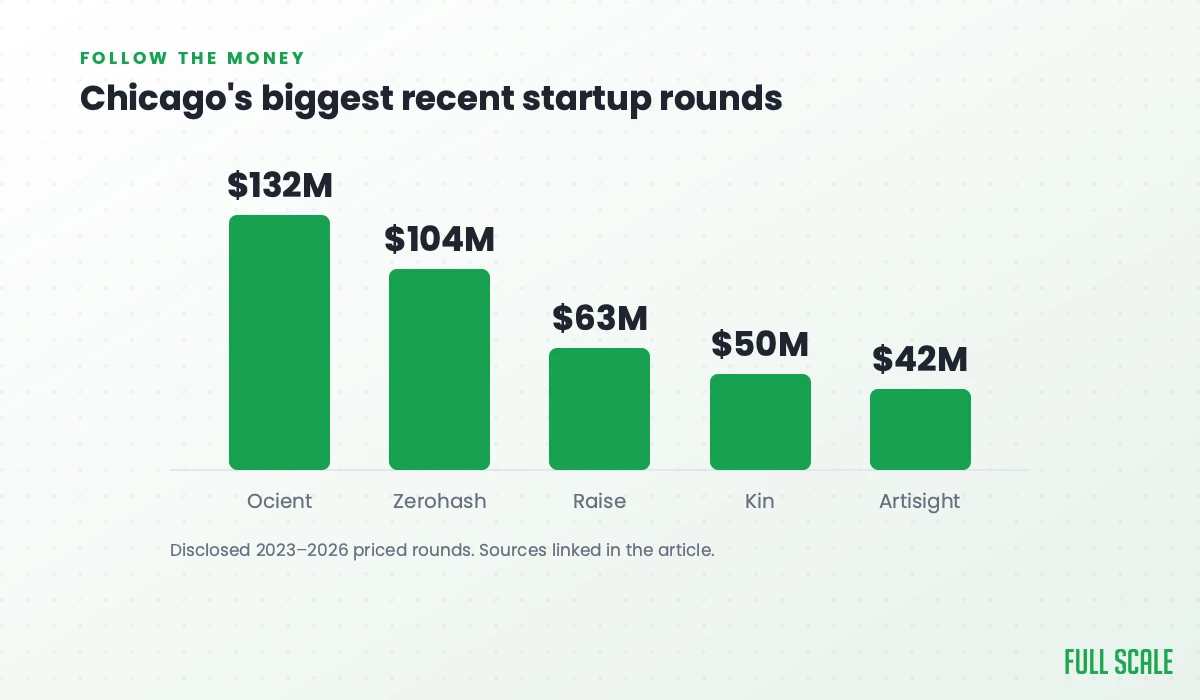
These are the Chicago companies with real money on the board lately, and the rounds tell you where the heat is. Worth flagging first: Crain’s put Chicago venture dollars at a multi-year low across 2024 and 2025, so a sizable raise right now counts as a genuine signal. I have listed them biggest check to smallest, from a nine-figure balance sheet down to the first institutional money in.
Ocient builds a data-analytics platform for the kind of hyperscale workloads that break normal databases, the trillions of rows behind AI, energy, and telecom. It closed a $132 million Series B, with extensions, in 2025. It is the biggest recent raise on this list.
Zerohash is the crypto and stablecoin infrastructure quietly powering other companies’ products, from Stripe to Interactive Brokers. It raised a $104 million Series D in 2025 led by Interactive Brokers, reaching a reported $1 billion valuation.
Raise runs a digital gift-card and loyalty marketplace and is moving that activity onto the blockchain. It raised a $63 million round in 2025 led by Haun Ventures.
Kin Insurance is a direct-to-consumer home insurer built for the high-risk, extreme-weather markets traditional carriers are fleeing. It raised a $50 million Series E in 2025 at a reported $2 billion valuation, led by QED Investors and Activate Capital.
Artisight puts computer vision to work inside hospitals, watching for the things a short-staffed floor can miss, like a patient at risk of a fall. It raised an oversubscribed $42 million Series B in 2024, with NVIDIA among its investors, and reportedly added another large round in 2025.
Honeycomb Insurance uses AI and aerial imagery to underwrite insurance for landlords and condo associations. It raised a $40 million Series C in 2026 led by Zeev Ventures.
NuMat Technologies was one of the first companies to commercialize a class of designer materials called metal-organic frameworks, used to capture and filter chemicals. It raised a $40 million Series C extension in 2025.
HDVI sells commercial-trucking insurance priced off real telematics data instead of a guess. It raised a $40 million growth round in 2025, co-led by 8VC, Autotech Ventures, and Munich Re Ventures.
Letter AI builds an AI-native platform that arms enterprise sales teams with the right content and coaching at the right moment. It raised a $40 million Series B in 2026 led by Battery Ventures, less than a year after its Series A.
GeoWealth runs a turnkey investment-management platform for the independent financial advisors who do not want to build their own back office. It raised a $38 million Series C in 2025 led by Apollo, then added a $42.5 million extension from Goldman Sachs Asset Management in 2026.
Architect Financial Technologies is building an exchange for perpetual futures on traditional assets like currencies and metals. It raised a $35 million Series A in 2025, anchored by Miami International Holdings, the parent of the MIAX exchanges. Its founder, Brett Harrison, ran FTX US, leaving months before its collapse, which makes this a closely watched second act.
Kivu and Greycroft led a $31.5 million Series A in 2025 for HOPPR, which builds the foundation-model infrastructure that medical-imaging AI gets trained on.
ElectronX is building the first federally regulated, direct-access exchange where companies can trade electricity contracts to hedge against wild power prices. It raised a $30 million Series A in 2025 led by DCVC.
Capital Markets Gateway connects the buy side and sell side of the equity capital markets on one platform, modernizing how stock deals get done. It raised a $30 million Series C in 2025 led by StageDotO.
Formic rents factory automation to mid-sized manufacturers by the hour instead of selling them a million-dollar robot. It raised a $27.4 million tranche of its Series A in 2024, led by Blackhorn Ventures.
KeyCare runs a virtual-care platform built on Epic, so health systems can offer telehealth without leaving their own software. It raised a $27.4 million round in 2026.
Kalderos untangles the drug-discount and rebate mess between drugmakers, pharmacies, and the government. It raised a reported $26.4 million Series C that closed in 2024.
Coinflow builds stablecoin payments infrastructure for instant settlement and cross-border money movement, and raised a $25 million Series A in 2025 led by Pantera Capital, with Jump Capital and Coinbase Ventures in the round.
Paro is an AI-matched marketplace that connects companies with fractional finance and accounting experts. It raised a $25 million Series C in 2023 led by Top Tier Capital Partners.
Aeropay is a pay-by-bank network that moves money straight between accounts, skipping card fees. It raised a $20 million Series B in 2024 led by Group 11, with Chicago Ventures participating.
Prenosis built the software behind the first AI sepsis diagnostic the FDA cleared, pulling a life-or-death signal out of messy hospital data. It raised a $20 million Series A in 2026 alongside a $20 million federal contract.
The graduates: Chicago startups that made it big
These are the companies that started small in Chicago and turned into real exits or public listings. They are the proof that the city grows companies that go the distance, not just ones that flash for a season. A few of the biggest sit in the tech-names section below, but they have plenty of company up here.
Groupon is the one everybody remembers. Founded in Chicago in 2008, it went public in 2011 at a valuation around $12.7 billion, which at the time was the second-biggest tech IPO in US history behind Google.
Grubhub was founded in Chicago in 2004, went public in 2014, and kept its headquarters here even after merging with a New York rival. In 2021 it sold to Europe’s Just Eat Takeaway for $7.3 billion.
Tempus AI brings AI to cancer diagnostics and precision medicine. Founded in Chicago in 2015 by Eric Lefkofsky, the same person who co-founded Groupon, it went public in 2024 at roughly a $6 billion valuation.
Sprout Social builds social-media management software for businesses. Founded in Chicago in 2010, it went public in 2019 and is still run from downtown.
Paylocity sells cloud payroll and HR software out of suburban Schaumburg. Founded in 1997, it went public in 2014 and is now a multi-billion-dollar company.
GoHealth runs a digital marketplace for Medicare plans. Founded in Chicago in 2001, it went public in 2020 in one of that year’s largest healthcare IPOs, at a valuation around $6.6 billion.
Enova International is an online lender for consumers and small businesses underserved by banks. Built in Chicago, it began trading on the NYSE in 2014 after spinning off from Cash America.
Coyote Logistics was a tech-driven freight brokerage founded in Chicago in 2006. Founded by Jeff and Marianne Silver, it sold to UPS for $1.8 billion in 2015.
Echo Global Logistics built freight-brokerage technology, went public in 2009, and was taken private by The Jordan Company in 2021 in a deal worth about $1.3 billion. Founded in Chicago in 2005, it is the third company on this list tied to Eric Lefkofsky.
Cleversafe built object-storage technology in Chicago, founded in 2004 by Chris Gladwin, who later started Ocient at the top of the funded list. IBM acquired it in 2015 for a reported $1.3 billion, and it now powers IBM Cloud Object Storage.
SAP Fieldglass built software for managing contract and contingent workers. Founded in Chicago in 2000, it sold to the German software giant SAP in 2014 in a deal reported to be worth more than $1 billion.
Trustwave is a managed cybersecurity company founded in Chicago in 1995. Singapore’s Singtel acquired it for about $810 million in 2015.
SMS Assist built a cloud platform for managing facilities maintenance across thousands of properties. A Chicago unicorn, it sold to Lessen in 2023 in a deal valued at about $950 million.
A few never sold or went public but grew into giants anyway. Relativity, founded in Chicago in 2001, makes the e-discovery software used by the Justice Department and most of the country’s biggest law firms; a 2021 investment valued it around $3.6 billion, and it filed to go public in 2026. project44 tracks shipments in real time across the global supply chain and reached a $2.7 billion valuation. ActiveCampaign builds marketing automation for small businesses and hit a $3 billion valuation in 2021. Avant became one of Chicago’s first fintech unicorns back in 2015. And G2, the “Yelp for business software,” crossed a $1 billion valuation in 2021.
Not every Chicago unicorn was real, and it is worth being honest about that. Outcome Health put health-information screens in doctors’ offices and hit a $5.6 billion valuation in 2017, briefly one of the most valuable Chicago startups since Groupon. Then it collapsed in a billion-dollar fraud, and a co-founder and its CEO was sentenced to seven and a half years in federal prison. It belongs on the list as a cautionary tale, not a success story.
Big tech names you didn’t know are from Chicago
This is the part I have the most fun with, because people almost always miss these. Most stopped being startups a long time ago. They are names you already know, with Chicago roots that have quietly slipped everyone’s mind.
Motorola. The company that built the first handheld cell phone was founded in Chicago in 1928, back when it made car radios. It moved its headquarters to suburban Schaumburg in 1976, and Motorola Solutions moved back downtown in 2015. The company that put a phone in everyone’s pocket is a nearly hundred-year-old Chicago institution, not a Silicon Valley one.
Basecamp. The project-management software company, originally called 37signals, was founded and is still run in Chicago. Its outsized fame comes from the fact that the Ruby on Rails programming framework was created here, which shaped how a generation of web apps got built. It is a deliberately small, fiercely independent shop, not a venture-backed coastal startup.
Braintree. The payments company that PayPal bought for $800 million in 2013 was founded in Chicago in 2007. The bigger surprise: Braintree owned Venmo, which it had acquired in 2012, so the company behind one of the most popular payment apps in America was Chicago-built. Its founder, Bryan Johnson, is now better known for spending a fortune trying to reverse his own aging.
Cars.com. The automotive marketplace nearly every American car shopper has used was founded and headquartered in Chicago in 1998.
Home Chef. Meal kits read like a Blue Apron or HelloFresh story, but the one that actually got bought by a grocery giant was Chicago’s. Founded here in 2013, it sold to Kroger in 2018 in a deal worth up to $700 million.
Morningstar. The investment-research company behind the fund “star ratings” that anyone with a 401(k) has seen was started in a Chicago apartment in 1984 with $80,000. It is still headquartered here.
CDW. The Fortune 500 technology reseller that sells IT gear to businesses and governments across the country was founded in 1984 and is headquartered in the Chicago suburb of Vernon Hills. It does more than $20 billion in revenue, and most people have never connected it to Chicago.
Cameo. The app for booking personalized videos from celebrities feels like a Los Angeles company, for obvious reasons. It was founded in Chicago in 2016 and made the city its global headquarters.
Orbitz. The online travel agency, originally backed by a group of major US airlines, was founded and headquartered in Chicago in 2000 before Expedia acquired it.
Why Chicago keeps doing this
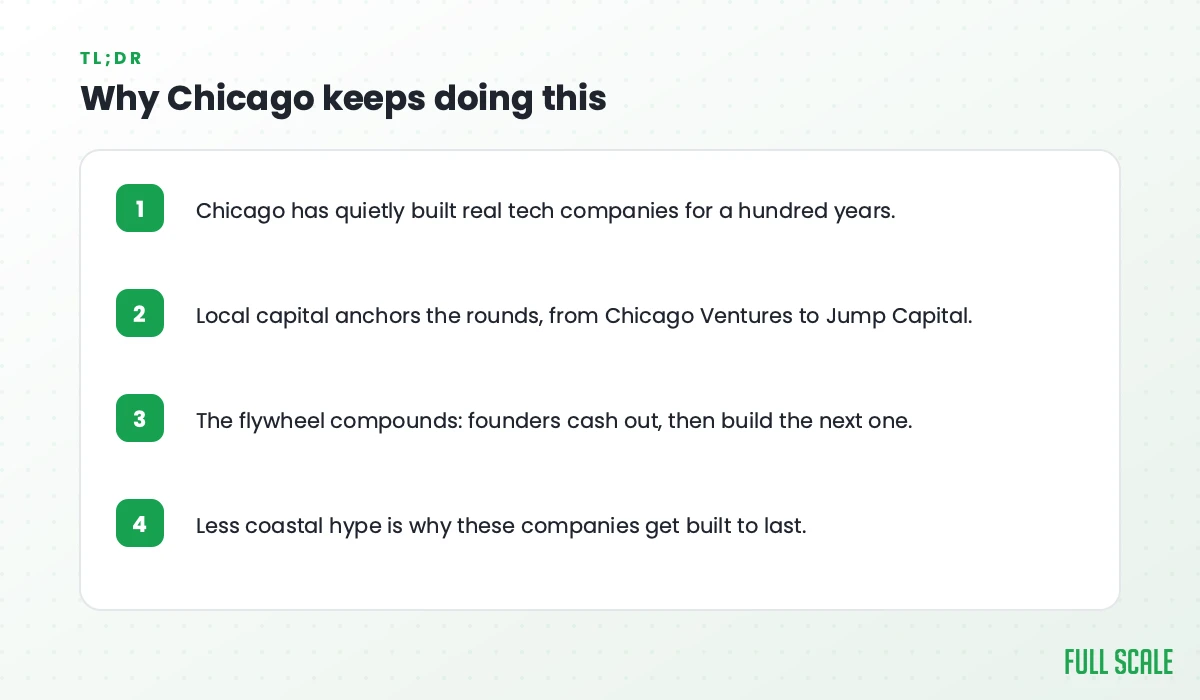
After two decades building companies around the Midwest and watching Chicago do its thing from a state away, the pattern is hard to miss. The engineering schools keep feeding the city talent. The money is here too, with local investors like Chicago Ventures, Hyde Park Angels, and Jump Capital showing up round after round. And the part that actually compounds is the flywheel: a founder cashes out and starts the next thing. Chris Gladwin went from Cleversafe to Ocient. Eric Lefkofsky’s name is on Groupon, Tempus, and Echo Global.
There is none of the coastal noise here, and I think that is exactly why what gets built in Chicago tends to be built to keep.
Full Scale, the company I run today, is a Midwest outfit too. We build software teams for companies, and I am pulling for everyone on this page, because the whole idea behind what we do is that a San Francisco zip code was never the requirement for building something that lasts. If you are building in Chicago, or hiring the engineers to do it, get in touch.
If you made the list, you earned the spot. And if I left someone obvious off, that is on me, so send it over and I will take a look. This thing is only going to get longer.