Successful Software Offshoring Strategies: Why Most Fail (And the One That Actually Works)
Most articles about successful software offshoring strategies give you the same checklist. Communicate clearly. Set expectations. Do your research.
Here’s the problem with that advice. None of it matters if your engagement model is fundamentally broken.
You can have perfect communication with a team managed by three layers of project coordinators. You can set crystal-clear expectations with developers who’ll be reassigned in 60 days. You can research thoroughly and still end up with an outsourcing partner treating your developers like interchangeable resources.
The offshore development horror stories you’ve heard? They didn’t happen because someone forgot to “communicate clearly.” They happened because the traditional project outsourcing model is designed to fail.
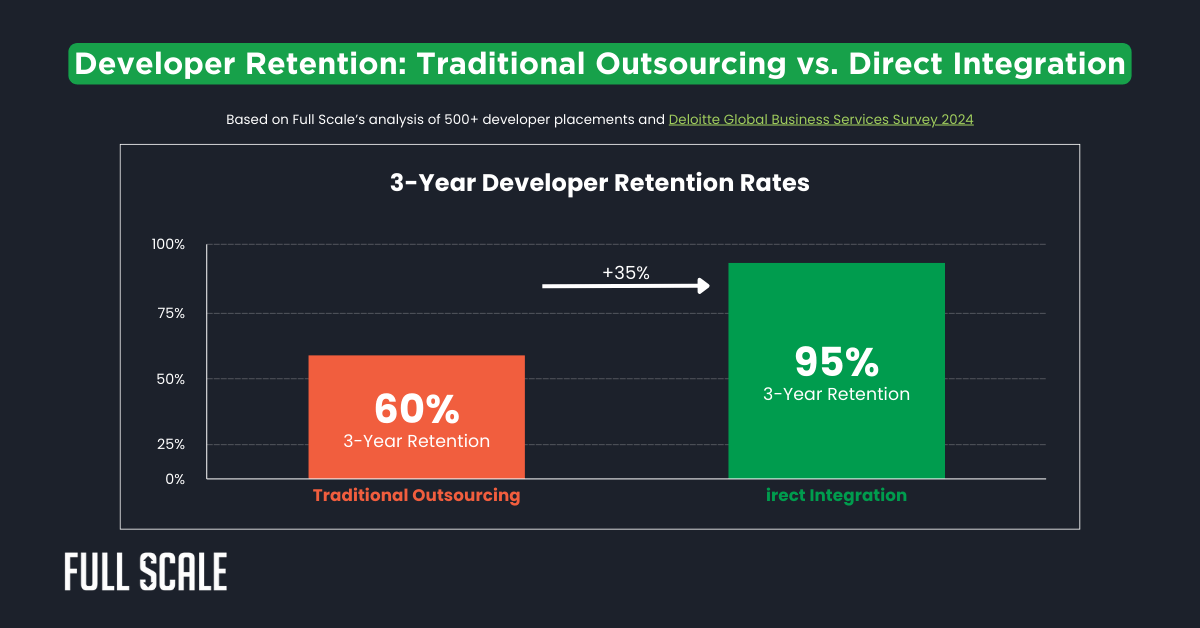
After placing 500+ developers and maintaining a 95% retention rate over 3+ years, we’ve learned something. Success has less to do with “strategies” and everything to do with the engagement model.
What You'll Learn:
- Why conventional offshore "strategies" treat symptoms, not causes
- The structural difference between models that fail and models that succeed
- What Full Scale's Direct Integration Model does differently (with retention data to prove it)
- The 5 successful software offshoring strategies that actually work when you fix the model first
- When offshore development isn't the right choice (honest assessment)
Why Traditional Offshore Strategies Don't Work
Most offshore advice assumes project-based outsourcing is the default model. But project outsourcing has structural problems no “strategy” can fix.
Here’s what actually breaks. The middleman problem creates 2-3 layers between you and developers. The agency wants billable hours, while you want efficiency.
Developers get rotated between projects like interchangeable parts. Every rotation means starting over. Knowledge walks out the door every 60-90 days.
I've talked to dozens of CTOs who say "We tried offshore. It didn't work."
When I dig deeper, here's what actually happened. They hired through a traditional outsourcing agency. They paid $50-75/hr thinking they were getting senior developers.
Instead, they got a project manager who doesn't code. That PM managed 2-3 junior developers who were also working on 4 other projects.
Communication was slow. Knowledge transfer was constant. When they finally got the PM and devs aligned, the agency rotated someone out.
Six months later, they had nothing to show but invoices. They think they have an 'offshore problem.' What they really have is an 'outsourcing model problem.'
According to Deloitte’s 2024 Global Outsourcing Survey, traditional outsourcing struggles with high turnover and talent challenges. That means every 15 months, your entire team has been replaced. All the associated knowledge loss comes with it.
So what actually works instead? Let me show you the structural difference.
What Actually Makes Offshore Development Successful
Successful software offshoring strategies depend on model, not strategy. Staff augmentation with direct integration—where developers work as full-time extensions of your team without middlemen—achieves 95% retention rates and seamless collaboration. This contrasts sharply with traditional project outsourcing's communication barriers caused by project manager intermediaries.
The structural contrast matters more than any checklist you’ll follow. Let me show you exactly what breaks in traditional models versus what works in direct integration.
When you choose staff augmentation over project outsourcing, you’re not just changing vendors. You’re changing the fundamental relationship between your company and offshore talent.
| Factor | Traditional Project Outsourcing | Staff Augmentation (Direct Integration) |
|---|---|---|
| Control | Low (PM middleman filters everything) | High (direct Slack/Zoom/standup access) |
| Team Stability | High turnover (40%+ annually) | 5% over 3 years (95% retention) |
| Knowledge Retention | Lost every rotation | Builds over time |
| Start Time | 4-12 weeks (contract negotiation) | 7-14 days (pre-vetted pool) |
| Communication | Asynchronous through PM | Real-time with developers |
| Cost Structure | Markup on hours + PM overhead | Transparent flat monthly rate |
| Developer Treatment | Project-hopping contractors | Full-time employees with benefits |
The strategies that work for project outsourcing are actually workarounds for a broken model. “Over-communicate” means fighting through middlemen. “Document everything” compensates for constant turnover.
With direct integration, you don’t need workarounds. You just work.
How the Direct Integration Model Works Differently
Here’s what makes our approach structurally different from traditional outsourcing. These aren’t minor tweaks—they’re fundamental differences in how developers integrate with your team.
Key Differentiators:
- You interview and approve every developer — We handle pre-vetting, you make final decisions
- They join your Slack, attend your standups, use your tools — No translation layer
- They’re full-time on your team — Not juggling 4 other projects
- They stay with you — 95% retention means the team you start with is the team you keep
- No PM middleman — Direct communication with developers who own their work
- Month-to-month contracts — Not locked into year-long commitments
Now that we’ve established the foundation—model matters most—let me give you tactical strategies. These successful software offshoring strategies work WITHIN the right model. Without direct integration, they become band-aids on a broken system.
5 Successful Software Offshoring Strategies That Actually Work
Strategy 1: Treat Offshore Developers Like In-House Team Members
Same tools, same access, same meetings. No “offshore team” versus “in-house team” mentality.
Include them in product decisions, not just implementation. When developers feel like disposable contractors, they act like it. When they’re treated as long-term team members, they invest in your success.
Real example: One of our FinTech clients holds a monthly all-hands where their 8 offshore developers present features to the entire company. The developers aren’t just coding. They’re product owners. That ownership drives quality.
Strategy 2: Start Small, Scale Smart
Begin with 1-2 developers for 90 days. Prove the model works before scaling to 6-8.
Use the initial period to establish processes. This reduces risk, builds confidence, and lets you refine collaboration before major commitment.
Most successful Full Scale engagements follow this pattern. Start with 2 developers, scale to 5 within 6 months, then 8-12 within a year. The slow ramp lets you build processes that stick.
Strategy 3: Own the Product Vision, Let Developers Own Implementation
You define WHAT and WHY. Developers determine HOW. Trust their technical judgment.
Micromanaging offshore teams creates bottlenecks. Empowering them creates velocity.
The CTOs who struggle with offshore are usually the ones trying to specify every implementation detail. The ones who succeed give developers the problem to solve, not the solution to implement.
Senior developers don't want to be code monkeys. They want to engineer solutions.
Strategy 4: Establish Overlap Hours (But Not 100% Overlap)
Three to four hours of daily overlap for collaboration. Remaining hours for focused deep work. Async updates for non-critical items.
This balances real-time collaboration with the timezone advantage. You get nearly 24-hour development cycles.
The Philippines as an Example (13-hour difference from US Eastern):
- 8am-12pm Eastern = 9pm-1am Manila (overlap window)
- Morning standup at 9am ET / 10pm Manila
- Developers do deep work during their morning (your evening)
- You review progress each morning
- Result: Nearly 24-hour development cycle
Strategy 5: Measure Output, Not Activity
Focus on delivered features, not hours logged. Track velocity through story points and features shipped.
Avoid surveillance tools that track mouse movements. Trust drives performance. Micromanagement drives turnover.
Contrarian take: If you need to track keystrokes to trust your offshore team, you hired the wrong team. Our clients don’t track hours. They track outcomes. That’s only possible because developers are invested in the product, not just collecting hourly rates.
Is Your Company Ready for Successful Software Offshoring Strategies?
Answer these 5 questions to assess your readiness:
These five successful software offshoring strategies accelerate results—but only when you have the right foundation. Let’s be honest about when offshore development isn’t the right choice.
When You're NOT Ready for Offshore Development
We turn down about 30% of discovery calls because the timing isn’t right. Offshore development isn’t a fit for everyone. That’s okay.
We’d rather be honest about fit than take your money and deliver mediocre results.
Scenarios Where Offshore Doesn’t Work:
You don’t have a clear product roadmap. Offshore works for execution, not exploration. If you’re still figuring out what to build, keep it local until you have clarity.
You need someone local for regulatory reasons. Some healthcare and FinTech clients require US-based dev teams. Certain compliance needs mandate local presence.
Your team isn’t remote-friendly. If your in-house team can’t work with remote US developers, they won’t work with offshore. Remote culture is a prerequisite.
You’re looking for quick consulting, not long-term team building. Offshore staff augmentation shines for 6+ month engagements. For 2-week projects, hire a consultant.
We’ve covered when offshore isn’t right. Now, let me show you what happens when you fix the model first, then apply proper successful software offshoring strategies.
What Success Actually Looks Like
Case Study 1: SaaS Startup Scaling Challenge
The Challenge: Needed to scale from 2 to 12 developers in 6 months. Local hiring timeline was 18+ months. Total cost would hit $2.1M in salaries. They couldn’t afford the wait or the cost.
The Solution: Started with 2 Full Scale developers. Scaled to 8 within 5 months. Total annual cost was $720K—saving $1.38M compared to local hiring.
The Results:
- 95% retention (only 1 developer departure in 2 years)
- Fully integrated into daily standups, Slack, and sprint planning
- Shipped 3 major features in year one
- Development velocity increased 3x within 6 months
“The Full Scale team doesn’t feel ‘offshore’—they feel like the team. They’re in our Slack making jokes, challenging product decisions, and owning their features. I forget they’re 8,000 miles away.” — CTO, FinTech SaaS
Case Study 2: E-commerce Platform Specialized Skills
The Challenge: Needed Golang and React expertise. The local market demanded $180K+ per developer. Minimum 90-day hiring timeline.
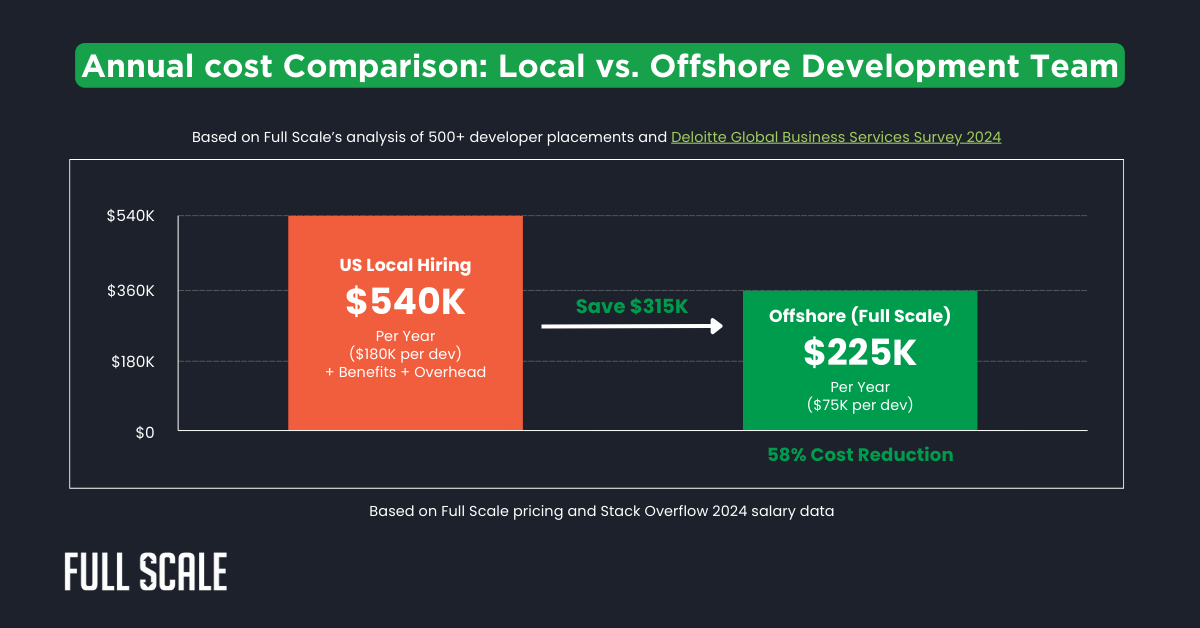
The Solution: Hired 3 Full Scale developers with specific stack experience. Started in 12 days from the pre-vetted talent pool. Total annual cost was $225K versus $540K local.
The Results:
- Completed platform rewrite in 9 months
- All 3 developers are still on the team after 18 months
- Client expanded to 6 offshore developers
- Saved $315K annually on developer salaries alone
Choose Model First, Optimize Strategy Second
Successful software offshoring strategies aren’t about following a checklist. They’re about choosing an engagement model that makes success inevitable.
Traditional project outsourcing creates problems that no strategy can overcome. Staff augmentation with direct integration makes offshore hiring as predictable as local hiring.
Why Partner with Full Scale?
- 95% retention rate over 3+ years
- 500+ successful placements across 60+ tech companies
- 7-14 day start times from pre-vetted talent pool
- Direct integration — no PM middlemen, real-time collaboration
- Transparent pricing — $4,800-$6,600/month per developer
- Month-to-month contracts — no long-term commitment required
- Full-time dedicated developers — they’re on your team, not project-hopping
The successful software offshoring strategies you need for direct integration are the same ones you use with your local team.
Clear communication. Shared goals. Trust. Accountability. That’s the point. When you fix the model, offshore development stops being “special” and starts being normal.
With the right model, you’ll see productivity within 30 days. Full integration typically takes 60-90 days as developers learn your codebase and product. Traditional project outsourcing can take 6+ months to see value due to communication barriers and knowledge transfer gaps.
Choosing the wrong engagement model. Most companies default to project outsourcing because it’s familiar, not because it works. Project-based models with PM middlemen create the exact problems offshore development is blamed for: communication issues, lack of control, and high turnover.
Quality isn’t about geography—it’s about hiring standards and engagement model. Full Scale’s 5-stage vetting process screens for technical skills, English proficiency, and cultural fit. Then direct integration ensures developers are accountable to you, not a distant PM. Our 95% retention rate means quality compounds over time.
The Philippines offers the best balance for US companies: 3-4 hours of daily overlap with US time zones, English proficiency, and strong technical education. The time zone difference enables near-24-hour development cycles—your offshore team works while you sleep, you review in your morning.
enior offshore developers cost $50-75K annually compared to $150-250K for equivalent US talent—60-70% cost savings according to Stack Overflow’s 2024 Developer Survey. But focus on the total cost of ownership, not just hourly rates. Agencies charging $30/hr with high turnover cost more than $75/hr with 95% retention. Based on Full Scale’s transparent pricing, monthly rates range from $4,800-$6,600 per developer, depending on experience level.
Yes, when they have the right model. Full Scale developers work on enterprise SaaS platforms, FinTech applications, and complex e-commerce systems. The limitation isn’t capability—it’s whether they have direct access to your team and product context. Middlemen create complexity. Direct integration enables complexity.
Companies with 10-50-person engineering teams see the biggest impact. You’re large enough to need dedicated developers but not large enough to pay Silicon Valley rates for every role. Startups with product-market fit and growth-stage companies scaling rapidly are the sweet spot.
Track the same metrics you track for local developers: velocity, quality, retention, and integration. If your offshore developers are attending standups, contributing to product discussions, and staying on your team for 12+ months, it’s working. If you’re constantly onboarding replacements, your model is broken.